All 8 questions from the West African Examinations Council (WAEC) Economics 2019 Theory paper, with the correct answer and a full explanation for each. Free, no signup needed.
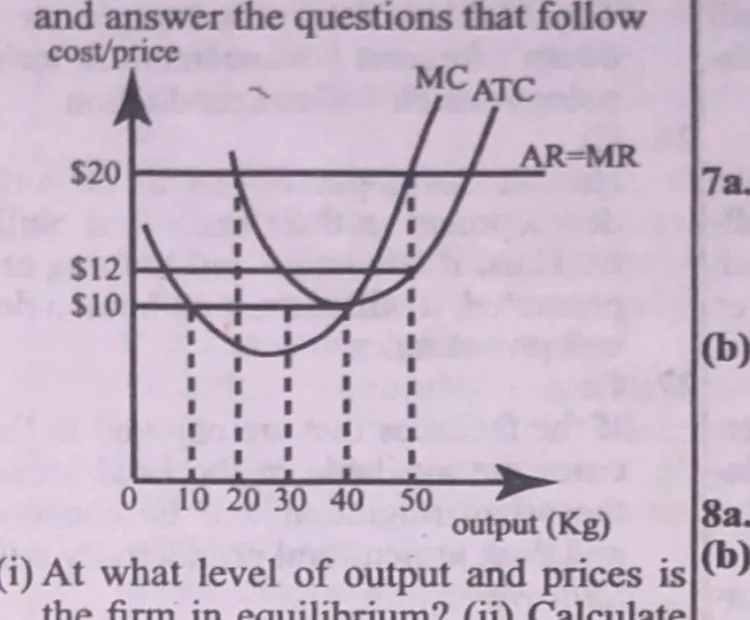
1(a)-(c) [SECTION A — Compulsory] The diagram below represents the equilibrium position of a firm in a perfectly competitive industry. Study it carefully and answer the questions that follow.
(a)(i) At what level of output and prices is the firm in equilibrium? (ii) Calculate the firm's profit in equilibrium. (iii) What type of profit is it? Explain your answer.
(b) Why is the average revenue (AR) function horizontal?
(c) State any two ways in which marginal cost (MC) and average total cost (ATC) are related. [Total: not specified]
Model answer
(a)(i) A firm is in equilibrium at the level of output and price where MR = MC. At this level, output = 50 kg while price = $20.
(ii) Profit = Revenue − Cost. Revenue = 50 × $20 = $1000. Cost = $12 × 50 = $600. Profit at equilibrium = $1000 − $600 = $400.
(iii) This is abnormal (economic/supernormal) profit, because the profit is earned at a point where price (AR) is greater than average cost (AC).
(b) The AR function is horizontal because the firm operates in a perfectly competitive industry. In perfect competition, firms are price takers, so the price (AR) they receive is fixed regardless of the quantity they sell.
(c) (i) When MC is less than ATC, ATC is falling. (ii) When MC equals ATC, ATC is at its minimum. (iii) When MC is greater than ATC, ATC is rising. (Any two of these.)
3(a)-(c) [SECTION B] (a)(i) Define distribution of goods. (ii) Illustrate the normal chain of distribution of goods.
(b) Describe a consumer's cooperative society.
(c) Outline any four roles performed by a consumers' cooperative society.
Model answer
(a)(i) Distribution of goods can be defined as the channels through which goods reach the final consumer from the producer.
(ii) The normal chain of distribution of goods is: Producers → Wholesalers → Retailers → Consumers.
(b) A consumer's cooperative society is an association formed by a group of consumers with similar interests, for their mutual benefit. They pool their resources to buy goods in large quantities from distributors, manufacturers, or government agencies, and sell mainly to their members. Members participate in running the society and are rewarded according to patronage, with interest paid on capital contributed.
(c) Roles of a consumers' cooperative society:
(i) It protects the interests of its consumer-members.
(ii) It buys goods in large quantities from producers and sells them in smaller units to its members.
(iii) It is targeted at improving the welfare of its members.
(iv) It stands against any form of intimidation or exploitation of the consumer.
4(a)-(c) [SECTION B] (a) What is an industry?
(b) Explain the following: (i) Division of labour (ii) Economies of scale.
(c) Outline any four internal economies of scale.
Model answer
(a) An industry can be defined as a combination/group of firms which produce similar products and/or outputs.
(b)(i) Division of labour is the breaking down of a production process into different stages, such that each stage/part is handled by a particular individual, unit, or department.
(ii) Economies of scale are the internal and external cost-saving benefits that accrue to a firm as it expands in size.
(c) Internal economies of scale (any four):
(i) Marketing economies — larger firms can buy inputs in bulk at a discount, employ an efficient, well-organized marketing strategy, and afford to advertise more.
(ii) Risk-bearing economies — larger firms can diversify their products so they don't suffer unduly if one line of production becomes unprofitable.
(iii) Financial economies — larger firms can more easily access loans from banks/financial institutions at lower interest rates, being more credit-worthy with more collateral.
(iv) Technical economies — as a firm expands, it can afford more advanced technology and sophisticated plant/machinery, leading to increased output at a lower unit cost.
(v) Managerial economies — larger firms can employ well-qualified, competent personnel to supervise various departments. (Any four of the above.)
5(a)-(c) [SECTION B] (a) Define a joint venture.
(b) Identify any three merits of a private company over a partnership.
(c) State any three sources of finance to a public enterprise.
Model answer
(a) A joint venture is a form of business jointly owned by two or more independent firms, who continue in their original businesses but pool resources together into another line of business.
(b) Merits of a private company over a partnership (any three):
(i) A private company can raise capital more easily than a partnership — e.g. it can issue debentures or borrow more easily from banks.
(ii) Shareholders enjoy limited liability (they cannot lose more than their capital invested), whereas partners have unlimited liability and can have personal assets sold to offset business debts.
(iii) The business is a separate legal entity from its owners, unlike a partnership where the business and owners are not legally separate.
(iv) The business has greater perpetual existence, while a partnership can be dissolved more easily (e.g. on the death/exit of a partner).
(v) The business can enjoy greater internal economies of scale, operating on a larger scale than a typical partnership.
(c) Sources of finance to a public enterprise (any three):
(i) Grants and subsidies received from the government.
(ii) Funds raised from the capital market by issuing bonds.
(iii) Sale of business assets to raise funds.
(iv) Rents from properties owned by the enterprise.
(v) Revenue from services rendered to the public.
6(a)-(b) [SECTION B] (a) Distinguish between the following pairs of concepts: (i) elastic demand and inelastic demand; (ii) income elasticity of demand and cross elasticity of demand.
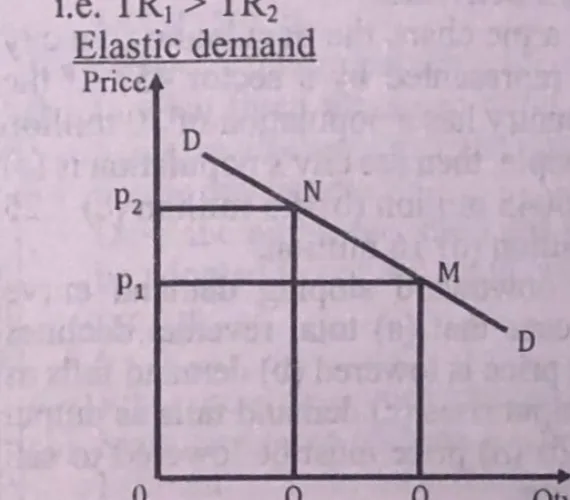
(b) Using diagrams, explain how an increase in price will affect the total revenue of a producer if demand for his product is: (i) Price elastic; (ii) Price inelastic.
Model answer
(a)(i) Demand is elastic if a change in the price of a commodity results in a more than proportionate change in quantity demanded. Demand is inelastic if a change in price results in a less than proportionate change in quantity demanded.
(ii) Income elasticity of demand is the degree of responsiveness of quantity demanded of a commodity to a change in the consumer's income. Cross elasticity of demand is the degree of responsiveness of quantity demanded of one commodity to a change in the price of another (related) commodity.
(b)(i) Price-elastic demand: an increase in price results in a more than proportionate fall in quantity demanded, so the producer's total revenue FALLS. As shown in the diagram, quantity demanded falls from 0Q₁ to 0Q₂ as price rises from 0P₁ to 0P₂. TR before the increase (area of rectangle 0P₁MQ₁) is greater than TR after the increase (area of rectangle 0P₂NQ₂); i.e. TR₁ > TR₂.
(ii) Price-inelastic demand: an increase in price results in a less than proportionate fall in quantity demanded, so the producer's total revenue RISES. Quantity demanded falls only slightly (from 0Q₁ to 0Q₂) as price rises from 0P₁ to 0P₂. TR before the increase (area of rectangle 0P₁TQ₁) is smaller than TR after the increase (area of rectangle 0P₂SQ₂); i.e. TR₁ < TR₂. (The inelastic-demand diagram mirrors the elastic one shown, but with a steeper, more vertical demand curve.)
7(a)-(b) [SECTION B] (a) Distinguish between: (i) a growing population and a declining population; (ii) overpopulation and underpopulation.
(b) Explain any four disadvantages of a rapidly growing population in an economy.
Model answer
(a)(i) A growing population is one that continues to increase year-in, year-out, while a declining population is one in which a country continues to experience a decreasing population year-in, year-out.
(ii) Overpopulation is a situation in which the available population is greater than the available resources in the economy, while underpopulation is a situation in which the total population is less than the available resources.
(b) Disadvantages of a rapidly growing population (any four):
(i) It disrupts economic planning, making the economy backward.
(ii) It causes urban congestion, as a result of rural-urban migration.
(iii) It places too much pressure on the (already inadequate) available social infrastructure.
(iv) It leads to a high rate of crime, as a result of the resulting unemployment.
8(a)-(c) [SECTION B] (a) What is public debt?
(b) Outline any three reasons why countries borrow.
(c) Highlight any three effects of a huge national debt on the economy of a country.
Model answer
(a) Public debt is the total amount of borrowings which the government owes to the general public, domestically or internationally.
(b) Reasons why countries borrow (any three):
(i) To finance deficit budgeting.
(ii) To hasten economic growth and development.
(iii) To provide basic amenities needed by the economy.
(c) Effects of a huge national debt (any three):
(i) Devaluation of the domestic currency.
(ii) Too much influence/interference from foreign creditor countries.
(iii) High cost of servicing the debt (large share of revenue goes to interest/repayments).
Advertisement
Sign up free to unlock
Score tracking
Practice history
Saved questions
Progress dashboard
Personalized sessions
Weak-topic breakdown
…and/or go further with premium services and No Ads.