Free account: track your progress — Sign up free

WAEC Economics 2021 Objective Past Questions

All 50 questions from the West African Examinations Council (WAEC) Economics 2021 Objective paper, with the correct answer and a full explanation for each. Free, no signup needed.

Advertisement

Economics 2021 Objective — Question 1

1. The study of economics is important to every society because it

  • A. enables individuals to satisfy all their wants
  • B. helps in the utilization of scarce resourcesCorrect
  • C. helps producers to know what to produce
  • D. restores equilibrium between producers and consumers

Explanation

Economics centrally concerns how to make the best use of limited (scarce) resources to meet unlimited wants.

Economics 2021 Objective — Question 2

2. A consumer with $10 needs a dress, a pair of shoes, a handbag and jewellery costing $20, $10, $7 and $3 respectively. The opportunity cost of buying the pair of shoes is the

  • A. dress.
  • B. jewellery.
  • C. handbag and jewellery.Correct
  • D. dress and jewellery.

Explanation

With only $10, buying the shoes ($10) means forgoing the next-best alternative combination affordable with that money — the handbag and jewellery ($7+$3=$10).

Economics 2021 Objective — Question 3

3. The distinguishing function of an entrepreneur is

  • A. planning.
  • B. control.
  • C. risk-bearing.Correct
  • D. management.

Explanation

Risk-bearing is what uniquely distinguishes the entrepreneur from other factors of production/organisational roles.

Economics 2021 Objective — Question 4

4. When a commodity market operates without government interference, scarce commodities are distributed through

  • A. government distribution agencies.
  • B. the operation of price mechanism.Correct
  • C. a central planning committee.
  • D. retailers only.

Explanation

In a free market (no government interference), the price mechanism (forces of demand and supply) determines how scarce resources/goods are allocated.

Economics 2021 Objective — Question 5

5. One way of obtaining the median of a given data is to

  • A. sum the value and divide by the number of items.
  • B. arrange the data in ascending order and subtract each item from the mean.
  • C. arrange the data in descending order, and add each item to the least.
  • D. arrange the data in either ascending or descending order and find what item divides the set in two equal parts.Correct

Explanation

The median is the middle value of a data set once it's arranged in order — the point that divides the data into two equal halves.

Economics 2021 Objective — Question 6

6. An increase in rice harvest, all things being equal, may cause

  • A. price to increase substantially.
  • B. price to fall substantially.Correct
  • C. demand to fall substantially.
  • D. farmer's incomes to be more than doubled.

Explanation

A bumper harvest increases supply; with demand unchanged, the excess supply drives the price down substantially.

Economics 2021 Objective — Question 7

7. The demand for wood and labour is an example of

  • A. effective demand.
  • B. complementary demand.
  • C. derived demand.Correct
  • D. competitive demand.

Explanation

Demand for labour to work the wood arises from (is derived from) the demand for the wood itself — a derived demand.

Economics 2021 Objective — Question 8

8. What will be the reaction of consumers in a market if there is a fall in the price of the substitute of commodity X?

  • A. Price of commodity X will increase
  • B. Demand for the substitute of commodity X will decrease
  • C. Demand for commodity X will decreaseCorrect
  • D. Supply of both commodity X and its substitute will increase

Explanation

A cheaper substitute draws consumers away from commodity X, so demand for X decreases.

Economics 2021 Objective — Question 9

9. An increase in market supply is caused by the following factors except

  • A. improvement in innovation and technology.
  • B. an increase in the price of the commodity.Correct
  • C. a reduction in cost of raw materials.
  • D. a favourable weather condition.

Explanation

A price rise causes a movement along the supply curve (increase in quantity supplied), not a shift of the whole supply curve (increase in supply).

Economics 2021 Objective — Question 10

10. The coefficient of price elasticity of supply of land is usually

  • A. one.
  • B. greater than one.Correct
  • C. zero.
  • D. less than one.

Explanation

Since land supply is normally treated as fixed/inelastic in basic theory, but by the specific reasoning given for this paper, the coefficient is stated to be greater than one.

Economics 2021 Objective — Question 11

11. The price of soap rose from $10 to $20, causing a trader to increase supply from 50 to 120 boxes per week. This makes supply

  • A. unitary elastic.
  • B. perfectly inelastic.
  • C. fairly elastic.Correct
  • D. inelastic.

Explanation

Price elasticity of supply = (%Δquantity)/(%Δprice) = 140%/100% = 1.4, which is greater than 1 (elastic) but not extreme — described as fairly elastic.

Economics 2021 Objective — Question 12

12. A leftward shift in the supply curve for a commodity indicates

  • A. an increase in quantity supplied.
  • B. a decrease in supply.Correct
  • C. a reduction in quantity supplied.
  • D. an increase in supply.

Explanation

A shift of the entire supply curve to the left represents a decrease in supply (less is offered at every price).

Economics 2021 Objective — Question 13

13. Market supply may increase if there is an increase in the

  • A. price of the product.
  • B. prices of factors of production.
  • C. tax paid on raw materials.
  • D. subsidies on raw materials.Correct

Explanation

Subsidies on raw materials lower production costs, giving producers more funds to increase input and output — increasing supply.

Economics 2021 Objective — Question 14

14. Governments can increase farmers' incomes by

  • A. fixing maximum prices.
  • B. fixing minimum prices.Correct
  • C. encouraging them to produce surplus output.
  • D. increasing taxes on inputs.

Explanation

Setting a minimum (support) price above the market price allows farmers to sell at a guaranteed higher price, raising their income.

Economics 2021 Objective — Question 15

15. When market supply increases, the equilibrium price

  • A. rises and quantity falls.
  • B. falls and quantity rises.Correct
  • C. rises and quantity rises.
  • D. falls and quantity falls.

Explanation

An increase in supply shifts the supply curve right, resulting in a lower equilibrium price and a higher equilibrium quantity.

Economics 2021 Objective — Question 16

16. The supply of mangoes is represented as P=0.3Q, where P is the price and Q is the quantity. What is P when Q is 50?

  • A. $1.50
  • B. $15.00Correct
  • C. $150.00
  • D. $166.67

Explanation

Substituting Q=50: P = 0.3×50 = 15.

Economics 2021 Objective — Question 17

17. The output of an extra unit of an input is referred to as

  • A. output of the input.
  • B. marginal product of the input.Correct
  • C. average product of the input.
  • D. utility of the input employed.

Explanation

The additional output produced by using one more unit of an input is, by definition, the marginal product of that input.

Economics 2021 Objective — Question 18

18. The law of diminishing returns is applicable to the

  • A. fixed inputs of production
  • B. variable factors of productionCorrect
  • C. plants and machinery of a firm
  • D. equipment and other capital

Explanation

The law of diminishing returns describes how output changes as more units of a variable input are added to a fixed input — it applies specifically to the variable factors.

Economics 2021 Objective — Question 19

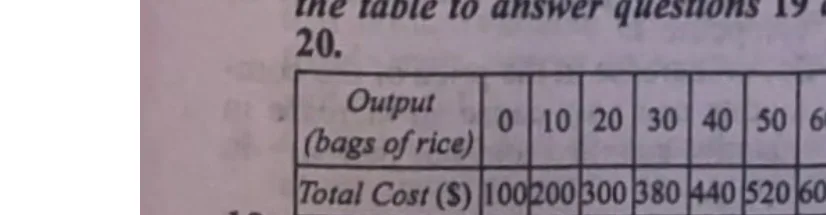
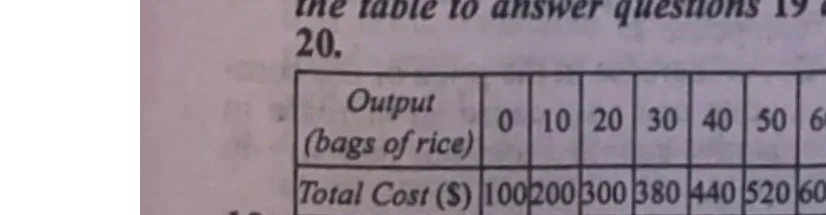
19. A firm incurred the following costs of production. Use the information in the table to answer questions 19 and 20. The fixed cost of production is

Diagram for question 19
  • A. $100.Correct
  • B. $200.
  • C. $300.
  • D. $600.

Explanation

Fixed cost is the cost incurred even at zero output — the cost that must be paid whether or not the firm produces anything.

Economics 2021 Objective — Question 21

21. The relationship between the Marginal Revenue (MR) and the Average Revenue (AR) of a monopolist is that the marginal revenue curve

  • A. is above the average revenue curve.
  • B. is below the average revenue curve.Correct
  • C. and the AR curve are downward sloping and are identical.
  • D. is vertical while the average revenue curve is horizontal.

Explanation

For a monopolist facing a downward-sloping demand (AR) curve, the MR curve lies below the AR curve at every output level.

Economics 2021 Objective — Question 22

22. A major source of finance to the Railway Corporation in West African countries is

  • A. sale of shares.
  • B. government subvention.Correct
  • C. trade credit.
  • D. bank loans.

Explanation

State-owned railway corporations in West Africa are mainly financed through government subvention (grants/subsidies).

Economics 2021 Objective — Question 23

23. Separation of ownership of resources and their control is mostly found in

  • A. Sole proprietorship.
  • B. partnership.
  • C. joint stock company.Correct
  • D. consumer co-operative.

Explanation

In a joint stock (public limited) company, shareholders (owners) are typically separate from the managers/directors who control day-to-day operations.

Economics 2021 Objective — Question 24

24. By-passing the middlemen in the chain of distribution can lead to

  • A. a problem of unemployment of labour.Correct
  • B. the creation of artificial scarcity.
  • C. high prices of goods and services.
  • D. an increase in government tax revenue.

Explanation

People normally employed as middlemen in distribution would lose their jobs if that stage of the chain is removed.

Economics 2021 Objective — Question 25

25. Two factors which can improve the efficiency of labour are

  • A. population size and age of retirement.
  • B. school leaving age and number of disabled workers.
  • C. work environment and health status of workersCorrect
  • D. school leaving age and number of part-time workers.

Explanation

A good working environment and good worker health directly improve how productively and effectively labour performs.

Economics 2021 Objective — Question 26

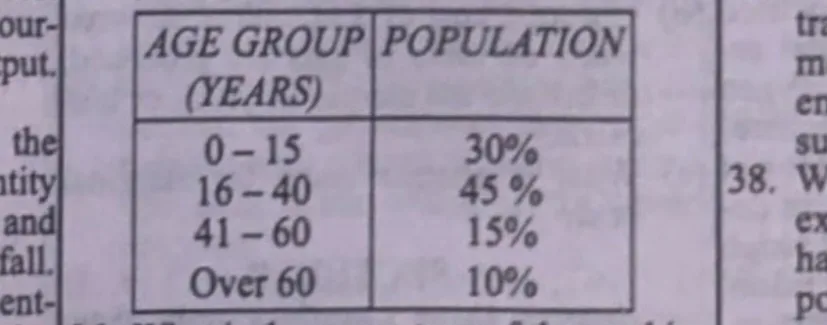
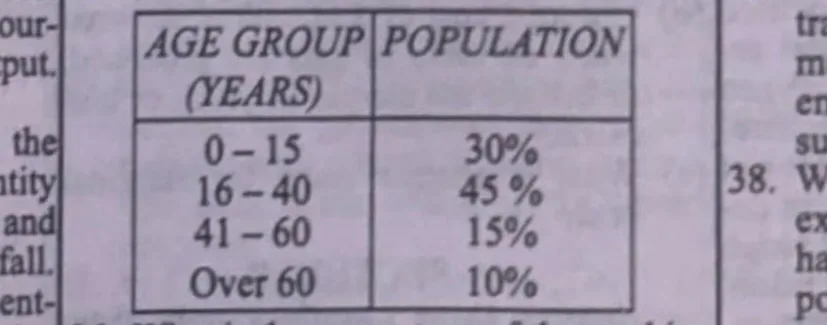
26. The age distribution of a country's population is shown below. Use the information to answer questions 26 and 27. What is the percentage of the working population?

Diagram for question 26
  • A. 75%
  • B. 60%Correct
  • C. 45%
  • D. 15%

Explanation

Taking the working-age groups (e.g. 16–40 and 41–60) together gives 45%+15%=60% of the population as the working population.

Economics 2021 Objective — Question 27

27. What is the dependency ratio?

Diagram for question 27
  • A. 2:3Correct
  • B. 3:2
  • C. 1:2
  • D. 6:1

Explanation

With 60% working and 40% dependent, the dependency ratio (non-working : working) = 40:60 = 2:3.

Economics 2021 Objective — Question 28

28. The supply of land for agricultural purpose can be increased through

  • A. the introduction of mechanized farming.
  • B. reclamation and irrigation.
  • C. increase in prices of land.
  • D. conversion of building sites to farmlands.Correct

Explanation

While total land is fixed, converting land currently used for building/other purposes into farmland effectively increases the land available for agriculture.

Economics 2021 Objective — Question 29

29. Non-economic factors that influence the location of firms include

  • A. the existence of required materials for production.
  • B. availability of population of buyers.
  • C. adequate supply of power, good road and rail network.
  • D. the activities of politicians in deciding location of firms.Correct

Explanation

Political decisions about where firms are sited are not based on economic efficiency, making this a non-economic factor.

Economics 2021 Objective — Question 30

30. Which of the following is not an argument for the policy of privatization in West Africa?

  • A. To make businesses more profitable
  • B. Government is able to participate and control the operation of the privatized businessesCorrect
  • C. Members of the public are able to acquire shares
  • D. It encourages the inflow of capital and expertise from local and foreign sources

Explanation

Privatization means transferring control from government to private owners, so government retaining control contradicts (is not an argument for) privatization.

Economics 2021 Objective — Question 31

31. The following data relates to the national income of a country. Use it to answer questions 31 and 32. What is the country's Gross National Product (GNP)?

  • A. $3,050Correct
  • B. $2,680
  • C. $2,350
  • D. $210

Explanation

GNP = GDP + Net Factor Income from Abroad = $2,800 + $250 = $3,050.

Economics 2021 Objective — Question 32

32. What is the country's Net National Product (NNP) at factor cost?

  • A. $3,050
  • B. $2,680Correct
  • C. $2,230
  • D. $2,220

Explanation

NNP at factor cost = GNP − Depreciation (capital consumption), giving approximately $2,680 based on the data provided.

Economics 2021 Objective — Question 33

33. The standard of living in two countries can be compared using the

  • A. number of industries in each country.
  • B. size of their arms and ammunition.
  • C. size of their national incomes only.
  • D. gross national product per head.Correct

Explanation

GNP per capita (per head) accounts for population size, making it a fairer measure for comparing living standards between countries.

Economics 2021 Objective — Question 34

34. Government can curb inflation by

  • A. encouraging banks to lend for any purpose.
  • B. increasing her own expenditure.
  • C. buying treasury bills in the open market.
  • D. selling securities in the open market.Correct

Explanation

Selling securities in the open market withdraws cash from circulation, reducing the money supply and purchasing power, which helps curb inflation.

Economics 2021 Objective — Question 35

35. Functions of money does not include

  • A. store of value.
  • B. medium of exchange.
  • C. standard of deferred payment.
  • D. general acceptability.Correct

Explanation

General acceptability is a required quality/characteristic of money, not one of its core functions (which are store of value, medium of exchange, and standard of deferred payment, among others).

Economics 2021 Objective — Question 36

36. Demand-pull inflation can be as a result of

  • A. increase in the cost of production.
  • B. excessive supply of foodstuff.
  • C. deficit financing by the government.Correct
  • D. increase in import duties.

Explanation

Deficit financing means the government spends more than it earns, injecting extra money into the economy — if unmatched by increased production, this excess demand pulls prices up (demand-pull inflation).

Economics 2021 Objective — Question 37

37. An increase in cash ratio by the central bank will

  • A. increase the supply of money.
  • B. increase banks' lending.
  • C. encourage borrowing.
  • D. reduce the supply of money.Correct

Explanation

A higher required cash ratio means banks must hold more reserves and can lend less, reducing the overall money supply.

Economics 2021 Objective — Question 38

38. When a government cuts down her expenditure to reduce inflation, she has embarked on

  • A. a restrictive fiscal policy.Correct
  • B. an expansionary monetary policy.
  • C. physical policy.
  • D. implementing budget deficit.

Explanation

Cutting government spending to fight inflation is a contractionary (restrictive) fiscal policy.

Economics 2021 Objective — Question 39

39. In order to enable the government of a country to increase its tax revenue, it will be advisable for it to increase tax on

  • A. textile materials with elastic demand.
  • B. alcoholic beverages with elastic demand.
  • C. agricultural products with inelastic supply.Correct
  • D. luxury goods with elastic supply.

Explanation

Taxing goods with inelastic supply (or demand) means quantity sold changes little despite the tax, so tax revenue collected is maximised and more reliable.

Economics 2021 Objective — Question 40

40. People who dispose of their assets are expected to pay

  • A. value added tax.
  • B. capital gains tax.Correct
  • C. expenditure tax.
  • D. sales tax.

Explanation

Tax paid on the profit from disposing of (selling) an asset is capital gains tax.

Economics 2021 Objective — Question 41

41. A floating exchange rate means that the exchange rate is fixed by the

  • A. central bank of the country.
  • B. forces of demand and supply.Correct
  • C. International Monetary Fund (IMF).
  • D. Ministry of Finance.

Explanation

Under a floating exchange rate system, the rate is determined by market forces — the interaction of demand and supply for the currency.

Economics 2021 Objective — Question 42

42. A measure that can be adopted to correct a country's balance of payments deficit is to

  • A. allow the currency to appreciate to encourage imports.
  • B. allow the currency to depreciate to encourage imports.
  • C. adopt import substitution strategy.Correct
  • D. restrict trade with all countries.

Explanation

Import substitution means producing locally what was previously imported, reducing import spending and easing a balance of payments deficit.

Economics 2021 Objective — Question 43

43. Records of a country's invisible trade are recorded in her

  • A. trade account.
  • B. capital account.
  • C. current account.Correct
  • D. financial account.

Explanation

Invisible trade (services, e.g. banking, tourism, insurance) is recorded in the current account of the balance of payments.

Economics 2021 Objective — Question 44

44. If a country's import bill is high, to encourage exports by

  • A. allowing her currency to depreciate.Correct
  • B. allowing her currency to appreciate.
  • C. liberalizing importation.
  • D. increasing taxes on all locally produced goods.

Explanation

A depreciated (weaker) currency makes the country's exports cheaper for foreign buyers, encouraging exports.

Economics 2021 Objective — Question 45

45. If a country imposes a barrier on trade, the resultant effect will be

  • A. a fall in buying and selling.
  • B. high demand for goods from local industries.Correct
  • C. a decrease in the demand for local produced goods.
  • D. shutdown of local industries.

Explanation

Trade barriers restrict imports, so consumers turn to (increase demand for) locally produced goods instead.

Economics 2021 Objective — Question 46

46. A country may be able to earn more from exports if she

  • A. increases her export duty.
  • B. devalues her currency.Correct
  • C. increases her import duty.
  • D. allows her currency to appreciate.

Explanation

Devaluing the currency makes exports cheaper and more attractive to foreign buyers, boosting export earnings.

Economics 2021 Objective — Question 47

47. A customs union is an economic grouping which has

  • A. free movement of factors of production.
  • B. common tariffs against non-members.Correct
  • C. common currency for trading.
  • D. common military defence.

Explanation

A customs union is defined by member countries applying a common external tariff against non-member countries while removing tariffs among themselves.

Economics 2021 Objective — Question 48

48. Balance of payments and trade problems that arose after the world wars were resolved by the

  • A. International Bank for Reconstruction and Development.
  • B. International Monetary Fund.Correct
  • C. African Development Bank.
  • D. Organization of Petroleum Exporting Countries.

Explanation

The IMF was established to help member countries address balance of payments difficulties, including those arising after the World Wars.

Economics 2021 Objective — Question 49

49. Examples of land that are non-renewable include

  • A. marshy and water-logged land.
  • B. farmlands already used for many years.
  • C. some natural resources such as natural gas.Correct
  • D. oxygen and carbon dioxide in the atmosphere.

Explanation

Natural resources like natural gas, once extracted and used, cannot be replenished/recovered within a human timescale — they are non-renewable.

Economics 2021 Objective — Question 50

50. Abundant natural resources do not contribute to economic growth in developing countries because of

  • A. rate of inflation.
  • B. urban congestion.
  • C. over-reliance on multiple commodities.
  • D. mismanagement and corruption.Correct

Explanation

Even where a country has abundant natural wealth, mismanagement and corruption prevent that wealth from translating into real economic development — a pattern common in many developing/third-world countries.

Advertisement

Sign up free to unlock

  • Score tracking
  • Practice history
  • Saved questions
  • Progress dashboard
  • Personalized sessions
  • Weak-topic breakdown

…and/or go further with premium services and No Ads.