All 9 questions from the West African Examinations Council (WAEC) Economics 2022 Theory paper, with the correct answer and a full explanation for each. Free, no signup needed.
SECTION A
1. A hypothetical national income data for a country in a particular year is presented below.
ITEM | $ MILLION
Wages and salaries | 250
Income paid abroad | 75
Income from self employment | 120
Stock appreciation | 5
Interest | 10
Income received from abroad | 50
Rent | 25
Depreciation allowance | 3
Royalties | 2
Profits and dividends | 35
From the data above, answer the following questions. Calculate the: (a) Gross Domestic Product (GDP); (b) Gross National Product (GNP); (c) Net National Product (NNP).
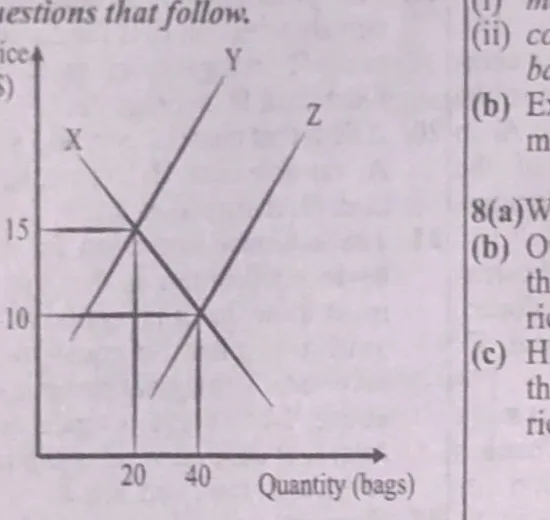
The diagram below shows the effects of the introduction of a subsidy on the production of maize.
[Diagram: Price(S) vs Quantity(bags) graph, showing curves X (demand curve), Y (original supply curve before subsidy/S), Z (new supply curve after subsidy/S1); P=15 intersecting at Q=20, and P=10 intersecting at Q=40]
Study the diagram and answer the questions that follow.
Model answer
(a) Gross Domestic Product = Wages and Salaries + Income from self-employment + Interest + Rent + Profits and dividends + Royalties − Stock appreciation
= $[(250+120+10+25+35+2)−5] million
= $(442−5) million
= $437 million
(b) Gross National Product = Gross Domestic Product + Income from abroad − Income paid abroad
= $(437+50−75) million
= $412 million
(c) Net National Product = Gross National Product − Depreciation allowance
= $(412−3) million
= $409 million
2(a)(i) Identify the curves labelled X, Y and Z.
(ii) State the direction of change in price and quantity with the introduction of subsidy.
(b) Calculate the total revenue of the producers: (i) before the introduction of subsidy; (ii) after the introduction of subsidy.
(c) Calculate the percentage increase or decrease in the total revenue of the producers with the introduction of subsidy.
(d) If the quantity demanded of maize increases from 20 to 40 bags as a result of a fall in price from $15 to $10, calculate the price elasticity of demand.
(e) State the type of elasticity of demand in 2(d).
Model answer
(a)(i) X = Demand curve; Y = Old/Original Initial supply curve/supply curve before subsidy/S; Z = New supply curve/supply curve after subsidy/final supply curve/S1
(ii) Price decreases from $15 to $10. Quantity increases from 20 bags to 40 bags.
(b)(i) Total revenue before the subsidy: TR = P × Q = $15 × 20 = $300.00
(ii) Total revenue after the subsidy: TR = P × Q = $10 × 40 = $400.00
(c) Percentage change in total revenue = [(400−300)/300] × 100 = (100/300) × 100 = 33.33%
% increase in total revenue is 33.3%
(d) % change in quantity demanded = [(40−20)/20] × 100 = 100%
%Δ in price = [(10−15)/15] × 100 = (−5/15) × 100 = −33.3%
Price elasticity of demand = 100%/33.3% = 3.0
(e) Demand is elastic (since the coefficient of price elasticity, 3.0, is greater than 1).
SECTION B
3(a) Define the term limited liability.
(b) Describe four differences between a public joint-stock company and a private joint-stock company.
Model answer
(a) Limited liability exists where the financial obligations of a firm's owners, in case it fails, is limited to the amount of capital invested in the enterprise.
(b) Differences between a public joint-stock company and a private joint-stock company:
(i) Ownership: A private joint-stock company is made up of between 2 and 50 members while a public joint-stock company is made up of between 7 and infinity (unlimited members).
(ii) Finance: The private company raises shares privately while the public company raises capital through the stock market. (OR: Shares for the private company are not quoted on the Stock Exchange but public companies have their shares on the Stock Exchange.)
(iii) Publishing of accounts: Private companies are not mandated to publish their annual accounts, but public companies are compelled by law to publish their accounts.
(iv) List of directors: Private companies are not under obligation to submit the list of directors to the Registrar of Companies, but public ones are requested by law to do so.
(v) Transfer of shares/ownership: Members of private companies cannot easily transfer shares, but shareholders of public companies can easily do so through the stock market.
(vi) Public companies can raise capital by issuing debentures, while private companies cannot.
(vii) In public companies ownership is separated from management, while in private companies ownership may not be separated from management.
(viii) The name of a public company must end with 'Plc' and that of a private company 'ltd'.
3(c) Outline three sources of finance available to sole proprietorship.
Model answer
Sources of finance available to sole proprietorship:
(i) Personal savings.
(ii) Borrowing from family and friends.
(iii) Loans from financial institutions.
(iv) Plough back profits.
(v) Trade credit.
(vi) Grants/loans from government.
(vii) Inheritance.
(viii) Sale of assets.
(ix) Hire purchase.
(x) Leasing of assets.
(xi) Assistance from family and friends.
4(a)(i) Distinguish between labour force and efficiency of labour.
(b) Describe five factors which determine the size of the labour force in a country.
Model answer
(a)(i) Labour force refers to the proportion of a country's population in the working age group who are employed or are seeking employment, while efficiency of labour refers to the ability of labour to achieve the highest output possible without compromising quality in a given period of time.
(b) Factors which determine the size of the labour force in a country:
i. The total population of the country. If the total population is large, labour force will be large and vice versa.
ii. The age distribution of the country's population. If the population is youthful, labour force will be large and vice versa.
iii. The official retirement age of workers. If this is low, labour force will be reduced and vice versa.
iv. The number of women who take up paid jobs. If this is large, labour force will also be large and vice versa.
v. School leaving age of students. If this is low, labour force will be large and vice versa.
vi. The number of people pursuing further studies after the school leaving age. If this is large then labour force will be small.
vii. The number of people who retire voluntarily before the official retirement age. If more people retire before the official retirement age, labour force will be small and vice versa.
viii. The number of disabled persons of working age. If this is quite large, labour force will be small and vice versa.
ix. The number of persons in voluntary unemployment. If this is large, labour force will be small and vice versa.
x. The net migration. If the number of immigrants is higher than the number of emigrants, labour force will be large and vice versa.
5(a) What is a demand schedule?
(b) Explain each of the following terms: (i) effective demand; (ii) composite demand; (iii) derived demand.
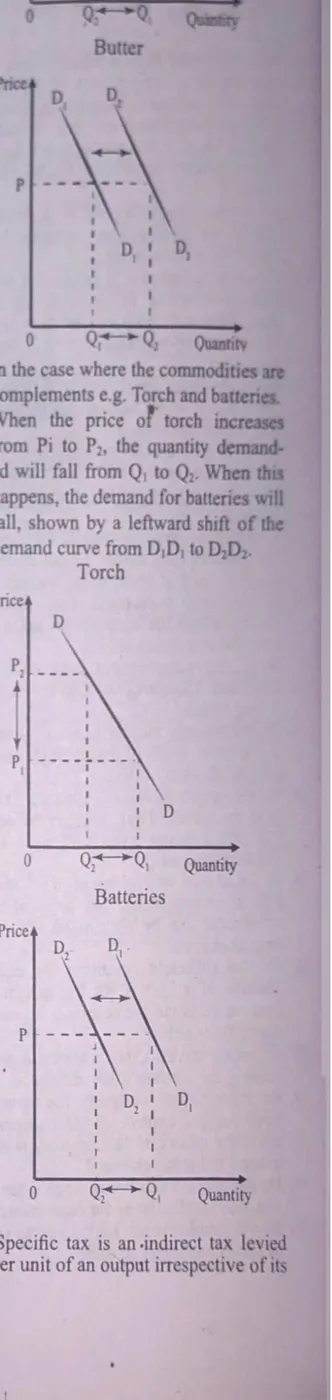
(c) Using appropriate diagrams, explain how a change in the price of a commodity would influence the demand of its: (i) substitute; (ii) complement.
Model answer
(a) A demand schedule is a table showing the quantities of a commodity demanded at various prices.
(b)(i) Effective demand refers to the desire for a commodity backed by the ability to pay for it at a particular price and time.
(ii) Composite demand refers to the demand for a commodity due to its various uses.
(iii) Derived demand refers to demand for a commodity, not for its own sake, but for the production of another commodity.
(c)(i) In the case where two commodities are substitutes e.g. Margarine and butter: When the price of margarine increases from P1 to P2, its quantity demanded will decrease from Q1 to Q2. When this happens, consumers being rational will switch to increasing the demand for butter, shown by a rightward shift of the demand curve from D1D1 to D2D2.
(ii) In the case where the commodities are complements e.g. Torch and batteries: When the price of torch increases from P1 to P2, the quantity demanded will fall from Q1 to Q2. When this happens, the demand for batteries will fall, shown by a leftward shift of the demand curve from D1D1 to D2D2.
6(a)(i) Specific tax is an indirect tax levied per unit of an output irrespective of its value.
(ii) Value added tax is an indirect tax levied on value added to a good or service produced. It is levied on the difference between sales revenue and the cost of producing an output.
Explain the following types of taxes: (i) specific tax; (ii) value-added tax.
(b) With the aid of diagrams, describe the effects of an indirect tax on a commodity when demand is: (i) perfectly inelastic; (ii) perfectly elastic.
Model answer
(a)(i) Specific tax is an indirect tax levied per unit of an output irrespective of its value.
(ii) Value added tax is an indirect tax levied on value added to a good or service produced. It is levied on the difference between sales revenue and the cost of producing an output.
(b)(i) Demand is perfectly inelastic if at every price level, quantity demanded remains the same. The market price of the commodity will rise by the full amount of the tax and the whole burden of the tax rests on the consumer.
[Diagram: vertical demand curve D; supply shifts from S0S0 to S1S1; price rises from 0P1 to 0P2; the full amount of the tax P1E1E2P2 rests on the consumer]
0P1 was the price before the imposition of an indirect tax and the initial supply curve was S0S0. When the tax was imposed, the supply curve shifted from S0S0 to S1S1 forcing the price to rise from 0P1 to 0P2. The full amount of the tax is P1E1E2P2 above and is borne by the consumer.
(ii) Demand is perfectly elastic at a given price; consumers are willing to buy all the commodities that are available and none at any price above the market price. Since the producer cannot increase the price of the commodity, price remains the same and the entire burden of the tax rests on the producer.
[Diagram: horizontal demand curve D; supply shifts from S0S0 to a new steeper supply curve S1S1; price remains the same at 0P1, and the whole burden of the tax P1E1E2P2 rests on the producer]
The imposition of an indirect tax results in a leftward shift of the initial supply curve S0S0 to a new supply curve S1S1. Price remains the same at 0P1, and the whole burden of the tax P1E1E2P2 rests on the producer.
7(a)(i) Distinguish between a mortgage bank and a merchant bank.
(ii) Distinguish between a commercial bank and a development bank.
(b) Explain any four functions of commercial banks.
Model answer
(a)(i) A mortgage bank is a financial institution that specializes in granting loans to individuals and corporate bodies for building purposes. Such loans are repaid by instalments spread over several years.
While a merchant bank is a financial institution that provides specialized services like acceptance of bills of exchange, corporate finance, portfolio management, equipment leasing and acceptance of deposits.
(ii) Commercial banks are financial institutions that perform the services of accepting deposits and using such money to make loans and other financial services available to customers. The loans are usually for short and medium terms.
While a development bank is a financial institution set up to provide long term loans to groups of individuals and governments for development projects. They provide financial assistance in high risk, low profit and long gestation period investments which are unattractive to commercial banks.
(b) Functions of commercial banks:
(i) Acceptance of deposit — Customers' money can be kept in any of the different commercial banks' accounts: Savings, current or demand deposit and time or fixed deposit accounts etc.
(ii) Lending of money — Commercial banks make available loans and over-drafts.
(iii) Commercial banks provide facilities for the safe keeping of valuables.
(iv) Commercial banks provide facilities for domestic and foreign remittance.
(v) Commercial banks provide trust services for individuals and organizations. Trust services include the management of trust funds.
(vi) Commercial banks act as agents for their customers in the purchase and sale of securities.
(vii) Commercial banks offer advisory services to customers.
(viii) Commercial banks discount bills of exchange for their customers.
(ix) Commercial banks act as executors of will for their customers.
(x) Commercial banks help the Central Bank to implement governments' monetary policy.
(xi) Commercial banks sell foreign exchange to their customers.
8(a) What is economic integration?
(b) Outline any three short-comings of the Economic Community of West African States (ECOWAS).
(c) Highlight any three achievements of the Economic Community of West African States (ECOWAS).
Model answer
(a) Economic integration is a form of international cooperation among nations to achieve a greater efficiency in the production of goods and services for the social and economic welfare of their countries.
(b) Short-comings of ECOWAS:
i. Divided loyalty of member states.
ii. Ideological differences.
iii. Inability to create a common currency.
iv. Differences in levels of development among member states/fear of domination of small countries by big countries.
v. Political/social instability in the sub-region.
vi. Inability to differentiate her products. Members produce similar primary products.
vii. Inadequate infrastructural facilities in the sub-region.
viii. Lack of political will to implement the policies/agreements of the union.
ix. Non-payment of dues by some member states.
x. Negative attitude towards member countries because of language differences.
xi. Differences in trade policies among member countries.
(c) Achievements of ECOWAS:
i. Removal of customs duties.
ii. Reduced administrative restrictions e.g. on investment.
iii. Establishment of common fund for co-operation, compensation and development.
iv. Mediation among member states.
v. Formation of the Economic Community of West African States Monitoring Group (ECOMOG).
vi. Growth and expansion of markets.
vii. Unity in the sub-region.
viii. Cooperation in culture and sports.
ix. Free movement of labour.
Advertisement
Sign up free to unlock
Score tracking
Practice history
Saved questions
Progress dashboard
Personalized sessions
Weak-topic breakdown
…and/or go further with premium services and No Ads.