All 8 questions from the West African Examinations Council (WAEC) Economics 2023 Theory paper, with the correct answer and a full explanation for each. Free, no signup needed.
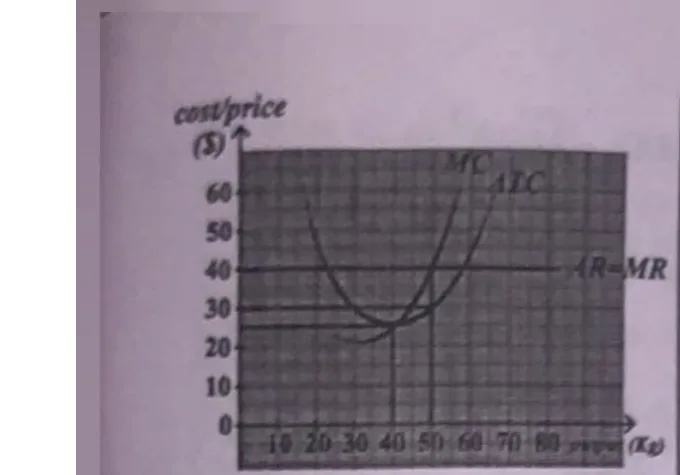
The equilibrium position of a firm is illustrated in the diagram below (cost/price curve showing ATC, MC, AR=MR). Study the diagram and answer the questions that follow.
(a) Determine the firm's: (i) equilibrium output level; (ii) equilibrium price.
(b) At the equilibrium output, calculate the firm's: (i) total cost; (ii) total revenue; (iii) total profit.
(c) Is the firm operating in the long-run or short-run? Explain your answer.
(d)(i) What type of market is the firm operating in? (ii) List three features of the market type identified in (d)(i).
Model answer
(a)(i) Equilibrium output level = 50 units. (ii) Equilibrium price = $40.00.
(b)(i) Total cost (TC) = AC×Q = $30×50 = $1500. (ii) Total revenue (TR) = AR×Q = $40×50 = $2000. (iii) Total profit = TR−TC = $2000−$1500 = $500.
(c) The firm is operating in the short-run because it is operating in a perfect market and it made abnormal/super-normal profit, where price exceeds average cost and average revenue exceeds average cost.
(d)(i) Perfectly competitive market/perfect market. (ii) Features: there are many buyers and sellers; there is free entry and exit into and from the market; sellers are price takers/there is one market clearing price/there is no government intervention; there is perfect knowledge about the market; there are no extra transport costs incurred.
Table 1 below represents the output levels of a firm producing hand sanitizer. Use the information to answer the questions that follow.
Table 1 — Output (units): 0, 10, 18, 28, 36, 45
If the cost function of the firm is given as C = 30 + 4q, where C is the total cost and q is the units produced, calculate:
(a) total cost in dollars of producing: (i) 18 units; (ii) 36 units.
(b) average cost in dollars of producing: (i) 28 units; (ii) 45 units.
(c) What is the marginal cost in dollars of producing 28 units?
(d) Determine the profit made from producing 45 units when the market price is fixed at $5.00 per unit.
(e) Determine the fixed cost of the firm. Explain your answer.
Model answer
(a)(i) TC₁₈ = 30+4(18) = 30+72 = $102. (ii) TC₃₆ = 30+4(36) = 30+144 = $174.
(b)(i) AC₂₈ = TC₂₈/28 = [30+4(28)]/28 = 142/28 = $5.07 or $5.1. (ii) AC₄₅ = TC₄₅/45 = [30+4(45)]/45 = 210/45 = $4.67.
(c) MC = (TC₂₈−TC₁₈)/(28−18) = (142−102)/10 = 40/10 = $4.00.
(d) Profit = TR−TC = (5×45)−TC₄₅ = 225−210 = $15.
(e) Fixed cost of the firm is $30, because when q=0, C = 30+4(0) = $30; i.e. at output 0, total fixed cost incurred is $30 (the constant term in the cost function that does not vary with output).
3(a). Distinguish between: (i) money cost and opportunity cost; (ii) normal good and inferior good.
3(b). Explain how the scale of preference assists the following economic groups in making efficient allocation of their resources: (i) individuals; (ii) firms; (iii) governments.
Model answer
(a)(i) Money cost is the expenses in terms of money incurred to produce or to have a commodity, while opportunity cost or real cost is the alternative forgone or that which has to be sacrificed to have a commodity.
(ii) A normal good is a good for which its demand increases when income increases and demand decreases when income decreases. While an inferior good is a good for which its demand tends to fall when income rises and its demand rises when income falls.
(b)(i) Individuals: when faced with the problem of limited resources, a scale of preference will enable an individual to order/arrange his wants according to which one gives the highest amount of satisfaction/is urgently needed/is most important. He will then allocate his resources to obtain the want that gives the highest amount of satisfaction.
(ii) Firms: a firm is also faced with the problem of limited resources needed to produce everything it wants. It will therefore rank its production according to which product will give the highest amount of satisfaction, measured in terms of profit. The firm will therefore allocate its resources according to which product gives the highest amount of profit.
(iii) Governments: government is also faced with the problem of limited resources/revenue. It cannot therefore produce all the goods and services it wants. It will therefore rank the goods and services according to which one will give the citizenry the highest amount of well-being or welfare. It will therefore allocate resources to produce such goods and services.
4(a). Define economic system.
4(b). Distinguish between a capitalist economy and a socialist economy under the following: (i) aim of production; (ii) consumer sovereignty; (iii) competition.
4(c). State three features of land as a factor of production.
Model answer
(a) An economic system is the social, legal and institutional framework for the management of resources in an economy.
(b)(i) Aim of production: In capitalism, the aim of production is to make profit so goods and services are produced on a large scale. In socialism, the aim of production is to provide for the welfare of the citizens by making goods and services available at low/affordable prices.
(ii) Consumer sovereignty: In capitalism, the consumer is king as it is he who dictates what is to be produced through his purchases — the consumer's taste drives production. In socialism, consumers' demands are determined by government so they have little or no influence on what is produced.
(iii) Competition: Since profit is the motive in capitalism, competition exists and it ensures efficiency, leading to production of high quality goods that attract customers. In socialism, there is no competition since government decides what is to be produced, and this can lead to production of low quality goods.
(c) Features of land as a factor of production: (i) Land is a natural gift and has a zero cost of production. (ii) The supply/size of land is fixed and cannot be increased or decreased. (iii) The quality of land can be degraded if not used with care. (iv) Land has many uses which are both short-term (farming, fishing) and long-term (roads, dams, factories). (v) The value of land depends on its location; land in urban centres costs higher than land in rural areas. (vi) Land is subject to diminishing returns if the right number of a variable factor is not applied to it. (vii) Land is geographically immobile.
5(a). A sole proprietorship is a type of business owned and controlled by an individual with the primary aim of maximizing profit, while a partnership is a type of business set up by two to twenty members with a common goal of making profits.
5(b). List four characteristics of a sole proprietorship.
5(c). Outline four advantages of a public limited liability company.
Model answer
(b) Characteristics of a sole proprietorship: (i) It is set up by a single person who bears all risks. (ii) Capital is provided by only the owner, either from personal savings, inheritance, etc. (iii) He enjoys all the profits since he provides the capital alone. (iv) He manages and controls the business alone. (v) It is not a legal entity because the business is not separate from the owner. (vi) His death or incapacitation may lead to a collapse of the business. (vii) He has unlimited liability, since losses could extend to his private property.
(c) Advantages of a public limited liability company: (i) It can raise large capital through the sale of shares. (ii) It enjoys economies of scale because it can easily expand output or its size of operation. (iii) It can sue and be sued because it is a legal entity. (iv) There is continuous existence — if a member withdraws or dies, because shares are legally transferable. (v) It enjoys limited liability since shareholders lose only capital invested in times of bankruptcy. (vi) Shares can be transferred easily through the stock exchange market. (vii) It is easy for them to get loans from banks because they have the necessary collateral.
6(a). Location of industry refers to the siting of a firm in a particular area to minimize the cost of production based on certain factors.
6(b). Explain how the following factors would influence where a firm is sited: (i) raw materials; (ii) market; (iii) government policy.
6(c). Outline three advantages of localization of industry.
Model answer
(b)(i) Raw materials: If the raw material used is quite bulky or perishable, transporting it over a longer distance is much more expensive or risky, so firms will site their factories near the source of raw materials to reduce transportation costs, e.g. wood and mining companies, food processing and fish farming firms etc. are located near the raw material.
(ii) Market: Where finished products are highly perishable, bulky or fragile such that damage will be done to them in the process of transporting them, firms are located very close to the market e.g. glasses, tiles, etc.
(iii) Government policy: Governments may want to ensure even development or fulfil campaign promises by siting a firm in a particular area through its policies or laws e.g. industrial estates. This choice is often made without giving any consideration to its economic implication.
(c) Advantages of localization of industry: (i) Labour already employed can easily acquire new skills which will be useful in other firms. (ii) New firms can tap the expertise of old ones when it comes to training. (iii) Subsidiary firms that can use the by-products of established firms will emerge. (iv) Firms can co-operate and buy raw materials in bulk to reduce per unit cost or support one another in times of need. (v) It facilitates division of labour and specialization where different parts of a product e.g. equipment, is produced by different firms. (vi) Common problems are identified and a joint research unit can be formed to help solve problems that will arise e.g. internet services, accessibility, security etc. (vii) More jobs are created for the people where an industry is localized and this helps improve the standard of living of the people.
7(a). Define Gross Domestic Product (GDP).
7(b). Describe the output approach as a method of computing national income.
7(c). Identify any three problems associated with the expenditure approach of calculating national income.
Model answer
(a) Gross Domestic Product is the total money value of all final output of goods and services produced within the boundaries of a country during a specified period of time, usually a year.
(b) The output approach calculates the Gross Domestic Product of a country by adding together the values of the net contributions of all the various sectors of the economy. To avoid double counting, either the value-added at every stage of production is added together or the value of only the final output of goods and services produced in the economy is considered. The value of exports is included while the value of imports is excluded to arrive at Gross National Product. The value of the physical wear and tear of capital goods used during production, called depreciation, must be deducted to arrive at the Net National Product at market price. Indirect business taxes are then deducted and subsidies added to arrive at national income which is at factor cost.
(c) Problems with the expenditure approach: (i) Problem of determining the values of all imports and all exports since many transactions do not pass through the official channel. (ii) There is the problem of double counting as intermediate and final expenditures are sometimes included. (iii) There is inadequate records of the expenditures of the households and business units in the informal sector. (iv) Services not paid for such as owner-occupied houses and do-it-yourself activities lower the national income, e.g. communal labour on a project. (v) Problem of deciding which method of depreciation allowance to use. (vi) Frequent changes in price and the value of money make determination of the value of goods difficult.
8(a). What is an embargo?
8(b). Outline any three reasons for imposing tariffs on imports.
8(c). Explain any three reasons against the use of tariffs.
Model answer
(a) An embargo is an outright ban instituted on the import or export of a good or service.
(b) Reasons for imposing tariffs: (i) It is used to protect infant/local industries to be able to stand on their feet and expand. (ii) It is a means of helping increase employment in the home country. (iii) It is a means of raising revenue for the imposing country. (iv) It helps countries with long-term balance of payments problems to correct them. (v) It is a measure to control dumping. (vi) It is used to control the consumption of products considered harmful. (vii) It can be used as a retaliatory measure against other imposing countries.
(c) Reasons against the use of tariffs: (i) It can lead to possible retaliation from affected countries. (ii) Protection of local firms do not encourage them to grow, they produce low standard goods since there is little or no competition. (iii) It may lead to loss of revenue for the imposing government depending on the elasticity of demand for imports and exports. (iv) It can lead to smuggling of products considered harmful and also of other products to evade tax. (v) Consumers in the home country are denied the opportunity of choosing from a variety of imports. (vi) It may lead to contraction of total world output.
Advertisement
Sign up free to unlock
Score tracking
Practice history
Saved questions
Progress dashboard
Personalized sessions
Weak-topic breakdown
…and/or go further with premium services and No Ads.