Free account: track your progress — Sign up free

WAEC Economics 2024 Objective Past Questions

All 50 questions from the West African Examinations Council (WAEC) Economics 2024 Objective paper, with the correct answer and a full explanation for each. Free, no signup needed.

Advertisement

Economics 2024 Objective — Question 1

1. There is scarcity when

  • A. the means exceed society's wants.
  • B. demand for resources is greater than its supply.Correct
  • C. productive resources are in excess.
  • D. supply of resources is greater than its demand.

Explanation

Scarcity occurs when demand is greater than supply; you meet something (i.e. demand) but there are no means to satisfy it (scarcity).

Economics 2024 Objective — Question 2

2. Points within a Production Possibilities Curve (PPC) indicate

  • A. optimum production levels.
  • B. attainable but inefficient production levels.Correct
  • C. unattainable production levels.
  • D. attainable and efficient production levels.

Explanation

Any point within the PPC curve represents under-utilization. It is attainable because, if the economy shrinks, it gets to it.

Economics 2024 Objective — Question 3

3. Which of the following is NOT a feature of labour?

  • A. It is an active factor of production.
  • B. It is highly mobile.
  • C. Its reward is wages or salaries.
  • D. Its efficiency depends on its size.Correct

Explanation

The efficiency of labour does not depend on its size but on the expertise/skill relevant to the job assigned to the worker.

Economics 2024 Objective — Question 4

4. The pursuit of private profits is a feature of

  • A. command economies.
  • B. socialist economies.
  • C. capitalist economies.Correct
  • D. statutory corporations.

Explanation

Capitalist economies look for profit from both public and private means. After making publicly obtainable profit, operators explore any available private profit.

Economics 2024 Objective — Question 5

5. A major feature of the socialist economic system is

  • A. setting of production targets by public authorities.Correct
  • B. freedom of choice for consumers.
  • C. determination of price by market forces.
  • D. private ownership of productive inputs.

Explanation

In a socialist economy, the government determines what will be produced and consumed within the economy.

Economics 2024 Objective — Question 6

6. If the budget on education is $50m out of an annual national budget of $300m, the sector of a pie chart representing education is

  • A. 16.6°
  • B. 60°Correct
  • C. 150°
  • D. 300°

Explanation

Angle = 50/300 x 360° = 60°.

Economics 2024 Objective — Question 7

7. Price elasticity of demand is the responsiveness of quantity demanded to a change in

  • A. demand for the product.
  • B. price of another product.
  • C. income of the buyer.
  • D. price of the product.Correct

Explanation

Price elasticity of demand is the responsiveness of quantity demanded to a change in the price of the commodity.

Economics 2024 Objective — Question 8

8. When total revenue increases as price falls, the coefficient of price elasticity of demand is

  • A. greater than one.Correct
  • B. one.
  • C. less than one.
  • D. zero.

Explanation

If a fall in price results in an increase in revenue, the good is price elastic; when demand is price elastic, the price elasticity of demand must be greater than one.

Economics 2024 Objective — Question 9

9. If the quantity demanded of rice decreased from 150 bags to 100 bags, the percentage change in quantity demanded is

  • A. 30.0%
  • B. 33.3%Correct
  • C. 50.0%
  • D. 66.7%

Explanation

% change in quantity demanded = (QD0 - QDn)/QD0 x 100% = (150-100)/150 x 100% = 33.3%.

Economics 2024 Objective — Question 10

10. The law of demand will not hold when

  • A. normal goods are involved.
  • B. the size of the population changes.
  • C. rare commodities are involved.Correct
  • D. incomes of consumers increase.

Explanation

The law of demand applies to normal commodities; it is not applicable to rare (e.g. prestige/Giffen-type) commodities.

Economics 2024 Objective — Question 11

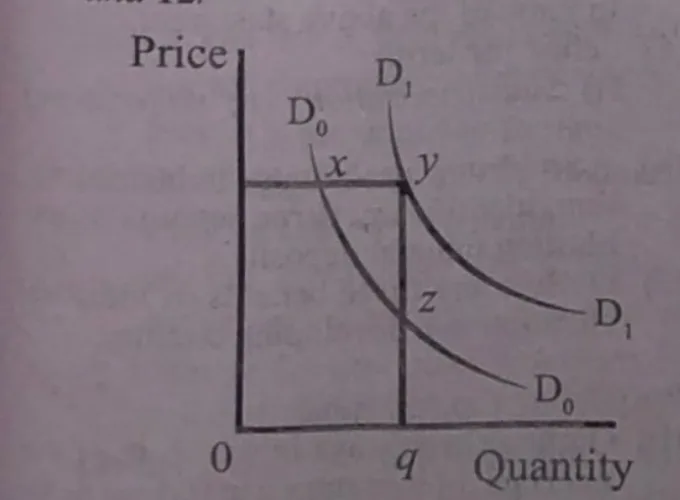
11. The diagram below shows the demand for milk. The movement from points x to z might have been caused by

Diagram for question 11
  • A. a change in taste in favour of milk.
  • B. a decrease in price of milk.Correct
  • C. an increase in income of consumers.
  • D. a favourable weather condition.

Explanation

A movement along a demand curve can only be caused by a change in the price of the commodity itself. The movement from x to z is caused by a decrease in the price of milk.

Economics 2024 Objective — Question 12

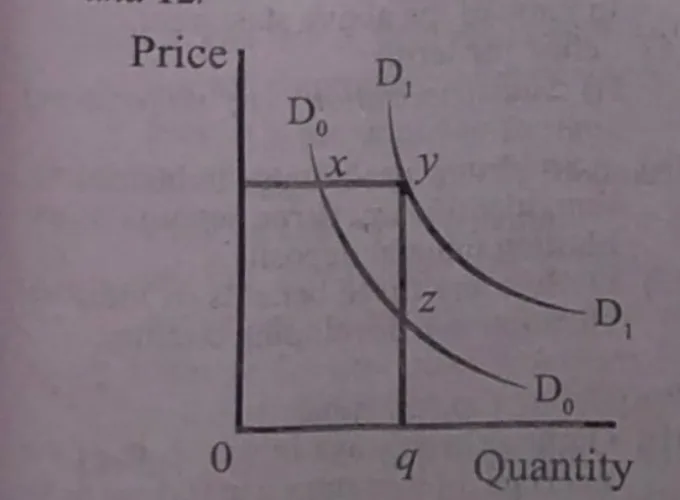
12. If demand for postal services declines as a result of increased use of e-mails, then the two services are in

Diagram for question 12
  • A. composite demand.
  • B. derived demand.
  • C. competitive demand.Correct
  • D. complementary demand.

Explanation

Since one service substitutes for the other, the demand relationship between them is referred to as competitive demand.

Economics 2024 Objective — Question 13

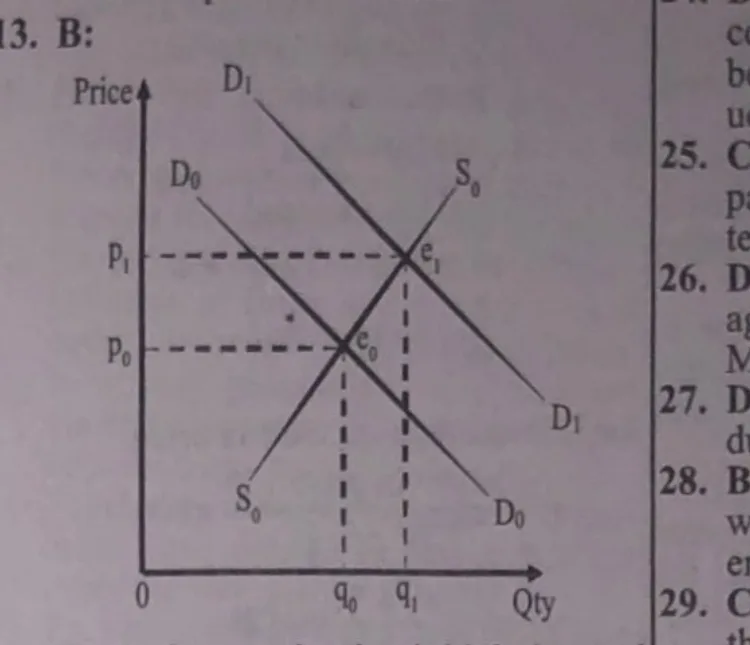
13. Other things being equal, an increase in the demand for land in the short-run will cause an increase in the

Diagram for question 13
  • A. price only.Correct
  • B. price and supply.
  • C. quantity supplied only.
  • D. supply only.

Explanation

The initial demand curve is D0D0 with equilibrium e0. When demand increases, ceteris paribus, the demand curve shifts to D1D1, moving equilibrium to e1. This causes price to rise from P0 to P1, while quantity supplied only moves along the fixed short-run supply curve from q0 to q1 (supply itself does not shift).

Economics 2024 Objective — Question 14

14. If the coefficient of price elasticity of supply of a commodity is 0.8, then supply is

  • A. perfectly elastic.
  • B. fairly elastic.Correct
  • C. perfectly inelastic.
  • D. fairly inelastic.

Explanation

A coefficient below one indicates an inelastic response; since the coefficient (0.8) is not zero or infinite, supply is classified as fairly elastic/inelastic in degree, per the WAEC key, answer B.

Economics 2024 Objective — Question 15

15. The negative slope of the demand curve is best explained by

  • A. consumer's choice.
  • B. increasing returns to scale.
  • C. diminishing returns to scale.
  • D. diminishing marginal utility.Correct

Explanation

The law of diminishing marginal utility explains why quantity and price are negatively related; as price falls, quantity demanded rises, giving the downward-sloping demand curve.

Economics 2024 Objective — Question 16

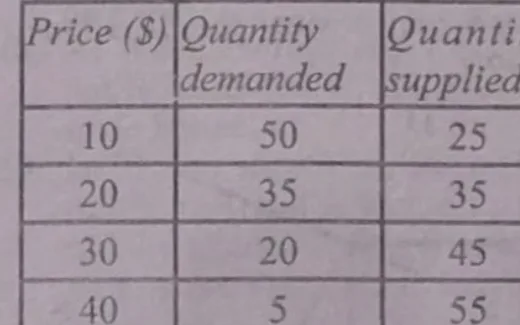
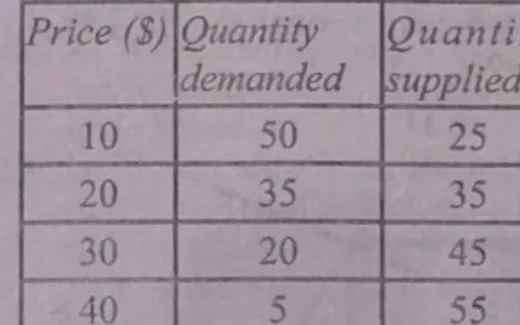
16. Minimum price legislation is used to protect the interests of (use the table showing the demand and supply schedule for apples to answer this question)

Diagram for question 16
  • A. small scale producers.Correct
  • B. foreign companies.
  • C. government.
  • D. consumers.

Explanation

A minimum price is set above the equilibrium price, used mainly to protect the interests of small-scale producers.

Economics 2024 Objective — Question 17

17. At what price is excess supply equal to 25? (use the table showing the demand and supply schedule for apples)

Diagram for question 17
  • A. $10
  • B. $20
  • C. $30Correct
  • D. $40

Explanation

At a price of $30, quantity demanded is 20 units and quantity supplied is 45 units, giving an excess supply of 25 units (45-20).

Economics 2024 Objective — Question 18

18. Which of the following best explains diseconomies of scale? Increase in output causes

  • A. the average cost to rise.Correct
  • B. marginal revenue to fall.
  • C. marginal cost to fall.
  • D. the firm to be destabilized.

Explanation

When average cost rises as output is increased, diseconomies of scale have set in.

Economics 2024 Objective — Question 19

19. In the short-run, a firm can increase output by

  • A. increasing the size of its machines.
  • B. purchasing more machines.
  • C. changing its organizational structure.
  • D. increasing the quantity of raw materials.Correct

Explanation

In the short run, only variable inputs (such as raw materials) can be increased to raise output; other factors are fixed in the short-run.

Economics 2024 Objective — Question 20

20. The fixed cost of producing 100 units of a good is $600. If the variable cost is $400, the average total cost of one unit of the good is

  • A. $4
  • B. $6
  • C. $8
  • D. $10Correct

Explanation

Average total cost = (Total fixed cost + Total variable cost)/Quantity = ($600 + $400)/100 = $10.

Economics 2024 Objective — Question 21

21. Firms in perfect competition break even in the long-run because

  • A. new firms cannot enter the market due to copyright laws.
  • B. more firms can enter the industry due to attractive profits.Correct
  • C. marginal revenue is greater than marginal cost at all levels.
  • D. profits are not enough to repay traders' loans.

Explanation

In the long run, attractive profits draw new entrants until the market is filled and no further firms enter; the market then reaches equilibrium and firms break even.

Economics 2024 Objective — Question 22

22. The government policy that encourages public corporations to operate profitably is

  • A. liberalization.
  • B. nationalization.
  • C. commercialization.Correct
  • D. indigenization.

Explanation

When the government commercializes a public enterprise, it turns it into a profit-making organization.

Economics 2024 Objective — Question 23

23. Separation of ownership from control is more pronounced in a

  • A. partnership.
  • B. joint-stock company.Correct
  • C. sole-proprietorship.
  • D. consumer co-operative society.

Explanation

In a joint-stock company, ownership is spread among many shareholders, so experts are hired to manage the business to avoid conflicting interests.

Economics 2024 Objective — Question 24

24. Warehousing of goods in the process of distribution is the function of

  • A. supermarkets.
  • B. departmental stores.
  • C. retailers.
  • D. wholesalers.Correct

Explanation

Wholesalers collect goods from factories and store them before distribution, helping to sustain continuous production of goods.

Economics 2024 Objective — Question 25

25. The supply of labour to an occupation will tend to rise when

  • A. there are less monetary benefits.
  • B. holiday entitlement is cut.
  • C. welfare packages improve.Correct
  • D. unemployment benefit rises.

Explanation

When the welfare package for a particular job is improved, more labour tends to move to that job.

Economics 2024 Objective — Question 26

26. Malthus' predictions did not come to pass mainly because

  • A. food supply and population grew at the same rate.
  • B. the use of machines in agriculture was discouraged.
  • C. a lot of people died during epidemics.
  • D. many people emigrated to the new lands.Correct

Explanation

As people migrated to new lands, agricultural produce increased, invalidating Malthus' theory.

Economics 2024 Objective — Question 27

27. In determining the growth of a country's population, infant mortality is a component of

  • A. immigration rate.
  • B. fertility rate.
  • C. net migration.
  • D. death rate.Correct

Explanation

Infant mortality is counted as part of the death rate during population counting.

Economics 2024 Objective — Question 28

28. The low productivity per worker in agriculture experienced in West African countries is due to

  • A. laziness on the part of farmers.
  • B. the use of simple traditional implements.Correct
  • C. the presence of many extension workers.
  • D. the law of increasing returns to scale.

Explanation

Agricultural productivity is low in West Africa mainly because most farmers still use simple, traditional tools to farm.

Economics 2024 Objective — Question 29

29. What will be the likely effect if agriculture is fully mechanized in West Africa?

  • A. More jobs will be available for farm labourers.
  • B. Labour intensive method of farming will still be dominant.
  • C. Less labour will be required on the farm.Correct
  • D. Governments will no longer be involved in agriculture.

Explanation

When agriculture is mechanized, less labour will be required on the farm.

Economics 2024 Objective — Question 30

30. Locating firms in urban areas may

  • A. reduce rural-urban migration.
  • B. ensure balanced development of rural areas.
  • C. make a firm enjoy the benefits of the existence of other firms.Correct
  • D. increase urban-rural migration.

Explanation

A firm located in urban areas will enjoy the facilities and benefits that are available due to the existence of other firms nearby.

Economics 2024 Objective — Question 31

31. An advantage a small firm has over a large firm is that the former can better

  • A. enjoy financial economies of scale.
  • B. satisfy individual tastes.
  • C. enjoy internal economies of scale.Correct
  • D. attract huge discounts on inputs.

Explanation

Smaller firms can more readily enjoy internal economies of scale because they can add more inputs to produce more output without changing capital components.

Economics 2024 Objective — Question 32

32. National income estimates will be understated as a result of the activities of

  • A. subsistence farmers.Correct
  • B. musicians.
  • C. laundry women.
  • D. housekeepers.

Explanation

The activities of subsistence farmers are largely not quantified in monetary terms, leading to under-estimation of national income.

Economics 2024 Objective — Question 33

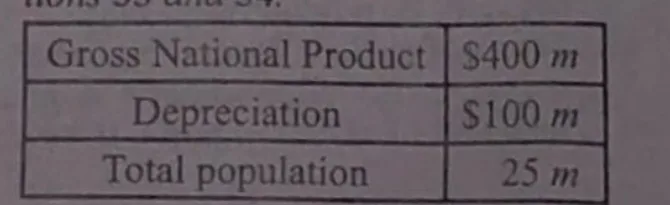
33. (Use the table showing Gross National Product $400m, Depreciation $100m, and Total population 25m) The value of Net National Product is

Diagram for question 33
  • A. $100m
  • B. $275m
  • C. $300mCorrect
  • D. $500m

Explanation

Net National Product = Gross National Product - Depreciation = $400m - $100m = $300m.

Economics 2024 Objective — Question 34

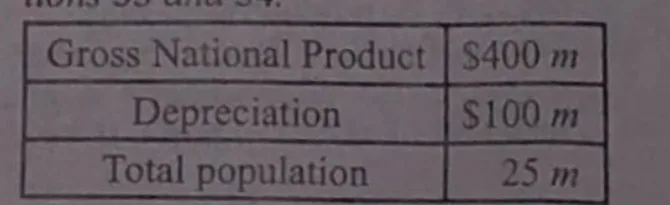
34. (Use the table showing Gross National Product $400m, Depreciation $100m, and Total population 25m) The value of per capita income is

Diagram for question 34
  • A. $20
  • B. $12
  • C. $8
  • D. $4

Explanation

Per capita income = Gross National Product/Population = $400m/25m = $16, which does not correspond to any of the options given; the WAEC key records no valid answer for this item.

Economics 2024 Objective — Question 35

35. One effect of inflation is that

  • A. money's purchasing power will increase.
  • B. the real incomes of workers will rise.
  • C. both borrowers and lenders benefit from it.
  • D. money's purchasing power will fall.Correct

Explanation

Inflation makes each unit of money worth less; thus, the purchasing power of money falls during inflation.

Economics 2024 Objective — Question 36

36. The function of money that enables credit purchases of goods and services is

  • A. unit of account.
  • B. store of value.
  • C. standard for deferred payment.Correct
  • D. relative scarcity.

Explanation

Money acting as a standard for deferred payment makes it possible for payments for goods to be made in the future, enabling credit purchases.

Economics 2024 Objective — Question 37

37. Supply of money is best defined as the

  • A. money in circulation plus bank deposits.Correct
  • B. money given out as loans to members of the public.
  • C. amount of currency printed annually by the government.
  • D. amount of money spent on consumer goods.

Explanation

The supply of money is the total volume of currency in circulation plus deposits held in banks.

Economics 2024 Objective — Question 38

38. Capital market operators deal in the

  • A. supply of and demand for short term loans only.
  • B. supply of and demand for long term loans for investment.Correct
  • C. sales and purchases of treasury bills.
  • D. sales and purchases of capital equipment.

Explanation

Operators in the capital market deal in the supply of and demand for long-term loans for investment purposes.

Economics 2024 Objective — Question 39

39. Money supply will increase when the Central Bank

  • A. buys securities from the public.Correct
  • B. increases the reserve requirements.
  • C. increases the bank rate.
  • D. sells securities to the public.

Explanation

When the Central Bank buys securities, it pays people with cash, and this results in an increase in money supply in the economy.

Economics 2024 Objective — Question 40

40. Expansionary fiscal policy implies

  • A. decreasing bank loans.
  • B. raising tax rates.
  • C. increasing the bank rate.
  • D. decreasing tax rates.Correct

Explanation

Expansionary fiscal policy aims to put more money into the economy; one way to do this is by decreasing taxes, leaving people with more money in hand.

Economics 2024 Objective — Question 41

41. A commodity with perfectly inelastic demand has the burden of tax borne by

  • A. both the sellers and the buyers.
  • B. the buyers alone.Correct
  • C. the government alone.
  • D. both the buyers and the government.

Explanation

If the price elasticity of demand for a product is perfectly inelastic, the buyers bear the entire burden of the tax alone.

Economics 2024 Objective — Question 42

42. An increase in a country's production capacity usually leads to economic

  • A. development.
  • B. stability.
  • C. growth.Correct
  • D. efficiency.

Explanation

When a country's production capacity increases, there is economic growth; if this growth is sustained, it eventually leads to economic development.

Economics 2024 Objective — Question 43

43. One indicator of the low level of capital formation in developing countries is

  • A. low per capita income.Correct
  • B. high rate of investment.
  • C. low importation of consumer goods.
  • D. high household savings.

Explanation

Low per capita income shows that the level of investment is low; nothing else causes the investment level to be low other than low capital formation.

Economics 2024 Objective — Question 44

44. Balance of payments is defined as the

  • A. difference between the values of visible imports and visible exports.
  • B. record of financial transactions between a country and the rest of the world.Correct
  • C. relationship between prices of exports and prices of imports.
  • D. difference between a country's expected revenue and proposed expenditure.

Explanation

The balance of payments records the financial transactions (both visible and invisible trade) between a country and the rest of the world.

Economics 2024 Objective — Question 45

45. Devaluation of currency will help to correct a balance of payments deficit if a country's

  • A. exports have perfectly inelastic demand.
  • B. imports have inelastic demand.
  • C. exports have elastic demand.Correct
  • D. productivity is low.

Explanation

Devaluation only helps correct a balance of payments deficit if the elasticity of demand for the country's exports is elastic. Devaluation makes the country's goods cheaper, encouraging more people to buy them.

Economics 2024 Objective — Question 46

46. Terms of trade is favourable when the

  • A. value of visible imports is greater than that of visible exports.
  • B. price of imports is greater than that of exports.
  • C. payments on imports is greater than receipts from exports.
  • D. price of exports is rising faster than that of imports.Correct

Explanation

Terms of trade is the rate at which export prices pay for import prices; it is favourable when export prices are rising faster than (higher than) import prices.

Economics 2024 Objective — Question 47

47. Short-term deficits in the current account of the balance of payments can be financed by balancing with the

  • A. invisible account.
  • B. capital account.
  • C. visible account.Correct
  • D. national income account.

Explanation

The visible account balance can help balance a deficit in the invisible (current) account, and vice versa.

Economics 2024 Objective — Question 48

48. Harmonised monetary and fiscal policies is a feature of

  • A. a free trade area.Correct
  • B. an economic union.
  • C. a customs union.
  • D. a common market.

Explanation

In a free trade area, there is a tax waiver (fiscal aspect) and more money is imported into the economy (monetary aspect); that is why fiscal and monetary policies are harmonized.

Economics 2024 Objective — Question 49

49. One major achievement of the Economic Commission for Africa (ECA) is the

  • A. setting up of the African Development Bank (AfDB).Correct
  • B. provision of long term loans to non-members.
  • C. reduction of balance of payments problems in Africa.
  • D. removing the gap between African countries and the rich nations.

Explanation

The major achievement of the Economic Commission for Africa (ECA) is the establishment of the African Development Bank (AfDB).

Economics 2024 Objective — Question 50

50. Exploitation of solid minerals in developing countries can stabilize their revenue base mainly because it helps in

  • A. promoting a mono-economy.
  • B. the transfer of technology.Correct
  • C. the diversification of the economy.
  • D. the provision of energy.

Explanation

Exploitation of solid minerals leads to the transfer of technology, as advanced countries bring in sophisticated machinery from which local workers learn.

Advertisement

Sign up free to unlock

  • Score tracking
  • Practice history
  • Saved questions
  • Progress dashboard
  • Personalized sessions
  • Weak-topic breakdown

…and/or go further with premium services and No Ads.