All 8 questions from the West African Examinations Council (WAEC) Economics 2025 Theory paper, with the correct answer and a full explanation for each. Free, no signup needed.
Figure 1 shows the output, cost and revenue position of a business producing tissue paper. Study the diagram and answer the questions that follow:
(a) Determine the firm's equilibrium price and output.
(b) Which of the curves represents the market's demand curve? Give a reason for your answer.
(c) In what market is the firm operating? Give a reason for your answer.
(d) At the profit-maximizing level of output, identify the areas that represent: (i) total revenue; (ii) total cost; (iii) profit or loss.
(e) What is the implication of the profit or loss earned on the market in (d)(iii)?
Model answer
(a) The firm is in equilibrium where MC = MR, at the output level where the two curves intersect. Equilibrium price and output are read off from where this intersection meets the price and quantity axes.
(b) The market demand curve is the AR (= MR) curve, because in this market the price line is horizontal and represents both average revenue and marginal revenue.
(c) The firm is operating in a perfectly competitive market, because it is only under perfect competition that the AR curve equals the MR curve (a horizontal, price-taking demand curve).
(d) (i) Total revenue is the rectangle formed by price multiplied by the equilibrium output. (ii) Total cost is the rectangle formed by average cost multiplied by the equilibrium output. (iii) Profit or loss is the shaded rectangle representing the difference between the total revenue and total cost rectangles.
(e) Since in this case total cost exceeds total revenue (a loss situation), the implication is that in the long run the firm will be forced to shut down if it is unable to cover its variable costs.
The terms of trade position for Country X for the years 2020 and 2021 are given in Table 1 (Price index of exports and price index of imports for each year).
(a) Calculate the terms of trade for Country X in 2020 and 2021.
(b) In what year(s) is the terms of trade (i) favourable (ii) unfavourable? Give a reason for your answer in each case.
(c) State any two likely reasons for the terms of trade position identified in (b).
(d) If the balance of trade in 2022 is $4,062,500 and the current account balance is $812,500, determine the country's balance of invisible trade. Explain your answer.
Model answer
(a) Terms of Trade = (Index of export prices / Index of import prices) x 100.
For 2020: (180/150) x 100 = 120.
For 2021: (160/200) x 100 = 80.
(b) 2020 is favourable: the terms of trade index is above 100, meaning export prices can pay for imports and still save about 20%. 2021 is unfavourable: the index is below 100, meaning export earnings cannot fully pay for the cost of imports (import prices are about 20% above export prices).
(c) Likely reasons for the unfavourable terms of trade: devaluation or depreciation of the local currency; and over-dependence on foreign (imported) products.
(d) Current Account Balance = Balance of Trade + Balance of Invisible Trade, so Balance of Invisible Trade = Current Account Balance - Balance of Trade = $812,500 - $4,062,500 = -$3,250,000. This negative figure indicates an unfavourable balance of invisible trade, meaning the country pays more for services (e.g. shipping, insurance, tourism) than it earns from rendering such services to the rest of the world.
3.(a) Distinguish between complementary goods and substitute goods.
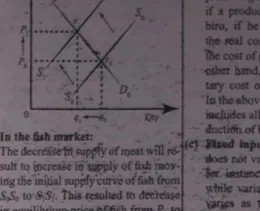
(b) Using diagrams, explain how a decrease in the supply of meat, other things being equal, will affect the equilibrium price and quantity of: (i) meat (ii) fish.
Model answer
(a) Complementary goods are goods that are consumed together, such that one cannot be meaningfully consumed independently of the other (e.g. car and petrol) - an increase in consumption of one leads to increased consumption of the other. Substitute goods are goods that compete against each other, such that increased consumption of one leads to reduced consumption of the other (e.g. tea and coffee).
(b)(i) Meat market: A decrease in the supply of meat shifts the supply curve leftward from S0S0 to S1S1. This moves the equilibrium position upward, so the equilibrium price of meat rises from P0 to P1 while the equilibrium quantity falls from q0 to q1.
(ii) Fish market: Since meat and fish are substitutes, the change in the meat market causes an increase in the supply of fish, shifting the fish supply curve rightward from S0S0 to S1S1. This results in a fall in the equilibrium price of fish from P0 to P1 and an increase in the equilibrium quantity of fish from q0 to q1.
4.(a) Define minimum price control.
(b) Identify any three reasons governments should introduce minimum prices for agricultural produce.
(c) Outline any three disadvantages of imposing minimum price control on agricultural produce.
Model answer
(a) Minimum price control is the lowest price below which a particular commodity must not be sold; it is usually set above the equilibrium price to protect producers, especially farmers.
(b) Reasons for setting minimum prices for agricultural produce: (i) to protect farmers from exploitation by buyers and middlemen; (ii) to stimulate/encourage farmers to produce more; (iii) to prevent unstable farmer incomes caused by price fluctuations.
(c) Disadvantages of minimum price control: (i) it increases government costs, as the government may have to purchase the excess supply; (ii) it may lead to excessive supply of agricultural produce, leading to wastage; (iii) it may encourage smuggling, since prices are set above the equilibrium price.
5.(a) Define production cost.
(b) Distinguish between real cost and explicit cost.
(c) With an example each, distinguish between fixed input and variable input.
(d) State any four types of short-run cost.
Model answer
(a) Production cost is the total amount spent on raw materials, labour and other expenses incurred in producing a particular commodity.
(b) Real cost is the opportunity cost of producing a commodity - for example, if a producer could make either a book or a biro and chooses to produce the biro, the real cost is the book forgone. Explicit cost is the actual monetary expense incurred in production - for example, all the money spent in producing the biro.
(c) Fixed input is an input whose quantity does not vary with the level of output, e.g. a factory building. Variable input is an input whose quantity varies as output varies, e.g. labour and raw materials.
(d) Types of short-run cost: (i) Fixed cost - does not vary with output; (ii) Variable cost - varies with output, rising as output rises and vice versa; (iii) Total cost - the sum of fixed cost and variable cost; (iv) Average cost - the cost per unit of output.
6.(a) Define monopoly.
(b) State any three factors that give rise to monopoly.
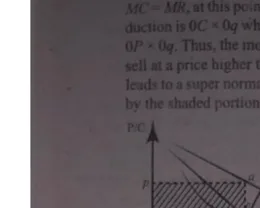
(c) With the aid of a diagram, show how a monopolist earns a super-normal profit.
Model answer
(a) Monopoly is a market structure with a sole producer or supplier of a commodity that has no close substitute.
(b) Factors giving rise to monopoly: (i) Resources barrier - large capital requirements to start the business may give the firm monopoly power; (ii) Barrier to entry - legal restrictions preventing other firms from entering the industry; (iii) Technological barrier - possession of technology not available to others gives the firm monopoly power.
(c) The monopolist is in equilibrium where MC = MR, at output 0q. At this output, cost per unit is 0C and price (average revenue) is 0P. Since price exceeds average cost, the firm earns a super-normal profit, shown by the shaded rectangle CPae on the diagram (bounded by the AC and AR curves at the equilibrium output).
7.(a) State the instruments traded in the money market.
(b) With a relevant example each, explain the condition under which a manufacturer will seek funds from the: (i) money market (ii) capital market.
(c) Explain any three functions of Development banks.
Model answer
(a) Instruments traded in the money market: (i) Treasury bills - issued by government to borrow, with a maturity of 90 days; (ii) Commercial bills/promissory notes - unsecured debt instruments issued by large corporations to borrow money for a short period; (iii) Banker's acceptance - short-term debts issued by large corporations but secured by banks.
(b)(i) Money market: a manufacturer seeks funds here for short-term loans, to meet the daily operating costs of the business, such as raw materials and fuelling, to be repaid within a short period. (ii) Capital market: a manufacturer seeks funds here for long-term loans, to expand operations such as building a new factory or replacing obsolete machinery; loans obtained here are for a longer period.
(c) Functions of Development banks: (i) they provide short and medium-term loans for government and investors; (ii) they provide technical and financial advice to government and investors; (iii) they contribute to the training of manpower to improve the productivity of a country.
8.(a) What is a regressive system of taxation?
(b) Explain the following principles of taxation: (i) equity (ii) certainty (iii) economy.
(c) Outline any three reasons why government imposes tax in a country.
Model answer
(a) A regressive tax system is one in which the rate paid as tax decreases as income increases, so that higher income earners pay a smaller portion of their income as tax while lower income earners pay a larger portion of theirs (e.g. as described for personal income tax in this system).
(b) (i) Equity: the burden of taxation should be fairly distributed - those who earn more should pay more than those below them (vertical equity), and those who earn the same amount should pay the same amount of tax (horizontal equity). (ii) Certainty: both the tax collector and the taxpayer should know with certainty how much tax is to be paid and when it is due. (iii) Economy: the cost of collecting a tax should be reasonable, and should not be so high that it makes little economic sense to collect the tax.
(c) Reasons government imposes tax: (i) To earn revenue - governments earn most of their revenue from taxes; (ii) To regulate the economy - tax can be used to regulate people's purchasing power and manage inflationary pressure; (iii) To redistribute income - government can use tax to redistribute income by collecting from those who have more and giving to those who have less.
Advertisement
Sign up free to unlock
Score tracking
Practice history
Saved questions
Progress dashboard
Personalized sessions
Weak-topic breakdown
…and/or go further with premium services and No Ads.