Physics 2018 Theory — Question 1
1.(a) Define Strain.
Model answer
Strain is the relative deformation produced by stress; it is the ratio of extension to original length, and has no units (dimensionless): strain = extension/original length.
All 27 questions from the West African Examinations Council (WAEC) Physics 2018 Theory paper, with the correct answer and a full explanation for each. Free, no signup needed.
Advertisement
1.(a) Define Strain.
Model answer
Strain is the relative deformation produced by stress; it is the ratio of extension to original length, and has no units (dimensionless): strain = extension/original length.
1.(b) A rubber band is stretched to twice its original length. Calculate the strain on the rubber band.
Model answer
Extension = 2l₀ − l₀ = l₀. Strain = extension/original length = l₀/l₀ = 1 (i.e. 100%).
2. State three materials used for making optical fibres.
Model answer
Silicon dioxide (silica glass), sapphire, and chalcogenide glass (plastic/polycarbonate fibres are also used in some applications).
3. Name three classes of magnetic materials.
Model answer
Ferromagnetic materials, paramagnetic materials, and diamagnetic materials.
4.(a) What is an intrinsic semiconductor?
Model answer
An intrinsic semiconductor is a chemically pure semiconductor containing no impurities, whose (low) conductivity arises only from thermally generated electron-hole pairs.
4.(b) Distinguish between the p-type and n-type semiconductors.
Model answer
N-type: majority carriers are electrons, minority carriers are holes; formed by adding pentavalent (donor) impurities; donor density exceeds acceptor density. P-type: majority carriers are holes, minority carriers are electrons; formed by adding trivalent (acceptor) impurities; acceptor density exceeds donor density.
5. A missile is projected so as to attain its maximum range. Calculate the maximum height attained if the initial velocity of projectile is 200ms⁻¹. [g = 10ms⁻²]
Model answer
Maximum range occurs at θ=45°. Maximum height H = u²sin²θ/2g = (200²×sin²45°)/(2×10) = (40000×0.5)/20 = 1000m.
6. A black body radiates maximum energy when its surface temperature T and the corresponding wavelength are related by the equation λmaxT = constant. Given the values of the constant and surface temperature as 2.9×10⁻³mK and 57°C respectively, calculate the frequency of the energy radiated.
Model answer
T = 57+273 = 330K. λmax = 2.9×10⁻³/330 ≈ 8.79×10⁻⁶m. f = c/λmax = (3×10⁸)/(8.79×10⁻⁶) ≈ 3.41×10¹³Hz.
7.(a) What does the acronym LASER stand for?
Model answer
LASER stands for Light Amplification by Stimulated Emission of Radiation.
7.(b) What is a laser?
Model answer
A laser is a device that produces a highly coherent, nearly monochromatic and intense beam of light as a result of the cooperative stimulated emission of radiation from many atoms.
8.(a) Define uniform acceleration.
Model answer
Uniform acceleration is the constant (steady) time rate of increase of velocity of a body.
8.(b) List the forces acting on a car in motion: (i) Horizontal forces and their directions; (ii) Vertical forces and their directions.
Model answer
Horizontal forces: the driving/thrust force (forward, in the direction of motion) and the frictional/air-resistance force (backward, opposing motion). Vertical forces: the weight of the car (downward) and the normal reaction from the road (upward).
8.(c) A car starts from rest and accelerates uniformly for 20s to attain a speed of 25ms⁻¹. It maintains this speed for 30s before decelerating uniformly to rest. The total time for the journey is 60s. (i) Sketch a velocity–time graph for the motion. (ii) Use the graph to determine: (iii) Total distance travelled (iv) Deceleration of the car.
Model answer
(i) The graph is a trapezium: velocity rises linearly from 0 to 25ms⁻¹ over 0–20s, stays constant at 25ms⁻¹ from 20–50s, then falls linearly to 0 from 50–60s. (iii) Total distance = area under the graph = ½(60+30)×25 = ½×90×25 = 1125m. (iv) Deceleration = (0−25)/(60−50) = −2.5ms⁻² (i.e. a deceleration of 2.5ms⁻²).
9.(a) List two factors each that affect heat loss by (i) radiation; (ii) convection.
Model answer
Radiation: surface area of the body; nature (colour/texture) of the surface; temperature of the body/excess temperature over surroundings. Convection: exposed surface area; density of the surrounding fluid; temperature difference between body and fluid.
9.(b) State two factors that determine the quantity of heat in a body.
Model answer
The mass of the body and its specific heat capacity (and its temperature/temperature change).
9.(c) Explain the statement: The specific latent heat of vaporization of mercury is 2.72×10⁵J/kg.
Model answer
This means that 2.72×10⁵ joules of heat energy are required to change 1kg of mercury from liquid to vapour at its boiling point without any change in temperature.
9.(d) A jug of heat capacity 250JK⁻¹ contains water at 28°C. An electric heater of resistance 35Ω connected to a 220V source is used to raise the temperature of the water until it boils at 100°C in 4 minutes. After another 5 minutes, 300g of water has evaporated. Assuming no heat is lost to the surroundings, calculate: (i) the mass of water in the jug before heating; (ii) the specific latent heat of vaporization of steam. [Specific heat capacity of water = 4200JK⁻¹kg⁻¹]
Model answer
Heat supplied in first 4min (240s): Q=V²t/R = 220²×240/35 ≈ 331,886J. This heats the jug (ΔQ=250×72=18,000J) and the water (mcΔT=m×4200×72=302,400m). 331,886 = 18,000 + 302,400m → m ≈ 1.04kg. (ii) Heat supplied in next 5min (300s): Q₂=220²×300/35 ≈ 414,857J. This evaporates 0.3kg of water: L = Q₂/mass = 414,857/0.3 ≈ 1.38×10⁶ J/kg.
10.(a) Define diffraction.
Model answer
Diffraction is the spreading and bending of waves as they pass through a narrow opening or around an obstacle; a narrow gap produces a larger diffraction effect.
10.(b)(i) Explain critical angle. (ii) A ray of light passing through a rectangular transparent plastic block makes an angle of 44° as shown. (a) Determine the value of the critical angle. (b) Calculate the refractive index of the block.
Model answer
(i) The critical angle is the angle of incidence (in the denser medium) for which the angle of refraction in the less dense medium is 90°. (a) ic + 44° = 90° → ic = 46°. (b) Refractive index η = 1/sin(ic) = 1/sin46° ≈ 1.39.
10.(c) A pipe closed at one end has fundamental frequency of 200Hz. The frequency of the first overtone of the closed pipe is equal to the frequency of the first overtone of an open pipe. Calculate the: (i) Fundamental frequency of the open pipe; (ii) Length of the closed pipe; (iii) Length of the open pipe. [Speed of sound in air = 330ms⁻¹]
Model answer
Closed pipe: f₀=200Hz, first overtone = 3f₀ = 600Hz. (i) For the open pipe, first overtone = 2f₀' = 600Hz → f₀' = 300Hz. (ii) Length of closed pipe: f₀=v/4L → L = 330/(4×200) = 0.4125m. (iii) Length of open pipe: f₀'=v/2L' → L' = 330/(2×300) = 0.55m.
11.(a) Define: (i) reactance; (ii) impedance in an a.c. circuit.
Model answer
(i) Reactance is the opposition which an inductor or capacitor offers to the flow of a.c. current without dissipating heat, measured in ohms. (ii) Impedance is the overall (total) opposition offered to the passage of a.c. current by a mixed circuit containing resistance and one or both of inductance and capacitance, also measured in ohms.
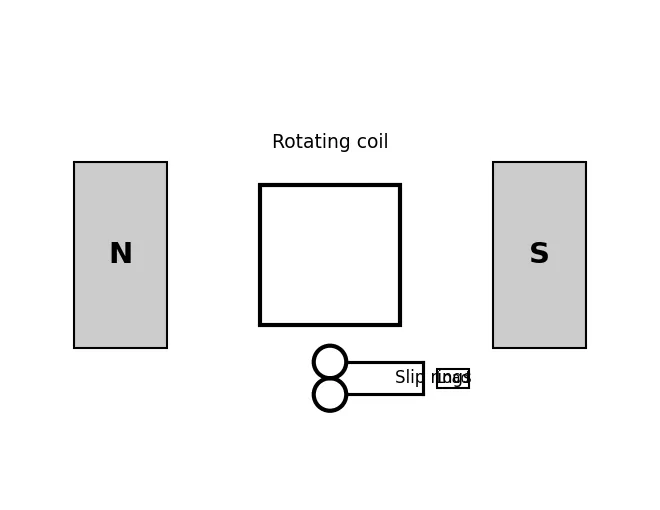
11.(b) The diagram above illustrates an a.c. generator. When the coil is rotated, an e.m.f. is induced in the coil. (i) Explain why an e.m.f. is induced. (ii) State the purpose of the slip rings. (iii) Name and state the law used to determine the direction of the induced current. (iv) State two ways to increase the induced e.m.f.
Model answer
(i) As the coil rotates in the magnetic field, it continuously cuts (changes) the magnetic flux linking it, and by electromagnetic induction this changing flux induces an e.m.f. in the coil. (ii) The slip rings transfer the alternating induced current from the rotating coil to the external circuit continuously. (iii) Lenz's Law: the direction of the induced current is always such as to oppose the change in magnetic flux producing it. (iv) Increase the number of turns on the coil; increase the speed of rotation of the coil (also: increase the area of the coil or use a stronger magnet).
11.(c) A lamp is rated 12V, 6W. Calculate the amount of energy transformed by the lamp in 5 minutes.
Model answer
Energy = Power × time = 6W × (5×60)s = 6×300 = 1800J.
12.(a) Define binding energy in an atom.
Model answer
Binding energy is the energy released when the individual constituent particles (nucleons) come together to form an atomic nucleus; equivalently, it is the energy required to separate a nucleus into its individual constituent nucleons.
12.(b) List three evidences to support the claim that X-rays are electromagnetic waves.
Model answer
(i) X-rays travel through space/vacuum with the speed of light. (ii) X-rays can be polarised. (iii) X-rays are not deflected by electric or magnetic fields.
12.(c) List three peaceful uses of nuclear energy.
Model answer
(i) Generation of electrical power. (ii) Medical diagnosis and treatment (e.g. radiotherapy). (iii) Preservation of food and sterilization of equipment (or industrial radiography/tracing).
12.(d) Light of wavelength 4.5×10⁻⁷m is incident on a metal resulting in the emission of photoelectrons. If the work function of the metal is 3.0×10⁻¹⁹J, calculate the: (i) frequency of the incident light; (ii) energy of the incident light; (iii) energy of the photoelectrons. [Speed of light = 3.0×10⁸ms⁻¹, h = 6.6×10⁻³⁴Js]
Model answer
(i) f = c/λ = (3.0×10⁸)/(4.5×10⁻⁷) ≈ 6.67×10¹⁴Hz. (ii) E = hf = 6.6×10⁻³⁴×6.67×10¹⁴ ≈ 4.4×10⁻¹⁹J. (iii) Energy of photoelectrons = E − work function = 4.4×10⁻¹⁹ − 3.0×10⁻¹⁹ = 1.4×10⁻¹⁹J.
Advertisement
…and/or go further with premium services and No Ads.