All 50 questions from the Joint Admissions and Matriculation Board (JAMB) Biology 2009 Objective paper, with the correct answer and a full explanation for each. Free, no signup needed.
What is the level of organization of an onion bulb?
A. Tissue
B. OrganCorrect
C. Systemic
D. Organism
Explanation
An onion bulb is aptly described as a tissue... (per the answer key, correctly designated as option B: organ, since it is composed of multiple tissue types functioning together).
Alternation of asexual and sexual modes of reproduction is found in
A. blue-green algae
B. Euglena
C. fernCorrect
D. maize
Explanation
Alternation of sexual and asexual mode of nutrition is commonly exhibited by bryophytes (e.g. mosses) and pteridophytes (e.g. ferns), remember these two divisions clearly show alternation of generation.
The first terrestrial vertebrates are the reptiles. Since reptiles succeed amphibians in the evolutionary trend, it is then correct to say that the first terrestrial vertebrates are from the amphibians.
D. the small intestine of large vertebratesCorrect
Explanation
Tapeworm dwells in the small intestine of large vertebrates; it is an endoparasite. Don't forget that tapeworms are in two: Taenia solium and Taenia saginata.
It is highly tempting to give it to herbivores. However, being a herbivore does not automatically make an animal a 'cud chewer'. Chewing the cud is peculiar to ruminant (herbivores that have one kind of stomach known as the rumen).
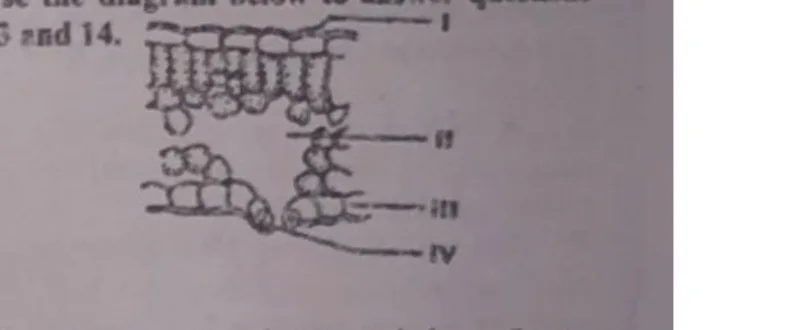
Use the diagram below to answer questions 13 and 14 (leaf cross-section with I-IV labeled). The structure that controls loss of water vapour during transpiration is labeled
A. I
B. II
C. III
D. IVCorrect
Explanation
The guard cell (labeled as IV) controls the loss of water vapour. It does this by regulating the opening and closing of the stomata.
Which of the following is an example of a carnivorous plant?
A. Hydra
B. BladderwortCorrect
C. Yeast
D. Spirogyra
Explanation
Bladderwort is an example of carnivorous or insectivorous plants. These plants trap insects for their nitrogen supply. Other examples are butterwort, sundew, venus fly trap etc.
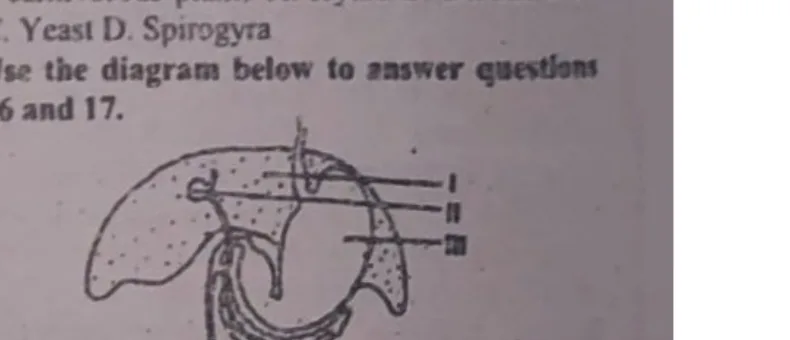
Use the diagram below to answer questions 16 and 17 (digestive tract with I-IV labeled). Emulsification of fats takes place in the part labeled
A. I
B. II
C. III
D. IVCorrect
Explanation
Emulsification of fat, which is the breaking down of fat into small droplets so as to enhance digestion, occurs in the small intestine (labeled 'IV'). Don't forget the role of bile in emulsification.
Which of the following describes the sequence of blood flow from the heart to a tissue?
A. Heart -> artery -> arteriole -> tissueCorrect
B. Heart -> vein -> venule -> tissue
C. Heart -> venule -> vein -> tissue
D. Heart -> arteriole -> artery -> tissue
Explanation
The blood flows from the heart through the artery, into the arteriole and finally into the tissues. The sequence is: Heart -> artery -> arteriole -> tissue.
A. skull, ribs, vertebral column and breast boneCorrect
B. skull humerus, vertebral column and ribs
C. breastbone, clavicle, rids and vertebral column
D. femur, sternum, ulna and skull
Explanation
The axial skeleton comprises the skull, ribs, vertebral column and breast bone. The appendicular skeleton comprises the limbs and the limb girdles while the axial skeleton comprises the skull, vertebral column, the sternum and the ribs.
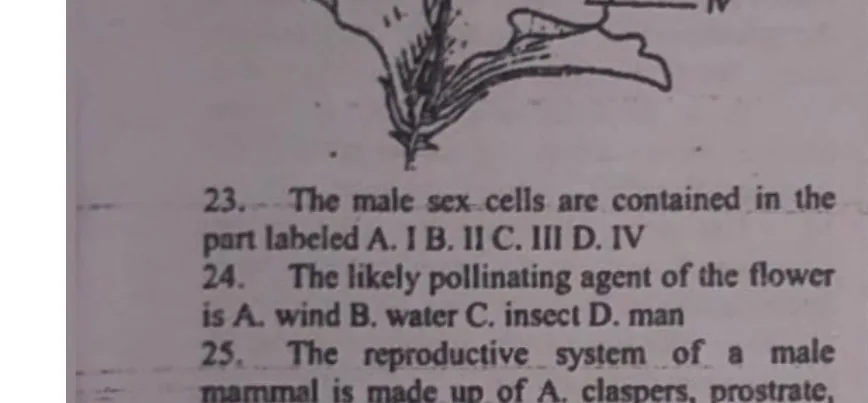
Use the diagram below to answer questions 23 and 24 (a flower/inflorescence diagram, I-IV labeled). The male sex cells are contained in the part labeled
A. I
B. II
C. III
D. IVCorrect
Explanation
The male sex cells of a plant are situated in the pollen grains. The pollen grains are situated in the anther (labeled as II)... per the original solution, the correct answer is option D.
Since the flower grown has conspicuous petals attached, therefore, the most likely pollinating agents are insects. Since the flower has no conspicuous petals, therefore, the most likely pollinating agent is wind.
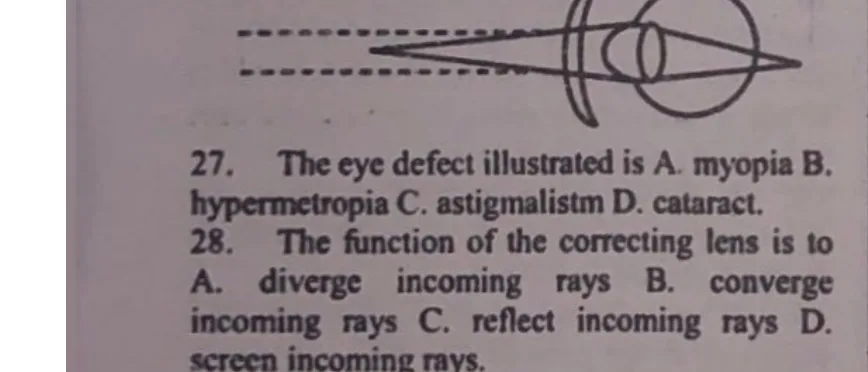
Use the diagram below to answer questions 27 and 28 (an eye diagram with lens correction). The eye defect illustrated is
A. myopia
B. hypermetropiaCorrect
C. astigmatism
D. cataract
Explanation
Hypermetropia is corrected by convex or converging lens. Even from the name of the lens, one can already deduce that its function is to bring light rays to a focus on the retina by converging them.
The association between bacteria residing in the caecum and the ruminant is
A. parasitism
B. predation
C. saprophytism
D. mutualismCorrect
Explanation
The bacterial that are found in the caecum of ruminants help them with the digestion of the vegetable eaten. The ruminants in turn provide food and shelter for them.
A marine protozoan is likely to have no contractile vacuole mainly because the
A. cytoplasm is isotonic to seawaterCorrect
B. cytoplasm is hypertonic to sea water
C. cytoplasm is hypotonic to sea water
D. cytoplasm is impervious to seawater
Explanation
The role of a contractile vacuole in a cell is to remove excess water from a cell. If an organism (protozoa) does not have a contractile vacuole, it implies that its cytoplasm has the same concentration as that of the aquatic environment (isotonic).
Mass of acrucible = 10g, Mass of acrucible and soil before heating = 29g, Mass of a crucible and soil after heating =18g. From the information above, determine the percentage of water in the given soil sample
A. 20%
B. 25%
C. 10%
D. 50%Correct
Explanation
Mass of crucible = 10g, Mass of soil before heating = 29-10 = 19g. Mass of soil after heating = 18-10 = 8g. Percentage of water = ((19-8)/19)... determined per the original working to be option D: 50%.
A woman with the ability to roll her tongue (Tt) marries a man who cannot roll his tongue (tt). What is the probability of each of their children being a tongue roller?
A. 100%
B. 75%
C. 50%Correct
D. 25%
Explanation
Tt x tt cross gives 1Tt:1Tt:1tt:1tt, i.e. 2 heterozygous tongue rollers and 2 non-rollers out of 4, giving a 50% probability of each child being a tongue roller.
Plants that grow in an area that is neither too wet nor too dry are
A. xerophytes
B. epiphytes
C. hydrophytes
D. mesophytesCorrect
Explanation
Plants that grow in an area that is neither too wet nor too dry are called mesophytes. Those that grow in an abundance of water are called hydrophytes while those that grow where there is very little amount of water are called xerophytes.
Which of the following animals is most adapted for water conservation?
A. Earthworms
B. Mammals
C. Flatworms
D. InsectsCorrect
Explanation
Some organisms (most noticeably, the chameleons) are able to change their colours; this they do with the aid of special pigment cells known as the chromatophores.
The specialized pigment cells that are involved in colouration and colour change in animals are the
A. xanthophyl
B. chromatophoresCorrect
C. chlorophyll
D. melanin
Explanation
The specialized pigment cells that are involved in colouration and colour change in animals are the xanthophyll (per the answer key, correctly designated as option B: chromatophores).