All 50 questions from the Joint Admissions and Matriculation Board (JAMB) Biology 2015 Objective paper, with the correct answer and a full explanation for each. Free, no signup needed.
Pollution of water by crude oil can lead to
A. a decrease in carbon(IV)oxide contentB. an increase in oxygen contentC. a decrease in oxygen contentCorrect D. an increase in growth of aquatic organismsExplanation Crude oil is a major pollutant of water; it blocks oxygen exchange at the surface, leading to a decrease in the oxygen content of the water.
When a few drops of barium chloride is added to an unknown sample acidified with hydrochloric acid, a white precipitate insoluble in excess of the acid was obtained. The likely anion in the sample is
A. SO₄²⁻Correct B. Cl⁻C. S²⁻D. CO₃²⁻Explanation A white precipitate that remains undisclosed (insoluble) even after adding excess HCl confirms the presence of SO₄²⁻, since CO₃²⁻ and SO₃²⁻ would dissolve with effervescence.
Oxygen in air can be removed using
A. lime water or caustic soda solutionB. caustic soda solutionC. alkaline pyrogallol solutionCorrect D. slaked limeExplanation Alkaline pyrogallol solution is commonly used to absorb/remove oxygen from air in gas analysis.
Calculate the pH of a solution of 0.0001moldm⁻³ hydrochloric acid.
Explanation [H⁺] = 0.0001 = 10⁻⁴ moldm⁻³. pH = −log₁₀(10⁻⁴) = 4.
Which of the following drying agents is NOT suitable for drying hydrogen sulphide?
A. CaOCorrect B. P₄O₁₀C. CaCl₂D. H₂SO₄Explanation CaO (a basic drying agent) would react with the acidic gas H₂S, so it is unsuitable for drying it.
Diamond is used in making jewelry due to its
A. high refractive indexCorrect B. transparencyC. hardnessD. high melting pointExplanation Diamond's high refractive index makes it shine brilliantly when polished, making it a good ornament.
The presence of impurities in a solid will make the melting point to
A. decreaseCorrect B. increaseC. remain unchangedD. be zeroExplanation Impurities generally cause the melting point of a solid to decrease (melting point depression), while they raise the boiling point of a liquid.
The discovery that protons and neutrons are concentrated at the nucleus of an atom was postulated by
A. E. RutherfordCorrect B. J. DaltonC. J.J. ThomsonD. N. BohrExplanation Rutherford's gold-foil experiment led to the discovery that the mass/protons and neutrons of an atom are concentrated in a small dense nucleus.
Which of the following is a hydroscopic substance?
A. NaNO₃Correct B. MgCl₂C. FeCl₂D. CaCl₂Explanation Hygroscopic substances absorb moisture from the atmosphere; NaNO₃ is a common example, alongside CuO and H₂SO₄.
In a chemical reaction, when the energy of the colliding reactant particles is less than the activation energy, the reaction will
A. be spontaneousB. not occurCorrect C. occurD. be slowExplanation For a reaction to occur, colliding particles must have energy greater than or equal to the activation energy; if less, the reaction will not occur.
The monomer of natural rubber is
A. 2-methylbuta-1,3-dieneCorrect B. 1-buten-3-yneC. buta-1,3-dieneD. 2-chlorobuta-1,3-dieneExplanation Natural rubber is a polymer of the diolefin monomer 2-methylbuta-1,3-diene (isoprene).
The monomer of natural rubber is
A. 2-methylbuta-1,3-dieneCorrect B. 1-buten-3-yneC. buta-1,3-dieneD. 2-chlorobuta-1,3-dieneExplanation As with question 11, the monomer of natural rubber is 2-methylbuta-1,3-diene (this question is repeated in the original source).
PCl₅(g) ⇌ PCl₃(g) + Cl₂(g), ΔH = +ve. In the reaction above, the forward reaction is favoured by
A. increasing the size of the containing vesselB. increasing the pressureC. adding a catalystD. increasing the temperatureCorrect Explanation Since the forward reaction is endothermic (ΔH = +ve), it is favoured by an increase in temperature.
Which of the following halogens is the most reactive?
A. Cl₂B. I₂C. Br₂D. F₂Correct Explanation Fluorine is the most electronegative element and the most reactive halogen; reactivity decreases down the group: F > Cl > Br > I.
A gas that forms a black precipitate with lead(II) ethanoate is
A. Cl₂B. NH₃C. SO₂D. H₂SCorrect Explanation H₂S reacts with lead(II) ethanoate to produce lead(II) sulphide, an insoluble black precipitate.
The common ore of iron is
A. galenaB. cassiteriteC. bauxiteD. magnetiteCorrect Explanation Magnetite is a common ore of iron; galena is an ore of lead, cassiterite an ore of tin, and bauxite an ore of aluminium.
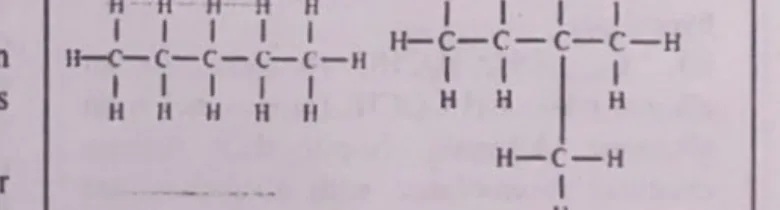
A property common to the two structures shown (normal pentane and 2-methylbutane) is that they have the same
A. structural and molecular formulaeB. structural formula but different molecular formulaeC. number of carbon but different molecular massD. molecular formula but different structural formulaCorrect Explanation Normal pentane and 2-methylbutane are isomers — they share the same molecular formula (C₅H₁₂) but have different structural formulae.
The type of salt that ionizes to produce three different ions in solution is
A. acidicB. complexC. doubleCorrect D. basicExplanation A double salt ionizes to produce three different ions in solution — two metallic ions and a negative acid radical, or a metallic ion, an ammonium ion, and a negative acid radical (e.g. potash alum).
H₂S(g) + Br₂(g) → 2HBr(g) + S(s). In the reaction above, the oxidizing agent is
A. H₂S(g)B. S(s)C. Br₂(g)Correct D. HBr(g)Explanation The oxidation number of bromine decreases from 0 in Br₂ to −1 in HBr (reduction), so Br₂ is the oxidizing agent, while H₂S is the reducing agent.
The process whereby a gaseous body loses some of its kinetic energy to a colder body is referred to as
A. condensationCorrect B. meltingC. evaporationD. freezingExplanation When a gaseous substance loses kinetic energy, it may change into liquid form; this process is known as condensation.
Which of the quantum numbers determines the energy sub-level in an orbital?
A. magneticB. principalC. azimuthalCorrect D. spinExplanation The azimuthal (angular/secondary/subsidiary) quantum number determines the energy sub-level in an orbital.
Fehling's solution can be used to distinguish between
A. CH₃CHO and C₂H₅OHB. CH₃COCH₃ and CH₃COOCH₃C. CH₃CHO and CH₃COCH₃Correct D. C₂H₅OH and CH₂CH₂COOHExplanation Alkanals (e.g. CH₃CHO, ethanal) reduce Fehling's solution while alkanones (e.g. CH₃COCH₃, propanone) do not, so Fehling's test distinguishes them.
What is the molecular formula of a compound with empirical formula CH₂ and vapour density 42? [C=12, H=1]
A. C₆H₁₂Correct B. C₃H₆C. C₄H₈D. C₅H₁₀Explanation Molar mass = 2×vapour density = 84. Empirical formula mass (CH₂) = 14. n = 84/14 = 6, so molecular formula = C₆H₁₂.
The separation technique that is based on the principle of solubility of a solid in two miscible liquids is
A. fractional distillationB. distillationC. precipitationCorrect D. filtrationExplanation Fractional/solvent extraction (precipitation as listed) exploits differing solubility of a solid in two miscible liquids to separate it.
Hydrogen bond can be found in
A. hydrogen sulphideB. hydrogen bromideC. hydrogen fluorideCorrect D. hydrogen chlorideExplanation Hydrogen bonding occurs in compounds containing hydrogen bonded to a very small, highly electronegative element such as fluorine; hydrogen fluoride exhibits hydrogen bonding.
24g of magnesium reacts with dilute hydrochloric acid. Calculate the volume of hydrogen gas evolved at s.t.p. [Mg=24, Molar volume of gas at s.t.p. = 22.4dm³]
A. 22.4dm³Correct B. 5.6dm³C. 11.2dm³D. 44.8dm³Explanation Moles of Mg = 24/24 = 1 mol. Mg + 2HCl → MgCl₂ + H₂, so 1 mol Mg produces 1 mol H₂ = 22.4dm³ at s.t.p.
Aluminium is usually used as electrical cables due to its
A. good conductivityCorrect B. malleabilityC. silvery-white appearanceD. high melting pointExplanation Aluminium's good electrical conductivity is why it is used for electrical cables.
A chemical reaction with entropy change of +20 Jk⁻¹ and free energy change +55000J occurred at −23°C. Calculate the enthalpy change.
A. 55460JB. 44540JC. 50000JD. 60000JCorrect Explanation ΔG = ΔH − TΔS ⟹ ΔH = ΔG + TΔS = 55000 + (250×20) = 55000+5000 = 60000J.
The enzyme invertase converts sucrose into
A. glucose and glucoseB. glucose and galactoseC. glucose and fructoseCorrect D. fructose and galactoseExplanation Invertase hydrolyses sucrose into glucose and fructose.
The number of lone pairs of electrons in a water molecule is
Explanation The oxygen atom in a water molecule has two lone pairs of electrons.
n monosaccharide (−x→) polysaccharide (−y→) + n water. In the illustration above, x and y respectively represent
A. condensation and hydrolysisCorrect B. hydrolysis and condensationC. fermentation and condensationD. fermentation and hydrationExplanation The conversion of monosaccharide to polysaccharide is condensation (with loss of water); the reverse process (polysaccharide back to monosaccharide) is hydrolysis.
The main product of the reaction between phosphorus(V) chloride and ethanol is
A. chloroethaneCorrect B. chloromethaneC. dichloromethaneD. chloroetheneExplanation Phosphorus(V) chloride reacts with ethanol (C₂H₅OH + PCl₅ → C₂H₅Cl + POCl₃ + HCl) to give chloroethane as the main organic product.
The bond-breaking energies in an endothermic reaction is usually
A. equal to the bond-forming energiesB. more than the bond-forming energiesCorrect C. less than the bond-forming energiesD. double the bond-forming energiesExplanation In an endothermic reaction, the bond-breaking energy is usually more than the bond-forming energy (the reverse is true for exothermic reactions).
²³⁴₉₀Th → ˣ_yPa + β. In the reaction above, x and y respectively are
A. 234 and 91Correct B. 235 and 90C. 233 and 89D. 230 and 86Explanation Beta decay: mass number is conserved (x=234) while atomic number increases by 1 (y=91).
The compound of calcium used to make refractory furnace linings is
A. calcium oxideCorrect B. calcium trioxonitrate(V)C. calcium hydroxideD. calcium chlorideExplanation Calcium oxide (quicklime), due to its extremely high melting point (about 2600°C), is used for making refractory furnace linings.
The mass of copper deposited when a current of 2.0A is passed through a solution of a copper salt for 60 minutes is [Cu=64, F=96500 Cmol⁻¹]
A. 4.78gB. 0.04gC. 2.39gCorrect D. 9.55gExplanation Q=It=2×3600=7200C. For 1 mole Cu (64g), 2F (193000C) is required, so mass deposited = (64/193000)×7200 ≈ 2.39g.
Which of the following compounds will liberate carbon(IV) oxide on reacting with sodium trioxocarbonate(IV)?
A. CH₃COOC₂H₅B. CH₃COOHCorrect C. CH₃CHOD. CH₃COCH₃Explanation Acids (like ethanoic acid, CH₃COOH) react with carbonates to liberate carbon(IV) oxide.
Kerosene is a petroleum fraction that distils over in the temperature range of
A. 50°C – 500°CB. 40°C – 200°CC. 200°C – 250°CCorrect D. 25°C and aboveExplanation Kerosene is a mixture of hydrocarbons containing C₁₀–C₁₆ carbon atoms, boiling between 200°C and 250°C.
The preference in the usage of asbestos support to platinum block as a catalyst can be attributed to its
A. increased surface areaCorrect B. high concentrationC. low concentrationD. decreased surface areaExplanation A catalyst's effectiveness is higher with increased surface area; asbestos support provides this over a plain platinum block.
In the deduction of ethyl ethanoate with LiAlH₄, the product obtained is
A. ethanolCorrect B. ethaneC. ethanoic acidD. ethaneExplanation Ethyl ethanoate is reduced to ethanol using reducing agents like lithium aluminium hydride (LiAlH₄).
A sample of a salt was heated on a Bunsen flame. If the colour of the flame turned bluish-green, the metal present is likely to be
A. potassiumB. copperCorrect C. sodiumD. ironExplanation Copper produces a bluish-green flame colouration in a flame test.
A salt that loses moisture on exposure to the atmosphere is said to be
A. effervescentB. hygroscopicC. deliquescentD. efflorescentCorrect Explanation A salt that loses its water of crystallization to become anhydrous on exposure to the atmosphere is said to be efflorescent.
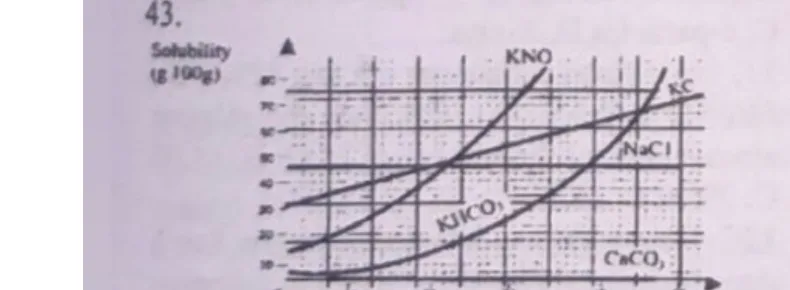
In the graph, at what temperature is the solubility of KHCO₃ and NaCl the same?
A. 35°CB. 42°CCorrect C. 37°CD. 18°CExplanation KHCO₃ and NaCl have the same solubility at the point where their solubility curves intersect, which corresponds to about 42°C.
1050cm³ of helium gas was produced at −33°C and 700mmHg. What volume would the gas occupy at 23°C and 750mmHg?
A. 1208.67cm³Correct B. 794.59cm³C. 912.16cm³D. 1387.50cm³Explanation Using the combined gas law: V₂ = P₁V₁T₂/(P₂T₁) = (700×1050×296)/(750×240) ≈ 1208.67cm³.
¹⁴₇N + X → ¹⁷₈O + ¹₁H. In the reaction above, X is a(n)
A. lithium atomB. neutronC. helium atomCorrect D. deuterium atomExplanation Balancing mass and atomic numbers (14+4=17+1; 7+2=8+1) shows X is a helium atom (alpha particle).
The colour of phenolphthalein in an alkaline medium is
A. yellowB. colourlessC. pink/redCorrect D. orangeExplanation Phenolphthalein is colourless in acidic/neutral medium but turns pink/red in alkaline medium.
Calculate the molecular formula of a compound with empirical formula CH₂O and relative molecular mass 120. [C=12, O=16, H=1]
A. C₂H₄O₂B. C₄H₈O₄Correct C. C₆H₁₆O₆D. C₈H₁₆O₈Explanation Empirical formula mass = 12+2+16 = 30. n = 120/30 = 4, so molecular formula = (CH₂O)₄ = C₄H₈O₄.
MnO₂(s) + 4HCl(aq) → MnCl₂(aq) + Cl₂(g) + 2H₂O(l). In the reaction above, MnO₂ acts as a(n)
A. catalytic agentB. oxidizing agentCorrect C. bleaching agentD. reducing agentExplanation The oxidation state of manganese decreases from +4 in MnO₂ to +2 in MnCl₂ (reduction), so MnO₂ is the oxidizing agent.
Calculate the mass of magnesium that would be deposited by 8 faradays of electricity. [Mg=24]
A. 96gCorrect B. 48gC. 72gD. 120gExplanation Mg²⁺ + 2e⁻ → Mg, so 2F deposits 1 mole of Mg (24g). 8F will deposit 4 moles = 96g.
Which of the following hydrocarbons will NOT undergo polymerization reaction?
A. C₄H₆B. C₃H₄C. C₃H₆D. C₄H₁₀Correct Explanation C₄H₁₀ (butane) is an alkane (saturated hydrocarbon); alkanes do not undergo polymerization reactions.
Sign up free to unlock …and/or go further with premium services and No Ads .