All 40 questions from the Joint Admissions and Matriculation Board (JAMB) Biology 2017 Objective paper, with the correct answer and a full explanation for each. Free, no signup needed.
Size, colour and fingerprints are examples of
A. physiological variationB. discontinuous variationC. morphological variationCorrect D. adaptive variationExplanation Size, colour and fingerprints deal with body form/structure rather than function, so they are morphological variations.
The soil component which has the ability to retain a high amount of water is
A. loamB. sandC. siltD. clayCorrect Explanation Clay has the highest water retention capacity, followed by loamy soil, while sandy soil retains the least water.
Ability to taste PTC (Phenyl Thiocarbamide) in some individuals is a character that is
A. acquiredB. heritableCorrect C. sex-linkedD. morphologicalExplanation The ability to taste PTC is a genetically inherited (heritable) trait.
The axial skeleton comprises of
A. pectoral and pelvic girdlesB. pelvic girdles and the ribsC. fore limb and hind limbD. skull and the vertebral columnCorrect Explanation The axial skeleton consists of the skull and vertebral column (plus ribs/sternum); limbs and limb girdles form the appendicular skeleton.
An example of organism which exists as a colony is
A. VolvoxCorrect B. ParameciumC. EuglenaD. ChlamydomonasExplanation Volvox is a colonial organism, unlike Paramecium, Euglena and Chlamydomonas, which are typically solitary.
The type of nutrition exhibited by sheep and man is
A. saprophyticB. parasiticC. carnivorousD. holozoicCorrect Explanation Sheep and man obtain nutrients directly from solid organic matter, which is holozoic nutrition.
The host of Taenia solium is
A. cowB. pigCorrect C. sheepD. dogExplanation Taenia solium (pork tapeworm) is found in pigs, while Taenia saginata (beef tapeworm) is found in cows.
Agglutination can occur during blood transmission when
A. similar antigens reactB. blood of incompatible blood groups is mixedCorrect C. similar antibodies reactD. white blood cells from two persons are mixedExplanation Agglutination (clumping) occurs from a reaction between contrasting antigens and antibodies when incompatible blood groups are mixed.
The colour of the left eyes of two out of three newly born kittens of the same parents is different from the right eyes. This is because of
A. mutationCorrect B. natural selectionC. adaptationD. inheritanceExplanation A difference in the colours of the left and right eyes might be due to genetic mutation.
The lung of the lungfish is an adaptation for respiration
A. to complement gills while in waterB. to complement gills while on landC. while on landCorrect D. while in waterExplanation The lungfish uses its lung for respiration while on land, and gills while in water.
In mosses, the structure which performs the function of water absorption is the
A. root hairsB. rhizoidsCorrect C. capsuleD. hyphaeExplanation In mosses, the root-like structures that absorb water are known as rhizoids.
The excretory products common to both plants and animals are
A. tannins and saltB. water and ureaC. carbon (IV) oxide and resinsD. water and carbon (IV) oxideCorrect Explanation Water and carbon (IV) oxide are common excretory/waste products in both plants and animals.
The allele which phenotypically expresses itself when in heterozygous pairing is said to be
A. a hybridB. a mutantC. recessiveD. dominantCorrect Explanation The allele that expresses itself in a heterozygous pairing is dominant; the one that is masked is recessive.
Carbon (IV) oxide is added to the atmosphere when
A. plants build up organic compoundsB. plants absorb mineral saltsC. sugars are completely broken down in animalsCorrect D. there is thunderstormExplanation The breakdown of sugar to release energy during respiration adds carbon (IV) oxide to the atmosphere.
The feeding relationship among a set of members of a community is referred to as
A. a food webB. pyramid of energyC. a food chainCorrect D. pyramid of memberExplanation A food chain is the feeding relationship among a set of organisms; many interlinked food chains form a food web.
The continuous absence of iron in a diet of man can result to
A. anaemiaCorrect B. goitreC. ricketsD. scurvyExplanation Persistent lack of dietary iron leads to anaemia, since iron is essential for haemoglobin production.
The matured sex cell which takes part in sexual reproduction is referred to as
A. gameteCorrect B. foetusC. embryoD. zygoteExplanation A mature sex cell (like sperm or ovum) is called a gamete; when gametes unite, a zygote is formed.
The joint between the femur and tibia is known as
A. hinge jointCorrect B. ball-and-socket jointC. pivot jointD. gliding jointExplanation The knee joint (between femur and tibia) is a hinge joint, allowing movement in one plane, like the elbow.
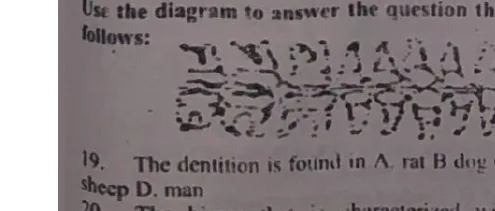
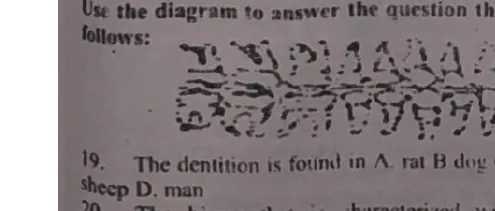
Use the diagram to answer the question that follows. The dentition is found in
A. ratB. dogC. sheepD. manCorrect Explanation The diagram shows the set of teeth in one half of the jaw; with 16 teeth per half-jaw, the full set totals 32 — the dentition of man.
The biome that is characterized with large herbivores, few and scattered fire-resistant trees is
A. savannaCorrect B. tropical rain forestC. montane forestD. desertExplanation The savanna biome is characterised by large herbivores and few, scattered fire-resistant trees.
The level of organization of Amoeba and Euglena cell is
A. organB. systemC. cellCorrect D. tissueExplanation Amoeba, Euglena, Chlamydomonas and Paramecium all exist at the cell level of organisation.
An example of insect that undergoes complete metamorphosis is
A. tickB. cockroachC. butterflyCorrect D. termiteExplanation Butterflies undergo complete metamorphosis (egg-larva-pupa-adult), while cockroaches and termites undergo incomplete metamorphosis.
Which of the following is an adaptation of grassland vegetation?
A. Ability to withstand long periods of droughtB. Possession of fewer tree branches bearing a large number of leavesCorrect C. Ability to maintain a high salt content in their cellsD. Possession of leaves that are large and leatheryExplanation Grassland (savanna) vegetation is characterised by widely-spaced trees with fewer branches bearing broad leaves.
Use the diagram (dentition, see earlier question) to answer the question that follows. The structure is adapted for
A. omnivoresCorrect B. herbivoresC. carnivoresD. omnivores and carnivoresExplanation As the dentition shown is that of man, it is adapted for an omnivorous diet.
The modification in structure, physiology and behaviour of plant and animal is called
A. adaptationCorrect B. evolutionC. variationD. successionExplanation Adaptation is the modification of structure, physiology and behaviour that helps an organism live successfully in its environment.
The protista that is a producer in an aquatic food chain is
A. TrypanosomeB. ParameciumC. ChlamydomonasCorrect D. AmoebaExplanation Chlamydomonas is autotrophic, possessing chlorophyll for photosynthesis, making it a producer in aquatic food chains.
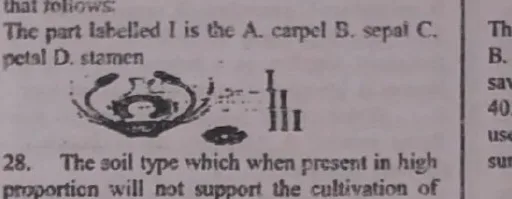
Use the diagram to answer the question that follows. The part labelled I is the
A. carpelCorrect B. sepalC. petalD. stamenExplanation The part labelled I (comprising stigma, style and ovary) is the carpel.
The soil type which, when present in high proportion, will not support the cultivation of vegetable is
A. humusB. loamC. siltD. clayCorrect Explanation A high proportion of clay produces poorly-drained, compact soil that does not favour vegetable cultivation.
Red blood cells are also known as
A. erythrocytesCorrect B. thrombocytesC. phagocytesD. leucocytesExplanation Red blood cells are known as erythrocytes; white blood cells are leucocytes and platelets are thrombocytes.
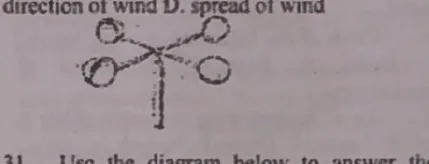
Use the diagram to answer the question that follows. The instrument is used to measure
A. atmospheric pressureB. relative humidityC. direction of windCorrect D. spread of windExplanation The instrument shown is a windvane, which measures the direction of the wind (an anemometer measures wind speed).
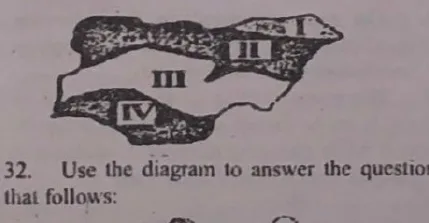
Use the diagram below to answer the question that follows. Epiphytic plants are more abundant in the part labelled
A. IVB. IIC. IIID. ICorrect Explanation The southern part of Nigeria (labelled I) is very rich in epiphytes due to its high rainfall and humidity.
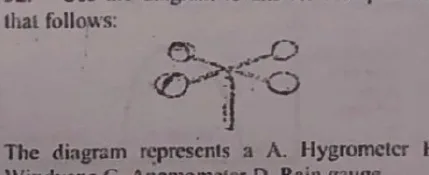
Use the diagram to answer the question that follows. The diagram represents a
A. HygrometerB. WindvaneCorrect C. AnemometerD. Rain gaugeExplanation The diagram represents a windvane, an instrument that shows the direction of the wind.
A bacteria that is spherically shaped is called
A. diplobacillusB. coccusCorrect C. bacillusD. vibrioExplanation Cocci bacteria are spherical/circular in shape; bacilli are rod-like, and vibrio are curved.
Which of the following is a characteristic of a fungus?
A. They all cause diseaseB. They are both saprophytic and parasiticCorrect C. They are all motileD. They reproduce only by sexual methodExplanation Fungi include both saprophytic species (living on dead matter) and parasitic species (living on living hosts).
When an ovary is placed on the receptacle above the other floral parts, it is referred to as
A. half inferior ovaryB. superior ovaryCorrect C. inferior ovaryD. half superior ovaryExplanation An ovary placed higher than other floral parts is a superior ovary; such a flower is described as hypogynous, e.g. Hibiscus.
Nephridium is a structure that removes waste product from the body of an
A. earthwormCorrect B. a cockroachC. a turtleD. an ostrichExplanation Nephridium is the excretory structure found in annelids such as the earthworm.
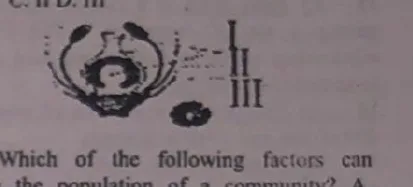
Use the diagram to answer the question that follows. The part that attracts insect for pollination is
A. IB. IVCorrect C. IID. IIIExplanation The petal is the part of the flower that attracts insects for pollination.
Which of the following factors can reduce the population of a community?
A. ImmigrationB. EdaphicC. PredationCorrect D. MutualismExplanation Predation reduces the population of a community by removing individuals through predator-prey interaction.
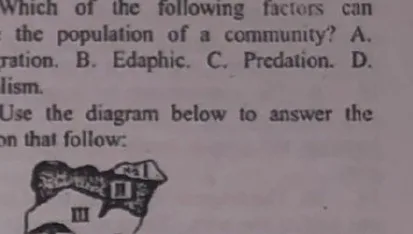
Use the diagram below to answer the question that follows. The part labelled is
A. tropical rainforestB. Sudan savannaC. Sahel savannaD. Guinea savannaCorrect Explanation The part labelled (III) on the vegetation map of Nigeria is the Guinea savanna.
The most efficient respiratory structure used by free-living protozoan is
A. body surfaceCorrect B. gillsC. buccal cavityD. spiracleExplanation Free-living protozoans respire efficiently through their body surface; fishes use gills, and amphibians use the buccal cavity.
Sign up free to unlock …and/or go further with premium services and No Ads .