Economics 2016 Objective — Question 1
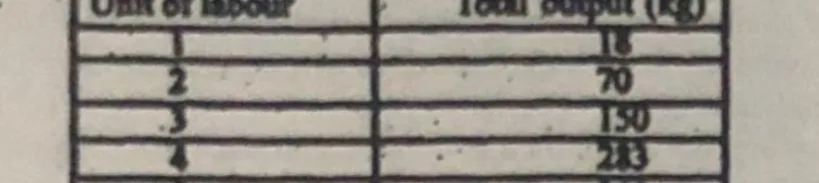
From the table above, the average product of the 3rd unit of labour is
- A. 50Correct
- B. 70
- C. 350
- D. 150
Explanation
A.P = Total output / Unit of labour. For the 3rd unit: 150/3 = 50kg.
All 40 questions from the Joint Admissions and Matriculation Board (JAMB) Economics 2016 Objective paper, with the correct answer and a full explanation for each. Free, no signup needed.
Advertisement
From the table above, the average product of the 3rd unit of labour is
A.P = Total output / Unit of labour. For the 3rd unit: 150/3 = 50kg.
Which of the following is an indicator of economic growth?
High GDP is one of the best indicators of growth; it reflects the economy's position better than other indicators like GNP.
Given that Qd = 10-2p while Qs=5x3p, if P=N1 determine the equilibrium quantity
Qd=10-2p, Qs=5x3p. With p=N1: Qd=10-2(1)=8, Qs=15; equilibrium quantity = 7.
The main determinant of a change in the quantity of a commodity demanded is the
The price of the commodity itself is the main determinant of quantity demanded; the other options affect demand generally, not quantity demanded directly.
Which of the following budgets will increase government expenditure?
A deficit budget (spending more than revenue) is used to increase aggregate expenditure in the economy.
Inflationary trends in an economy will negatively affect, majorly
Creditors are negatively affected by inflation because the value of money drops; debtors actually gain.
Which of the following is NOT a source of government revenue?
Personal income, disposable income and transfer earnings are sources of revenue TO individuals, not sources of government revenue.
From the table above, it can be inferred that there is
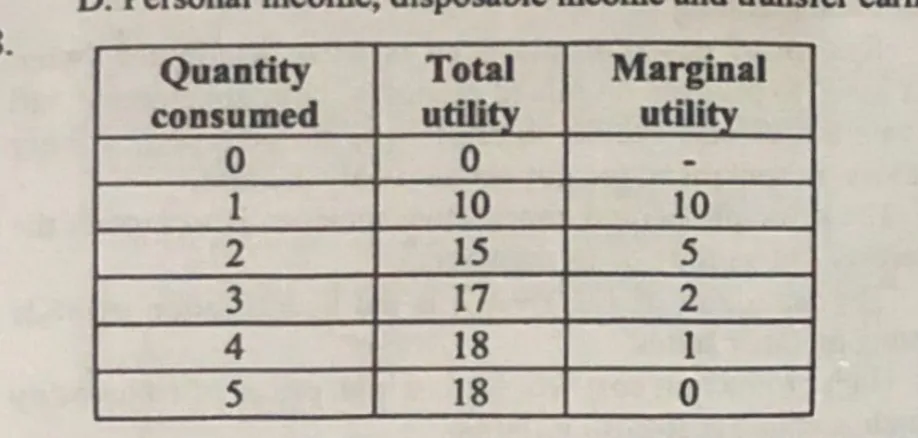
Diminishing marginal utility is shown in the table: as more units are consumed, each additional unit adds less satisfaction (clear from units 4 & 5).
One of the reasons why Nigeria is a mono-economy is because of her
Nigeria's huge dependence on petroleum activities is the major reason for her mono-economy situation.
The bowed shape of the Production Possibilities Curve illustrates
The bowed (concave) shape of the PPC reflects the law of increasing (marginal) cost - resources aren't perfect substitutes between goods.
A firm owned and managed by a family is an example of a
A business owned and managed by one family is classed as a sole proprietorship.
Determine the level of a nation's national income if government expenditure is N15, investment is N20, consumption is N25, output is N10, import 8 and MPC=0.82
N.I = C + I + G(X-M) = 25 + 20 + 15(10-8) = 25+20+30 = wait per given solution = 120 using the stated formula and figures.
One of the major causes of farmers'-unstable income in Nigeria is
Pest and disease infestation is one of the major causes of farmers' unstable income across Nigeria/Africa.
Given that X̄ = 7 and Σfx = 56, calculate the value of N
N = Σfx / x̄ = 56/7 = 8.
The graph above represents
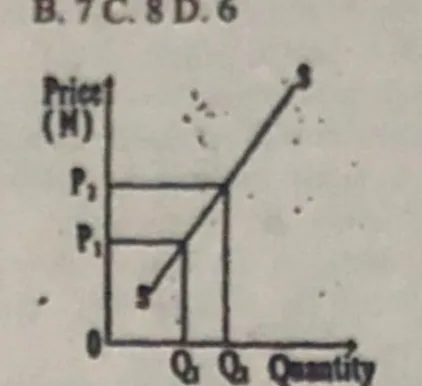
The graph shows price rising from P1 to P2 with a corresponding increase in quantity supplied from Q1 to Q2 - i.e. an increase in quantity supplied.
The appropriate formula for the computation of standard deviation of a grouped data is
The correct formula for standard deviation of grouped data is S = √(Σf(x-x̄)²/n).
A partnership sourcing for funds to expand its business would approach
Money market is the only option among those listed that grants funds directly to individuals or companies seeking finance.
Excess supply over demand will place a price advantage on
Excess supply over demand pushes prices down, which favours consumers and disadvantages suppliers.
Which of the following institutions operate in the money market?
Money deposit banks (e.g. commercial banks) belong to and operate within the money market.
The national income of a country can be measured by using
The output method is one of the three standard ways (alongside income and expenditure methods) used to measure national income.
Given a consumption function C = 10 + 0.6Y, determine the value of C if Y is 20
C = 10 + 0.6Y; with Y=20: C = 10 + 0.6(20) = 10+12 = 22.
The population theory that is concerned with the cases of over population and shortage of food production is
The Malthusian Population Theory deals with population growing geometrically while food supply grows arithmetically, causing food shortages.
The modal value of 3, 8,4,6,3,5,2,7,3 and 5 is
3 occurs most frequently (three times) in the data set, making it the mode.
Which of the factors of production is inelastic?
Land has a perfectly inelastic supply - its quantity cannot increase no matter how reward (rent) changes.
The production within domestic territory of a country is called the
Gross-domestic product measures the total value of goods/services produced within a country's domestic territory.
A well conducted census is important for
A well-conducted census provides accurate population data essential for economic planning.
The economic questions about what and how to produce in an economy is solely answered by the
The system of economy practiced (capitalist, socialist, mixed, etc.) determines what and how an economy produces.
The basic principle of cooperative societies is to
The core principle of cooperative societies is to protect the interests and welfare of their members.
The main aim of Economic Community of West African States is the
ECOWAS' main aim is the liberalization of trade among its member states.
Cost-push inflation occurs when
Cost-push inflation results from high production costs being passed on as higher prices.
Government proposed projects for 2013 fiscal year: I. Dam-Completed II. Road-Uncompleted III. Airport-Completed IV. Hospital-Uncompleted. From the information provided above, government opportunity cost would be
Based on the projects listed, only the Road and Hospital remain uncompleted - so the opportunity cost includes II and IV.
One of the unique features that distinguishes the perfect and imperfect market conditions is
The number of sellers and buyers is a key distinguishing feature between perfect and imperfect market structures.
A country's terms of trade can be improved by
Reducing demand for imported goods (e.g. via tariffs) helps improve a country's terms of trade.
One of the functions of the price system is that it
The price system regulates what is produced and consumed through the forces of demand and supply.
Petro-chemical industries are located in the Rivers State of Nigeria because of
Rivers State's crude oil deposits (a key raw material) is why petro-chemical industries are located there.
Goods sold in perfectly competitive markets are generally
Goods sold in perfectly competitive markets are homogeneous - identical in size, shape, and quality.
The storage of goods in order to derive more satisfaction in future is
Time utility refers to preserving/storing goods so they can satisfy needs in the future.
The most effective measure to reduce unemployment is to
Diversifying the economy creates the most job opportunities, making it the most effective way to reduce unemployment.
Which of the following is an indirect tax?
Excise duty is the only indirect tax among the listed options (others are direct taxes).
Localization of industry is encouraged because of
Localization of industries is encouraged where infrastructure (power, water, roads) has been improved.
Advertisement
…and/or go further with premium services and No Ads.