All 40 questions from the Joint Admissions and Matriculation Board (JAMB) Economics 2023 Objective paper, with the correct answer and a full explanation for each. Free, no signup needed.
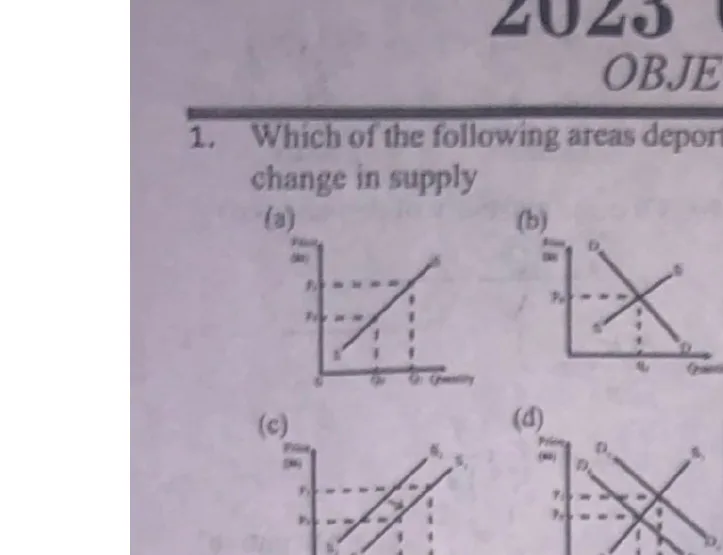
Which of the following graphs depicts a change in demand?
A. Graph AB. Graph BC. Graph CCorrect D. Graph DExplanation A change in demand (a shift of the whole demand curve, as opposed to a movement along it) is shown by the curve in option C.
Which of the following financial institutions creates more money?
A. Central bankB. Commercial bankCorrect C. Mortgage bankD. InsuranceExplanation Commercial banks create money mainly through the deposit and lending (credit creation) process, extending far beyond central bank currency issuance in an economy's day-to-day money creation.
Which of the following is not a measure of central tendency?
A. MeanB. MedianC. RangeCorrect D. None of the aboveExplanation Range is a measure of dispersion (spread), not central tendency; mean and median are measures of central tendency.
Cartel is a/an
A. OligopolisticCorrect B. MonopolisticC. duopolisticD. none of the aboveExplanation A cartel is a coming together of producers of a particular product to regulate output and prices, a feature of oligopolistic markets.
Deficit budget of the government will lead to
A. UnemploymentB. inflationCorrect C. deflation deficit balance of paymentD. None of the optionsExplanation A deficit budget means government spending exceeds its revenue, putting excess money in the hands of the people and leading to inflation.
Personal income tax is
A. ProgressiveCorrect B. repressiveC. proportionalD. excessiveExplanation Personal income tax is progressive because the rate paid increases as a person's income increases.
This graph depicts
A. Perfect competition marketB. oligopolistic marketC. imperfect competition marketCorrect D. duopolistic marketExplanation The graph shows AR ≠ MR (the AR/demand curve is separate from and above the MC/MR intersection), which is characteristic of an imperfect competition market.
In order to raise more revenue from taxes, government should tax goods that are
A. PlasticB. perfectly elasticC. perfectly inelasticCorrect D. unitary elasticExplanation Taxing a perfectly inelastic good does not reduce the quantity purchased when price rises, so government revenue from the tax is maximised.
If the marginal propensity to consume of an economy is 0.85, what is the multiplier?
A. 0.15B. 1/0.85C. 0.85/0.15D. 1/0.15Correct Explanation The multiplier = 1/(1−MPC) = 1/(1−0.85) = 1/0.15.
An economy in which private investors drive the major parameters can be regarded as
A. Mixed economyB. Capitalist economyCorrect C. Socialist economyD. Feudalistic economyExplanation In a capitalist economy, private investors and market forces (not the state) drive the major economic decisions.
Interest is the reward of
A. CapitalCorrect B. EntrepreneurC. landD. cardExplanation Interest is the reward paid to capital as a factor of production.
Which of the following countries is not a member of the Chad-Basin Commission?
A. NigeriaB. AlgeriaCorrect C. CameroonD. ChadExplanation The Chad Basin Commission comprises Nigeria, Niger, Cameroon and Chad; Algeria is not a member.
Which of the following tools can the CBN use to reduce money supply?
A. selling government securitiesCorrect B. buying government securitiesC. reducing reserve rateD. none of the aboveExplanation By selling government securities, the CBN withdraws cash from the economy, reducing money supply.
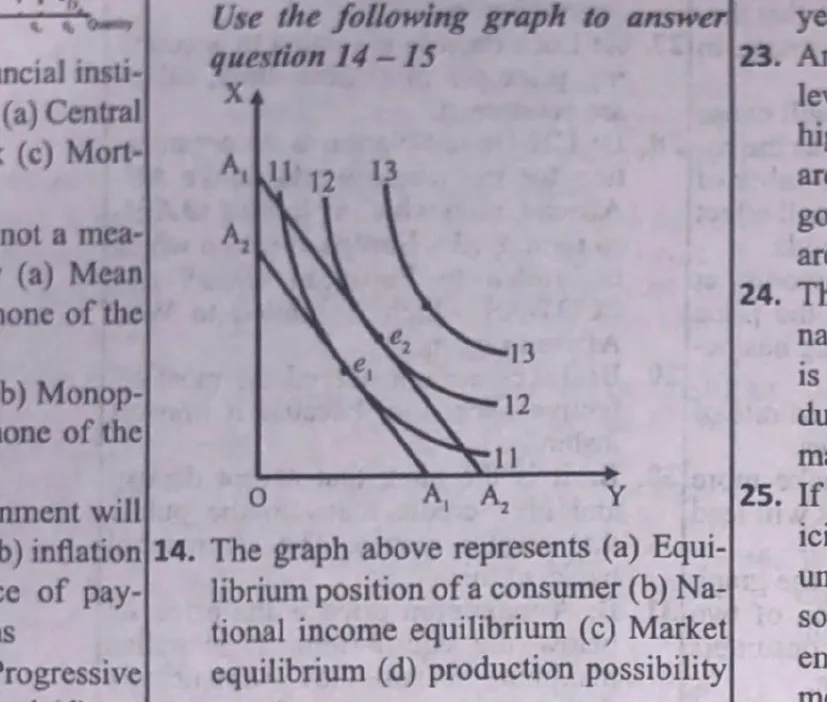
The graph above represents
A. Equilibrium position of a consumerCorrect B. National income equilibriumC. Market equilibriumD. production possibility curveExplanation The graph combines a budget line with indifference curves, showing the point where a consumer maximises satisfaction subject to their budget — the equilibrium position of a consumer.
To move the equilibrium point from e₁ to e₂, the
A. producer must produce moreB. consumer must increase his budget for X and YCorrect C. consumer and producer must add to their budgetsD. consumer must increase budget for XExplanation Moving to a higher indifference curve (from e₁ to e₂) requires the consumer to increase their budget for both X and Y, shifting the budget line outward.
The table depicts
A. Consumer's budgetB. demand scheduleCorrect C. supply scheduleD. producer's budgetExplanation The table shows quantity demanded falling as price rises (Price #50→Qty 1000; #70→800; #90→600; #110→400), which is a demand schedule.
The elasticity of demand is
A. 1.0B. 0.10C. 10D. 0.5Correct Explanation Using %change in quantity demanded ÷ %change in price (e.g. from the table, 20% ÷ 40%), the price elasticity of demand = 0.5.
It can be said that the goods is
A. perfectly elasticB. fairly inelasticCorrect C. perfectly inelasticD. unitary elasticExplanation Since the elasticity coefficient (0.5) is less than 1 but greater than 0, the demand for the good is fairly inelastic.
The total monetary value of goods produced by the citizens of an economy is referred to as
A. gross domestic productB. gross national productCorrect C. net national productD. net domestic productExplanation GNP is the total value of goods and services produced by the citizens of a country (wherever located) within a period.
The deliberate act of setting up firms close to each other is referred to as
A. agglomeration of firmsB. consolidation of firmsC. localization of firmsCorrect D. concentration of firmsExplanation Localization of firms is the deliberate effort of setting up firms in a particular locality, often to benefit from shared resources or infrastructure.
The act of selling a product at a lower price in a foreign country is regarded as
A. DumpingCorrect B. SubsidiesC. GrantsD. AidsExplanation Dumping is selling a product at a lower price abroad than in the domestic market, often below cost.
Population census is carried out every ____
A. 5 yearsB. 2 yearsC. 15 yearsD. 10 yearsCorrect Explanation In most countries, including Nigeria, a national population census is conducted every 10 years.
An economy is said to be at optimum level when
A. The citizens have the highest capital per headB. all persons are gainfully employedCorrect C. Prices of goods are lowestD. Prices of goods are highestExplanation An economy is at its optimum (full employment) level when all factors of production, including labour, are gainfully employed.
The major problem of computing the national income using the output approach is
A. incomplete recordsB. over-productionC. double countingCorrect D. unmarketed productExplanation Using the output approach, an input and its final product can both be counted, leading to double counting of national income.
If the government introduced new policies that lead to unemployment, such unemployment is regarded as
A. Seasonal unemploymentB. Structural unemploymentCorrect C. Cyclical unemploymentD. Frictional unemploymentExplanation Unemployment caused by changes in government policy (altering the structure of the economy) is structural unemployment.
The most stagnant factor of production is
A. LandCorrect B. labourC. capitalD. entrepreneurExplanation Land is fixed in supply and location, making it the most immovable (stagnant) factor of production.
The largest employer of labour in Nigeria is
A. Information TechnologyB. AgricultureCorrect C. BanksD. GovernmentExplanation Agriculture is the largest employer of labour in Nigeria and in much of the world.
Which of the following cannot be regarded as fiscal policy?
A. TaxB. government budgetC. CBN ratesCorrect D. government borrowingsExplanation Fiscal policy is a tool used by government to regulate the economy through taxation, budgets and borrowing. Since the CBN is an independent monetary authority, its rates are a monetary (not fiscal) policy tool.
ECOWAS was formed in
A. 1985B. 2023C. 1990D. 1975Correct Explanation ECOWAS (Economic Community of West African States) was formed on 28 May 1975 in Lagos, Nigeria.
The most important attribute of money is
A. acceptabilityB. scarcityC. recognisabilityCorrect D. divisibilityExplanation Money's most important attribute is that it can be easily recognized as money by all who use it.
An illegal way of not paying tax is referred to as tax
A. evasionCorrect B. avoidanceC. escapeD. reliefExplanation Illegally avoiding payment of tax (e.g. by falsifying records) is known as tax evasion, which is unlawful — unlike tax avoidance, which is a legal way of minimising tax liability.
World Health Organisation (WHO) is an organ of
A. United NationsCorrect B. African UnionC. European UnionD. American UnionExplanation The WHO is a specialized agency (organ) of the United Nations responsible for international public health.
The current director of the World Trade Organization (WTO) is
A. Okonjo IwealaCorrect B. Mamman TarabaC. Condoleezza RiceD. Traore MacaExplanation Ngozi Okonjo-Iweala is the Director-General of the World Trade Organization.
For a consumer to reach equilibrium, the price of the last unit consumed must equal its
A. Marginal costB. Marginal revenueC. Marginal utilityCorrect D. Max utilityExplanation A consumer reaches equilibrium where the price paid for the last unit equals the marginal utility derived from it (MUx = Px).
Given Qs=5P−2 and Qd=19−(1/4)P, the equilibrium price is
A. #20B. #22C. #10D. #4Correct Explanation Setting Qs=Qd: 5P-2 = 19-¼P. Solving gives 5¼P = 21, so P = #4.
Given Qs=5P−2 and Qd=19−(1/4)P, the equilibrium quantity is
A. 18 UnitsCorrect B. 20 UnitsC. 4 UnitsD. 10 UnitsExplanation Substituting the equilibrium price P=#4 into Qs=5P-2 gives Qs=5(4)-2=18 units (which also satisfies Qd).
Given Qs=5P−2 and Qd=19−(1/4)P, at what value of P will Qs = 23 units?
A. #4B. #2C. #6D. #5Correct Explanation Setting Qs=23: 23=5P-2, so 5P=25, giving P=#5.
An anticipated increase in price will lead to
A. Abnormal demandCorrect B. Normal demandC. Ostentation demandD. carelessnessExplanation When consumers anticipate a future price increase, they tend to buy more now, a pattern known as abnormal demand.
One of the following is a better indicator of economic development
A. increased GDPB. increased per capita incomeC. improved health servicesCorrect D. higher growth rateExplanation Economic development is a sustained improvement in the quality of life for citizens; improved health services reflect that better than purely monetary measures like GDP or growth rate.
The headquarters of ECOWAS is located in
A. AbujaCorrect B. LagosC. Addis AbabaD. AccraExplanation The headquarters of ECOWAS is located in Abuja, Nigeria.
Sign up free to unlock …and/or go further with premium services and No Ads .