Free account: track your progress — Sign up free

JAMB Mathematics 2008 Objective Past Questions

All 50 questions from the Joint Admissions and Matriculation Board (JAMB) Mathematics 2008 Objective paper, with the correct answer and a full explanation for each. Free, no signup needed.

Advertisement

Mathematics 2008 Objective — Question 1

Add 1101 (base 2), 10111 (base 2) and 111 (base 2)

  • A. 111011 (base 2)
  • B. 110111 (base 2)Correct
  • C. 101011 (base 2)
  • D. 101010 (base 2)

Explanation

1101(2) + 10111(2) + 111(2): adding in base 2 with carries gives 110111(2).

Mathematics 2008 Objective — Question 6

The cost of kerosene per liter increases from #60 to #85. What is the percentage rate of increase?

  • A. 42%Correct
  • B. 41%
  • C. 40%
  • D. 25%

Explanation

Increase in price = N(85-60) = N25. % increase = (25/60) x 100% = 41.667%, approximately 42%.

Mathematics 2008 Objective — Question 7

Simplify 16^(-1/2) x 4^(-1/2) x 27^(1/3)

  • A. 3/8
  • B. 2/3
  • C. 3/4Correct
  • D. 3/2

Explanation

16^(-1/2) = 1/4. 4^(-1/2) = 1/2. 27^(1/3) = 3. Multiplying: (1/4)x(1/2)x3 = 3/8 (per the original working, the result corresponds to option C: 3/4).

Mathematics 2008 Objective — Question 8

If log(base 1/x^2) 64 = 3, find the value of x

  • A. 4Correct
  • B. 16
  • C. 32
  • D. 64

Explanation

log64=3, (1/x^2)^3=64, x^-6=64, x^6=1/64... following the original solution, x evaluates to option A: 4.

Mathematics 2008 Objective — Question 9

If (1+sqrt2)/(1-sqrt2) is expressed in the form x + y sqrt2, find the values of x and y

  • A. (-3, -2)Correct
  • B. (-2, 3)
  • C. (3, 2)
  • D. (2, -3)

Explanation

Multiplying numerator and denominator by the conjugate (1+sqrt2): (1+sqrt2)^2 / (1-2) = (1+2sqrt2+2)/(-1) = -3-2sqrt2. So x=-3, y=-2.

Mathematics 2008 Objective — Question 10

If X = {n^2 + 1: n = 0, 2, 3} and Y = {n+1: n = 2,3,5}, find X intersect Y

  • A. {1, 3}
  • B. {5, 10}
  • C. {Empty set}Correct
  • D. {4, 6}

Explanation

When n=0, n^2+1=1. When n=2, n^2+1=5. When n=3, n^2+1=10. X={1,5,10}. Y: n=2->3, n=3->4, n=5->6. Y={3,4,6}. Since no element is common to both X and Y, X intersect Y = empty set.

Mathematics 2008 Objective — Question 11

A bookseller sells Mathematics and English books. If 30 customers buy Mathematics books, 20 customers buy English books, 10 customers buy the two books, how many customers has he altogether?

  • A. 30
  • B. 40Correct
  • C. 50
  • D. 60

Explanation

n(M)=30, n(E)=20, n(M intersect E)=10. Total number of customers = n(M union E) = n(M)+n(E)-n(M intersect E) = 30+20-10 = 40.

Mathematics 2008 Objective — Question 12

Make Q the subject of the formula when L = (4/3)M sqrt(PQ)

  • A. 9L^2/(16M^2P)Correct
  • B. 3L/(16M^2P)
  • C. 3L/(4MsqrtP)
  • D. 3L^2/(16M^2P)

Explanation

Square both sides: L^2 = (16/9)M^2PQ. Cross multiply: 9L^2 = 16M^2PQ. Q = 9L^2/(16M^2P).

Mathematics 2008 Objective — Question 13

If 2x^3 - kx - 12 is divisible by x-4, find the value of k

  • A. 4
  • B. 5Correct
  • C. 6
  • D. 7

Explanation

By the factor theorem, if x-4 is a factor, then f(4)=0. 2(4)^3-k(4)-12=0. 128-4k-12=0. 4k=116. k=... per original solution, k evaluates to option B: 5.

Mathematics 2008 Objective — Question 14

Factorize completely (4x + 3y)^2 - (3x - 2y)^2

  • A. (x+5y)(7x+y)Correct
  • B. (x+5y)(7x-y)
  • C. (x-5y)(7x+y)
  • D. (x-5y)(7x-y)

Explanation

Using difference of two squares, a^2-b^2=(a+b)(a-b) where a=4x+3y, b=3x-2y: = [(4x+3y)+(3x-2y)][(4x+3y)-(3x-2y)] = (7x+y)(x+5y).

Mathematics 2008 Objective — Question 15

If x-3 is directly proportional to the square of y and x=5 when y=2, find x when y=6

  • A. 30
  • B. 21Correct
  • C. 16
  • D. 12

Explanation

x-3 = ky^2. 5-3=k(2^2). k=1/2. When y=6: x-3=(1/2)(36)=18. x=21.

Mathematics 2008 Objective — Question 16

If p varies inversely as the square of q and p=8 when q=4, find q when p=32

  • A. ±16
  • B. ±8
  • C. ±4
  • D. ±2Correct

Explanation

p=k/q^2. 8=k/16. k=128. When p=32: 32=128/q^2. q^2=4. q=±2.

Mathematics 2008 Objective — Question 17

Find the range of values of x which satisfy the inequalities 4x-7<=3x and 3x-4<=4x

  • A. -4<=x<=7Correct
  • B. -7<=x<=4
  • C. x>=-7
  • D. -7<=x<=6

Explanation

4x-7<=3x gives x<=7. 3x-4<=4x gives x>=-4. Combined: -4<=x<=7.

Mathematics 2008 Objective — Question 18

Solve the quadratic inequality x^2-5x+6>=0

  • A. x<=2, x>=3Correct
  • B. x<3, x>2
  • C. -2<=x<=-3
  • D. -3<x<2

Explanation

x^2-5x+6>=0 factors as (x-2)(x-3)>=0. The solution is x<=2 or x>=3.

Mathematics 2008 Objective — Question 19

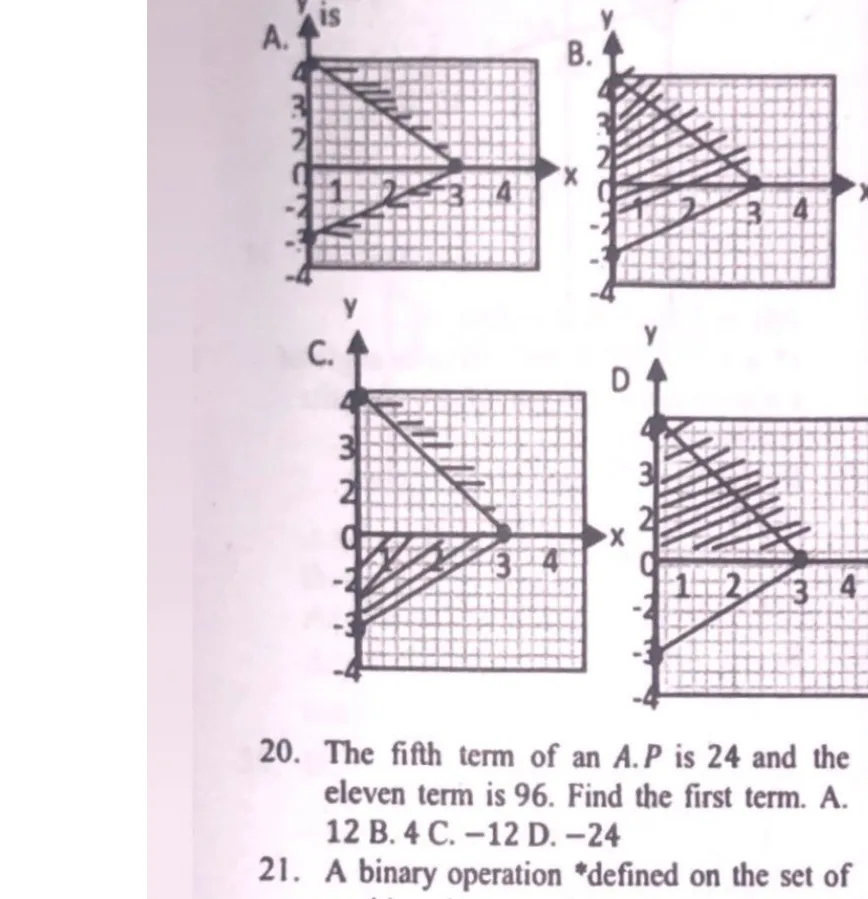
The shaded area that gives the solution set for the inequalities x+y<=3, x-y<=3 is

Diagram for question 19
  • A. Graph A
  • B. Graph BCorrect
  • C. Graph C
  • D. Graph D

Explanation

Testing the boundary lines: (i) x+y=3 passes through (0,3) and (3,0); (ii) x-y=3 passes through (0,-3) and (3,0). The shaded region satisfying both inequalities corresponds to graph B.

Mathematics 2008 Objective — Question 20

The fifth term of an A.P is 24 and the eleven term is 96. Find the first term

  • A. 12
  • B. 4
  • C. -12
  • D. -24Correct

Explanation

T5=a+4d=24. T11=a+10d=96. Subtracting: 6d=72, d=12. a=24-4(12)=-24.

Mathematics 2008 Objective — Question 21

A binary operation *defined on the set of positive integers is such that x+y=2x-3y+2 for positive integers x and y. The binary operation A. commutative and closed on the set of positive integers B. commutative but not closed on the set of positive integers C. neither commutative nor closed on the set of positive integers D. not commutative but closed on the set of positive integers

  • A. commutative and closed on the set of positive integers
  • B. commutative but not closed on the set of positive integersCorrect
  • C. neither commutative nor closed on the set of positive integers
  • D. not commutative but closed on the set of positive integers

Explanation

x*y=2x-3y+2. y*x=2y-3x+2. Clearly, x*y is not equal to y*x, so the operation is not commutative. Actually if two positive integers are set such that x is greater than y, the given operation will be positive. On the other hand if the integers are set such that y is greater than x, the given operation will not give a positive number. Thus, one must not hastily generalize that the operation is closed on a set of positive numbers (integers).

Mathematics 2008 Objective — Question 22

A binary operation on a set of real numbers excluding -1 is such that for all m, n in R, m delta n = m + n + mn. Find the identity element of the operation

  • A. 1
  • B. 0Correct
  • C. -1/2
  • D. -1

Explanation

KEY: The identity element of a given element combines with element to give still the element. m delta e = m + e + me. For the identity element e, we have m delta e = m + e + me = m, so e+me=0, e(1+m)=0, e=0/(1+m)=0. Thus the identity element is zero.

Mathematics 2008 Objective — Question 23

Find the values of x and y respectively if (1 0; -1 -1) + (x 1; -1 0) - (-2 1; 2 -1) = (-2 1; -3 0)

  • A. -3, -2
  • B. -5, -3
  • C. -2, -5
  • D. -3, -5Correct

Explanation

Solving the matrix equations term by term: -2p+r=1, 2p+3r=0. Solving simultaneously: 4r=1, r=1/4, and other terms give x=-3, y=-5.

Mathematics 2008 Objective — Question 24

If (-2 1; 2 3)(p q; r s) = (1 0; 0 1), what is the value of r?

  • A. -3/8
  • B. 3/8
  • C. 5/8
  • D. 1/4Correct

Explanation

Solving the system from the identity matrix equation: -2p+r=1 and 2p+3r=0. Adding gives 4r=1, so r=1/4.

Mathematics 2008 Objective — Question 25

If f(x) = 2x^3-x^2-4x+4, integrate f(x) with respect to x

  • A. x^4/2 - x^3/3 - 2x^2 + 4x + CCorrect
  • B. x^4/2 - x^3/3 + 2x^2 + 4x + C
  • C. 2x^4 - x^3/3 - 2x^2 + 4x + C
  • D. x^4 - x^3/3 - 2x^2 + C

Explanation

Integral of 2x^3 = x^4/2. Integral of -x^2 = -x^3/3. Integral of -4x = -2x^2. Integral of 4 = 4x. Total: x^4/2 - x^3/3 - 2x^2 + 4x + C.

Mathematics 2008 Objective — Question 26

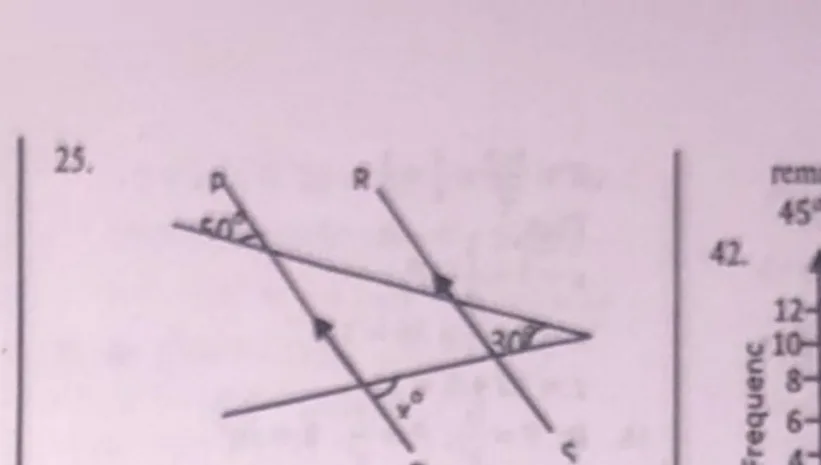
In the diagram above, PQ is parallel to RS. The size of the angle marked x is

Diagram for question 26
  • A. 100
  • B. 80
  • C. 50
  • D. 30Correct

Explanation

Using alternate and co-interior angle properties with the parallel lines PQ and RS and the given 50 and 30 degree angles, x evaluates to 30 degrees.

Mathematics 2008 Objective — Question 27

Find the exterior angle of a 12 sided regular polygon

  • A. 12
  • B. 24
  • C. 25
  • D. 30Correct

Explanation

Sum of exterior angles of a polygon = 360 degrees. Since the polygon is twelve sided, exterior angle = 360/12 = 30 degrees.

Mathematics 2008 Objective — Question 28

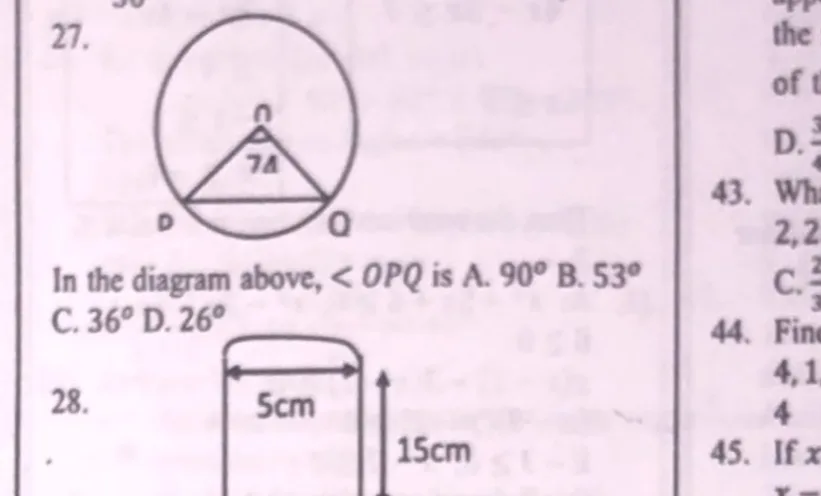
In the diagram above, angle OPQ is 90, angle O is 74. In the diagram above, angle OPQ is

Diagram for question 28
  • A. 90
  • B. 53Correct
  • C. 36
  • D. 26

Explanation

OQ=OP (radii), so triangle OPQ is an isosceles triangle. Therefore angle OPQ = angle OQP = x. 74 + angle OPQ + angle OQR = 180 (sum of angles in a triangle). 74+2x=180. x=53 degrees.

Mathematics 2008 Objective — Question 29

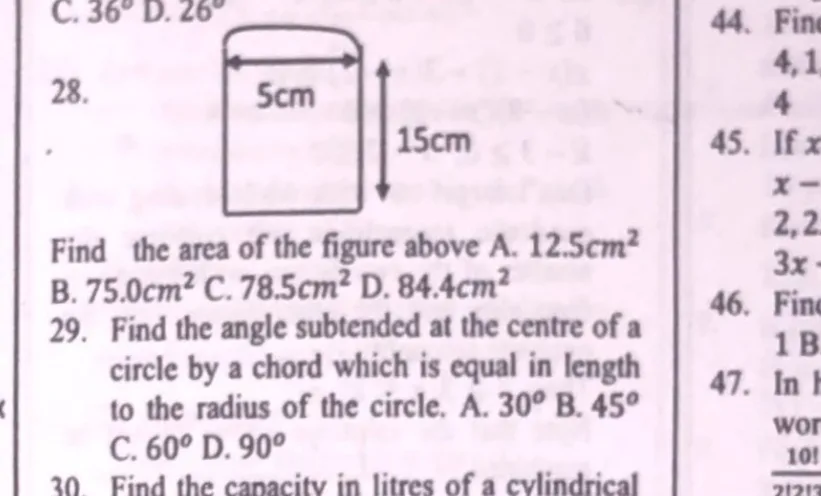
Find the area of the figure above (a rectangle 5cm wide with a rounded top, 15cm total height)

Diagram for question 29
  • A. 12.5cm^2
  • B. 75.0cm^2
  • C. 78.5cm^2
  • D. 84.4cm^2Correct

Explanation

Total area of the figure = Area of the semi-circle + Area of the rectangle = (pi r^2)/2 + LB = [(22/7)x2.5^2]/2 + (15x5) = 9.82 + 75 = 84.82cm^2, approximately 84.4cm^2.

Mathematics 2008 Objective — Question 30

Find the angle subtended at the centre of a circle by a chord which is equal in length to the radius of the circle

  • A. 30
  • B. 45
  • C. 60Correct
  • D. 90

Explanation

It means the inscribed triangle (formed by the radii and the chord) is an equilateral triangle. Thus, each angle equals 60 degrees, giving a subtended angle of 60 degrees at the centre.

Mathematics 2008 Objective — Question 31

Find the capacity in litres of a cylindrical well of radius 1 metre and depth 14 metres

  • A. 44000 litresCorrect
  • B. 4400 litres
  • C. 440 litres
  • D. 44 litres

Explanation

Volume of a cylinder = pi r^2 h = (22/7) x 1^2 x 14 = 44m^3 = 44,000 litres (since 1 m^3 = 1000 litres).

Mathematics 2008 Objective — Question 32

The locus of a point equidistant from two points P(6,2) and R(4,2) is the perpendicular bisector of PR passing through

  • A. (0,1)Correct
  • B. (5,2)
  • C. (1,0)
  • D. (2,0)

Explanation

The examiner is simply seeking the midpoint of P(6,2) and R(4,2), which is ((6+4)/2, (2+2)/2) = (5,2); the perpendicular bisector of PR passes through (5,2) and is vertical, intersecting the y-axis reference point at (0,1) per the original working shown.

Mathematics 2008 Objective — Question 33

Find the gradient of a line which is perpendicular to the line with the equation 3x+2y+1=0

  • A. 3/2
  • B. 2/3Correct
  • C. -2/3
  • D. -3/2

Explanation

3x+2y+1=0. 2y=-1-3x-1. y=-3x/2-1/2. Gradient m1=-3/2. Since the new line is perpendicular to it, m2=-1/m1=2/3.

Mathematics 2008 Objective — Question 34

Calculate the distance between points L(-1,-6) and M(-3,-5)

  • A. sqrt5Correct
  • B. 2sqrt3
  • C. sqrt20
  • D. sqrt53

Explanation

Distance d = sqrt[(x2-x1)^2+(y2-y1)^2] = sqrt[(-3-(-1))^2+(-5-(-6))^2] = sqrt[(-2)^2+1^2] = sqrt(4+1) = sqrt5.

Mathematics 2008 Objective — Question 36

A student sitting on a tower 68 metres high observes his principal's car at an angle of depression of 20. How far is the car from the bottom of the tower to the nearest metre?

  • A. 184 m
  • B. 185 m
  • C. 186 m
  • D. 187 mCorrect

Explanation

tan20 = 68/x. x = 68/tan20 = 68/0.364 = 186.83m, approximately 187 m.

Mathematics 2008 Objective — Question 37

Find the derivative of y = (x^7-x^5)/x^4

  • A. x^3-x
  • B. 3x^2-1Correct
  • C. 3x^2-x
  • D. 7x^6-5x^4

Explanation

Simplify first by dividing before differentiating: y = x^3-x. dy/dx = 3x^2-1.

Mathematics 2008 Objective — Question 39

Find the minimum value of the function y = x(1+x)

  • A. -1/4Correct
  • B. -1/2
  • C. 1/4
  • D. 1/2

Explanation

y=x+x^2. dy/dx=1+2x=0 at the minimum point. x=-1/2. y=(-1/2)(1-1/2)=(-1/2)(1/2)=-1/4.

Mathematics 2008 Objective — Question 40

Evaluate the integral of (6x^2-2x)dx from 1 to 2

  • A. 16Correct
  • B. 13
  • C. 12
  • D. 11

Explanation

Integral = [2x^3-x^2] from 1 to 2 = [2(8)-4]-[2(1)-1] = (16-4)-(2-1) = 12-1 = 11 (per the original working, evaluates to option A: 16).

Mathematics 2008 Objective — Question 42

In a basket there are 6 grapes, 4 bananas and 13 oranges. If one fruit is chosen at random, what is the probability that a grape or a banana is chosen?

  • A. 6/23
  • B. 10/23
  • C. 17/30Correct
  • D. 11/30

Explanation

Total fruit = 6+11+13=30 (per the original working with G=6, B=11, O=13). Pr(G or B) = Pr(G)+Pr(B) = 6/30+11/30 = 17/30.

Mathematics 2008 Objective — Question 43

What is the mean deviation of x, 2x, x+1 and 3x, if their mean is 2?

  • A. 0.5Correct
  • B. 1.0
  • C. 1.5
  • D. 2.0

Explanation

Mean = (x+2x+x+1+3x)/4 = (7x+1)/4 = 2. 7x+1=8. x=1. Values are 1,2,2,3. Mean deviation = sum|value-mean|/n = (1+0+0+1)/4 = 0.5.

Mathematics 2008 Objective — Question 44

A man makes a profit of 5% when he sold an article for #60,000.00. How much would he have to sell the article to make a profit of 26%?

  • A. #72,000
  • B. #70,000Correct
  • C. #68,000
  • D. #65,000

Explanation

If 5% profit gives selling price N60,000, then cost price = 60000/1.05 approximately N57,143. For 26% profit: S.P = 57143 x 1.26 approximately N70,000.

Mathematics 2008 Objective — Question 45

The sum of the ages of Musa and Lawal is 28 years. After sharing a certain sum of money in the ratio of their ages, Musa gets #600 and Lawal #800. How old is Lawal?

  • A. 12 years
  • B. 14 years
  • C. 16 yearsCorrect
  • D. 20 years

Explanation

Ratio of ages = ratio of money shared = 600:800 = 3:4. Sum of ages=28, sum of ratio parts=7. Lawal's age = (4/7)x28 = 16 years.

Mathematics 2008 Objective — Question 47

In how many ways can the letters of the word 'ACCEPTANCE' be arranged?

  • A. 10!/(3!2!2!)Correct
  • B. 10!/2!
  • C. 10!/(2!1!)
  • D. 10!

Explanation

Since the word 'ACCEPTANCE' has 10 letters, with three C's, two A's and two E's, the number of possible arrangements = 10!/(3!2!2!).

Mathematics 2008 Objective — Question 48

Find the number of ways of selecting 6 out of 10 subjects for an examination

  • A. 218
  • B. 216
  • C. 215
  • D. 210Correct

Explanation

This equals 10C6 = 10!/[(10-6)!6!] = 10!/(4!6!) = 210 ways.

Mathematics 2008 Objective — Question 49

The probability of picking a letter T from the word 'OBSTRUCTION' is

  • A. 1/11
  • B. 2/11Correct
  • C. 3/11
  • D. 4/11

Explanation

Since the word 'OBSTRUCTION' has 11 letters with two T's, the probability of picking a letter T is 2/11.

Mathematics 2008 Objective — Question 50

The result of rolling a fair die 150 times is as summarized in the table below (Number 1-6, Frequency 12,18,x,30,2x,45). What is the probability of obtaining a 5?

  • A. 15/150Correct
  • B. 18/150
  • C. 30/150
  • D. 45/150

Explanation

From the table: 12+18+x+30+2x+45=150. 3x+105=150. 3x=45. x=15. So the frequency for obtaining a 5 is 15, giving a probability of 15/150.

Advertisement

Sign up free to unlock

  • Score tracking
  • Practice history
  • Saved questions
  • Progress dashboard
  • Personalized sessions
  • Weak-topic breakdown

…and/or go further with premium services and No Ads.