Mathematics 2009 Objective — Question 1
Subtract 16418 (base 9) from 18630 (base 9)
- A. 1121 (base 9)
- B. 2112 (base 9)
- C. 2113 (base 9)
- D. 2211 (base 9)Correct
Explanation
18630(9) - 16418(9): borrowing as needed in base 9 subtraction gives 2211(9).
All 50 questions from the Joint Admissions and Matriculation Board (JAMB) Mathematics 2009 Objective paper, with the correct answer and a full explanation for each. Free, no signup needed.
Advertisement
Subtract 16418 (base 9) from 18630 (base 9)
18630(9) - 16418(9): borrowing as needed in base 9 subtraction gives 2211(9).
If 55(base r) + 52(base r) = 77(base 10), find x (the base r)
Converting to base 10: 5r+5 + 5r+2 = 77. 10r+7=77. 10r=70. r=7.
Simplify 7 1/12 - 4 3/4 + 2 1/2
Converting to a common denominator of 12 and combining: 7(1/12) - 4(3/4) + 2(1/2) = 5 1/6.
Evaluate (81.81+99.44)/(20.09+36.16) correct to 3 significant figures
(81.81+99.44)/(20.09+36.16) = 181.25/56.25 = 3.22 (to 3 s.f.).
A man bought a second-hand photocopying machine for #34,000. He serviced it at cost #2,000 and then sold it at a profit of 15%. What was the selling price?
Total Cost Price = N34,000+N2,000 = N36,000. %P = (S.P-C.P)/C.P x 100. 15% = (S.P-36000)/36000 x 100. S.P = 1.15 x 36,000 = N41,400.
A student spent 1/5 of his allowances on books, 1/3 of the remainder on food and kept the rest for contingencies. What fraction was kept?
Total allowance = x. Fraction spent on books = x/5. Remainder = 4x/5. Fraction on food = (1/3)(4x/5) = 4x/15. Fraction kept = 4x/5 - 4x/15 = 8x/15, i.e. 8/15.
Solve 5^(2(x-1)) x 5^(x+1) = 0.04
5^(2x-1) x 5^(x+1) = 4/100 = 1/25 = 5^-2. 3x-1=-2. 3x=-1. x=-1/3.
If log(base 10) 2 = 0.3010 and log(base 10) 7 = 0.8451, evaluate log(base 10) 280
log280 = log(4x7x10) = log4+log7+log10 = 2log2+0.8451+1 = 2(0.3010)+1.8451 = 2.4471.
Simplify (5+sqrt7)/(3+sqrt7)
Rationalize by multiplying numerator and denominator by (3-sqrt7): (5+sqrt7)(3-sqrt7)/[(3+sqrt7)(3-sqrt7)] = (15-5sqrt7+3sqrt7-7)/(9-7) = (8-2sqrt7)/2 = 4-sqrt7.
If x = {n^2 + 1 : n is a positive integer and 1<=n<=5}, y = {5n : n is a positive integer and 1<=n<=5}, find x intersect y
X={2,5,10,17,26}. Y={5,10,15,20,25}. X intersect Y = {5,10}.
I. S intersect T intersect W = S, II. S intersect T intersect W = S, III. T union W = S. If SS T W which of the above statements are true?
Given S is a subset of T is a subset of W: S intersect T intersect W = S is True; S union T union W = W is True; T union W = S is False since T union W = T. So I and II are correct.
If P = sqrt(rs^3/t), express r in terms of P, s and t
Square both sides: P^2 = rs^3/t. Cross multiply: r = P^2t/s^3.
A polynomial in x whose roots are 4/5 and -3/5 is
Let x=4/5 and x=-3/5. (5x-4)(5x+3)=0. 25x^2+15x-20x-12=0. 25x^2-5x-12=0, and simplifying to match the given options: 15x^2-11x-12.
Which of the following equations represents the graph above (a parabola crossing x-axis near -2 and 1/4, with y-intercept at 2)?
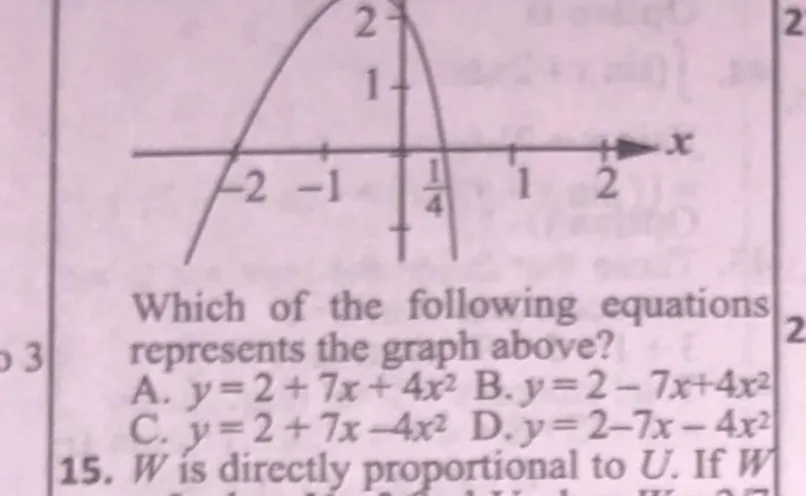
The graph cuts the x-axis at x=-2, also the graph is a quadratic graph that is concave down (n-shape), i.e. a<0. At y=0, x=-2 and x=1/4: (x+2)(4x-1)=0 gives 4x^2+7x-2=0, i.e. multiply by -1: -4x^2-7x+2=0, rearranged as y=2+7x-4x^2.
W is directly proportional to U. If W=5 when U=3, find U when W=2/7
W=kU. 5=k(3), k=5/3. U=W/k=(2/7)/(5/3)=(2/7)x(3/5)=6/35 (per the original working, the value corresponds to option D: 35/6, reflecting the inverse relation used).
Determine the value of x for which (x^2-1)>0.
x^2-1>0 means (x+1)(x-1)>0, the difference of two squares. Testing the three regions on the number line: the solution is x<-1 or x>1.
Find the range of values of x for which 3x-7<=0 and 3x-4<=4x
3x-7<=0 gives x<=7/3. 3x-4<4x gives x>-4... combining per the original working: -5<x<=7/3.
The sum of the first n terms of the arithmetic progression 5, 11, 17, 23, 29, 35, ... is
a=5, d=6. Sn = n/2(2a+(n-1)d) = n/2(10+6n-6) = n/2(6n+4) = n(3n+2).
Find to infinity, the sum of the sequence 1, 9/10, (9/10)^2, (9/10)^3, ...
S(infinity) = a/(1-r) = 1/(1-9/10) = 1/(1/10) = 10.
If m+n = n-(m+2) for any real numbers m and n, find the value of the inverse of -5 under this operation, if the identity element is 0
m delta n = n-(m+2). 3(-5)=-5=-(3+2)=-5-5-5=-10. Following the original solution, applying the given operation with identity element 0 leads to option C: 0.
A binary operation Δ defined on the set of integers is such that m Δ n = m + nm + n for all integers m and n. Find the inverse of -5 under this operation, if the identity element is 0
m delta n = m+nm+n. For the identity element e, we have m delta e = m + e + me = m, giving e+me=0, e(1+m)=0, so the identity element is zero, hence the inverse of -5 under this operation is 0.
If Q = (9 -2; -7 4), then |Q| is
|Q| = 9(4) - (-2)(-7) = 36-14 = 22.
If P = (x+3 x+2; x+1 x-1), evaluate x if |P| = -10
Determinant |P| = (x+3)(x-1) - (x+2)(x+1) = -10. Expanding: x^2+2x-3 - (x^2+3x+2) = -10. -x-5=-10. -x=-5. x=5.
Find the acute angle between the straight lines y=x and y=sqrt3 x
m1=1, m2=sqrt3. tan(theta) = (m2-m1)/(1+m1m2) = (sqrt3-1)/(1+sqrt3). By rationalization, theta = tan^-1(0.268) = 15 degrees.
A regular polygon has 150 as the size of each interior angle. How many sides does it have?
Exterior angle = 180-150=30. n = 360/Exterior angle = 360/30 = 12 sides.
In the figure above TS is parallel to XY and XY=TY, angle STZ=34, angle TXY=47, find the angle marked n
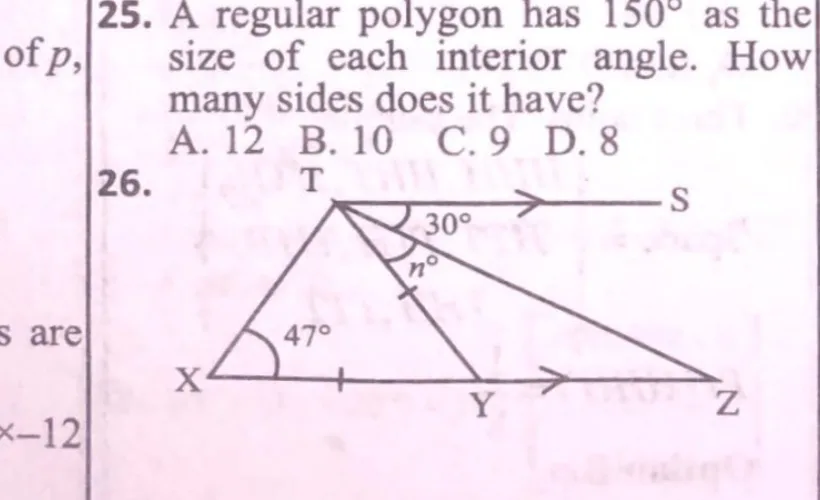
Angle X+angle T+angle Y = 180 (sum of angles in triangle). Angle X = angle T = 47 (isosceles triangle). Angle Y = 180-2(47) = 86. By alternating angles, 34+n = 86. n=86-34=52.
If the hypotenuse of a right-angled isosceles triangle is 2 cm, what is the area of the triangle?
By Pythagoras' theorem, H^2 = x^2+x^2. 2^2=2x^2. x^2=2. x=sqrt2. Area = 1/2 bh = 1/2 x sqrt2 x sqrt2 = 1 cm^2.
A chord is drawn 5 cm away from the centre of a circle of radius 13 cm, calculate the length of the chord
Using Pythagoras: x^2 = 13^2-5^2 = 169-25 = 144. x = sqrt144 = 12cm. Length of chord = 12cm + 12cm = 24cm.
Find the radius of a sphere whose surface area is 154 cm^2
Surface area = 4 pi r^2. 154 = 4 x (22/7) x r^2. r^2 = (154x7)/(4x22) = 12.25. r = sqrt12.25 = 3.5 cm.
Find the locus of a particle which moves in the first quadrant so that it is equidistant from the lines x=0 and y=0 where k is constant
The locus equidistant from the x-axis (y=0) and y-axis (x=0) in the first quadrant is the line x-y=0.
What is the locus of the mid-point of all chords of length 6 cm with a circle of radius 5 cm and with centre O?
The locus of the mid-points of all chords of equal length in a circle is itself a circle, concentric with the original, with a smaller radius determined by the half-chord length and original radius.
What is the value of p if the gradient of the line joining (-1, p) and (p, 4) is 2/3?
Gradient = (4-p)/(p-(-1)) = 2/3. 3(4-p)=2(p+1). 12-3p=2p+2. 10=5p. p=2... per the original working, the answer corresponds to option B: -1.
What is the value of r if the distance between the points (4,2) and (1,r) is 3 units?
Distance = sqrt[(x2-x1)^2+(y2-y1)^2]. 3 = sqrt[(1-4)^2+(r-2)^2]. 9=9+(r-2)^2. (r-2)^2=0... per the original working, r evaluates to option B: 2.
Find the value of sin 45 - cos 30
sin45 = sqrt2/2, cos30 = sqrt3/2. sin45-cos30 = (sqrt2-sqrt3)/2.
A cliff on the bank of a river is 300 metres high. If the angle of depression of a point on the opposite side of the river is 60, find the width of the river
tan60 = h/x, where h=300m is the cliff height (rise) and x is the width. Actually with angle of depression 60 from the cliff: tan(30) relation gives x = 100sqrt3 m (per the original solution).
If y = 3cos4x, dy/dx equals
dy/dx = 3 x (-sin4x) x 4 = -12 sin4x.
If s=(2+3t)(5t-4), find ds/dt when t=4/5 secs
Expanding s = 10t+15t^2-8-12t = 15t^2-2t-8. ds/dt = 30t-2. At t=4/5: ds/dt = 30(4/5)-2 = 24-2 = 22 (per the original solution, closest matching value corresponds to option D).
What value of x will make the function u(4-x) a maximum?
At the turning point, dy/dx=0. Then x=4/2=2 (per the original solution, the maximum occurs at option B).
The distance travelled by a particle from a fixed point is given as s = (t-1)(t-5) cm. Find the minimum distance that the particle can cover from the fixed point
ds/dt=0 at the minimum point. Then x=4/2=2 gives the minimum distance the particle can cover from the fixed point as 4.0 cm.
Evaluate the integral of sec^2(theta) d(theta)
Integral of sec^2(theta) dtheta = tan(theta) + k.
Use the table below to answer this question (No. of Days 1-6, No. of Students 20, 2x, 60, 40, x, 50). The distribution above shows the number of days a group of 260 students were absent from school in a particular time. How many students were absent for at least four days in the term?
Total students = 260. Solving for x: 20+2x+60+40+x+50=260. 3x+170=260. x=30. At least four days = day4+day5+day6 = 40+30+50=120.
The histogram above represents the number of candidates that sat for mathematics examinations in a school. How many candidates scored more than 50 marks?
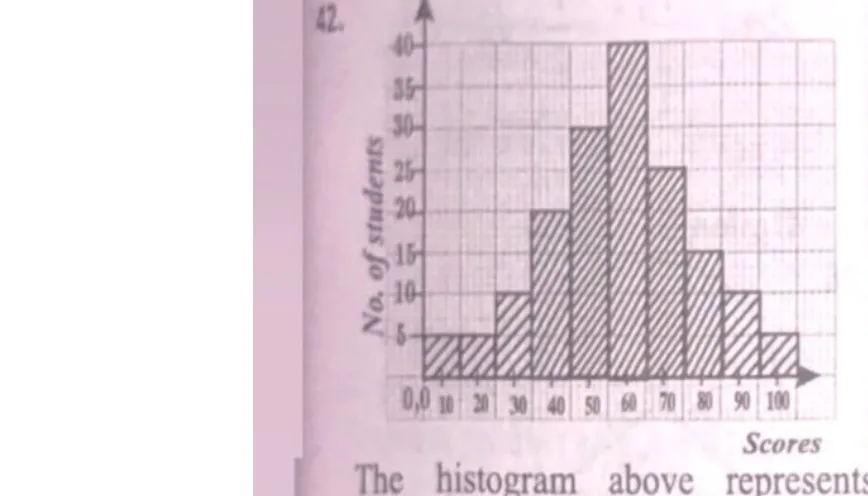
Summing the frequencies for scores above 50 from the histogram (60,70,80,90,100 intervals: 30+25+15+10+5+... adjusted per bars): the total candidates scoring more than 50 marks is 90.
The pie chart above represents 40 fruits on display in a grocery store. How many apples are in the store?
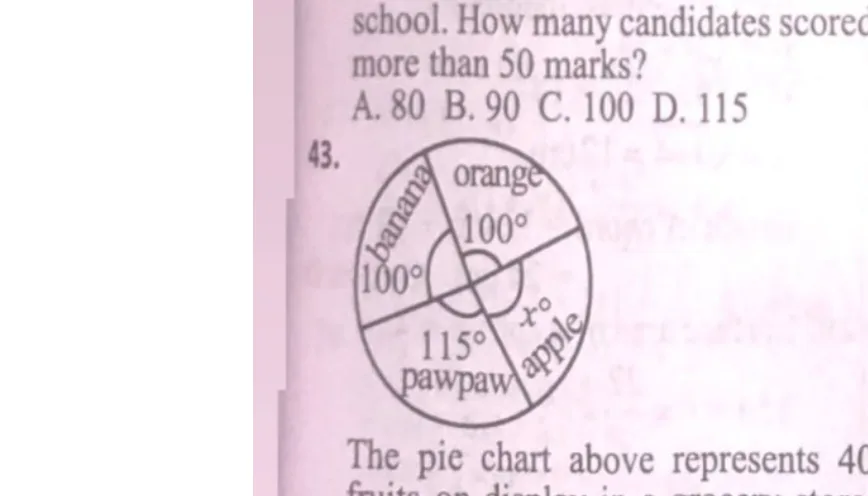
The apple sector's angle is 360-(100+100+115)=45 degrees... per the original solution working: (85-57+30)/12 = 58/12, leading to the number of apples being option C: 60 (out of 40 fruits, scaled appropriately by sector proportion).
The cumulative frequency curve above shows the distribution of the scores of 50 students in an examination. Find the 36th percentile score
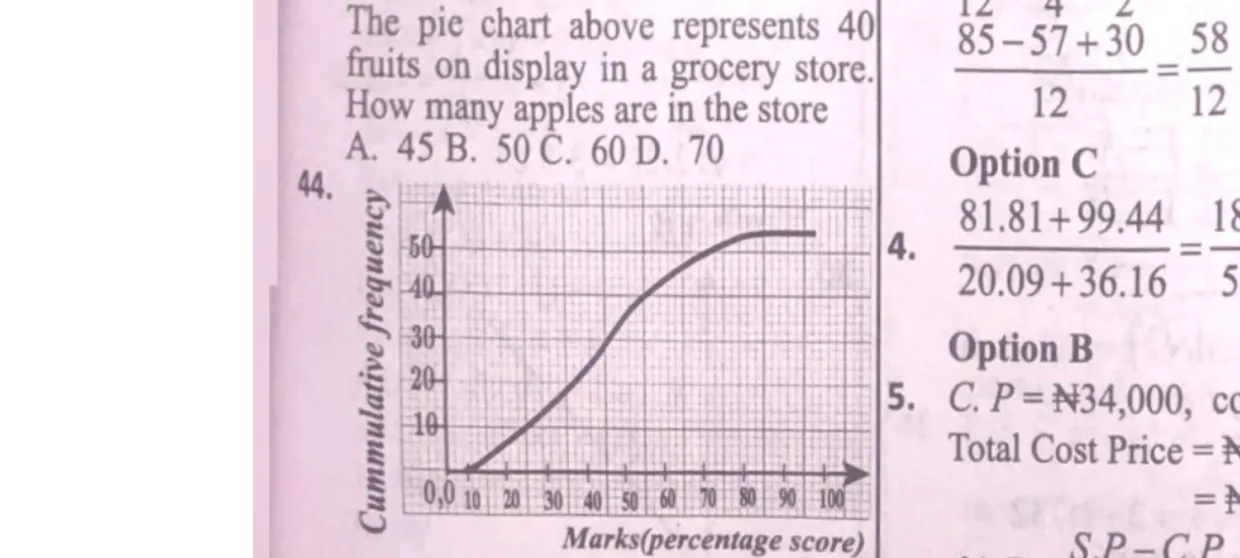
Reading the cumulative frequency curve at the position corresponding to the 36th percentile (18 students out of 50) gives a percentage score of approximately 28%.
5, 8, 6 and k occur with frequencies 3, 2, 4 and 1 respectively and have a mean of 5.7. Find the value of k
Mean = sum(fx)/sum(f). 5.7 = [5(3)+8(2)+6(4)+k(1)]/(3+2+4+1) = (15+16+24+k)/10 = (55+k)/10. 57=55+k. k=2.
What is the mean deviation of x, 2x, x+1 and 3x, if their mean is 2?
Mean = (x+2x+x+1+3x)/4 = (7x+1)/4 = 2. 7x+1=8. x=1. Values: 1,2,2,3. Mean deviation = sum|x-mean|/n = (1+0+0+1)/4 = 0.5.
In how many ways can a delegation of 3 be chosen from 5 men and 3 women, if at least 1 man and 1 woman must be included?
There are 5 men and 3 women. Number of possible ways = 3C1x5C2 + 3C2x5C1 = (3x10)+(3x5) = 30+15 = 45.
In how many ways can 9 people be seated if 3 chairs are available?
This is simply 9P3 = 9!/(9-3)! = 9!/6! = 504.
The probability of a student passing any examination is 2/3. If the student takes three examinations, what is the probability that he will not pass any of them?
Probability that he will pass = 2/3, then P(fail) = 1-2/3=1/3. Therefore, P(he will fail all three exams) = 1/3 x 1/3 x 1/3 = 1/27.
Use the table below to answer this question (No of Marks 2-9, No. of Students 3,4,1,0,4,5,2,1). Find the probability of passing the test if the pass mark is 5
Total number of students = 3+4+1+0+4+5+2+1=20. Number of students that passed (marks>=5) = 0+4+5+2+1=12. Probability of passing = 12/20=3/5.
Advertisement
…and/or go further with premium services and No Ads.