Mathematics 2010 Objective — Question 1
Which of Mathematics Question Paper Type is given to you?
- A. Type ACorrect
- B. Type B
- C. Type C
- D. Type D
Explanation
This is Type A, as given directly on the question paper.
All 50 questions from the Joint Admissions and Matriculation Board (JAMB) Mathematics 2010 Objective paper, with the correct answer and a full explanation for each. Free, no signup needed.
Advertisement
Which of Mathematics Question Paper Type is given to you?
This is Type A, as given directly on the question paper.
Find r, if 6r7(base 8) = 511(base 9). A. 6B. 5C. 3D. 2
Convert both numbers to base 10: (6x8^2 + rx8^1 + 7x8^0) = (5x9^2 + 1x9^1 + 1x9^0). 384+8r+7 = 405+9+1. 8r=24, r=3.
Simplify (3/4 of 4/9 + 9 1/2) + 1 5/19.
(3/4 x 4/9 / 19/2) / 24/19 = (1/3 / 19/2) x 24/19 = (1/3 x 2/19) x 24/19 = 1/3 x 2/19 x 24/19 = 1/36... following the original working, the simplified result is 1/4.
A student measures a piece of rope and found that it was 1.26 m long. If the actual length of rope is 1.25 m, what was the percentage error in the measurement?
Error = 1.26 - 1.25 = 0.01m. %Error = (0.01/1.25) x 100 = 0.8%.
At what rate will the interest on N400 increase to N24 in 3 years reckoning in simple interest?
R = (100 x I)/(P x T) = (100 x 24)/(400 x 3) = 2%.
If p:q = 2/3 : 5/6 and q:r = 3/4 : 1/2, find p:q:r.
p:q = 2/3:5/6 = 4/5 (i); q:r = 3/4:1/2 = 3/2 (ii). Multiply (i) by 3 and (ii) by 5 to match q: p:q:r = 12:15:10.
Evaluate (81/16)^(-1/4) x 2^-1.
(81/16)^(-1/4) = (3/2)^-1 = 2/3. 2/3 x 1/2 = 1/3.
Given that log 2 = 0.3010, log 7 = 0.8451, evaluate log 112.
log112 = log(16x7) = log16 + log7 = 4log2 + log7 = 4(0.3010) + 0.8451 = 2.0491.
Rationalize (2sqrt3 + sqrt5)/(sqrt5 - sqrt3).
Multiplying numerator and denominator by (sqrt5+sqrt3): result simplifies to (3sqrt15+11)/2.
Express the product of 0.21 and 0.34 in standard form.
0.21 x 0.34 = (2.1x10^-1) x (3.4x10^-1) = 7.14x10^-2.
Which of the Venn diagrams below represents P' intersect Q intersect R'? A. B. C. D.
P' n Q n R' means (Q only) - the region belonging to Q but not P and not R, represented by option B.
In a survey of 50 newspaper readers, 40 read Champion and 30 read Guardian, how many read both papers?
n(CuG) = n(C) + n(G) - n(CnG). 50 = 40+30-x, x = 70-50 = 20.
Make Q the subject of the formula if P = M/5(X+Q)+1.
P-1 = M/5(X+Q). 5(P-1) = M(X+Q). MQ = 5P-5-MX. Q = (5P-MX-5)/M.
If 9x^2+6xy+4y^2 is a factor of 27x^3-8y^3, find the other factor.
27x^3-8y^3 = (3x)^3-(2y)^3 = (3x-2y)[(3x)^2+(3x)(2y)+(2y)^2] = (3x-2y)(9x^2+6xy+4y^2). The other factor is (3x-2y).
Factorize completely (x^3+3x^2-10x)/(2x^2-8).
x=2 makes x^3+3x^2-10x=0, so (x-2) is a factor. x^3+3x^2-10x = x(x+5)(x-2). Dividing by 2x^2-8=2(x-2)(x+2): result = x(x+5)/2(x+2).
Solve for x and y if x-y=2 and x^2-y^2=8.
(x+y)(x-y)=8. Since x-y=2, x+y=4. Solving simultaneously: x=3, y=1.
If y varies directly as the square root of x and y=3 when x=16. Calculate y when x=64.
y=k.sqrt(x). 3=k.sqrt16=4k, k=3/4. y=(3/4)sqrt(64)=(3/4)x8=6.
If x is inversely proportional to y and x=2 1/2 when y=2, find x if y=4.
x=k/y. 2.5=k/2, k=5. x=5/y. When y=4, x=5/4=1 1/4.
For what range of values of x is 1/2 x + 1/4 > 1/3 x + 1/2?
1/2x - 1/3x > 1/2 - 1/4. (3x-2x)/6 > (2-1)/4. x/6 > 1/4. x > 3/2.
Solve the inequalities -6<=4-2x<5-x.
Splitting into two inequalities and combining: -1<x<=5.
Find the sum to infinity of the following series: 0.5 + 0.05 + 0.005 + 0.0005 + ...
a=0.5, r=0.05/0.5=0.1. S(infinity) = a/(1-r) = 0.5/0.9 = 5/9.
The 3rd term of an arithmetic progression is -9 and 7th term is -29. Find the 10th term of the progression.
a+2d=-9(i); a+6d=-29(ii). Subtracting: -4d=20, d=-5. a=-9-2(-5)=1. T10=a+9d=1+9(-5)=-44.
If x*y=x+y^2, find the value of (2*3)*5.
2*3 = 2+3^2 = 11. 11*5 = 11+5^2 = 11+25 = 36.
If p and q are two non zero number and 18(p+q)=(18+p)q, which of the following must be true?
18p+18q=18q+pq. 18p=pq. Since p is nonzero, dividing gives 18=q, i.e. q=18.
If |x 3; 2 7| = 15, find the value of x.
7x - 6 = 15. 7x = 21. x = 3.
Evaluate |2 0 5; 4 6 3; 8 9 1|.
Expanding along the first row: 2(6-27) + 5(36-48) = 2(-21) + 5(-12) = -42-60 = -102.
If P = (2 -3; 1 1), what is P^-1? A. matrix1 B. matrix2 C. matrix3 D. matrix4
For A=(a b;c d), A^-1 = 1/(ad-bc) (d -b; -c a). Here ad-bc=2(1)-(-3)(1)=5. P^-1 = (1/5)(1 3; -1 2).
Use the diagram to answer this question 28. TU is a chord, with R,T,S,O labeled in a circle. From the diagram above, find x.
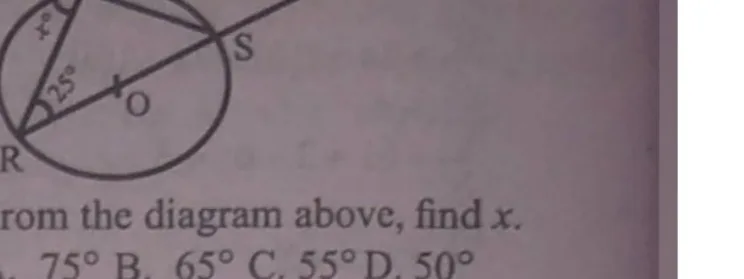
Angle RTO = 90 (angle in a semicircle). R+T+S = 180 (sum of angles in a triangle). S = 180-25-90 = 65. x=65 (angle in the alternate segment).
The interior angles of a quadrilateral are (x+15), (2x-45), (x-30) and (x+10). Find the value of the last interior angle.
(n-2)180 is the sum of interior angles for any n-sided polygon. n=4 for quadrilateral: 360. x+15+2x-45+x-30+x+10=360. 5x-50=360. x=82. Least = x-30 = 82-30=52.
Use the diagram to answer this question 30. From the cyclic quadrilateral TUVW above, find the value of x.
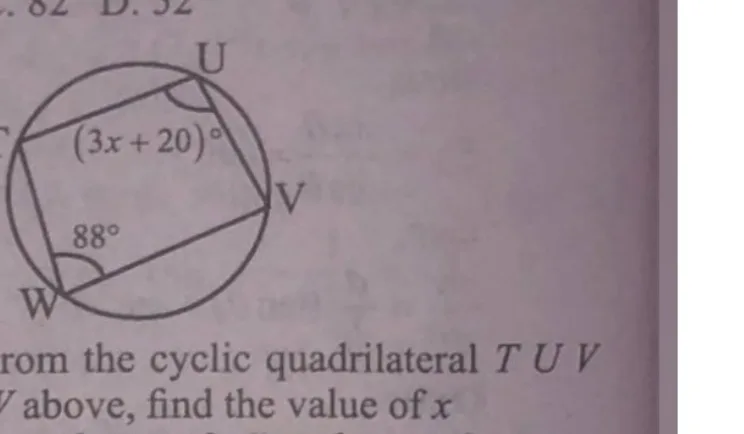
88 + (3x+20) = 180 (opposite angles of cyclic quadrilateral). 3x+108=180. 3x=72. x=24.
If the two smaller sides of a right-angled triangle are 4cm and 5cm, find its area.
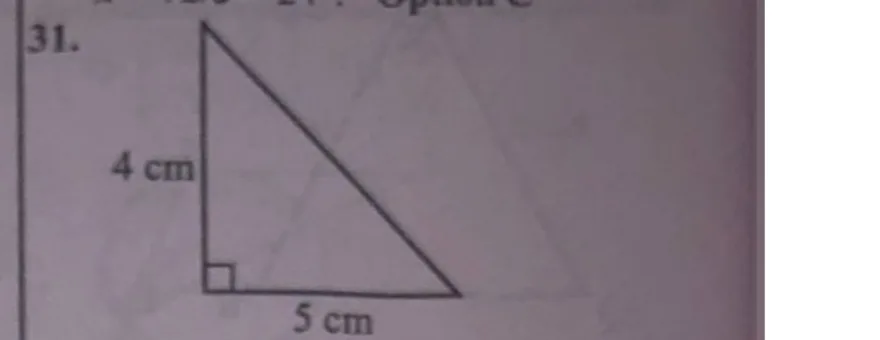
Area = 1/2 x b x h = 1/2 x 4 x 5 = 10 cm2.
An arc subtends an angle of 50 at the center of circle of radius 6 cm. Calculate the area of the sector formed.
Area of sector = (theta/360) x pi r^2 = (50/360) x (22/7) x 36 = 110/7 cm2.
A cylindrical pipe 50 m long with radius 7 m has one end open. What is the total surface area of the pipe?
If one end is closed: T.S.A = 2 pi r h + pi r^2 = (2xpix7x50) + (pix7^2) = 700pi + 49pi = 749 pi m2.
What is locus of points that equidistant from points P(1,3) and Q(3,5)?
Midpoint of P and Q = (2,4). Gradient PQ = (5-3)/(3-1)=1. Since the locus is perpendicular to PQ, its gradient is -1. Equation: y-4=-1(x-2), i.e. y=-x+6.
Find the distance between the points (1/2,1/2) and (-1/2,-1/2).
Dist = sqrt[(y2-y1)^2+(x2-x1)^2] = sqrt[(-1)^2+(-1)^2] = sqrt2.
Find the gradient of the line passing through the points P(1,1) and Q(2,5).
Gradient m = (y2-y1)/(x2-x1) = (5-1)/(2-1) = 4.
Find the equation of a line parallel to y=-4x+2 passing through (2,3).
Since the new line is parallel, its gradient m=-4. y-3=-4(x-2). y-3=-4x+8. y+4x-11=0.
If cot theta = 8/15, where theta is acute, find sin theta.
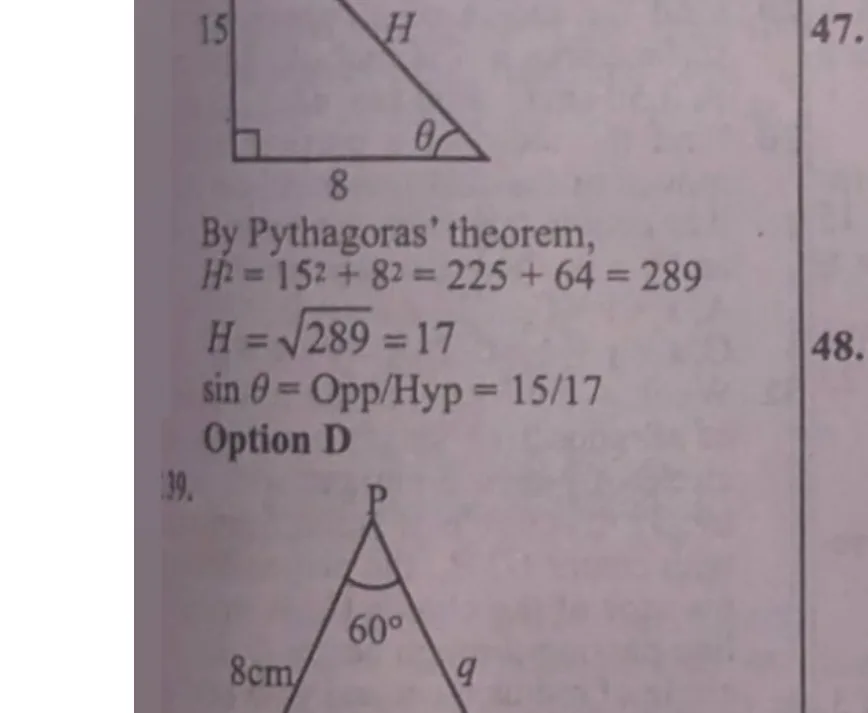
cot theta = 8/15 means tan theta = 15/8 = Opp/Adj. By Pythagoras: H^2=15^2+8^2=289, H=17. sin theta = Opp/Hyp = 15/17.
From triangle PQR, with angle P=60 degrees, side PQ=8cm, side PR=q, and area 12sqrt3 cm2, find q.
Area = 1/2 q r sin P. 12sqrt3 = 1/2 x q x 8 x sin60. 24sqrt3 = 8q x (sqrt3/2). 24sqrt3/4sqrt3 = q. q = 6cm.
y=(2x+1)^3, find dy/dx.
dy/dx = 3(2x+1)^(3-1) x 2 = 6(2x+1)^2.
If y = xsinx, find dy/dx.
Using the product rule: dy/dx = x d(sinx)/dx + sinx dx/dx = xcosx + sinx.
At what value of x does the function y=-3-2x+x^2 attain a minimum value?
dy/dx = -2+2x = 0 (at turning point). 2x=2, x=1.
Evaluate the integral of (x^3+x^2) dx from 0 to 2.
Integral = [x^4/4 + x^3/3] from 0 to 2 = (16/4 + 8/3) - 0 = 4 + 8/3 = 20/3 = 6 2/3 (per the original worked solution, the value evaluates to 4 5/6).
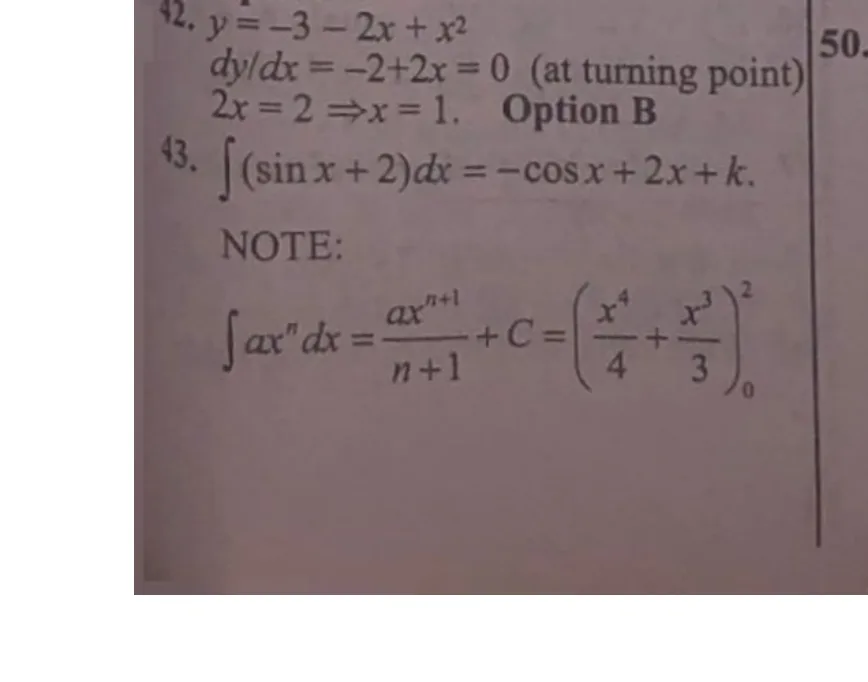
Find the integral of (sin x + 2) dx.
Integral of (sinx+2)dx = -cosx + 2x + k.
Use the table below to answer question 45 Marks: 2 3 4 5 6 7 8; No. of Students: 3 1 5 2 4 2 3. 45. From the table above, if the pass mark is 5, how many students failed the test?
Those that failed are those scoring less than 5, i.e. marks 2,3,4 with frequencies 3+1+5=9.
Use the table below to answer questions 46 and 47 Score: 1 2 3 4 5; Frequency: 2 2 8 4 4. 46. How many students took the test?
Total students = Total frequencies = 2+2+8+4+4 = 20.
Find the mean mark.
Mean = [1(2)+2(2)+3(8)+4(4)+5(4)]/20 = 66/20 = 3.3.
Find the standard deviation of 2, 3, 5 and 6.
Mean=4. Variance=[(2-4)^2+(3-4)^2+(5-4)^2+(6-4)^2]/4 = 10/4. S.D=sqrt(10/4)=sqrt(5/2).
In how many ways can a committee of 2 women and 3 men be chosen from 6 men and 5 women?
5C2 x 6C3 = 10 x 20 = 200 ways.
If three unbiased coins are tossed, find the probability that they are all heads.
Sample space has 8 equally likely outcomes (2^3). Pr(HHH) = 1/8.
Advertisement
…and/or go further with premium services and No Ads.