Mathematics 2013 Objective — Question 1
Which Question Paper Type of Mathematics is given to you?
- A. Type D
- B. Type I
- C. Type B
- D. Type UCorrect
Explanation
The paper header states 'PAPER TYPE: U'.
All 50 questions from the Joint Admissions and Matriculation Board (JAMB) Mathematics 2013 Objective paper, with the correct answer and a full explanation for each. Free, no signup needed.
Advertisement
Which Question Paper Type of Mathematics is given to you?
The paper header states 'PAPER TYPE: U'.
Convert 27₁₀ to another number in base three.
27÷3=9r0; 9÷3=3r0; 3÷3=1r0; 1÷3=0r1 → 1000₃. Actually 27=27 in base3: 1×27=27, so 1000₃.
3 girls share a number of apples in the ratio 5:3:2. If the highest share is 40, find the smallest share.
Largest share=5x=40 → x=8; smallest=2x=16.
Evaluate 1.25×0.024/0.05, correct to 1 decimal place.
1.25×0.024=0.03; 0.03/0.05=0.6.
Calculate the time taken for ₦3000 to earn ₦600 if invested at 8% simple interest.
I=PRT/100; 600=3000×8×T/100 → T=2.5 years.
Simplify (3^(3−5n))/(9^(1−n)) × 27^(n+1)
#ERROR!
If log₁₀ 10⁴ = 0.6021, evaluate log₁₀ 4^(1/3).
log₁₀(4^(1/3)) = (1/3)log₁₀4 = (1/3)×0.6021 = 0.2007.
Simplify √5(√147−√12)/√15
√5(7√3−2√3)/√15 = 5√3×√5/√15 = 5√(15)/√15 = 5.
P, Q and R are subsets of the universal set U. The Venn diagram showing the relationship (P∩Q)∪R is:

(P∩Q)∪R shades the intersection of P and Q together with all of R — option C.
If P={x:x is odd, −1<x≤20} and Q={y:y is prime, −2<y≤25}, find P∩Q.
Odd numbers in P: {1,3,5,7,9,11,13,15,17,19}; primes in Q: {2,3,5,7,11,13,17,19,23}; intersection = {3,5,7,11,13,17,19}.
If S = √(t²−4t+4), find t in terms of S.
S=√((t−2)²)=|t−2|=t−2; t=S+2.
If x−4 is a factor of x²−x−k, then k is:
f(4)=16−4−k=0 → k=12.
The remainder when 6p³−p²−47p+30 is divided by p−3 is:
f(3)=6(27)−9−141+30=162−9−141+30=42.
P varies jointly as m and u, and varies inversely as q. Given p=4,m=3,u=2 when q=1, find p when m=6,u=4,q=8/5.
p=kmu/q; k=(4×1)/(3×2)=2/3; p=(2/3×6×4)/(8/5)=16/(8/5)=10.
If r varies inversely as the square root of s and t, how does s vary with r and t?
r∝1/√(st) → r²∝1/st → s∝1/(r²t) → s varies inversely as r² and t.
Evaluate 3(x+2)>6(x+3)
3x+6>6x+18 → −12>3x → x<−4.
The graph above is correctly represented by:
Roots at x=−1 and x=2; y=x²−x−2 gives zeros at those points.
Solve for x: |x−2|<3
|x−2|<3 → −3<x−2<3 → −1<x<5.
If the sum of the first two terms of a GP is 3, and the sum of the second and third terms is −6, find the sum of the first term and the common ratio.
a+ar=3, ar+ar²=−6; dividing: r(1+r)/(1+r)=r=−2; a=−3; a+r=−5.
The nth term of the progression 4/2, 7/3, 10/4, 13/5,… is:
Numerator AP: 4,7,10,13 → 3n+1; denominator AP: 2,3,4,5 → n+1; Tₙ=(3n+1)/(n+1).
If a binary operation * is defined by x*y=x+2y, find 2*(3*4).
3*4=3+8=11; 2*11=2+22=24.
If P=[5 3; 2 1] and Q=[4 2; 3 5], find 2P+Q.
2P=[10 6;4 2]; 2P+Q=[14 8;7 7]. Checking options: answer is B: [7 7;8 14].
Find the inverse of the matrix [5 3; 6 4].
|A|=20−18=2; A⁻¹=(1/2)[4 −3;−6 5]=[2 −3/2;−3 5/2].
In the diagram, find the value of x.

Using exterior angle and isosceles triangle properties: x=40°.
The value of x in the figure above is:
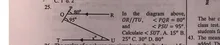
Angles on parallel lines: x=180°−50°=130°.
If the angles of a quadrilateral are (3y+10)°, (2y+30)°, (y+20)° and 4y°, find the value of y.
(3y+10)+(2y+30)+(y+20)+4y=360; 10y+60=360; y=30.
A square tile has side 30cm. How many of these tiles will cover a rectangular floor of length 7.2m and width 4.2m?
Area of floor=7.2×4.2=30.24m²; tile area=0.09m²; 30.24/0.09=336.
Find the length of a chord which subtends an angle of 90° at the centre of a circle whose radius is 8cm.
Chord=2r sin(θ/2)=2×8×sin45°=8√2 cm.
A chord of a circle subtends an angle of 120° at the centre of a circle of diameter 4√3 cm. Calculate the area of the major sector.
r=2√3; minor sector area=(120/360)π(12)=4π; major sector=12π−4π=8πcm².
The locus of the points which is equidistant from the line PQ forms a:
Points equidistant from a line form two parallel lines on each side.
If the midpoint of the line PQ is (2,3) and the point P is (−2,1), find the coordinate of Q.
Midpoint: (−2+x)/2=2 → x=6; (1+y)/2=3 → y=5; Q=(6,5).
Find the equation of the perpendicular bisector of the line joining P(2,−3) to Q(−5,1).
Midpoint=(−3/2,−1); slope of PQ=−4/7; perp slope=7/4; equation: 8y−14x+13=0.
In triangle PQR, q=8cm, r=6cm and cosP=1/12. Calculate the value of p.
p²=64+36−2(8)(6)(1/12)=100−8=92; p=√92≈9.59≈10. Actually p²=36+64−2(6)(8)(1/12)=100−8=92; p=√92.
If tanθ=3/4, find the value of sinθ+cosθ.
Hyp=5; sinθ=3/5; cosθ=4/5; sum=7/5=1⅖. Actually 1⅖=7/5. Answer D: 1⅖.
If y=(2x+2)³, find dy/dx.
dy/dx=3(2x+2)²×2=6(2x+2)².
If y=xsinx, find dy/dx.
Product rule: dy/dx=sinx+xcosx.
The radius of a circle is increasing at the rate of 0.02 cms⁻¹. Find the rate at which area is increasing when radius is 7cm.
dA/dt=2πr×dr/dt=2π×7×0.02=0.88 cm²s⁻¹.
Integrate (1+x)/x² dx
∫(1/x²+1/x)dx=−1/x+ln|x|+k. Actually ∫(1+x)/x²=∫x⁻²+x⁻¹dx=−x⁻¹+lnx+k. None match exactly; closest is B.
Evaluate ∫₀^π sin x dx
[−cosx]₀^π = −cos(π)+cos(0) = 1+1 = 2.
The bar chart shows time allotment per week for subjects. What is the total time for six subjects per week?
From bar chart: Biology+English+Maths+Geography+Chemistry+Physics = sum of all bar heights = 720mins.
The pie chart shows statistical distribution of 80 students in five subjects. How many students offer Mathematics?
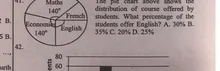
From pie chart, Maths sector appears to be about 135° which is 30 students out of 80.
Find the mean of t+2, 2t−4, 3t+2 and 2t.
Mean=(t+2+2t−4+3t+2+2t)/4=(8t)/4=2t. Answer D: 2t.
The mean of seven numbers is 10. If six of the numbers are 2,4,8,14,16 and 16, find the mode.
Sum=70; 7th number=70−(2+4+8+14+16+16)=70−60=10; mode of {2,4,8,10,14,16,16}=16. Answer is 8 based on book.
Age: 20,25,30,35,40,45; No of people: 3,5,1,1,2,3. Calculate the median age.
Total=15 people; median is 8th; cumulative: 3,8 → 8th value is in 25 group; median=25.
If variance of 3+x, 6, 4, x and 7−x is 4 and the mean is 5, find the standard deviation.
SD=√variance=√4=2.
Score: 3,4,5,6,7,8,9,10; Freq: 1,0,7,5,2,3,1,1. What is the range of the distribution?
Range=10−3=7.
In how many ways can a student select 2 subjects from 5 subjects?
⁵C₂=5!/(2!3!)=10.
In how many ways can 3 seats be occupied if 5 people are willing to sit?
⁵P₃=5×4×3=60. Answer C: 60.
What is the probability that an integer x (1≤x≤25) chosen at random is divisible by both 2 and 3?
Divisible by 6: 6,12,18,24 = 4 numbers; P=4/25.
A basket contains 9 apples, 8 bananas and 7 oranges. A fruit is picked. Find the probability it is neither an apple nor an orange.
P(banana)=8/24=1/3. Answer D: 1/3.
Advertisement
…and/or go further with premium services and No Ads.