All 50 questions from the Joint Admissions and Matriculation Board (JAMB) Mathematics 2015 Objective paper, with the correct answer and a full explanation for each. Free, no signup needed.
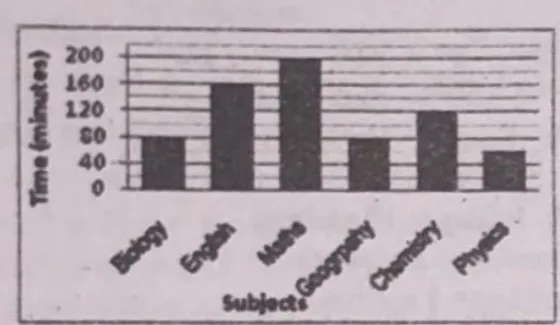
The bar chart shows the allotment of time (in minutes) per week for selected subjects in a certain school. What is the total time allocated to the six subjects per week?
A. 200minsB. 460minsC. 720minsCorrect D. 960minsExplanation Sum of all bars: Biology 80 + English 160 + Maths 200 + Geography 80 + Chemistry 120 + Physics 80 = 720 minutes.
Find the gradient of the line joining the points P(5, 6) and Q(3, 3).
A. 3B. 1/2C. 3/2Correct D. 2Explanation Gradient = (y₂−y₁)/(x₂−x₁) = (3−6)/(3−5) = −3/−2 = 3/2.
If gt² − k − w = 0, make g the subject of the formula.
A. (k−w)/t²B. (k−w)/tC. (k+w)/tD. (k+w)/t²Correct Explanation gt² = k + w ⟹ g = (k+w)/t².
Determine the maximum value of y = 3x² − x³.
Explanation dy/dx = 6x−3x² = 0 ⟹ x=0 or x=2. At x=2, y = 3(4)−8 = 4 (maximum).
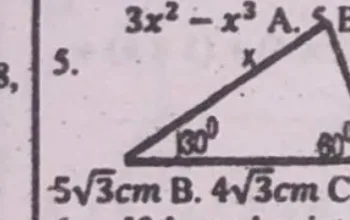
In the figure, find the value of x.
A. 5√3cmCorrect B. 4√3cmC. 20√3cmD. 10√3cmExplanation By the sine rule, x/sin60° = 10/sin90°, so x = 10×(√3/2) = 5√3cm.
If the end points of one side of square RSTU are R(-1,-1) and S(3,-1), find the area of the square.
A. 12 square unitsB. 36 square unitsC. 20 square unitsD. 16 square unitsCorrect Explanation Side length = distance RS = 4. Area = 4² = 16 square units.
Find the median of 5, 9, 1, 10, 3, 8, 9, 2, 4, 5, 5, 5, 7, 3 and 6.
Explanation Arranged in order the 8th of 15 values is 5, the median.
Factorise 2y² − 15xy + 18x².
A. (2y+3x)(y−6x)B. (3y+2x)(y−6x)C. (2y−3x)(y+6x)D. (2y−3x)(y−6x)Correct Explanation 2y²−15xy+18x² = 2y(y−6x)−3x(y−6x) = (2y−3x)(y−6x).
The mean of 2−t, 4+t, 3−2t, 2+t and t−1 is
A. tB. −2C. 2Correct D. −tExplanation Sum = 10 (the t terms cancel). Mean = 10/5 = 2.
The table represents the outcome of throwing a die 100 times (Numbers 1–6, Frequencies 18,22,20,16,10,14). What is the probability of obtaining at least a 4?
A. 2/5Correct B. 3/5C. 3/10D. 1/5Explanation P(≥4) = (16+10+14)/100 = 40/100 = 2/5.
Simplify (√147 − √75)/√48.
A. 2B. 1/2Correct C. 1/4D. 3Explanation √147=7√3, √75=5√3, √48=4√3. (7√3−5√3)/4√3 = 2√3/4√3 = 1/2.
If P = [[6,4],[5,7]], then |P| is
A. 32B. 16C. 18D. 22Correct Explanation |P| = (6×7) − (4×5) = 42 − 20 = 22.
If y = 3sin(−4x), dy/dx is
A. −12cos(−4x)Correct B. −12cos(4x)C. 12xcos(4x)D. 12sin(−4x)Explanation dy/dx = 3×(−4)cos(−4x) = −12cos(−4x).
If the angle of a sector of a circle with radius 10.5cm is 120°, find the perimeter of the sector.
A. 45cmB. 48cmC. 40cmD. 43cmCorrect Explanation Perimeter = 2r + (θ/360)×2πr = 21 + (1/3)×2×(22/7)×10.5 = 21+22 = 43cm.
The length a person can jump is inversely proportional to his weight. If a 20kg person can jump 1.5m, find the constant of proportionality.
A. 30Correct B. 20C. 15D. 60Explanation L = k/W ⟹ 1.5 = k/20 ⟹ k = 30.
A man donates 10% of his monthly net earnings to his church. If it amounts to ₦4500, what is his net monthly income?
A. ₦40,500B. ₦62,500C. ₦52,500D. ₦45,000Correct Explanation 10% of x = 4500 ⟹ x = 4500×10 = ₦45,000.
If y = x² − 3x + 4, find dy/dx at x = 5.
Explanation dy/dx = 2x−3. At x=5: 2(5)−3 = 7.
Evaluate (1.25×0.025)/0.05 correct to 1 decimal place.
A. 0.5B. 6.3C. 6.2D. 0.6Correct Explanation (1.25×0.025)/0.05 = 0.03125/0.05 = 0.625 ≈ 0.6.
Solve the inequality (1/3)x + 1/4 > (1/2)x + 1/3.
A. x < −1B. x > −1/2C. x > −1D. x < −1/2Correct Explanation Multiplying through by 12 and simplifying gives −2x > 1, so x < −1/2.
If P = [[5,3],[2,1]] and Q = [[4,2],[3,5]], find 2P + Q.
A. [[8,14],[7,7]]B. [[7,7],[14,8]]C. [[14,8],[7,7]]Correct D. [[7,7],[8,14]]Explanation 2P = [[10,6],[4,2]]; 2P+Q = [[14,8],[7,7]].
In how many ways can seven directors sit round a table?
A. 720Correct B. 120C. 24D. 5040Explanation Circular permutations of n items = (n−1)! = 6! = 720.
Evaluate lim(x→2) (x²−1)/(x+1).
Explanation (x²−1)/(x+1) = (x−1)(x+1)/(x+1) = x−1. As x→2, limit = 1.
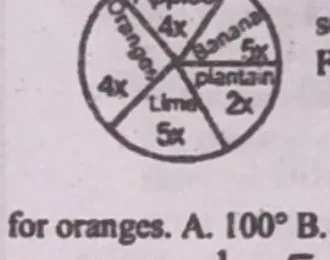
The pie chart shows the sectoral allocation of fruits. Find the allocation for oranges.
A. 100°B. 40°C. 60°D. 80°Correct Explanation Sector angles sum to 360°: 18x = 360°, x = 20°. Oranges = 4x = 80°.
Simplify 1/(2−√3) in the form a + b√3.
A. 2+√3Correct B. −2−√3C. −2+√3D. 2−√3Explanation Multiply numerator and denominator by (2+√3): (2+√3)/(4−3) = 2+√3.
If y = x² + √x, find dy/dx.
A. 2x + x^(1/2)B. 2x − ½x^(−1/2)C. 2x − x^(−1/2)D. 2x + ½x^(−1/2)Correct Explanation y = x²+x^(1/2). dy/dx = 2x + (1/2)x^(−1/2).
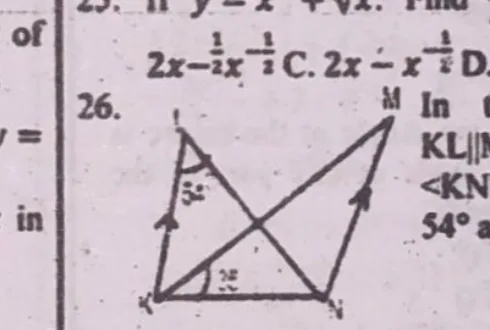
In the figure, KL∥MN, LN bisects ∠KNM. If angle KLN is 54° and angle MKN is 35°, calculate the size of angle KMN.
A. 91°B. 19°C. 37°Correct D. 89°Explanation ∠LNM = 54° (alternate to ∠KLN); LN bisects ∠KNM so ∠KNL=∠LNM=54°, giving ∠KNM=108°. In triangle KMN: ∠KMN = 180°−108°−35° = 37°.
The sixth term of an A.P is 3 times the second term. If the first term is 2, find the common difference.
A. −4B. 4C. 2Correct D. −3Explanation T₆=a+5d, T₂=a+d. a+5d=3(a+d) ⟹ 2d=2a ⟹ d=a=2.
Convert 27₁₀ to another number in base three.
A. 1000₃Correct B. 1100₃C. 1010₃D. 1001₃Explanation 27 = 3³, so 27₁₀ = 1000₃.
In a right angled triangle, if tanθ = 3/4. What is cosθ − sinθ?
A. 4/5B. 1/5Correct C. 2/5D. 3/5Explanation Opposite=3, Adjacent=4, Hypotenuse=5. cosθ−sinθ = 4/5−3/5 = 1/5.
The third term of a G.P is 4 while the sixth term is 32. Find its common ratio.
A. 1/2B. 8C. 4D. 2Correct Explanation ar²=4, ar⁵=32. Dividing gives r³=8, r=2.
Convert 101,100,011 (base 2, grouped) to base eight.
A. 543₈Correct B. 545₈C. 544₈D. 534₈Explanation 101₂=5, 100₂=4, 011₂=3, giving 543₈.
The table shows Values 1,2,3,4,5 with corresponding frequencies. Find the mode of the distribution.
Explanation The mode is the value occurring with the highest frequency, which is 4.
A matrix P has an inverse P⁻¹ = [[1,−3],[0,1]]. Find P.
A. [[1,3],[0,1]]Correct B. [[−1,3],[0,−1]]C. [[1,3],[0,−1]]D. [[1,−3],[0,−1]]Explanation |P⁻¹| = 1. P = adj(P⁻¹)/|P⁻¹| = [[1,3],[0,1]].
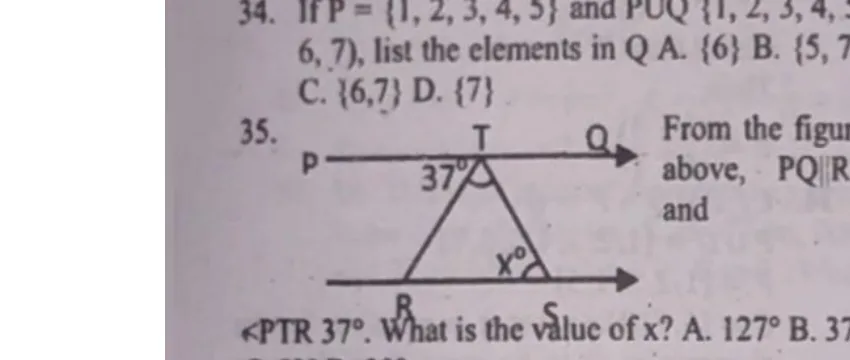
If P = {1,2,3,4,5} and P∪Q = {1,2,3,4,5,6,7}, list the elements in Q.
A. {6}B. {5,7}C. {6,7}Correct D. {7}Explanation Since P∪Q−P=Q and the extra elements are 6 and 7, Q={6,7}.
In the figure, PQ∥RS and ∠PTR = 37°. What is the value of x?
A. 127°Correct B. 37°C. 53°D. 90°Explanation Using angle relationships between the parallel lines PQ and RS with the transversal TS, x = 180°−37°−16° ... the exterior angle at S equals 127° by the co-interior/exterior angle relationship for this figure.
The locus of points that is equidistant from a fixed point is a
A. circle with that fixed point as centreCorrect B. line passing through the pointC. line round to the pointD. cube with the point as centreExplanation By definition, the locus of points equidistant from a fixed point is a circle centred at that point.
In how many ways can the letters in the word ELATION be arranged?
A. 7!Correct B. 5!C. 4!D. 8!Explanation ELATION has 7 distinct letters, so the number of arrangements is 7!.
Factorize ax − by − ay + bx.
A. (a−b)(x−y)B. (a+b)(y−x)C. (a−b)(x+y)D. (a+b)(x−y)Correct Explanation ax−by−ay+bx = x(a+b) − y(a+b) = (a+b)(x−y).
Solve the inequality 3(x+4) < 2(x+3).
A. x > 6B. x < 6C. x < −6Correct D. x > −6Explanation 3x+12<2x+6 ⟹ x < −6.
Evaluate ∫sin2x dx.
A. −1/2 cos2x + kCorrect B. −cos2x + kC. cos2x + kD. 1/2 cos2x + kExplanation ∫sin2x dx = −(1/2)cos2x + k.
The distribution of scores in a class test are 2, 8, 6, 5, 8, 6, 6, 5 and 6. Find the product of the modal and median score.
A. 48B. 30C. 36Correct D. 40Explanation Arranged: 2,5,5,6,6,6,6,8,8. Mode=6, Median=6. Product = 36.
A bag contains 10 black balls and 15 white balls. If a ball is picked at random without replacement, what is the probability of picking a white ball?
A. 2/5B. 3/5Correct C. 4/5D. 1/5Explanation P(white) = 15/(15+10) = 15/25 = 3/5.
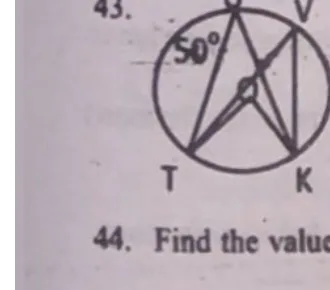
In the diagram, O is the centre of the circle. If ∠TUR is 50°, find the value of ∠TOR.
A. 40°B. 130°C. 100°Correct D. 50°Explanation The angle at the centre is twice the angle at the circumference: ∠TOR = 2×50° = 100°.
Find the value of the determinant |[0,3,2],[1,7,8],[0,5,4]|.
A. −1B. −2Correct C. 12D. 10Explanation Expanding along the first column: −1×(3×4−2×5) = −1×2 = −2.
Find the midpoint of S(−5,4) and T(−3,−2).
A. (−4,2)B. (4,−1)C. (−4,1)Correct D. (4,−2)Explanation Midpoint = ((−5−3)/2, (4−2)/2) = (−4,1).
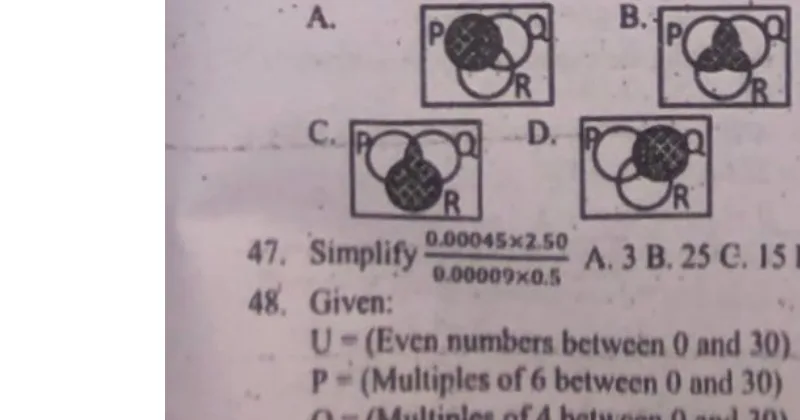
P, Q and R are subsets of the universal set U. Which Venn diagram shows the relationship (P∩Q)∪R?
A. Diagram AB. Diagram BC. Diagram CCorrect D. Diagram DExplanation (P∩Q)∪R includes all of R plus the common elements of P and Q, as shown fully shaded in diagram C.
Simplify (0.00045×2.50)/(0.00009×0.5).
A. 3B. 25Correct C. 15D. 5Explanation Expressing in standard form and simplifying gives 25.
U = even numbers between 0 and 30, P = multiples of 6 between 0 and 30, Q = multiples of 4 between 0 and 30. Find (P−Q)ᶜ.
A. {0,2,6,22,26}B. {0,10,14,22,16}C. {2,10,14,22,26}Correct D. {2,4,14,18,26}Explanation P={6,12,18,24}, Q={4,8,12,16,20,24,28}. P−Q={6,18}; its complement in U is {2,10,14,22,26} (among the listed options).
Y varies directly as w². When y=8, w=2, find y when w=3.
A. 18Correct B. 6C. 9D. 12Explanation k = y/w² = 8/4 = 2. When w=3, y = 2×9 = 18.
If some strips of sticks of lengths 7cm, 9cm and 27cm were cut independently from a single stem without a remainder, find the shortest possible length of that stem.
A. 197cmB. 54cmC. 81cmD. 189cmCorrect Explanation The shortest stem length is the LCM of 7, 9 and 27, which is 189cm.
Sign up free to unlock …and/or go further with premium services and No Ads .