Biology 2014 Objective — Question 1
The excretory product in protozoans is
- A. amino acids
- B. uric acids
- C. ammoniaCorrect
- D. urea
Explanation
The excretory products of protozoans are carbon dioxide, ammonia and water.
All 50 questions from the West African Examinations Council (WAEC) Biology 2014 Objective paper, with the correct answer and a full explanation for each. Free, no signup needed.
Advertisement
The excretory product in protozoans is
The excretory products of protozoans are carbon dioxide, ammonia and water.
Which of the following is a living organism?
A muscle is a tissue; the nucleus and mitochondrion are organelles; yeast (a fungus) is a living organism.
Which of the following organisms is the most specialized?
Spirogyra is a non-motile multicellular green algae; it is made up of several cylindrical cells joined end to end, making it more specialized than the others listed.
Active transport can be defined as the movement of
Active transport is the movement of substances against their concentration gradient. It involves the use of energy.
Which of the following cell inclusions can destroy other cell organelles?
Lysosomes are mobile vesicles containing powerful digestive enzymes capable of breaking down a variety of molecules, including other cell organelles.
In which of the following yam tissues will osmosis occur?
Raw and peeled yam can serve as a differentially permeable membrane for osmosis to occur.
The line XZ in the diagram represents an actual distance of 10.0cm and the length of the diagram is 5.0cm. What is the magnification of the diagram?
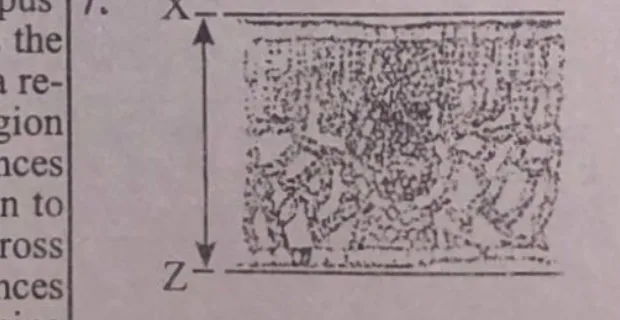
Magnification = length of diagram / actual length = 10cm/5cm = 2.
The following events occur during mitosis in a cell: I. Chromatids separate; II. Chromosomes become visible; III. Chromosomes align at the equator; IV. Cytoplasm divides (Cytokinesis). The correct sequence of the events is
The correct sequence is: II (chromosomes become visible) → III (chromosomes align at equator) → I (chromatids separate) → IV (cytoplasm divides).
Which of the following statements about asexual reproduction is correct? It
Asexual reproduction always involves one parent, and the offspring are genetically identical to the parent.
The diagram is an illustration of a mammalian bone. The bone illustrated above is the
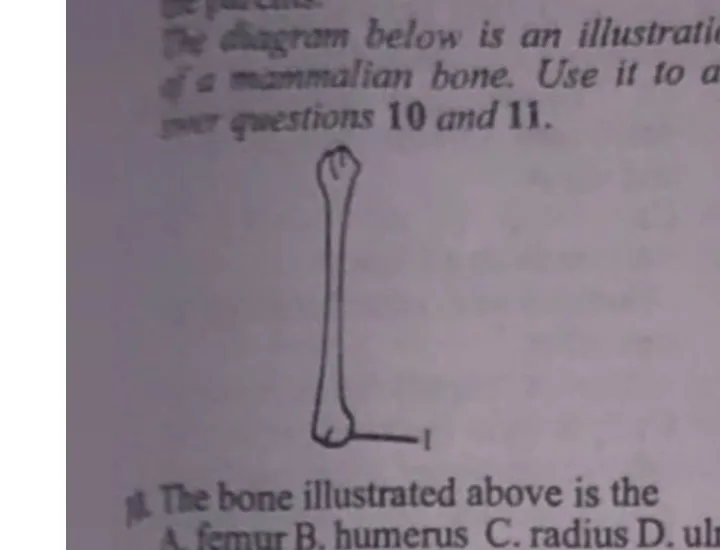
The bone illustrated is the femur — the largest bone in the human body.
Using the same diagram, the function of the part labeled I is to
The part labeled 'I' is the head of the femur. It fits into the acetabulum of the pelvic girdle to form a hip joint.
Which of the following is not a function of the mammalian skin?
The mammalian skin does not function for gaseous exchange in any way.
The legs of an accident victim with a fractured vertebral column and injured spinal cord could not be raised because
The legs of the victim could not be raised because impulses from receptors in the legs could not travel to the brain due to the injured spinal cord.
Which of the following conditions in flowering plants enhances self-pollination?
Cleistogamy is a condition in which ripe pollen grains are deposited on the stigma which becomes ripened at the same time, favouring/enhancing self-pollination.
The diagram below is an illustration of the left side of the human cerebrum. The part labeled X controls
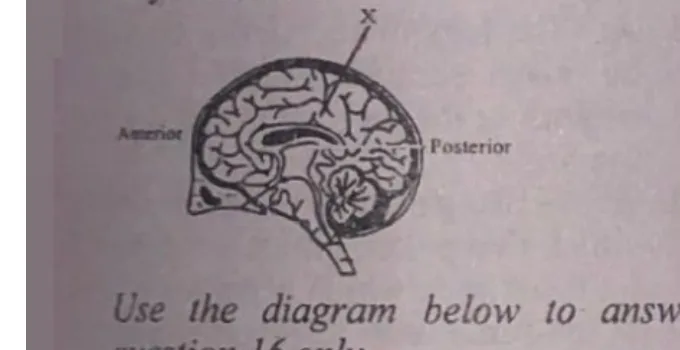
The part labeled X (in the cerebrum) controls general memory.
The diagram above is an illustration of
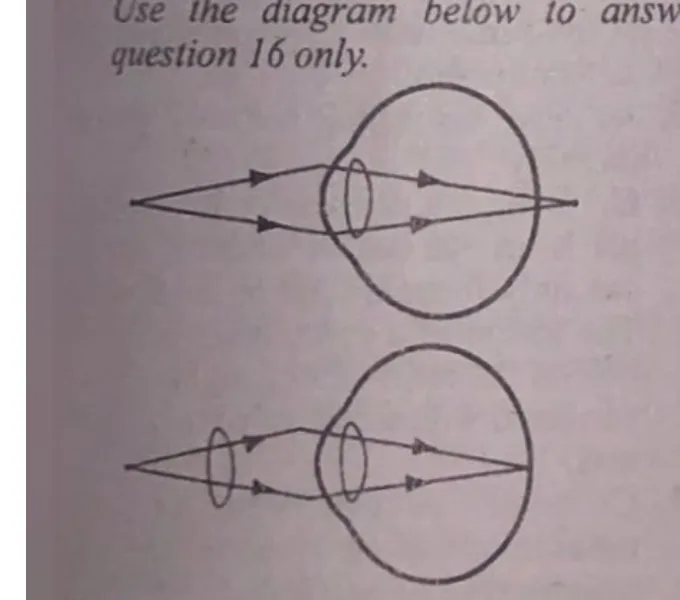
Long sightedness (hypermetropia) is an eye defect whereby the eye can only focus distant objects clearly; the image of a near object forms behind the retina. It is corrected with a convex/converging lens, as shown in the second part of the diagram.
The inability to maintain proper balance of the body in humans may be due to a defect in the
Semi-circular canals are part of the mammalian ear responsible for the maintenance of balance.
The following substances pass into the blood of the foetus from the mother's blood via the placenta except
The placenta carries oxygen, water and food from the mother's blood to the embryo's blood; it also removes excretory wastes like urea, salt, and carbon dioxide from the embryo's blood and puts it into the mother's blood for elimination. Carbon dioxide moves from the foetus to the mother, not the reverse.
An inferior ovary of a flower is situated
An ovary that is situated above other floral parts is said to be superior (hypogynous), while one situated below is said to be inferior (epigynous).
Older parts of plant roots do not normally absorb water because they
It is due to the absence of root hairs that older parts of plant roots do not normally absorb water.
The amount of starch in a germinating seed decreases because it is used up for
The amount of starch will decrease because it is used for the metabolism of the germinating seed.
The purpose of treating poor soil with lime is to increase the quantity of
Treating poor soil with lime increases the calcium content of the soil (Lime = quicklime = calcium oxide).
A meal consisting of yam and a lot of vegetables is not balanced because it does not contain
A meal consisting of yam and a lot of vegetables is not balanced because it does not contain proteins.
In a Biuret test, some protein was mixed with sodium hydroxide solution. Which of the following chemicals should be added to the mixture for a positive result?
The reagents needed for the Biuret test (a test for protein) are sodium hydroxide and copper sulphate.
A characteristic feature of plant parasites is the
Haustoria enables the parasite to absorb nutrients from the host plant.
The part of a leguminous plant where bacteria like Azotobacter can be found is
Symbiotic nitrogen-fixing bacteria such as Rhizobium leguminosarium inhabit the root nodules of leguminous plants.
The following adaptations are associated with the flight of birds except
The adaptations associated with the flight of birds are reduced body weight, streamlined shape, and the possession of powerful muscles — not clawed digits.
The following habitats can be found in West Africa except
The temperate grassland is not found in West Africa; it is found in Asia, North America, South America (Argentina), South Africa and Australia.
The difference between a community and a population is
A community is made up of populations of living organisms while a population is made up of organisms of the same species.
Which of the following statements about the circulation of water in nature is not correct?
Water removed from oceans is not permanently lost, as it eventually precipitates as rain and dew, so this statement is not correct.
The diagram below illustrates an ecological instrument. The instrument is
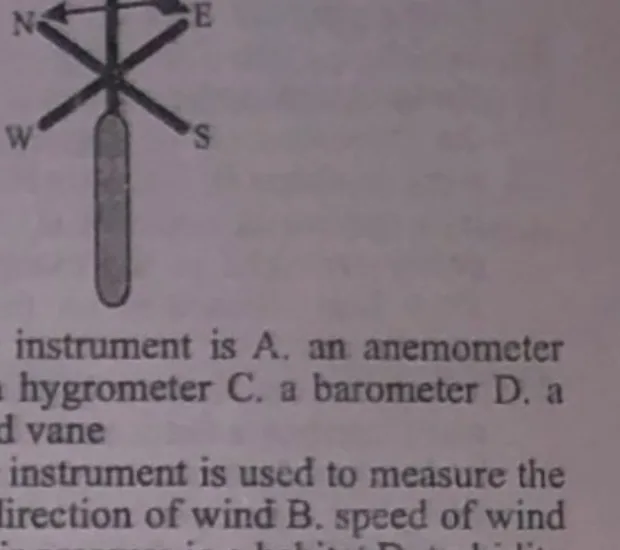
The instrument illustrated in the diagram is a wind vane.
Using the same diagram, the instrument is used to measure the
A wind vane is the instrument used to measure the direction of wind.
The following organisms are consumers except
Since Spirogyra is a green plant, it is able to photosynthesize; it is therefore a producer, not a consumer.
Which of the following substances constitute domestic waste? I. Fertilizer II. Insecticides III. Sewage IV. Crude oil V. Sulphur dioxide
The substance that constitutes domestic waste (out of the given substances) is sewage.
Which of the substances listed constitute domestic waste?
Sewage (option III) constitutes domestic waste since it comes from households.
The table shows the oxygen level, number of green plants and fish in rivers flowing through four towns. Which of the towns is likely to be discharging untreated sewage in their river?
The discharge of untreated sewage into a water body causes a decrease in the oxygen level of the water, because the bacteria that decompose the sewage feast on oxygen, reducing the population of aquatic animals like fish. Town D shows low oxygen, many green plants, and few fish — consistent with untreated sewage discharge.
Which of the following natural resources is non-renewable?
Coal is a non-renewable natural resource. Other non-renewable resources are petroleum, gold, silver, columbite, tin etc.
Which of the following statements is not a reason for banning bush burning?
Bush burning kills the fertility of a soil sample; thus, it does not enhance quick regrowth of grasses in any way, so this is not a valid reason for banning it (i.e. it is a false statement, hence the correct 'except' answer).
Which of the following statements explains why fertilizers are added to soils?
Fertilizers are added to soils because they increase the nutrient level of the soil.
Characteristics that exhibit continuous variation are generally controlled by
Characteristics that exhibit continuous variation are generally controlled by multiple genes.
Differences in characteristics that exist among individuals of the same species is referred to as
Variation refers to the differences in characteristics that exist among individuals of the same species.
Which of the following traits is not a morphological variation in humans?
Ability to taste PTC is a physiological variation, while others (colour, finger prints, size) are morphological variations.
Which of the following statements about chromosomes is correct?
The number of chromosomes present in organisms of the same species is constant. For instance, all humans have a diploid number of 46.
A small stem from a hibiscus plant was placed in a nutrient medium, and it developed into a new plant. The new plant was reproduced
This is asexual reproduction; the genotype of the parent plant is always conserved. Any method of reproduction that involves just one organism is asexual, and offspring of such means are always genetically identical to their parents (except in mutation).
The F1 generation of a cross between a red cock and white hen were all red because the gene for the
The red colour is able to mask the white colour because red colour is dominant over white. The white colour is said to be recessive.
Which of the following diseases can be inherited?
Sickle cell anaemia is an inheritable disease. It is controlled by a recessive gene which causes some of the red blood cells of some people to be sickle-shaped.
In dihybrid inheritance, Mendel considered
In monohybrid inheritance, only a pair of contrasting characters is involved, while two pairs of contrasting characters are involved in dihybrid inheritance.
The main reason for nuptial flight in termites is to
The main reason for nuptial flight in termites is to form new colonies.
The following organisms are social insects except
Termites, ants and bees are social insects while grasshoppers are not.
Lamarck's theory of evolution is based on the fact that
Organisms acquire genes from their parents. It must be duly noted that acquired characteristics cannot be inherited (this is the flaw in Lamarck's theory).
Advertisement
…and/or go further with premium services and No Ads.