All 5 questions from the West African Examinations Council (WAEC) Biology 2016 Theory paper, with the correct answer and a full explanation for each. Free, no signup needed.
SECTION A
1(a)(i) List three forms in which living cells exist
(ii) Give one example each of the forms listed in 1(a)(i)
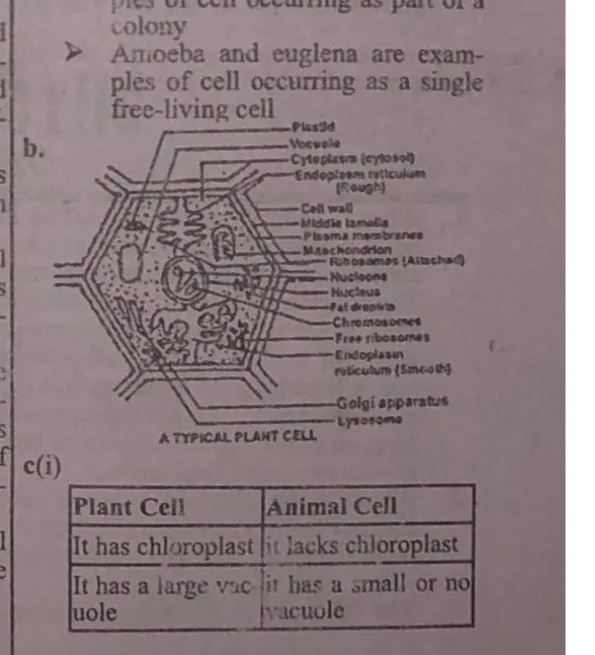
(b) Make a diagram, 6cm-10cm long, of a typical plant cell and label fully
(c) In a tabular form, state three differences between a plant cell and animal cell
Model answer
(a)(i) Forms in which living cells exist:
As part of a living organism
As part of a colony or filament
As a single free-living cell
(ii) Examples:
Skin cell is an example of a cell occurring as part of a living organism
Volvox and Pandorina are examples of cell occurring as part of a colony
Amoeba and euglena are examples of cells occurring as a single free-living cell
(b) [See diagram: A typical plant cell, labeled with: Plastid, Vacuole, Cytoplasm (cytosol), Endoplasm reticulum (Rough), Cell wall, Middle lamella, Plasma membrane, Mitochondrion, Ribosomes (attached), Nucleus, Nucleolus, Fat droplets, Chromosomes, Free ribosomes, Endoplasm reticulum (Smooth), Golgi apparatus, Lysosome]
(c) Differences between Plant Cell and Animal Cell:
| Plant Cell | Animal Cell |
| It has chloroplast | It lacks chloroplast |
| It has a large vacuole | It has a small or no vacuole |
| It has cell wall | It lacks cell wall |
| It lacks centriole | It has centriole |
2(a) In sequence, name the organs that constitute the alimentary canal of human
(b) State: (i) Three structural differences; (ii) Three structural similarities; between the alimentary canal of a bird and human
(c) Explain briefly how the dentition of herbivores is adapted for feeding
(d) State two roles of the pancreas in digestion
Model answer
(a) Mouth → Oesophagus → Stomach → Duodenum → Ileum → Jejunum → Large intestine → Rectum
(b)(i) Structural differences between alimentary canal of bird and human:
Human has mouth while a bird has beak
Humans have appendix while birds lack it
Humans lack crop while birds have crop
Humans have teeth while birds lack teeth
(ii) Structural similarities:
Both humans and birds have stomach
Both have large intestine
Both have duodenum
Both have caecum
Both have rectum
(c) Herbivores possess incisors for cutting grasses; they have molar for grinding; their diastema helps in rolling grass.
(d) Roles of the pancreas in digestion:
The enzyme lipase produced by pancreas converts fats and oil to fatty acid and glycerol
The enzyme amylase acts on starch
The enzyme trypsin acts on peptone
(Any two)
3(a)(i) A habitat is defined as the natural dwelling place of an organism.
(ii) List three roles of a decomposer in an ecosystem
(b) Explain briefly energy flow in a freshwater habitat
(c)(i) State three harmful effects of microorganisms to plants
(ii) State six beneficial effects of microorganism to humans
Model answer
(a)(i) A habitat is defined as the natural dwelling place of an organism.
(ii) Roles of a decomposer in an ecosystem:
Decomposers cause the decay of dead plants and animals
They release nutrients into the soil
They are crucial to nutrient cycling
(b) Energy flow in a freshwater habitat: The sunlight energy is harnessed by photoautotrophs in the water to produce food. A primary consumer feeds directly on the phototrophs (the producer). A secondary consumer is eventually fed on by the tertiary consumer. The tertiary consumer is also eventually feasted on by decomposers.
(c)(i) Harmful effects of microorganisms to plants:
They reduce crop yields
They reduce the quality of the crop
They cause diseases in plants
(ii) Beneficial effects of microorganisms to humans:
They release nutrients from dead plants and animals. These nutrients are then used for further food production.
They are useful in tanning of leather.
Some micro-organisms are useful during fermentation.
Yeasts, a microorganism, is used in baking.
Some microbes are useful in the production of antibiotics.
Some microorganisms are used in cleaning up oil spillage.
4(a)(i) Explain the term agglutination as used in blood transfusion
(ii) The table below represents blood transfusion between blood donors and recipients. Copy and complete the table using the keys (+) to represent compatibility and (-) to resent incompatibility [Donor: A,B,AB,O; Recipient: A,B,AB,O]
(b) Explain how each of the following organisms are adapted for obtaining food: (i) Mosquito larva; (ii) Dodder plant; (iii) Grasshopper
Model answer
(a)(i) Agglutination refers to the clumping together of the antigen of one blood sample and a contrasting antibody of another blood sample.
(ii) Blood transfusion compatibility table (Donor rows, Recipient columns A, B, AB, O):
Donor A: A(+) B(-) AB(+) O(-)
Donor B: A(-) B(+) AB(+) O(-)
Donor AB: A(-) B(-) AB(+) O(-)
Donor O: A(+) B(+) AB(+) O(+)
(b)(i) The mouth brushes of mosquito larva create water current, and which carries water and food particles into its mouth.
(ii) Dodder plant uses its haustorium to penetrate the tissue of the host plant to obtain nutrient.
(iii) The labium and labrum of the grasshopper help in guiding food into its mouth while its maxillae and mandibles function in cutting and grinding food.
SECTION B
5(a) State two differences between tactic and nastic movements in plants.
(b) Give two examples each of organisms that show: (i) tactic movement; (ii) nastic movement.
(c)(i) State three ways of caring for the mammalian skin.
(ii) List three stimuli to which the mammalian skin is sensitive
(d) State five effects of high temperature on a terrestrial habitat.
(e)(i) What is courtship behaviour in animals?
(ii) List three courtship behaviours in animals.
(f) Name three organisms that carry out holozoic mode of nutrition.
(g) Explain briefly how fingerprinting can be used to detect crime.
Model answer
(a) Differences between tactic and nastic movement:
Tactic movement is a directional response while nastic movement is non-directional.
Tactic movement involves the whole organism while nastic movement involves only a part of the organism.
(b)(i) Examples of organisms that show tactic movement: Chlamydomonas and Euglena.
(ii) Examples of organisms that show nastic movement: The four-o'clock plant and the sensitive plant (Mimosa).
(c)(i) Ways of caring for the mammalian skin:
By protecting the skin from injury
Regular washing with soap and water
By avoiding excessive exposure to radiation
(ii) Stimuli to which the mammalian skin is sensitive: pain, touch, pressure, cold and heat.
(d) Effects of high temperature on a terrestrial habitat:
It can cause bush fire
It makes animals uncomfortable
It causes plants to wither
It increases the rate of decay
It increases the rate of water loss by the organisms
(e)(i) Courtship behaviour refers to a type of behaviour in animals which is aimed at attracting a mate for the purpose of copulation/reproduction.
(ii) Courtship behaviours in animals: (examples include displaying colourful plumage, singing/calling, and dancing/specific movements)
(f) Organisms that carry out holozoic mode of nutrition: dogs, cats and rats.
(g) The materials found at the scene of an accident/crime should be checked for fingerprints. Since no two humans can have exactly the same fingerprint, the suspect whose fingerprint matches that on the materials is responsible for the crime in question.
Advertisement
Sign up free to unlock
Score tracking
Practice history
Saved questions
Progress dashboard
Personalized sessions
Weak-topic breakdown
…and/or go further with premium services and No Ads.