WAEC Biology 2016 Theory — Question 1
Question 1 of 5 from the West African Examinations Council (WAEC) Biology 2016 Theory paper, with the correct answer and a full explanation.
Advertisement
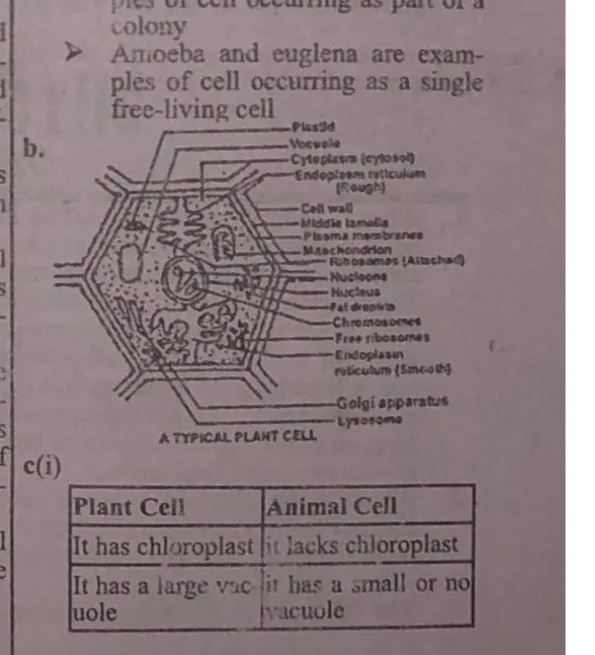
SECTION A 1(a)(i) List three forms in which living cells exist (ii) Give one example each of the forms listed in 1(a)(i) (b) Make a diagram, 6cm-10cm long, of a typical plant cell and label fully (c) In a tabular form, state three differences between a plant cell and animal cell
Model answer
(a)(i) Forms in which living cells exist: As part of a living organism As part of a colony or filament As a single free-living cell (ii) Examples: Skin cell is an example of a cell occurring as part of a living organism Volvox and Pandorina are examples of cell occurring as part of a colony Amoeba and euglena are examples of cells occurring as a single free-living cell (b) [See diagram: A typical plant cell, labeled with: Plastid, Vacuole, Cytoplasm (cytosol), Endoplasm reticulum (Rough), Cell wall, Middle lamella, Plasma membrane, Mitochondrion, Ribosomes (attached), Nucleus, Nucleolus, Fat droplets, Chromosomes, Free ribosomes, Endoplasm reticulum (Smooth), Golgi apparatus, Lysosome] (c) Differences between Plant Cell and Animal Cell: | Plant Cell | Animal Cell | | It has chloroplast | It lacks chloroplast | | It has a large vacuole | It has a small or no vacuole | | It has cell wall | It lacks cell wall | | It lacks centriole | It has centriole |
Advertisement
Sign up free to unlock
- Score tracking
- Practice history
- Saved questions
- Progress dashboard
- Personalized sessions
- Weak-topic breakdown
…and/or go further with premium services and No Ads.