All 5 questions from the West African Examinations Council (WAEC) Biology 2019 Theory paper, with the correct answer and a full explanation for each. Free, no signup needed.
1(a)(i) Complete the table below with the respiratory surface of each of the listed organisms: Tadpole (2 days old); Cockroach; Domestic fowl; Talinum; Earthworm; Amoeba. (ii) State five characteristic features of respiratory surfaces in organisms. (b) Make a drawing, 4cm to 6cm long of the respiratory organ in Tilapia and label fully.
Model answer
(a)(i) Respiratory surface table: Tadpole (2 days old) - External gill. Cockroach - Tracheal system. Domestic fowl - Lungs. Talinum - Stomata. Earthworm - Body surface. Amoeba - Body surface.
(ii) Characteristic features of respiratory surfaces in organisms (any five): They have large surface area; They are thin; They are highly vascularized; They are moist; They are permeable.
(b) [Drawing: labelled diagram of the respiratory organ (gills) in Tilapia, showing the oral cavity, buccal cavity, pharyngeal cavity, gills, branchial cavity, stomach, air-breathing organ/lung, and intestine, as relevant to the fish's respiratory and digestive structures.]
The table below shows the percentage composition of a fat and protein in six different meat types (A-F). Study it and answer questions 2(a) to 2(g). (a)(i) Which two of the meat types may be recommended for an obese patient? (ii) State one reason for the answer in 2(a)(i). (b)(i) Which two of the meat types would provide the most energy? (ii) State two reasons for the answer in 2(b)(i). (c)(i) Which three of the meat types would be recommended for a child suffering from kwashiorkor? (ii) State one reason for the answer in 2(c)(i). (d) Which of the meat types would most likely be suitable for (i) an active teenager, (ii) a 70-year old human? (e) Which other class of food provides energy in the human body? (f) State three uses of fat in the human body. (g) Describe briefly the procedure for testing for fat in a meat sample using a piece of white paper.
Model answer
(a)(i) The meat types that may be recommended for obese patients are types A and D. (ii) This is because meat types A and D have low fat content and are rich in protein.
(b)(i) The meat types that will provide the most energy are B and C. (ii) This is because these meat types contain a large percentage of fats.
(c)(i) The three most suitable meat types for a child suffering from kwashiorkor are types A, C and D. (ii) It is because meat types A, C and D contain a high percentage of proteins.
(d)(i) An active teenager needs meat type B. (ii) The meat type that would most likely be suitable for a 70-year old human is type D.
(e) Apart from fats and oils, the other food class that provides a considerable amount of energy is carbohydrate.
(f) Uses of fat in the human body (any three): It provides energy; It serves as insulator; It protects vital organs.
(g) To test for fat in a meat sample, it should be rubbed against a white paper. The appearance of a translucent spot indicates/confirms the presence of fat.
3(a) Classify the following biological associations under the headings in the table below: (i) Remora and shark; (ii) Lichen; (iii) Cattle and white Egret; (iv) Tapeworm in the gut of humans; (v) Flowers and honeybees; (vi) Mistletoe and cacao plant. (b)(i) State three adaptive features of parasites. (ii) State two effects of parasites on their hosts. (c)(i) What are saprophytes? (ii) Give four examples of saprophytes.
Model answer
(a) Classification table: Parasitism - Tapeworm in the gut of human; mistletoe and cacao plant. Mutualism - Flowers and honeybee; lichen. Commensalism - Cattle and white egret, Remora and shark.
(b)(i) Adaptive features of parasites (any three): Possession of structures for the attachment to the host; Ability to reproduce in large number; Possession of structure to withstand harsh conditions.
(ii) Effects of parasites on their hosts (any two): The host may experience loss in weight; The host may eventually die.
(c)(i) Saprophytes are organisms that obtain their nutrient from dead and decaying organic matter.
(ii) Examples of saprophytes: Rhizopus, mushroom, Mucor and toadstool.
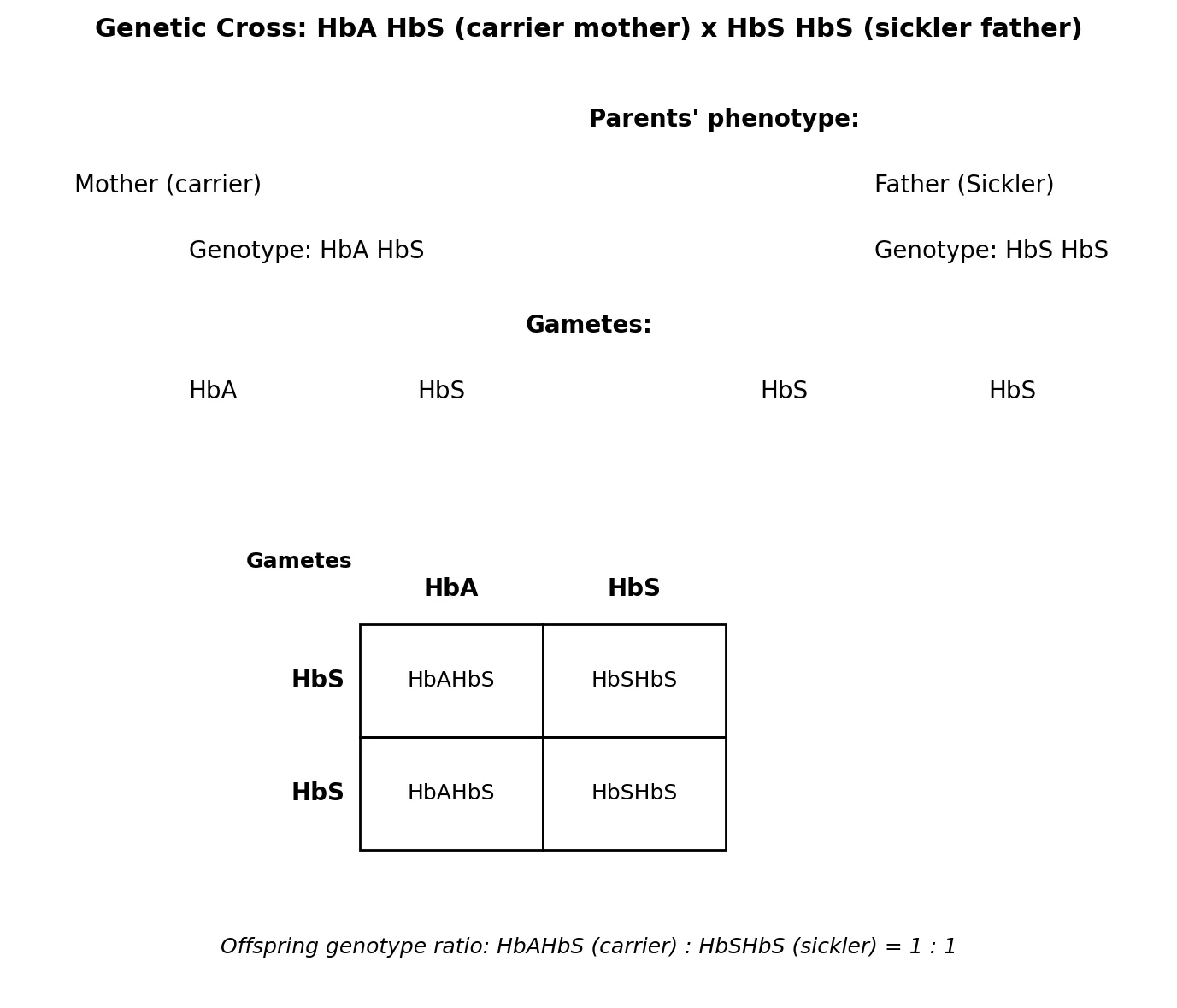
4(a) A female heterozygote for sickle cell married a Sickler. With the aid of a genetic diagram, determine the: (i) possible genotype of their offspring; (ii) phenotypic ratio of the offspring. (b) Explain briefly the reason why a Rhesus negative woman married to a Rhesus positive man might lose her second pregnancy. (c) Name two examples of features in animals that support the theory of use and disuse of body parts as used by Lamarck. (d) List three structures in mammals that are vestigial.
Model answer
(a) See the genetic cross diagram in the Diagram column, showing the cross between HbAHbS (carrier mother) and HbSHbS (sickler father). (i) Possible genotypes of the offspring: HbAHbS (carrier) and HbSHbS (Sickler). Since HbAHbS is a carrier while HbSHbS is a sickler, two out of the four offspring are carriers while the other two are Sicklers. (ii) Thus, the ratio of carriers to Sicklers = 1:1.
(b) If the child inherits the rhesus factor from its father, the rhesus factor will enter the mother's blood stream. In response, the mother's system will develop the anti-rhesus antibodies. These antibodies will then enter the bloodstream of the foetus, leading to the destruction of the red blood cells of the foetus. This will weaken or kill the baby at birth. This occurrence may repeat itself in subsequent pregnancies.
(c) Examples of features in animals that support the theory of use and disuse (Lamarckism): Long leg of herons; Long neck of giraffes.
(d) Examples of vestigial organs in mammal: appendix, body hair and coccyx in man.
SECTION C
6(a) Explain briefly the importance of the following factor and organisms in the nitrogen cycle: (i) lightning; (ii) Nitrosomonas; (iii) Azotobacter. (b) Name the excretory organ in: (i) insects; (ii) earthworm. (c) Explain briefly the following diseases: (i) hepatitis; (ii) kidney stones. (d)(i) State three effects of lack of sense receptors in the skin to humans. (ii) List the layers of the epidermis in the skin of human. (e) What is metamorphosis? State the type of metamorphosis exhibited by each of the following insects listed in the table below: Grasshopper; Cockroach; Butterfly; Mosquito; housefly.
Model answer
(a)(i) Lightening is essential to the nitrogen cycle as it causes nitrogen and oxygen to combine forming nitrogen oxides. These oxides are further oxidized to eventually produce nitrogen(IV)oxide, which then dissolves in rain water to form HNO2 and HNO3. These nitrates are utilized by plants.
(ii) Nitrosomonas acts on ammonia or ammonium compound, converting it into nitrite. NB: The eventual conversion of nitrite into nitrate is by another bacterium known as Nitrobacter.
(iii) Azotobacter (and other bacteria such as Rhizobium leguminosarium) help in nitrogen fixation. These bacteria help to fix atmospheric nitrogen into the soil. The relationship between azotobacter and these plants is said to be mutualistic because the bacteria obtain nutrient and shelter from the plant.
(b)(i) The malpighian tubules are the excretory structures in insects.
(ii) The excretory organ in earthworm is the nephridium.
(c)(i) Hepatitis is the inflammation of liver cells. It may occur as a result of infection.
(ii) Kidney stones are hard deposits of minerals and acid salts that stick together in concentrated urine. They are usually painful when passed through the urinary tract.
(d)(i) The lack of sense receptors in the skin of human will cause: Inability to detect pain; Inability to detect heat; Inability to detect pressure; Inability to detect touch.
(ii) The layers of the epidermis are the horny or cornified layer, granular layer and the malpighian layer.
(e)(i) Metamorphosis refers to the series of gradual changes that occur during the development of an animal from the zygote to the adult stage.
(ii) Type of metamorphosis: Grasshopper - Incomplete; Cockroach - Incomplete; Butterfly - Complete; Mosquito - Complete; Housefly - Complete.
Advertisement
Sign up free to unlock
Score tracking
Practice history
Saved questions
Progress dashboard
Personalized sessions
Weak-topic breakdown
…and/or go further with premium services and No Ads.