All 19 questions from the West African Examinations Council (WAEC) Biology 2024 Theory paper, with the correct answer and a full explanation for each. Free, no signup needed.
State one function each of the following parts of the nephron: (i) glomerulus; (ii) Bowman's capsule; (iii) proximal convoluted tubule; (iv) distal convoluted tubule.
Model answer
(i) Glomerulus: carries out ultrafiltration — filters the blood passing through it.
(ii) Bowman's capsule: collects the filtrate from the glomerulus.
(iii) Proximal convoluted tubule: carries out selective reabsorption — reabsorbs certain nutrients/materials/substances/amino acids, vitamins.
(iv) Distal convoluted tubule: causes tubular secretion/secretion of molecules/ions; reabsorbs water.
Complete the table below by stating the structure for excretion and the form in which waste is excreted for each organism: Flatworm, Earthworm, Cockroach, Human, (Green) Plant. (The Amoeba/Paramecium row is given as an example: Contractile vacuole; Gaseous/Liquid.)
An individual ate a hot and large meal of cassava with salty groundnut soup. The individual was sweating profusely and did not drink water after the meal. (a) State one role each played by the following organs involved in the activity above: (i) mouth; (ii) skin; (iii) tongue; (iv) kidney; (v) stomach; (vi) small intestine; (vii) large intestine; (viii) liver.
Model answer
(i) Mouth — contains salivary glands/secretes saliva which contains ptyalin/salivary amylase; moistens/softens the food.
(ii) Skin — excretes sweat/controls body temperature; excretes excess salt/eliminates excretory wastes.
(iii) Tongue — tastes the food; rolls the food into a bolus.
(iv) Kidney — excretes excess salt/excess water; carries out osmoregulation.
(v) Stomach — temporary storage of food; churning of food and turning it into chyme.
(vi) Small intestine — maltase converts maltose to glucose; lipase converts fats and oil to glycerol and fatty acids.
(vii) Large intestine — absorbs water from undigested food; moves waste to the rectum as faeces for expulsion through the anus.
(viii) Liver — deaminates excess amino acid; converts excess glucose to glycogen for storage.
(i) State one effect that the excess salt in the meal might have on the individual. (ii) State three advantages that the individual would derive from the meal.
Model answer
(i) Effects of excess salt: enlarges the heart muscle; stomach cancer; headache; dehydration; heart failure; high blood pressure; stroke; kidney disease/kidney stone (any one).
(ii) Advantages derived from the meal: prevents cardiovascular diseases; improves energy and mood; manages diabetes; promotes skin, nail and hair health; improves digestion; strengthens the immune system (any three).
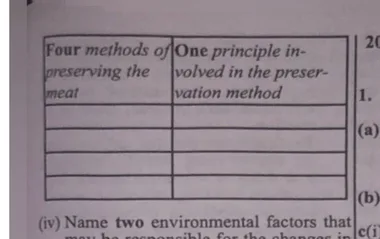
A piece of raw meat was left in an uncovered bowl for seven days. (i) State four likely changes that would be observed in the meat. (ii) Name the biological process that led to the changes observed in the meat. (iii) On the table below, list four methods of preserving meat to prevent it from the changes stated, and mention the principle involved in the methods.
Model answer
(i) Likely changes: bad odour/offensive smell; change in texture/slimy texture; change in colour/greenish colour/rot; presence of water around the meat; presence of microbial growth; presence of maggots (any four).
(ii) Biological process: Decay/decomposition/putrefaction.
(iii) Methods and principles:
Freezing — reduces the growth of micro-organisms.
Drying — removal of moisture/water content to prevent growth/multiplication of microbes.
Salting — salt kills micro-organisms by increasing the osmotic pressure in the meat.
Frying — involves the immersion of foods in boiling oils/dehydrates the items and decreases microbial growth.
Canning — involves heating to kill micro-organisms.
Smoking — reduces the water content of the meat; kills micro-organisms; prevents the entry of new ones. (Any four)
Complete the table below by stating the type of cell division and set of chromosomes for the listed cells: Onion cell, Sperm cell, Pollen grain, Ovum, Guard cell, Check cell (the Check cell row is given as diploid).
Mitosis is a type of cell division in which a cell replicates its chromosomes and segregates them, thereby producing two identical daughter cells with the same number of chromosomes as the parent cell.
Explain briefly how parents with blood groups A or B could have an offspring with blood group O.
Model answer
Parents with blood group A would have genotype AO, while the parent with blood group B would have genotype BO. When an individual with blood group AO mates with an individual with blood group BO, the offspring could be AB, BO, AO and OO; OO is the recessive genotype that gives blood group O.
Explain briefly how genes are involved in the process of evolution.
Model answer
Genes are inherited by the next generation through reproduction. Sometimes a mutation may cause a change in the gene, which alters the expression of a trait or produces a different characteristic. Some of the newly acquired traits make an organism better adapted to its environment, and the traits may be passed on to offspring of different generations.
(i) What is competition? (ii) List two types of competition. (iii) List four factors that organisms compete for in a habitat. (iv) Explain briefly the relationship between competition and succession.
Model answer
(i) Competition is the struggle for resources by organisms living in the same habitat, especially when the resources are limited; it could be between organisms of the same species or of different species.
(ii) Types of competition: intra-specific competition; inter-specific competition.
(iii) Factors organisms compete for in a habitat: space/territory/shelter; water/light; food; mate; inorganic substances. (Any four)
(iv) Relationship between competition and succession: succession is the changes that occur in the population of organisms in a habitat, until a climax is reached; for this change to occur, there must be competition between the old population and the new one.
(i) What is structural adaptation? (ii) State four types of structural adaptation in animals.
Model answer
(i) Structural adaptation is the possession of special structures which allow an organism to survive and reproduce successfully in its habitat.
(ii) Types of structural adaptation in animals: adaptation for obtaining food; adaptation for securing a mate; adaptation for water conservation; adaptation for offence and defence; adaptation for controlling temperature. (Any four)
Complete the table below by listing three types of adaptive colouration in animals and give one example each of an animal that shows the type of colouration (a sample row is given: Camouflage — Chameleon).
Model answer
(Any three of the pairs shown in the diagram column, e.g.:)
Warning colouration — Variegated grasshopper.
Protective/Cryptic colouration (concealing) — Green snakes in green grasses / lizard / lady bird.
Mimicry — Moth / grasshopper.