Free account: track your progress — Sign up free

WAEC Chemistry 2018 Objective Past Questions

All 50 questions from the West African Examinations Council (WAEC) Chemistry 2018 Objective paper, with the correct answer and a full explanation for each. Free, no signup needed.

Advertisement

Chemistry 2018 Objective — Question 1

Which of the following raw materials is used in the plastic industry?

  • A. EtheneCorrect
  • B. Methane
  • C. Sulphur
  • D. Hydrogen

Explanation

Ethene is polymerised to form polythene, making it a key raw material for the plastic industry.

Chemistry 2018 Objective — Question 2

Which of the following organic compounds can undergo both addition and substitution reactions?

  • A. Pentane
  • B. BenzeneCorrect
  • C. Propane
  • D. Hexane

Explanation

Benzene, despite its ring stability, can undergo both substitution (its typical reaction) and addition reactions under certain conditions; the alkanes (pentane, propane, hexane) are saturated and can only undergo substitution.

Chemistry 2018 Objective — Question 3

Which of the following equations represents a redox reaction?

  • A. AgNO₃(aq)+KCl(aq)→AgCl(s)+KNO₃(aq)
  • B. HNO₃(aq)+NaOH(aq)→NaNO₃(aq)+H₂O(l)
  • C. CaCO₃(s)→CaO(s)+CO₂(g)
  • D. 2H₂S(g)+SO₂(g)→2H₂O(l)+3S(s)Correct

Explanation

In 2H₂S+SO₂→2H₂O+3S, sulphur's oxidation state changes in both reactants (H₂S is oxidised, SO₂ is reduced), making it the redox reaction; the others are simple precipitation, neutralisation, or decomposition.

Chemistry 2018 Objective — Question 4

The process of extraction of iron from its ore is by

  • A. decomposition
  • B. oxidation
  • C. reductionCorrect
  • D. sublimation

Explanation

Iron is extracted from its ore (haematite) by chemical reduction using carbon monoxide in the blast furnace.

Chemistry 2018 Objective — Question 5

What is the solubility of a salt if 0.4g of it is obtained on evaporating 200cm³ of its saturated solution to dryness?

  • A. 0.08 gdm⁻³
  • B. 2.00 gdm⁻³Correct
  • C. 8.00 gdm⁻³
  • D. 80.00 gdm⁻³

Explanation

Solubility = mass/volume(dm³) = 0.4g / 0.2dm³ = 2.0 gdm⁻³.

Chemistry 2018 Objective — Question 6

An acidic salt has a double anions in its aqueous solution

  • A. a single cation in its aqueous solution
  • B. hydrogen ions in its aqueous solution
  • C. hydrogen atoms in its aqueous solutionCorrect
  • D. -

Explanation

An acidic salt (e.g. NaHSO₄, NaHS) releases hydrogen ions (H⁺) in aqueous solution, in addition to its normal cation and anion.

Chemistry 2018 Objective — Question 7

A reaction is endothermic if the

  • A. reaction vessel feels cool during the reactionCorrect
  • B. enthalpy change is negative
  • C. bond forming energy exceeds bond breaking energy
  • D. heat of formation of reactants exceeds heat of formation of products

Explanation

In an endothermic reaction, heat is absorbed from the surroundings, so the reaction vessel feels cold to the touch.

Chemistry 2018 Objective — Question 8

In which of the following compounds does hydrogen form ionic compound?

  • A. CH₄
  • B. HCl
  • C. NH₃
  • D. NaHCorrect

Explanation

In NaH, hydrogen exists as the H⁻ ion, forming an ionic (electrovalent) bond with sodium; in CH₄, HCl and NH₃ hydrogen is covalently bonded.

Chemistry 2018 Objective — Question 9

Consider the following reaction equation: Br₂ + 2KI → 2KBr + I₂. Bromine is reacting as a(n)

  • A. oxidizing agentCorrect
  • B. reducing agent
  • C. acid
  • D. base

Explanation

The oxidation number of bromine decreases from 0 (in Br₂) to −1 (in KBr) — bromine is reduced, meaning it acts as the oxidizing agent.

Chemistry 2018 Objective — Question 10

An organic compound has the empirical formula CH. If its molar mass is 42 gmol⁻¹, what is its molecular formula? [H=1.0, C=12.0]

  • A. C₂H₄
  • B. C₃H₆Correct
  • C. C₃H₈
  • D. C₄H₈

Explanation

Empirical formula mass CH = 13. n = 42/14... using (CH)n=42 → n=42/13≈3, so molecular formula = C₃H₆ (mass 42).

Chemistry 2018 Objective — Question 11

Ethene is produced from ethanol by

  • A. decomposition
  • B. hydrolysis
  • C. ozonolysis
  • D. dehydrationCorrect

Explanation

Ethanol undergoes dehydration (loss of water) using excess concentrated H₂SO₄ at about 180°C to produce ethene.

Chemistry 2018 Objective — Question 12

Consider the following equilibrium reaction: 2AB(g) + B₂(g) ⇌ 2AB₂(g) ΔH = −X kJmol⁻¹ the backward reaction will be favoured by

  • A. a decrease in pressureCorrect
  • B. an increase in pressure
  • C. a decrease in temperature
  • D. the introduction of a positive catalyst

Explanation

Since the backward reaction proceeds with an increase in volume (moles of gas), it is favoured by a decrease in pressure.

Chemistry 2018 Objective — Question 13

What is the mass of solute in 500cm³ moldm⁻³ H₂SO₄? [H=1.0, O=16.0, S=32.0]

  • A. 0.4908
  • B. 0.049
  • C. 0.245Correct
  • D. 0.245

Explanation

Volume = 500/1000 = 0.5dm³; concentration 0.005moldm⁻³ gives 0.0025mol; mass = 0.0025 × 98 = 0.245g.

Chemistry 2018 Objective — Question 14

Pure water can be made to boil at a temperature lower than 100°C by

Diagram for question 14
  • A. reducing its quantity
  • B. decreasing the external pressureCorrect
  • C. distilling it
  • D. increasing the external pressure

Explanation

The boiling point of water decreases with decreasing external (atmospheric) pressure.

Chemistry 2018 Objective — Question 15

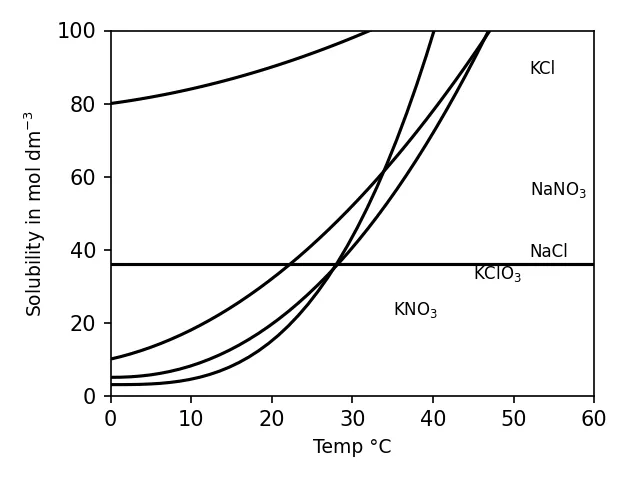
Consider the following sketch of the solubility curve of some substances. At what temperature does the solubility of KNO₃ equal that of NaNO₃?

  • A. 0°C
  • B. 20°CCorrect
  • C. 30°C
  • D. 40°C

Explanation

The solubility of KNO₃ equals that of NaNO₃ at the temperature where their solubility curves intersect — about 20°C.

Chemistry 2018 Objective — Question 16

When a salt is added to its saturated solution, the salt

  • A. dissolves and the solution becomes super saturated
  • B. dissolves and the solution becomes unsaturated
  • C. precipitates and the solution remains unchangedCorrect
  • D. dissolves and crystals are formed

Explanation

In a saturated solution, no more solute can dissolve, so any additional salt added simply precipitates out, leaving the solution unchanged.

Chemistry 2018 Objective — Question 17

When substance X was added to a solution of bromine water, the solution became colourless. X is likely to be

  • A. propane
  • B. propanoic acid
  • C. propyneCorrect
  • D. propanol

Explanation

A compound that decolourises bromine water must be unsaturated (an alkene or alkyne); propyne (an alkyne) fits this.

Chemistry 2018 Objective — Question 18

The preferential discharge of ions during electrolysis is influenced by the

  • A. mechanism of electrolysis
  • B. electrolytic reactions
  • C. nature of the electrodeCorrect
  • D. type of electrolytic cell

Explanation

Preferential discharge is influenced by factors including the position of the ion in the electrochemical series, concentration, and the nature of the electrode.

Chemistry 2018 Objective — Question 19

The valence electrons of ₁₂Mg are in the

  • A. 3s orbitalCorrect
  • B. 0.2Px orbital
  • C. 2s orbital
  • D. 1s orbital

Explanation

Magnesium (Z=12): 1s²2s²2p⁶6 3s². Its valence electrons occupy the 3s orbital.

Chemistry 2018 Objective — Question 20

Stainless steel is an alloy comprising of

  • A. Fe and CCorrect
  • B. Fe and Ni
  • C. Fe, C and Ni
  • D. Fe, C and Al

Explanation

Stainless steel is primarily an alloy of iron and carbon (with chromium and nickel typically added); of the given options, Fe and C best represents its base composition.

Chemistry 2018 Objective — Question 21

The number of hydrogen ions in 1.0dm³ of 0.02moldm⁻³ tetraoxosulphate(VI) acid is [N_A=6.02×10²³]

  • A. 1.2×10²²
  • B. 1.2×10²³
  • C. 2.4×10²²Correct
  • D. 2.4×10²³

Explanation

moles H₂SO₄ = 0.02mol → moles H⁺ = 0.04mol. Number of ions = 0.04 × 6.02×10²³ = 2.4×10²².

Chemistry 2018 Objective — Question 22

The most suitable substance for putting out petrol fire is

  • A. water
  • B. carbon (IV) oxideCorrect
  • C. fire blanket
  • D. sand

Explanation

Carbon (IV) oxide (CO₂) is the most suitable extinguishing agent for petrol fires as it smothers the flame without spreading burning fuel (unlike water).

Chemistry 2018 Objective — Question 23

The following factors would contribute to environmental pollution except

  • A. production of ammonia
  • B. manufacture of cement
  • C. photosynthesisCorrect
  • D. combustion

Explanation

Photosynthesis actually consumes CO₂ (a greenhouse gas) and reduces pollution, unlike the other listed industrial/combustion processes.

Chemistry 2018 Objective — Question 24

The position of equilibrium in a reversible reaction is affected by

Diagram for question 24
  • A. particle size of the reactants
  • B. vigorous stirring of the reaction mixture
  • C. presence of a catalyst
  • D. change in concentration of reactantsCorrect

Explanation

The position of equilibrium is affected by concentration, pressure, and temperature changes — not by particle size, stirring, or catalysts (which only affect rate).

Chemistry 2018 Objective — Question 25

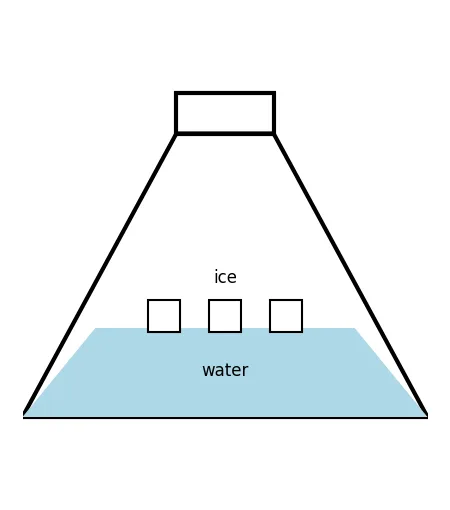
The diagram below illustrates a conical flask containing water and ice. Which of the following statements about the diagram is correct?

  • A. the water is at a lower temperature than the ice
  • B. energy is absorbed when the ice changes to waterCorrect
  • C. energy is released when the ice changes to water
  • D. the water molecules vibrate about a fixed point

Explanation

Melting is an endothermic process — energy is absorbed from the surroundings as the ice changes to water.

Chemistry 2018 Objective — Question 26

Which of the following statements best explains the differences between a gas and a vapour?

  • A. unlike gases, vapours are liquids at room temperature
  • B. unlike gases, vapour can easily be condensed into liquidsCorrect
  • C. unlike gases, vapor is readily converted into solids
  • D. vapours are generally denser than gases

Explanation

A vapour, unlike a true gas, can be liquefied by pressure alone at room temperature, since it exists below its critical temperature.

Chemistry 2018 Objective — Question 27

Consider the following reaction equations: 2HCl+Ca(OH)₂→CaCl₂+2H₂O. What is the volume of 0.1 moldm⁻³ HCl that would completely neutralize 25cm³ of 0.3 moldm⁻³ Ca(OH)₂?

  • A. 150cm³Correct
  • B. 75cm³
  • C. 30cm³
  • D. 25cm³

Explanation

Using CaVa/na = CbVb/nb with na=2 (HCl), nb=1 (Ca(OH)₂): Va = (0.3×25×2)/(0.1×1) = 150cm³.

Chemistry 2018 Objective — Question 28

Cu and HNO₃ are not suitable for preparing hydrogen gas because of their

  • A. reactivity and oxidation respectivelyCorrect
  • B. conductivity and corrosiveness respectively
  • C. melting point and reduction respectively
  • D. electronegativity and solubility respectively

Explanation

Copper is too unreactive (below hydrogen in the electrochemical series) to displace hydrogen, while HNO₃'s strong oxidizing nature converts any hydrogen produced into water instead.

Chemistry 2018 Objective — Question 29

Which of the following formula cannot be an empirical formula?

  • A. CH
  • B. CH₂
  • C. P₂O₅
  • D. N₂O₄Correct

Explanation

An empirical formula must be in its simplest whole-number ratio; N₂O₄ can be reduced further to NO₂, so it is not an empirical formula.

Chemistry 2018 Objective — Question 30

One of the criteria for confirming the purity of benzene is to determine its

  • A. heat capacity
  • B. boiling pointCorrect
  • C. P₂O₅
  • D. colour

Explanation

The purity of a liquid such as benzene can be confirmed by its boiling point — presence of impurity raises the boiling point above the pure substance's known value.

Chemistry 2018 Objective — Question 31

When chlorine is passed through a sample of water, the pH of the water sample would

  • A. < 7Correct
  • B. > 7
  • C. equal to 7
  • D. 0

Explanation

Chlorine is an acidic gas; when passed into water it forms HCl and HOCl, lowering the pH below 7.

Chemistry 2018 Objective — Question 32

How many atoms are contained in 0.2 moles of nitrogen? [N_A=6.02×10²³]

  • A. 1.20×10²³
  • B. 2.41×10²³Correct
  • C. 3.62×10²³
  • D. 4.82×10²³

Explanation

1 mole of N₂ contains 2 moles of N atoms. 0.2mol N₂ → 0.4mol N atoms. Number = 0.4×6.02×10²³ = 2.41×10²³.

Chemistry 2018 Objective — Question 33

The strength of metallic bonds depends on the

  • A. charge density of the atoms
  • B. ductility of the metal
  • C. number of valence electronsCorrect
  • D. total number of electrons in the atom

Explanation

The strength of a metallic bond varies directly with the number of valence electrons contributed to the delocalised 'sea of electrons', other factors being constant.

Chemistry 2018 Objective — Question 34

When Zinc is added to AgNO₃ solution, crystals of silver form on surface. This indicates that zinc is

  • A. oxidizedCorrect
  • B. reduced
  • C. decomposed
  • D. dissociated

Explanation

Zinc loses electrons to displace silver from solution (Zn → Zn²⁺ + 2e⁻), meaning zinc is oxidized.

Chemistry 2018 Objective — Question 35

The empirical formula of a compound containing 0.067 mol Cu and 0.066 mol O is [Cu=63.5, O=16.0]

  • A. Cu₂O
  • B. CuOCorrect
  • C. CuO₂
  • D. Cu₂O₄

Explanation

Mole ratio Cu:O ≈ 0.067:0.066 ≈ 1:1, giving empirical formula CuO.

Chemistry 2018 Objective — Question 36

The change in the oxidation state of iron in the reaction represented by the equation below is 2FeCl₃+H₂S→2FeCl₂+2HCl+S

  • A. +2 to +3
  • B. +3 to +2Correct
  • C. 0 to +2
  • D. +3 to 0

Explanation

Iron changes from the +3 oxidation state in FeCl₃ to the +2 state in FeCl₂.

Chemistry 2018 Objective — Question 37

Which of the following methods can be used to separate blood cells from plasma?

  • A. centrifugationCorrect
  • B. filtration
  • C. chromatography
  • D. distillation

Explanation

Blood cells can be separated from plasma by centrifugation, which spins the denser cells to the bottom.

Chemistry 2018 Objective — Question 38

Which of the following statements about ionic radius is correct? Ionic radius

  • A. increase as nuclear charge increases
  • B. decreases as nuclear charge increasesCorrect
  • C. decreases as nuclear charge decreases
  • D. remains constant as nuclear charge increases

Explanation

Across a period, as nuclear charge increases, the increased pull on electrons causes ionic (and atomic) radius to decrease.

Chemistry 2018 Objective — Question 39

Analysis of a hydrocarbon shows that it contains 0.93g of carbon per gram of the compound. The mole ratio of carbon to hydrogen in the compound is [H=1.0, C=12.0]

  • A. 1:1Correct
  • B. 1:2
  • C. 2:1
  • D. 2:3

Explanation

Carbon = 0.93g, Hydrogen = 1−0.93 = 0.07g. Moles: C=0.93/12≈0.0775, H=0.07/1=0.07. Ratio ≈ 1:1.

Chemistry 2018 Objective — Question 40

The law of definite proportions states that

  • A. pure samples of the same compound contains the same elements combined in the same portion by massCorrect
  • B. pure samples of substances are in the same proportion
  • C. chemical compounds are pure because they contain elements
  • D. matter can neither be created nor destroyed

Explanation

The law of definite proportions (constant composition) states that a pure compound always contains the same elements combined in the same fixed proportion by mass.

Chemistry 2018 Objective — Question 41

What is the relative molecular mass of a compound which has empirical formula CH₂O? [H=1.0, C=12.0, O=16.0]

  • A. 42
  • B. 45
  • C. 126
  • D. 180Correct

Explanation

Empirical formula mass CH₂O = 30. Testing the given options, only 180 is a whole-number multiple of 30 (180=30×6), so the molecular mass is 180.

Chemistry 2018 Objective — Question 42

Atoms are electrically neutral because they

  • A. do not conduct electricity
  • B. contain equal number of protons and electronsCorrect
  • C. are composed of neutrons and electrons
  • D. cannot be attracted by electromagnetic field

Explanation

An atom is neutral because the number of positively charged protons equals the number of negatively charged electrons.

Chemistry 2018 Objective — Question 43

Common salt (NaCl) is used for preserving foods. Which of the following properties could be used to determine its purity before use?

  • A. solubility in water
  • B. melting pointCorrect
  • C. relative density
  • D. crystalline nature

Explanation

The purity of a solid such as NaCl can be assessed by its melting point — a pure sample melts sharply at a known temperature, while an impure one melts over a range.

Chemistry 2018 Objective — Question 44

Which of the following electron configurations represents the transition element chromium (₂₄Cr)?

  • A. 1s²2s²2p⁶6 3s²3p⁶6 4s²3d⁴
  • B. 1s²2s²2p⁶6 3s²3p⁶6 4s²3d⁶
  • C. 1s²2s²2p⁶6 3s²3p⁶6 4s¹3d⁵Correct
  • D. 1s²2s²2p⁶6 3s²3p⁶6 4s²3d⁵

Explanation

Chromium is an exception to the normal filling order: its actual configuration is [Ar]4s¹3d⁵ (one electron shifts from 4s to 3d for a more stable half-filled d-subshell).

Chemistry 2018 Objective — Question 45

The atomic number of an isotope of hydrogen is equal to its mass number. This isotope is

  • A. ¹H (protium)Correct
  • B. ²H (deuterium)
  • C. ³H (tritium)
  • D. none of these

Explanation

Protium (¹₁H), the most common isotope of hydrogen, has 1 proton and 0 neutrons, so its atomic number equals its mass number (both = 1).

Chemistry 2018 Objective — Question 46

The total number of shared pairs of electrons in the compound shown below (H₂C=CH₂, ethene) is

  • A. 5
  • B. 6Correct
  • C. 10
  • D. 12

Explanation

Ethene (H₂C=CH₂) has 4 C–H single bonds (4 shared pairs) plus 1 C=C double bond (2 shared pairs) = 6 shared pairs of electrons.

Chemistry 2018 Objective — Question 47

The bonding pair of electrons in a hydrogen chloride molecule is pulled towards the chlorine atom because

  • A. chlorine has a larger atomic size
  • B. chlorine has a larger atomic mass
  • C. chlorine is more electronegativeCorrect
  • D. there is no bonding orbitals within the hydrogen atom

Explanation

Chlorine is more electronegative than hydrogen, so it pulls the shared bonding electron pair closer to itself.

Chemistry 2018 Objective — Question 48

The solubility of CO₂ in water can be accounted for by

  • A. van der Waal's forces
  • B. ionic attraction
  • C. dipole attractionCorrect
  • D. covalent bonding

Explanation

CO₂ dissolves in water partly due to dipole (dipole-induced dipole) attraction between the polar water molecules and the CO₂ molecule.

Chemistry 2018 Objective — Question 49

Which of the following properties would not influence electrovalent bond formation?

  • A. electronegativity
  • B. electron affinity
  • C. ionization potential
  • D. catalytic abilityCorrect

Explanation

Electrovalent (ionic) bond formation depends on electronegativity, electron affinity and ionization energy — catalytic ability has no bearing on bond formation.
Chemistry 2018 Objective — Question 50

Particles in a solid exhibit

  • A. vibrational motion onlyCorrect
  • B. translational motion only
  • C. vibrational and translational motion
  • D. random and translational motion

Explanation

In a solid, particles are fixed in position relative to each other and can only vibrate about these fixed points — they cannot move translationally.

Advertisement

Sign up free to unlock

  • Score tracking
  • Practice history
  • Saved questions
  • Progress dashboard
  • Personalized sessions
  • Weak-topic breakdown

…and/or go further with premium services and No Ads.