All 6 questions from the West African Examinations Council (WAEC) Chemistry 2020 Theory paper, with the correct answer and a full explanation for each. Free, no signup needed.
1(a)(i) State Faraday's first law of electrolysis. (ii) Distinguish between a strong electrolyte and weak electrolyte. (b) State one chemical property of ethyne. (c)(i) What is meant by the term unsaturated hydrocarbon? (ii) Complete the following reaction equation: CH3COOH + CH3OH -> (iii) Name the major product formed in the reaction stated in 1(c)(ii). (d) State one way by which the rate of esterification could be increased. (e) Consider the reaction represented by the following equation: Zn(s) + H2SO4(aq) -> ZnSO4(aq) + H2(g). If 3.75 g of Zn dust was added to excess H2SO4, calculate the number of molecules of hydrogen gas produced. [Zn=65.0, NA=6.02x10^23] (f) State one effect of global warming. (g) Consider the following reaction equations: A. Pb(NO3)2 + H2S -> PbS + 2HNO3 B. H2 + C2H4 -> C2H6 C. Zn(OH)2 + 2OH- -> [Zn(OH)4]2- (i) Which of the equations represent(s) a redox process? (ii) State the change in oxidation number of the species that are oxidized or reduced. (h)(i) State two of the main concepts of Bohr's model of the atom. (ii) State the limitation of Bohr's model. (i) List three factors that could influence the equilibrium position of a reversible reaction. (j) Calcium trioxocarbonate (IV) powder is added to separate equimolar solutions of hydrochloric acid and ethanoic acid. State one: (i) similarity in the observation in both reactions; (ii) difference in the observation in both reactions.
Model answer
(a)(i) Faraday's first law of electrolysis states that the mass of an element produced during electrolysis is directly proportional to the quantity of electricity passing through the electrolyte. M is proportional to Q; M=ZQ, Q=IT. Then, M=ZIT, where M=mass of element produced (g), Q=Quantity of electricity (C), I=current (A), t=time (sec), Z=Electrochemical equivalent (gC^-1).
(ii) A strong electrolyte ionizes/dissociates completely in solution while a weak electrolyte ionizes/dissociates only partially in solution.
(b) Ethyne reacts with excess hydrogen as at 200 C in the presence of nickel as a catalyst to produce ethane: C2H2+2H2 --(Ni,200C)--> C2H6. Ethyne also reacts very readily with excess hydrogen iodide at room temperature to form 1,1-diiodoethane: C2H2+2HI->C2H4I2.
(c)(i) An unsaturated hydrocarbon is one that has at least one carbon to carbon double or triple bond.
(ii) CH3COOH + CH3OH --(H+)--> CH3COOCH3 + H2O.
(iii) The name of the major product is methyl ethanoate.
(d) The rate of the reaction (esterification) could be increased by adding some drops of concentrated H2SO4.
(e) Zn(s)+H2SO4(aq)->ZnSO4(aq)+H2(g). Nzn=(3.75/65)mol=0.0577 mol. From the balanced equation of reaction, 1 mole of Zn produces 1 mole of H2. Thus, 0.0577 mol of H2. Number of H2 molecules = moles of H2 x Avogadro's constant = 0.0577 x 6.02x10^23 = 3.47x10^22.
(f) It may eventually cause flooding (as the polar ice caps melt).
(g)(i) Reaction 'B' is redox.
(ii) The oxidation number of hydrogen has increased from zero to +1 (oxidation) while that of carbon has decreased from -2 to -3 (reduction).
(h)(i) Main concepts of Bohr's model of the atom: Electrons orbit the nucleus at fixed energy levels; Orbits further from the nucleus exist at higher energy levels; When electrons return to a lower energy level, they emit energy in the form of light.
(ii) Limitation of Bohr's model: Poor spectral predictions when a larger atom is involved; Bohr's model does not explain the Zeeman effect.
(i) Factors that could influence the equilibrium position of a reversible reaction: Position in the electrochemical series; Concentration of the ions; Nature of the electrode.
(j)(i) Effervescence is produced in both cases.
(ii) The reaction is faster with hydrochloric acid than with ethanoic acid.
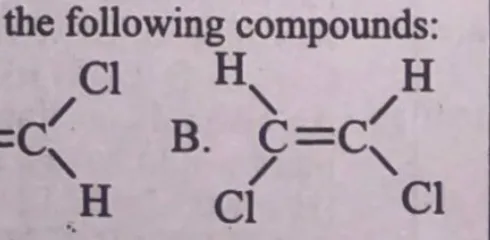
2(a) Consider the following compounds: A [H,Cl / C=C / H,Cl arranged trans] B [H,Cl / C=C / Cl,H arranged cis]. (i) What is the relationship between the compounds labelled A and B? (ii) Name each of compounds A and B. (iii) Will the chemical properties of compounds A and B be the same? (iv) Give the reason for the answer stated in 2(a)(iii). (b)(i) Give two characteristic features of boiling. (ii) What would be the effect of each of the following conditions on the boiling point of water? I. The addition of crystals of sodium chloride; II. Reduction of the atmospheric pressure. (c)(i) Differentiate between a saturated and an unsaturated solution. (ii) State two ways by which a saturated solution could be made to dissolve more solute. (iii) State one factor that could affect the solubility of a solid in a liquid.
Model answer
(a)(i) Compounds A and B are geometric isomers.
(ii) A is trans-1,2-dichloroethene; B is cis-1,2-dichloroethene.
(iii) Yes, A and B will have the same chemical properties.
(iv) This is because the compounds have the same functional group.
(b)(i) Characteristic features of boiling: Boiling occurs throughout the body of a liquid; It occurs at a definite temperature, known as the boiling point of the liquid.
(ii) I. The addition of crystals of sodium chloride (or any other impurity) will cause an increase in the boiling point of water. II. Reduction of the atmospheric pressure causes a decrease in the boiling point of water.
(c)(i) Boiling occurs at a fixed temperature (known as the boiling point of the liquid), while evaporation occurs at all temperatures. A saturated solution contains the maximum amount of solute it can hold at that temperature (in the presence of undissolved solute), while an unsaturated solution contains less than the amount of solute it can hold at that temperature.
(ii) Ways to make a saturated solution dissolve more solute: Increasing the temperature; Increasing the volume of the solvent.
(iii) Factors that could affect the solubility of a solid in a liquid: Nature of the solute; Nature of the solvent; Temperature.
3(a) In an equilibrium reaction of gases Q2 and R2 to form QR, the energy content of the reactants is 100 kJ and that of the activated complex is 210 kJ. (i) Draw an energy profile diagram for the reaction. (ii) Determine the: I. activation energy of the reaction; II. enthalpy change (Delta)H of the reaction. (iii) Write a balanced equation for the reaction. (iv) State whether the reaction is exothermic or endothermic. (v) Give a reason for the answer given in 3(a)(iv). (b) Consider the following table: Element E, F, G, H | Atomic number 7, 9, 12, 13. (i) Write the electron configuration for each of the elements. (ii) State: I. two elements that are metals; II. element(s) most likely to form ion with a charge of +3; III. the element(s) which belong(s) to group (VII) on the periodic table; IV. the formula of the compound formed between F and G. (c) Define the term Isotope. (d) Name the three building blocks of matter.
Model answer
(a)(i) [Energy profile diagram: y-axis Energy(kJ), x-axis Reaction progress. Reactants (Q2+R2) drawn at 100kJ, rising to a peak (activated complex) at 210kJ, then descending to products (2QR) at a lower energy level than the activated complex, illustrating an exothermic reaction profile.]
(ii) I. Activation energy = 210kJ - 100kJ = 110kJ. II. Q2+R2 -> 2QR (the reaction), with the enthalpy change (Delta)H being negative, since the energy involved in bond formation is greater than that involved in bond breaking.
(iii) Q2(g) + R2(g) -> 2QR(g).
(iv) The reaction is exothermic.
(v) This is because the energy involved in bond formation is greater than the energy involved in bond breaking.
(b)(i) Electron configuration: 7E = 1s2 2s2 2p3; 9F = 1s2 2s2 2p5; 12G = 1s2 2s2 2p6 3s2; 13H = 1s2 2s2 2p6 3s2 3p1.
(ii) I. 12G and 13H are metals. II. The element that will most likely form an ion with a charge of +3 is 13H. III. The element that belongs to group (VII) on the periodic table is 9F. IV. The formula of the compound formed between F and G is GF2.
(c) Isotopy is the occurrence of atoms of the same element with the same atomic number but different mass numbers.
(d) The building blocks of matter are: atoms, molecules and ions.
4(a)(i) In the laboratory preparation of dry chlorine gas, state the: I. reagents used; II. drying agents used; III. mode of collection. (b)(i) Name the main raw materials used for extraction of iron in the blast furnace. (ii) Write the equations of the reactions taking place in the blast furnace. (iii) What is the name given to the iron obtained directly from the blast furnace? (iv) State why the iron named in 4(b)(iii) have a relatively low melting point? (c) The following equation represents one of the reaction steps involved in the contact process: 2SO2(g) + O2(g) <=> 2SO3(g), (Delta)H=-395.7 kJ mol^-1. (i) Why is SO3 produced during the reaction not dissolved directly in water to form H2SO4? (ii) Why is H2SO4 regarded as a heavy chemical? (iii) State the property exhibited by tetraoxosulphate (IV) acid in each of the following reaction equations: I. Pb(NO3)2(aq) + H2SO4(aq) -> PbSO4(aq) + 2HNO3(aq); II. H2S(g) + H2SO4(aq) -> S(s) + 2H2O(l) + SO2(g). (d) Write a balanced chemical equation for the reaction between propanol and sodium.
Model answer
(a)(i) I. Reagents used in the laboratory preparation of dry chlorine gas: Hydrochloric acid and manganese (IV) oxide. II. Drying agent used: Concentrated H2SO4. III. Mode of collection: it is collected by downward delivery or upward displacement of air.
(b)(i) Main raw materials used for extraction of iron in the blast furnace: coke; Iron ore; Limestone.
(ii) Equations of reactions in the blast furnace: C+O2->CO2; C+CO2->2CO; Fe2O3+3CO->2Fe+3CO2; CaCO3 --(heat)--> CaO+CO2; CaO+SiO2->CaSiO3.
(iii) The iron obtained directly from the blast furnace is known as pig iron.
(iv) Pig iron has a relatively low melting point because it contains a high amount of carbon (as impurity).
(c)(i) It is because the direct dissolution of SO3 in water will release a huge amount of heat that can boil the acid formed and consequently cause a splash.
(ii) H2SO4 is regarded as a heavy chemical because it is produced and required in large quantities.
(iii) I. Precipitating agent. II. Oxidizing agent.
(d) 2C3H7OH + 2Na -> 2C3H7ONa + H2.
5(a)(i) Name two gases that can be used to perform the fountain experiment. (ii) What is the aim of the fountain experiment? (iii) Describe briefly the fountain experiment. (b)(i) Name two chemical industries. (ii) State three effects of a chemical industry on the community in which it is sited. (c)(i) Name three products of the destructive distillation of coal. (ii) Give one use each of any two of the products name in 5(c)(i). (d)(i) Name two substances responsible for hardness in water. (ii) State two methods for the removal of hardness. (iii) State two advantages of hard water.
Model answer
(a)(i) Gases that can be used to perform the fountain experiment: Hydrogen chloride gas; Ammonia; Sulphur (IV) Oxide.
(ii) It is to demonstrate the solubility of these gases.
(iii) Water is introduced through an inlet into a container filled with ammonia gas. Ammonia dissolves into the water and the pressure in the container drops. As a result, more water is forced into the container from another inlet creating a fountain effect.
(b)(i) Chemical industries: Pharmaceutical industry; Petroleum industry; Plastic industry; Petrochemical industry.
(ii) Effects of a chemical industry on the community in which it is sited: Employment opportunity; Development of the community; Improvement of standard of living.
(c)(i) Products of the destructive distillation of coal: Coke; Coal tar; Coal gas; Ammoniacal liquor.
(ii) Uses of products: Coke is used in the extraction of iron. Coal tar is used to manufacture paints, perfumes, dyes and explosives. Coal gas is used as a fuel in industries. Ammoniacal liquor is used as a source of nitrogen (for fertilizer production).
(d)(i) Substances responsible for hardness in water: Calcium hydrogen trioxocarbonate; Magnesium hydrogen trioxocarbonate; Calcium tetraoxosulphate (VI); Magnesium tetraoxosulphate (VI).
(ii) Methods for removal of hardness: Distillation; Use of ion exchange resin; Use of washing soda.
(iii) Advantages of hard water: Hard water tastes better because of the dissolved minerals in it; It does not dissolve lead pipe; Animals such as snails employ hard water in the formation of their shells.