All 50 questions from the West African Examinations Council (WAEC) Chemistry 2021 Objective paper, with the correct answer and a full explanation for each. Free, no signup needed.
The hydrolysis of proteins by dilute mineral acids produces
A. sucrose.B. glucose.C. amino acids.Correct D. fatty acids.Explanation Dilute mineral acids hydrolyse the peptide bonds in proteins, breaking them down into their constituent amino acids.
Which of the following oxides causes acid rain?
A. COB. NO2Correct C. H2OD. NO2Explanation Oxides such as NO2 and SO2 dissolve in atmospheric moisture to form acids, which fall as acid rain.
The ratio of carbon atoms to hydrogen atoms in a hydrocarbon is 1:2. If its molecular mass is 56, what is its molecular formula?
A. C3H6B. C4H8Correct C. C2H4D. CH2Explanation Empirical formula CH2 (mass 14). (CH2)n=56 → 14n=56 → n=4, giving molecular formula C4H8.
What is the relative molecular mass of the compound below? (benzene ring with -C(=O)-O-CH3 substituent) [H=1.0; C=12.0; O=16.0]
A. 137B. 136Correct C. 64D. 59Explanation The molecular formula is C8H8O2. R.M.M. = (12×8)+(1×8)+(16×2) = 96+8+32 = 136.
Cathodic protection of metals is based on
A. standard electrode potential of hydrogen.B. its electrical conductivity.C. nature of oxides formed.D. relative tendencies of oxidation.Correct Explanation Cathodic (sacrificial) protection works by attaching a more reactive metal that oxidises preferentially, based on relative tendencies of oxidation in the electrochemical series.
If humid air is polluted by chlorine discharge, the air can be restored by
A. sprinkling a solid MnO2.B. acidified KMnO4.Correct C. acidified FeSO4.D. saturated NaCl(aq).Explanation Acidified KMnO4 is a strong oxidising agent that can be sprinkled to remove/neutralise chlorine contamination in air.
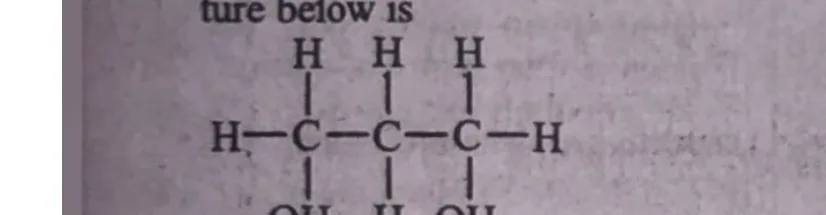
The alkanol represented by the structure below is (H-C-C-C-H chain with OH on carbons 1 and 3)
A. primary and dihydric.Correct B. secondary and monohydric.C. tertiary and dihydric.D. secondary and dihydric.Explanation The OH groups are on terminal (primary) carbons, and there are two OH groups, making it a dihydric (primary) alkanol.
Which of the following pairs of compounds would form a precipitate when their aqueous solutions are mixed?
A. NaCl and KNO3B. KCl and NaNO3C. K2SO4 and BaCl2Correct D. NH4NO3 and Na2CO3Explanation Mixing K2SO4 and BaCl2 produces insoluble BaSO4, a white precipitate.
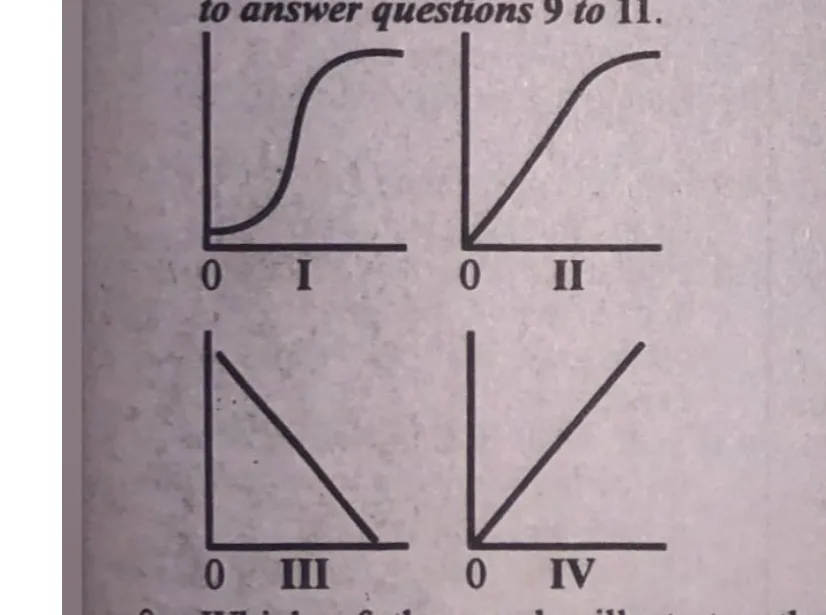
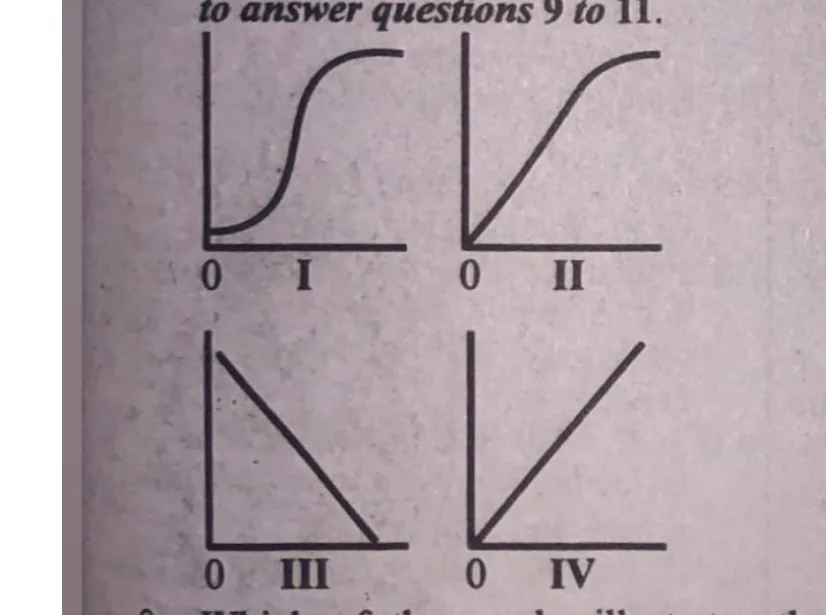
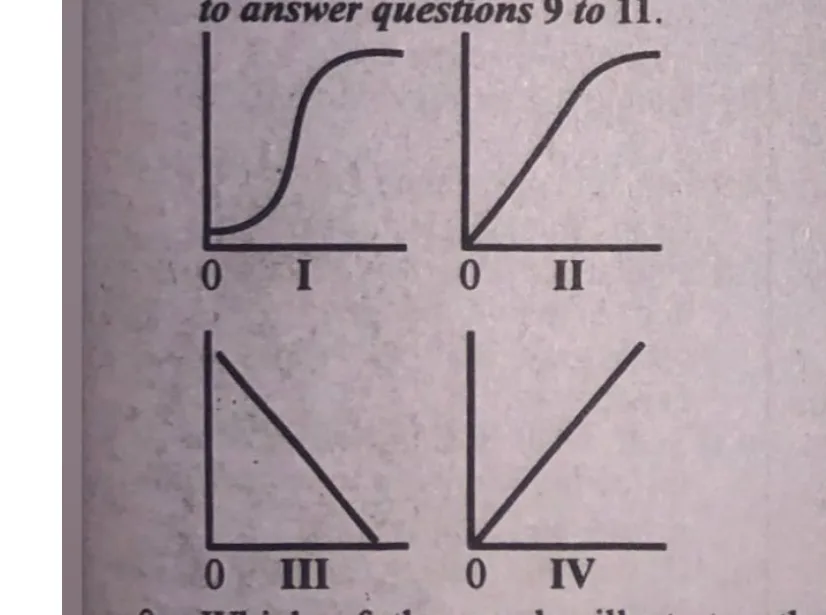
Study the graphs below (I, II, III, IV) and use them to answer questions 9 to 11. Which of the graphs illustrates the variation of the rate of evolution of a gas from a given length of magnesium ribbon (y-axis) with increase in the concentration of the acid added (x-axis)?
A. IB. IICorrect C. IIID. IVExplanation As acid concentration increases, the rate of gas evolution increases and levels off — the shape shown in graph II.
Which of the graphs illustrates the variation of the pH of a given volume of strong acid solution (y-axis) with the volume of strong base titrated against it (x-axis)?
A. ICorrect B. IIC. IIID. IVExplanation As base is added to the acid, pH rises steadily then sharply at the equivalence point — the shape shown in graph I.
Which of the graphs illustrates the variation of the solubility of a salt in water (y-axis) with increase in temperature (x-axis), if the dissolution process is exothermic?
A. IB. IIC. IIICorrect D. IVExplanation Since dissolution is exothermic, increasing temperature reduces solubility (Le Chatelier's principle) — a downward-sloping graph, shown in III.
The formation of ethene from dehydration of ethanol can be described as
A. an addition reaction.B. an elimination reaction.Correct C. an oxidation reaction.D. a substitution reaction.Explanation Dehydration of ethanol removes a water molecule from the molecule, which is an elimination reaction.
Which of the following gases is highly soluble in water at room temperature?
A. AmmoniaCorrect B. Carbon (IV) oxideC. ChlorineD. NitrogenExplanation Ammonia is extremely soluble in water due to hydrogen bonding, which is why it's used in the fountain experiment.
A molecule of phosphorus is
A. a diatomic.B. a triatomic.C. a tetraatomic.Correct D. a monoatomic.Explanation A molecule of phosphorus (P4) is tetraatomic, containing four phosphorus atoms.
The most common method of preparing insoluble salts is by
A. filtration.B. decomposition.C. neutralization.D. double decomposition.Correct Explanation Insoluble salts like AgCl are commonly prepared by double decomposition (precipitation) reactions, e.g. NaCl + AgNO3 → AgCl + NaNO3.
What number of moles of oxygen would exert a pressure of 10 atm at 320K in an 8.2dm³ cylinder? [R=0.082 atm dm³mol⁻¹K⁻¹]
A. 0.32B. 1.56C. 3.13Correct D. 31.25Explanation Using PV=nRT: n = PV/RT = (10×8.2)/(0.082×320) = 82/26.24 ≈ 3.13 mol.
The basic property of salts used as drying agents is
A. efflorescence.B. high melting point.C. hygroscopy.Correct D. low solubility.Explanation Drying agents are hygroscopic — they absorb moisture from the surrounding atmosphere.
What would be observed when aqueous ammonia is added in drops and then in excess to a solution of copper (II) ions?
A. A blue precipitate is formed which is soluble in excess ammoniaCorrect B. A brick red precipitate is produced which is insoluble in excess ammoniaC. A white precipitate is formed which is soluble in excess ammoniaD. A green precipitate is formed which is insoluble in excess ammoniaExplanation Cu²⁺ ions form a pale blue precipitate of Cu(OH)2 with dilute ammonia, which dissolves in excess ammonia to form a deep blue soluble complex.
When CuSO4(aq) is added to Pb(NO3)2(aq),
A. there would be no visible change.B. a blue precipitate would be formed.C. the resulting solution would become colourless.D. a white precipitate would be formed.Correct Explanation A double decomposition reaction occurs, forming insoluble white PbSO4 precipitate.
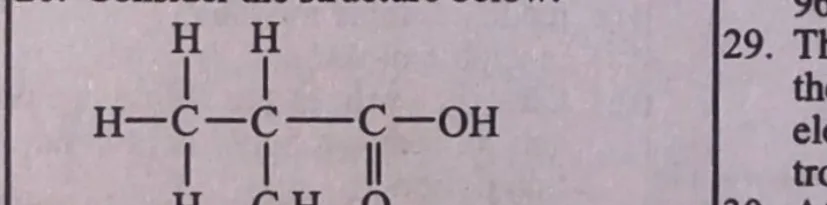
Consider the structure below (a carbon chain with -OH, a C2H5 branch, and a C=O group). How many carbon atoms does the parent chain contain?
Explanation Counting the longest continuous chain including the OH and C=O carbons gives 4 carbon atoms in the parent chain.
Under which conditions of pressure (P) and temperature (T) would the volume of an inflated balloon increase? When
A. both T and P are increasedB. both T and P are decreasedC. T is increased and P is decreasedCorrect D. T is decreased and P is increasedExplanation Volume is directly proportional to temperature and inversely proportional to pressure (combined gas law), so V increases when T rises and P falls.
The collision between ideal gas molecules are considered to be perfectly elastic because
A. they collide without losing energy.Correct B. they move randomly in straight lines.C. their average kinetic energy is variable.D. the distance between them is large compared to their sizes.Explanation An elastic collision is one where total kinetic energy is conserved — no energy is lost during collision.
Elements with high ionization energies would
A. lose electrons easily.B. have large atomic radii.C. have high effective nuclear charges.Correct D. have low atomic numbers.Explanation High ionization energy is associated with a strong (high) effective nuclear charge holding electrons tightly.
Which of the following statements about Group VII elements is correct?
A. They are present in the same physical stateB. They are strong reducing agentsC. Their reactivity decreases down the groupCorrect D. They exist as monoatomic moleculesExplanation Group VII (halogens) reactivity decreases down the group as atomic size increases and it becomes harder to attract an extra electron.
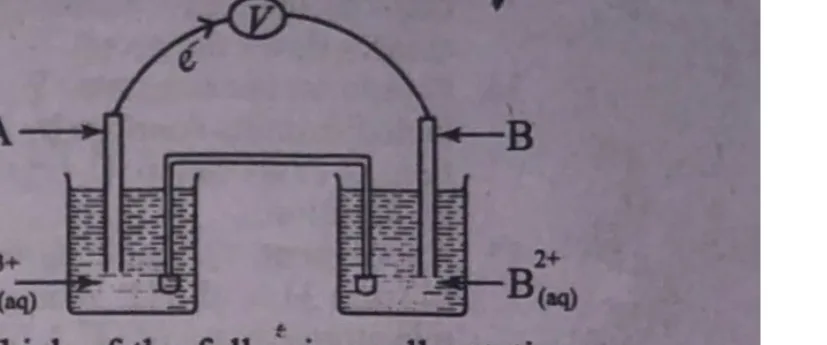
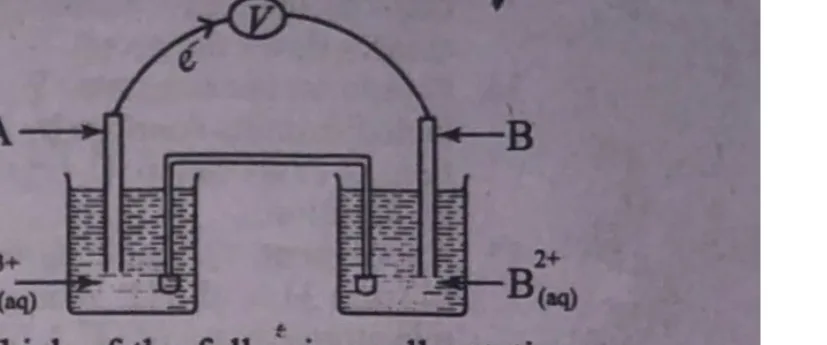
Consider the diagram below and use it to answer questions 25 and 26 (electrochemical cell with crystals A and B, A(aq)3+ and B(aq)2+). Which of the following cell notations represent the diagram?
A. B2+/B//A/A3+B. A3+/A//B/B2+C. B/B2+//A/A3+D. A/A3+//B2+/BCorrect Explanation By convention, the anode (oxidation) half-cell is written on the left and the cathode (reduction) half-cell on the right: A/A3+//B2+/B.
Which of the following half reaction equations represent the reaction at the cathode?
A. A3+(aq)+3e⁻→A(s)B. B2+(aq)+2e⁻→B(s)Correct C. A(s)→A3+(aq)+3e⁻D. B(s)→B2+(aq)+2e⁻Explanation At the cathode, reduction occurs. B2+ gains 2 electrons to form B(s): B2+(aq)+2e⁻→B(s).
The reactivity of fluorine is high because of
A. its high electronegativity.Correct B. the small size of the fluorine atom.C. the availability of d-orbitals.D. the strong F-F bond.Explanation Fluorine's very high electronegativity gives it a strong tendency to attract electrons, making it highly reactive.
How many coulombs of electricity would liberate 1.08g of Ag from a solution of silver salt? [Ag=108.0; 1F=96500C]
A. 96500CB. 9650CC. 965CCorrect D. 9.65CExplanation 1 mole of Ag (108g) requires 96500C. For 1.08g: (96500/108)×1.08 = 965C.
The Bohr model of the atom proposed
A. the existence of the nucleus.B. electron shells.Correct C. nucleons.D. neutrons.Explanation Bohr's model introduced the idea of electrons occupying fixed, quantized energy shells around the nucleus.
At 25°C, evaporation of a 100cm³ solution of K2CO3 to dryness gave 14g of the salt. What is the solubility of K2CO3 at 25°C? [K2CO3=138]
A. 0.01 mol dm⁻³B. 0.101 mol dm⁻³C. 1.01 mol dm⁻³Correct D. 10.0 mol dm⁻³Explanation Moles of K2CO3 = 14/138 = 0.1014 mol. Volume = 0.1 dm³. Solubility = 0.1014/0.1 = 1.014 mol dm⁻³ ≈ 1.01 mol dm⁻³.
Student X titrated 25cm³ of Na2CO3 with 0.1mol dm⁻³ HCl, using methyl orange as indicator. Student Y carried out the same exercise but used phenolphthalein as indicator. Which of the following statements about the titration is true?
A. Hydrogen chloride gas was released in the reactions in both titrationsB. The titre values obtained from the titrations are equalC. The titre value obtained by X is twice that of YCorrect D. The titre value obtained by Y is twice that of XExplanation With methyl orange, the reaction goes to completion (Na2CO3+2HCl→2NaCl+H2O+CO2); with phenolphthalein, it stops at the bicarbonate stage (Na2CO3+HCl→NaCl+NaHCO3), needing half the acid — so X's titre is twice Y's.
What is the concentration of a solution which contains 0.28g of potassium hydroxide in 100cm³ of solution? [KOH=56]
A. 0.01 mol dm⁻³B. 0.05 mol dm⁻³Correct C. 0.10 mol dm⁻³D. 0.50 mol dm⁻³Explanation Moles of KOH = 0.28/56 = 0.005 mol. Volume = 0.1 dm³. Concentration = 0.005/0.1 = 0.05 mol dm⁻³.
What is the empirical formula of a hydrocarbon containing 0.160 moles of carbon and 0.640 moles of hydrogen?
A. CH2B. CH3C. CH4Correct D. C2H4Explanation Dividing by the smaller value (0.16): C=1, H=4. Empirical formula is CH4.
Which of the following species has the largest ionic radius?
A. S2-Correct B. Cl-C. K+D. Ca2+Explanation S2- has the lowest effective nuclear charge for its electron count among these isoelectronic-like species, giving it the largest ionic radius.
Which of the following statements is correct about ionization energy? It
A. decreases across the periodsB. results in the formation of an anionC. causes metallic nuclei to disintegrateD. decreases down the groupCorrect Explanation Ionization energy generally increases across a period and decreases down a group as atomic radius increases and shielding grows.
Potassium trioxonitrate (V) can be obtained from its solution by
A. distillation.B. evaporation.C. crystallization.Correct D. filtration.Explanation Potassium trioxonitrate(V) is obtained by crystallization; evaporation to dryness would cause it to decompose thermally.
An element, Q, contains 69.0% of 63Q and 31% of 65Q. What is the relative atomic mass of Q?
A. 63.0B. 63.6Correct C. 65.0D. 69.0Explanation R.A.M = [(63×69)+(65×31)]/100 = (4347+2015)/100 = 63.62 ≈ 63.6.
The following ions have the same electron configuration except
A. Cl⁻Correct B. O2-C. Mg2+D. Al3+Explanation Cl⁻ has 18 electrons (1s²2s²2p⁶3s²3p⁶), while O2-, Mg2+, and Al3+ each have 10 electrons (1s²2s²2p⁶) — Cl⁻ is the exception.
The region around the nucleus where electrons can be located is called
A. a spectra.B. an orbital.Correct C. a quanta.D. a field.Explanation An orbital is the region of space around the nucleus where there is a high probability of finding an electron.
Protons and electrons are called fundamental particles because they
A. are indivisible.Correct B. have different charges.C. are the lightest particles.D. are found in all matter.Explanation They were historically considered fundamental (indivisible) particles, though protons are now known to be made of quarks.
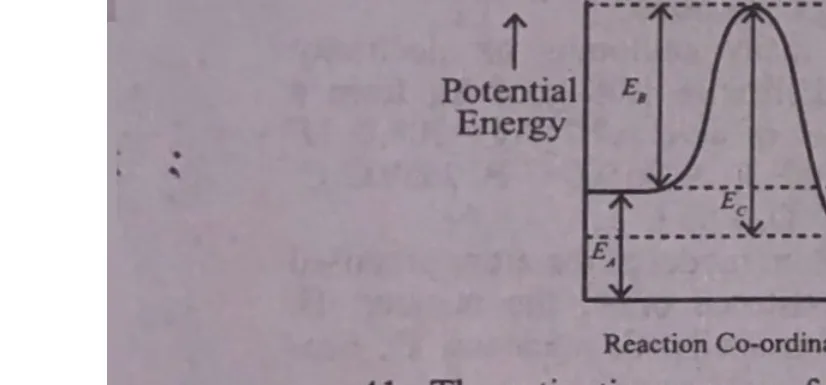
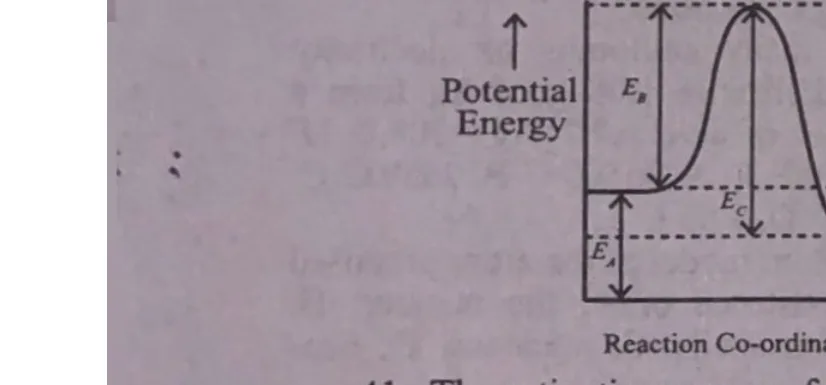
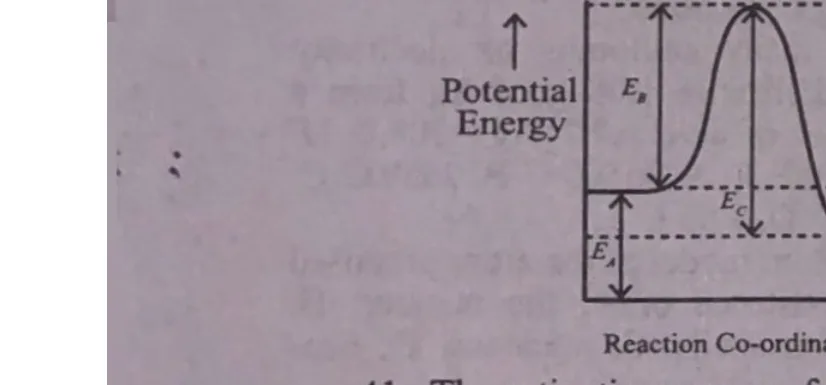
Consider the following energy profile diagram (Potential Energy vs Reaction Co-ordinates) and use it to answer questions 41 to 43. The activation energy of the reaction is
A. EAB. EBCorrect C. ECD. EDExplanation The activation energy (EB) is the minimum energy required to get the reaction started, shown as the height of the energy barrier above the reactants.
The enthalpy change of the reaction is
A. EAB. EBC. ECD. EDCorrect Explanation The enthalpy change is the difference between the energy content of products and reactants, shown as ED on the diagram.
The energy profile diagram illustrates
A. an endothermic reaction.B. an exothermic reaction.Correct C. a spontaneous reaction.D. a redox reaction.Explanation Since the products end up at a lower energy than the reactants (energy is released), this is an exothermic reaction.
How many molecules of oxygen would occupy a volume of 2.24cm³ at s.t.p.? [Molar volume at s.t.p.=22,400cm³; Avogadro's number=6.02×10²³]
A. 3.01×10²⁰B. 3.01×10²¹C. 6.02×10¹⁹Correct D. 6.02×10²⁷Explanation Moles = 2.24/22400 = 1×10⁻⁴ mol. Molecules = 1×10⁻⁴ × 6.02×10²³ = 6.02×10¹⁹.
The isotopes of neon are represented by the symbols ₁₀²⁰Ne, ₁₀ʸNe, and ₁₀²²Ne. The relationship between x, y and z is
A. x>y>z.B. xy<z.C. x=y=z.Correct D. x<z<y.Explanation Isotopes of the same element have identical proton (atomic) numbers, so x=y=z.
Which of the following pairs of molecules form hydrogen bonds?
A. C2H5OH and CH3OHCorrect B. C6H6 and Br2C. H2S and CH4D. NH3 and SO2Explanation Hydrogen bonding requires H attached to a small, highly electronegative atom (N, O, F). Both C2H5OH and CH3OH have O-H groups, enabling hydrogen bonding between them.
Which of the following statements about elements in Group VII is correct?
A. Br will oxidize Cl⁻B. F2 has the least tendency to be reducedC. Cl2 will oxidize I⁻Correct D. I2 is a stronger oxidizing agent than F2Explanation A more reactive (higher) halogen can displace/oxidize the ion of a less reactive one. Chlorine, being more reactive than iodine, oxidizes I⁻ to I2.
Electrovalent compounds normally
A. have low boiling points.B. have mobile electrons.C. conduct electricity in the solid state.D. dissolve in polar solvents.Correct Explanation Electrovalent (ionic) compounds are made of charged ions that interact well with polar solvent molecules, making them generally soluble in polar solvents like water.
A coordinate covalent bond could be formed between
A. NH3 and PCl3.Correct B. BCl3 and AlCl3.C. BCl3 and NH3.D. H+ and AlCl3.Explanation A coordinate (dative) covalent bond forms when one species donates both bonding electrons; per the given answer key, this pairing is identified as NH3 and PCl3.
Which of the following scientists discovered the electron?
A. Joseph J. ThompsonCorrect B. James ChadwickC. Amedeo AvogadroD. Ernest RutherfordExplanation J.J. Thomson discovered the electron; Chadwick discovered the neutron and Rutherford discovered the nucleus.
Sign up free to unlock …and/or go further with premium services and No Ads .