Chemistry 2023 Theory — Question 1
[Section A — Essay]
All 14 questions from the West African Examinations Council (WAEC) Chemistry 2023 Theory paper, with the correct answer and a full explanation for each. Free, no signup needed.
Advertisement
[Section A — Essay]
1. (a) What is a transition element? (b) Consider the electron configuration of the following elements: A = 2:8:6; B = 2:8:2; C = 2:8:1; D = 2:8:8. State the element which forms: (i) a double charged cation; (ii) a soluble trioxocarbonate (IV). (c) Explain briefly why there is a general increase in the first ionization energies of the elements across a period in the periodic table. (d) Give two examples of an aliphatic compound. (e) Explain briefly why alkanols are stronger bases than water. (f) State the major raw materials used in the Solvay process. (g) What is geometric isomerism? (h) Give a reason why water gas is a better fuel than producer gas. (i) Define the term heat of combustion. (j) (i) State Faraday's second law of electrolysis. (ii) Calculate the amount of silver deposited when 10920 coulombs of electricity is passed through a solution of a silver salt. [IF = 96500 C mol⁻¹]
Model answer
(a) A transition element is one which has an incompletely filled d-orbital. (b)(i) B — it has two valence electrons which can be lost on oxidation to form a doubly charged cation (B²⁺). (ii) C — soluble trioxocarbonates (IV) are prepared by bubbling carbon (IV) oxide through a solution of the corresponding alkali of a Group 1 metal; C (2:8:1) is in Group 1. (c) Across a period (left to right), there is a gradual increase in the number of protons in the nucleus (nuclear/effective charge). This increases the force of attraction between the nucleus and the electrons, so more energy is needed to remove the outermost electron — hence ionization energy increases. (d) Examples of aliphatic compounds: methane, ethene, ethyne, ethanol, ethanoic acid (any two). (e) Alkanols are stronger bases than water because of the electron-donating (positive inductive) effect of the alkyl group, which increases the electron density on the oxygen atom, making the lone pair more available to accept a proton. (f) Major raw materials for the Solvay process: sodium chloride (brine) and limestone (calcium carbonate). [Note: The Solvay process is the industrial method for manufacturing sodium carbonate (Na2CO3) from brine and limestone.] (g) Geometric isomerism is the existence of two compounds with the same molecular formula but which differ in the arrangement of groups attached to the carbon atoms of a double bond. (h) Water gas (CO + H2) is a better fuel than producer gas because both of its components (CO and H2) are combustible, giving it a higher calorific/heat value than producer gas. (i) Heat of combustion is defined as the heat change/released when 1 mole of a substance is completely burnt in excess oxygen (or completely burnt in air). (j)(i) Faraday's second law of electrolysis states that when the same quantity of electricity is passed through different electrolytes, the relative numbers of moles of the elements discharged are inversely proportional to the charges on the ions of the elements. (ii) Ag⁺ + e⁻ → Ag(s). 96500 C liberates 1.0 mol of Ag(s). ∴ 10920 C will liberate 10920/96500 = 0.113 mol of silver.
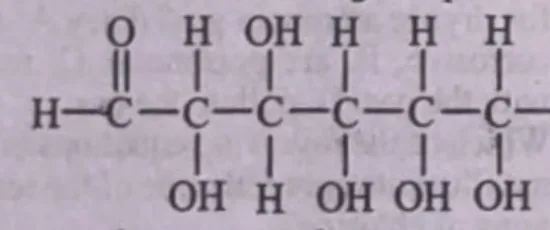
2. (a) In an experiment, 20.0 cm3 of a solution containing 4 g dm⁻³ of sodium hydroxide was neutralized by 8.0 cm3 of dilute tetraoxosulphate (VI) acid: (i) write a balanced equation for the reaction; (ii) calculate the concentration of the acid in mol dm⁻³. (b) (i) State two postulates of the Kinetic theory of gases which real gases do not obey. (ii) Explain briefly why real gases do not obey the postulates stated in 2(b)(i). (c) Consider the following organic compound: [Structural formula: O H OH H H / H–C–C–C–C–C–H / OH H OH OH H] (i) name the compound; (ii) name the two structural isomers of the compound; (iii) state the chemical process involved in the preparation of the compound from starch; (iv) write the chemical equation(s) for the steps involved in the process in 2(c)(iii); (v) name two enzymes involved in the process in 2(c)(iii). (d) Explain briefly the term structural isomerism.
Model answer
(a)(i) H2SO4 + 2NaOH → Na2SO4 + 2H2O (ii) Concentration of NaOH (CB) = conc. in g dm⁻³ ÷ Molar mass = 4/40 = 0.1 mol dm⁻³. Using CAVA/CBVB = nA/nB = 1/2: CA×8/(0.1×20) = 1/2, so CA = (0.1×20×1)/(2×8) = 0.125 mol dm⁻³. (b)(i) Real gases do not obey: (1) that the volume of gas molecules is negligible compared to the total volume of the container; (2) that there are no forces of attraction or repulsion between gas molecules (i.e. that collisions are perfectly elastic). (ii) The volume of a gas is not negligible because at high pressure the molecules occupy an appreciable volume, and at low temperature the intermolecular forces of attraction and repulsion become significant — so real gases deviate from ideal behaviour under these conditions. (c)(i) Glucose (ii) Fructose and Galactose (iii) Hydrolysis (starch hydrolysis is the breaking down of starch into smaller sugar molecules by water) (iv) 2(C6H10O5)n + nH2O —(diastase)→ nC12H22O11 (maltose); C12H22O11 + H2O —(maltase)→ 2C6H12O6 (glucose); [Further fermentation: C6H12O6 —(zymase)→ 2C2H5OH + 2CO2] (v) Diastase and maltase (zymase is also used if the process is extended to fermentation) (d) Structural isomerism is the existence of compounds having the same molecular formula but different structural formulae — i.e. a different arrangement/linkage of the atoms.
3. (a) A compound contains 52.2% C, 13.1% H and Oxygen only. The vapour density of the compound is 23. (i) Determine its empirical formula; (ii) Determine its molecular formula; (iii) The compound reacts with sodium metal to produce hydrogen gas, and when warmed with acidified KMnO4(aq) gives a solution which turns from purple to colourless. It also forms a sweet-smelling liquid when heated with ethanoic acid in the presence of concentrated H2SO4. I. name the functional group present in the compound; II. draw the structural formula of the compound. [H=1.0, C=12.0, O=16.0] (c) (i) Explain briefly why a piece of aluminium does not react with water. (ii) How can pure aluminium chloride crystals be obtained from an aluminium chloride solution? (d) Describe briefly how water can be separated from aqueous CuSO4.
Model answer
(a)(i) %O = 100 − (52.2 + 13.1) = 34.7 Element: C, H, O % composition: 52.2, 13.1, 34.7 ÷ Molar mass: 52.2/12 = 4.35; 13.1/1 = 13.1; 34.7/16 = 2.168 ÷ smallest (2.168): C = 2.00, H = 6.04, O = 1.00 Empirical formula = C2H6O (ii) 2 × vapour density = molecular mass; 2×23 = 46. (C2H6O)n = 46; [(12×2)+(1×6)+16]n = 46; 46n = 46; n = 1. ∴ Molecular formula = C2H6O (iii) I. Hydroxyl (–OH) functional group — the compound is ethanol. II. Structural formula: H–C(H)(H)–C(H)(H)–O–H (i.e. CH3–CH2–OH), each carbon bonded to the appropriate hydrogens and the terminal carbon bonded to the hydroxyl group. (c)(i) When aluminium is exposed, the reaction with water starts but the metal quickly produces a layer of aluminium oxide on its surface which is impermeable to water, so it stops the reaction from proceeding further. (ii) Add dilute hydrochloric acid to excess aluminium (or to aluminium oxide/hydroxide). Filter off the excess metal, leave the filtrate in a warm place (or evaporate the filtrate) to the point of crystallization, then leave it (e.g. in the sun) to crystallize. (d) The flask containing the aqueous CuSO4 is connected to a condenser and the solution is heated. The water vaporizes and is converted back to liquid water in the condenser (simple distillation), leaving the CuSO4 behind.
4. (a) Starting with calcium chloride, describe briefly how a solid sample of calcium trioxocarbonate (IV) can be prepared in the laboratory. (b) With relevant equations, outline the procedure for the purification of impure copper. (c) Copper reacts with concentrated trioxonitrate (V) acid: (i) write a balanced chemical equation for the reaction; (ii) state what would be observed in the reaction; (iii) state why the copper is oxidized; (iv) an excess of copper is added to 25.0 cm3 of 16.0 mol dm⁻³ HNO3. Calculate the volume of the gas formed at s.t.p. [H=1.0, N=14.0, O=16.0, Cu=63.0; Molar volume of gas at s.t.p. = 22.4 dm3]
Model answer
(a) Water is added to CaCl2 to form a solution. Na2CO3 solution is then added to precipitate CaCO3, which is filtered, washed and dried. (b) Electricity is passed through a solution of CuSO4, using impure copper as the anode and pure copper as the cathode. During electrolysis, the anode loses mass as copper dissolves into solution, and the cathode gains mass as copper is deposited on it. Anode: Cu(s) → Cu²⁺(aq) + 2e⁻ Cathode: Cu²⁺(aq) + 2e⁻ → Cu(s) (c)(i) Cu(s) + 4HNO3(aq) → Cu(NO3)2(aq) + 2NO2(g) + 2H2O(l) (ii) Observations: a blue solution forms; a reddish-brown gas is evolved; gas bubbles/effervescence occurs; the metal dissolves/disappears. (iii) The copper is oxidized because it loses electrons — its oxidation number increases (from 0 to +2). (iv) Moles of acid = 0.025 dm3 × 16 mol dm⁻³ = 0.4 mol. Moles of NO2 = (moles of acid)/2 = 0.2 mol (from the equation, 4 mol HNO3 produces 2 mol NO2). Volume of NO2 at s.t.p. = 0.2 mol × 22.4 dm3/mol = 0.48 dm3. (Cross-check via the copper side: 4 mol HNO3 reacts with 1 mol Cu = 63 g; 0.4 mol HNO3 reacts with 6.3 g Cu, consistent with excess copper being present; the gas volume computed above, 0.48 dm3, is the answer.)
5. (a) Describe how iron and aluminium react with each of the following substances: (i) dilute H2SO4; (ii) dilute HNO3. (b) (i) Write an equation for the burning of sulphur in air. (ii) Name the catalyst used in the contact process. (iii) In the contact process, why is an excess of air used? (iv) Why is it necessary to cool the catalyst used in 5(b)(ii)? (v) Give a reason why the air used in the contact process needs to be as clean as possible. (vi) State two reasons why SO2 should not be discharged into the atmosphere. (c) (i) State the reagent and condition used in the laboratory preparation of chlorine. (ii) State two uses of chlorine. (d) (i) Name the drying agent for each of the following gases: I. hydrogen; II. sulphur (IV) oxide; III. ammonia. (ii) State the components of the following alloys: I. Bronze; II. Brass.
Model answer
(a)(i) Iron dissolves readily in dilute H2SO4, liberating hydrogen and forming FeSO4. Aluminium reacts with dilute H2SO4 to form aluminium sulphate, Al2(SO4)3, also releasing hydrogen gas. (ii) With aluminium, there is essentially no reaction (a protective oxide layer prevents it), while iron dissolves in dilute HNO3, liberating hydrogen and forming Fe(NO3)2 (dilute conditions). (b)(i) S + O2 → SO2 (ii) Vanadium (V) oxide (V2O5) / platinized asbestos (iii) An excess of air is used to favour the formation of more product (SO3) by shifting the equilibrium. (iv) The reaction (SO2 + ½O2 ⇌ SO3) is exothermic; cooling favours the forward reaction since high temperature would favour the backward (endothermic) reaction. (v) Catalysts are easily poisoned/damaged by dirt/impurities in the air. (vi) SO2 should not be discharged into the atmosphere because: it damages buildings; it damages living things/causes acid rain; it causes irritation to the eyes, nose and throat; it causes lung and respiratory diseases (e.g. coughing, bronchitis). (Any two.) (c)(i) Reagent: manganese (IV) oxide (MnO2) with concentrated HCl, under heating; OR bleaching powder/CaOCl2/KMnO4 crystals with concentrated HCl at room temperature (no heat required). (ii) Uses of chlorine: bleaching wood pulp and textiles; production of plastics (e.g. PVC); extraction/recovery of tin from its ore; as a germicide/disinfectant/insecticide (e.g. in swimming pools); purification/sterilization of water supply; commercial manufacture of HCl; production of dyes and drugs; manufacture of solvents (e.g. CCl4, CHCl3). (Any two.) (d)(i) I. Hydrogen — fused calcium chloride / concentrated tetraoxosulphate (VI) acid. II. Sulphur (IV) oxide — concentrated tetraoxosulphate (VI) acid / anhydrous calcium chloride. III. Ammonia — calcium oxide (quicklime) / silica gel. (ii) I. Bronze — copper + tin. II. Brass — copper + zinc.
[Practical Alternative A]
1. Instructions: Answer all questions. All your burette readings (initial and final) as well as the size of your pipette must be recorded, but no account of experimental procedure is required. All calculations must be done in this booklet. A is 0.100 mol dm⁻³ of HCl. B is 0.030 mol dm⁻³ of a trioxocarbonate (IV) salt. (a) Put A into the burette and titrate it with 20.0 cm3 or 25.0 cm3 portions of B using methyl orange as indicator. Repeat the titration to obtain concordant titre values. Tabulate your results and calculate the average volume of A used. (b) From your results and the information provided, calculate the mole ratio of the acid to the trioxocarbonate (IV) in the reaction. (c) Given that B contains 5.0 g dm⁻³ of the hydrated trioxocarbonate salt, calculate the: (i) concentration of the anhydrous salt in B, in g dm⁻³; (ii) percentage of water of hydration in B; (iii) number of moles of hydrogen ions in the average titre value. [Molar mass of anhydrous salt in B = 106 g mol⁻¹]
Model answer
(a) Size of pipette used = 25.0 cm3. Burette readings (cm3): Titre 1: Final 24.00, Initial 0.00, Volume used 24.00 Titre 2: Final 48.30, Initial 24.20, Volume used 24.10 Titre 3: Final 24.20, Initial 0.00, Volume used 24.20 Average titre = (24.00 + 24.10 + 24.20)/3 = 24.10 cm3 (b) Amount of acid (HCl) in A = Concentration × Volume = 0.1 mol dm⁻³ × (24.10/1000) dm3 = 0.00240 mol Amount of CO3²⁻ in B = Concentration × Volume = 0.03 mol dm⁻³ × (25.00/1000) dm3 = 0.00075 mol Mole ratio (acid : carbonate) = 0.00240/0.00075 = 3.2 : 1 ≈ 3 : 1 (c)(i) Concentration of anhydrous salt (g dm⁻³) = molar concentration × molar mass = 0.03 mol dm⁻³ × 106 g mol⁻¹ = 3.18 g dm⁻³ (ii) Mass of water of hydration = 5.0 − 3.18 = 1.82 g dm⁻³. % water of hydration = (1.82/5.0) × 100% = 36.4% (iii) 1 mole of HCl contains 1 mole of H⁺, so 1000 cm3 of A contains 0.1 mole of H⁺. ∴ 24.10 cm3 of A contains (24.10 × 0.1)/1000 = 0.00241 mol of H⁺.
2. C is an organic compound. D is an inorganic compound. Carry out the following exercises on C and D. Record your observations and identify any gas(es) evolved. State the conclusions you draw from the results of each test. (a) Put C into a test tube and add about 5 cm3 of distilled water and shake well. Divide the resulting solution into two portions. (i) Test the first portion with litmus paper. (ii) To the second portion, add about 1 cm3 of Fehling's solutions A and B, and heat. (b) Divide D into two portions. (i) Put the first portion into a dry boiling tube, heat, and then allow to cool. (ii) Add about 5 cm3 of dilute HCl to the second portion and heat; allow it to cool and filter if necessary. Divide the resulting solution into two portions. (iii) To the first portion from (b)(ii), add NaOH(aq) in drops and then in excess. (iv) To the second portion from (b)(ii), add aqueous NH3 in drops and then in excess. (c) State what would be observed if a few drops of NaOH solution is added to 2 cm3 of solutions of each of the following salts: (i) Pb(NO3)2; (ii) Fe2(SO4)3.
Model answer
C = Glucose. D = Zinc oxide (ZnO). (a) C + distilled water → dissolves to form a colourless solution → C is a soluble compound. (i) C(aq) + litmus paper → no effect on litmus paper (red/blue stays same) → solution of C is neutral. (ii) C(aq) + Fehling's solution + heat → a brick-red precipitate is formed → C is a reducing sugar (a reducing agent is present). (b)(i) D + heat, then cool → solid turns yellow when hot, and turns white again on cooling → ZnO is present (characteristic of zinc oxide). (ii) D + dilute HCl + heat → dissolves to form a colourless solution → D is a basic oxide. (iii) 1st portion + NaOH(aq) in drops → a white gelatinous precipitate forms (Zn²⁺ or Al³⁺ may be present); in excess → the precipitate dissolves (confirms Zn²⁺ or Al³⁺, both amphoteric). (iv) 2nd portion + NH3(aq) in drops → a white gelatinous precipitate forms (Zn²⁺ or Al³⁺ may be present); in excess → the precipitate dissolves (confirms Zn²⁺ specifically, since Al(OH)3 does not dissolve in excess NH3 — this narrows it down to Zn²⁺ being present). (c)(i) Pb(NO3)2 + NaOH(aq) → a white (chalky) precipitate is formed. (ii) Fe2(SO4)3 + NaOH(aq) → a reddish-brown (gelatinous) precipitate is formed.
3. (a) Describe briefly how the melting point of benzoic acid could be determined in the laboratory.
Model answer
A small quantity of benzoic acid crystals is placed into a capillary tube sealed at one end. The filled capillary tube is tied to a thermometer such that the bulb of the thermometer is completely immersed. The set-up is clamped and lowered into a beaker half-filled with liquid paraffin, placed on a tripod stand with wire gauze. The beaker's contents are heated gently with constant stirring of the liquid paraffin, and the temperature is noted at which the benzoic acid begins to melt (t1) and the temperature at which it is completely liquefied (t2). The melting point is reported as the range (t1 – t2) °C. The process is repeated using a fresh sample of benzoic acid until the readings agree within 2.0°C.
[Practical Alternative B]
1. Instructions: Answer all questions. E is a solution containing 2.92 g of HCl per dm3. F is a solution obtained by diluting 20.0 cm3 of a saturated solution of Y(OH)2 at 25°C to 1 dm3 of solution. (a) Put E into the burette and titrate it against 20.0 cm3 or 25.0 cm3 portions of F using phenolphthalein as indicator. Repeat the titration to obtain concordant titre values. Tabulate your results and calculate the average volume of acid used. The equation for the reaction is: Y(OH)2 + 2HCl → YCl2 + 2H2O (b) From your results and the information provided, calculate the: (i) concentration of HCl in E, in mol dm⁻³; (ii) concentration of Y(OH)2 in F, in mol dm⁻³; (iii) solubility of Y(OH)2, in mol dm⁻³; (iv) mass of Y(OH)2 that would be deposited, given its molar mass is 74 g mol⁻¹.
Model answer
(a) Burette readings (cm3): Titre 1: Final 8.40, Initial 0.00, Volume used 8.40 Titre 2: Final 16.90, Initial 8.40, Volume used 8.50 Titre 3: Final 8.60, Initial 0.00, Volume used 8.60 Average titre = (8.40 + 8.50 + 8.60)/3 = 8.50 cm3 (b)(i) Molar mass of HCl = 1 + 35.5 = 36.5 g/mol. Concentration of HCl in E = (2.92 g dm⁻³) ÷ (36.5 g mol⁻¹) = 0.080 mol dm⁻³. (ii) From Y(OH)2 + 2HCl → YCl2 + 2H2O: ηHCl = 2, ηY(OH)2 = 1. Using CE·VE/CF·VF = ηE/ηF: CF = (CE × VE × ηF)/(VF × ηE) = (0.080 × 8.50 × 1)/(25 × 2) = 0.68/50 = 0.0136 mol dm⁻³. (iii) The 20 cm3 of saturated Y(OH)2 solution was diluted to 1 dm3 (1000 cm3) to make F, which has a concentration of 0.0136 mol dm⁻³. So the original saturated solution's concentration (solubility) = (0.0136 × 1000)/20 = 0.68 mol dm⁻³. (iv) Mass of Y(OH)2 = moles × molar mass = 0.68 mol × 74 g/mol = 50.32 g.
2. G is an inorganic salt. Carry out the following exercises on G. Record your observations and identify any gas(es) evolved. State the conclusions you draw from the results of each test. (a) Dissolve all of G in 10 cm3 of distilled water in a boiling tube. (b) (i) Test the resulting solution with litmus paper. (ii) To about 2 cm3 portion of the solution in a test tube, add NaOH(aq); then warm the resulting mixture gently. (iii) To another 2 cm3 portion of the solution, add dilute HNO3. (iv) To 2 cm3 portion of the solution, add BaCl2(aq) followed by excess dilute HNO3.
Model answer
G + distilled water → a colourless solution is obtained. (b)(i) Solution of G + litmus paper → red litmus turns blue → solution of G is alkaline/basic. (ii) Solution of G + NaOH(aq), then warmed → no immediate visible precipitate; on warming, a colourless gas is evolved with a pungent/choking/irritating smell → the gas turns red litmus paper blue and forms dense white fumes with concentrated HCl → the gas is ammonia (NH3) → NH4⁺ is present. (iii) Solution of G + dilute HNO3 → effervescence, a colourless gas is evolved → the gas turns limewater milky → the gas is CO2, indicating CO3²⁻ or HCO3⁻ is present. (iv) Solution of G + BaCl2(aq) + excess dilute HNO3 → a white (chalky) precipitate forms initially, then dissolves with rapid effervescence on adding the acid → this rules out SO4²⁻ (which would not dissolve) and SO3²⁻, confirming CO3²⁻ is present.
3. (a) Determine the volume of water that should be added to 100 cm3 of 0.5 mol dm⁻³ HCl in order to obtain 0.3 mol dm⁻³ HCl. (b) Describe briefly a chemical test to distinguish between dilute HCl and dilute HNO3. Support the test with a relevant equation.
Model answer
(a) Using C1V1 = C2V2: 0.5 × 100 = 0.3 × V2, so V2 = (0.5 × 100)/0.3 = 166.67 cm3. Volume of water to be added = 166.67 − 100 = 66.67 cm3. (b) Add AgNO3(aq) to each solution in a separate test tube. Formation of a white precipitate indicates the solution is HCl; if no precipitate forms, the solution is HNO3. AgNO3(aq) + HCl(aq) → AgCl(s)↓ + HNO3(aq) (Alternative tests: (i) Heat each sample in a test tube — brown fumes indicate HNO3, no brown fumes indicates HCl. (ii) To each sample, add fresh FeSO4(aq), then carefully add concentrated H2SO4 down the side of the test tube — a brown ring at the interface indicates HNO3 (brown-ring test), no brown ring indicates HCl. FeSO4 + NO → FeSO4.NO)
Advertisement
…and/or go further with premium services and No Ads.