All 8 questions from the West African Examinations Council (WAEC) Commerce 2020 Theory paper, with the correct answer and a full explanation for each. Free, no signup needed.
A sole proprietor has been advised to advertise her business in order to increase sales. (a)(i) List four advertising media she could use. (ii) State four factors she would consider in the choice of a medium. (b) State four advantages of advertising to her business.
Model answer
(a)(i) Advertising media: Radio; Television; Newspaper; Posters.
(ii) Factors to be considered in choosing advertising medium: The targeted audience — the people who the advert is meant for must be considered before choosing an advertising medium; The cost implication of the advertisement — the cost involved must be considered before choosing a particular medium; The size and extent of the market for the product that is being advertised must also be considered; The number of people which the media can reach at a time.
(b) Advantages of advertising: Through advertising, the sales level of the firm can be improved; It serves as means to sensitise the public about the product; It is used to create awareness about the product; It serves as a means of generating feedback about the product of the organisation.
2(a) State four functions of a cartel. (b) Explain three advantages and three disadvantages of public enterprises.
Model answer
(a) Functions of cartel: Cartel seeks to regulate the output of members; It also seeks to segment market among its members; It may influence price of output; At times, it creates artificial scarcity.
(b) Advantages of public corporation: It provides essential services at a cheap price; There is continuity; It provides job opportunity to the citizens.
Disadvantages of public corporation: Inefficiency and ineffectiveness; Waste of government resources; Favouritism is the order of the day in public corporation.
3(a) List six credit instruments used in business transactions. (b) Mr. Sylva is considering hire purchase as a source of finance for his business operations. State four advantages and three disadvantages of this source of finance.
Model answer
(a) Credit instrument used in business: Credit purchase; Accruals; Overdraft; Loans; Hire purchase; I Owe You (IOU).
(b) Advantages of hire purchase: It avails business to access assets which it cannot be acquired at once; It makes payment for huge capital easy for business; The interest on it is lower compared with other options; Allows business to access highly valued assets.
Disadvantages of hire purchase: It is quite expensive than cash purchase; Depreciation of asset before actual acquisition; Cash commitment on the business will not allow it to diverse investment.
4(a) Explain four factors to be considered in setting up a retail business. (b) State how government uses the following to regulate business: (i) Registration of business name; (ii) Patent; (iii) Trade mark; (iv) Copyright.
Model answer
(a) Factors to be considered before setting up a retail business: The capital required to set up: every business require initial set up, thus, the person intending to open a retail shop must consider what the business would require to start. The proximity to suppliers: a retailer will source his stock from a wholesaler, before setting up a retail shop, he must ensure he has access to these wholesalers. Proximity to the targeted market: the retailer must confirm that the targeted customers are available. Availability of other retail shops: If there are a wide range of existing retail shops or not, this must also be considered before setting up a retail shop.
(b) Government ways of regulating businesses (table): Registration of business name — Government states that businesses must be registered to distinguish business A from business B. Patent — The government imposes that a company/firm has exclusive right to produce an item that is its sole discovery. Trademark — By this, the products of firms are given unique mark to differentiate them. Copyright — This is exclusive right which the government grants a writer to be a sole producer of his art work to protect it from piracy.
5(a) State four functions of a Stock Exchange. (b) Explain the following types of securities traded on the stock exchange: (i) Debentures; (ii) Bonds; (iii) Shares; (iv) Stock.
Model answer
(a) Functions of stock exchange: It serves as market for buying and selling of financial securities; It gives update on prices of stocks regularly; It serves as platform for buyer and sellers to meet; It comprises professionals who can provide financial advice to both the company and investors.
(b)(i) Debenture is a financial document which specifies a company's indebtedness to the bearer. It attracts fixed interest and has a maturity date.
(ii) Bonds: A bond is referred to as a fixed income instrument since bonds traditionally paid a fixed interest rate (coupon) to debt holders.
(iii) Shares: Shares can be defined as a unit of ownership in a limited liability company. The holder is entitled to dividends and can attend the annual general meeting.
(iv) Stock: this can be defined as the name for all securities traded in the money market such as shares, bonds, debentures etc.
6(a) State five functions of an Export Promotion Council. (b) Outline five roles performed by the Customs and Excise Authority towards the growth of commerce.
Model answer
(a) Functions of Export Promotion Council (any five): Export Promotional Council collects export and import data of its members; It organises trade delegations to explore opportunities of exporting products in other countries; It provides technical advice to exporters; It serves as link between government and exporters; They regulate laws relating to export.
(b) Functions of customs and excise authority (any five): The customs and excise authority are to impose the necessary import and export duties on goods; Also, they check smuggling of unlawful and harmful goods into the country; They are also there to monitor usage of foreign exchange utilisation; They are also there to provide security for the importers and exporters; They provide temporary warehouse for importers before their goods are cleared.
Emeka has been a sales representative for three years but has never met his target. (a) State five reasons that could have accounted for his inability to meet his target. (b) Explain five promotional tools he could use to stimulate sales of his company's products.
Model answer
(a) Factors that can prevent a sales representative from achieving his target (any five): Poor quality of goods; Poor marketing skills; Shortage of supplies from the supplier; Too high price of the good; Too much competition.
(b) Promotional tools to stimulate sales (any five): Advertising — one of the most powerful promotional tools is advertising; through advertising, the marketing agent can persuade prospective customers to buy the product of the company. Sales promotion — this involves giving samples, buy one get two, buy one get gift and so on. This will entice people to buy more and more of the product. Public relation — this is the act of creating a special section for the customers where they can meet representatives of the company and discuss issues as related to the product of the company. Direct selling — also selling directly to the customers will boost their morale and will make them interested in buying more and more of the product. Giving free samples of the product.
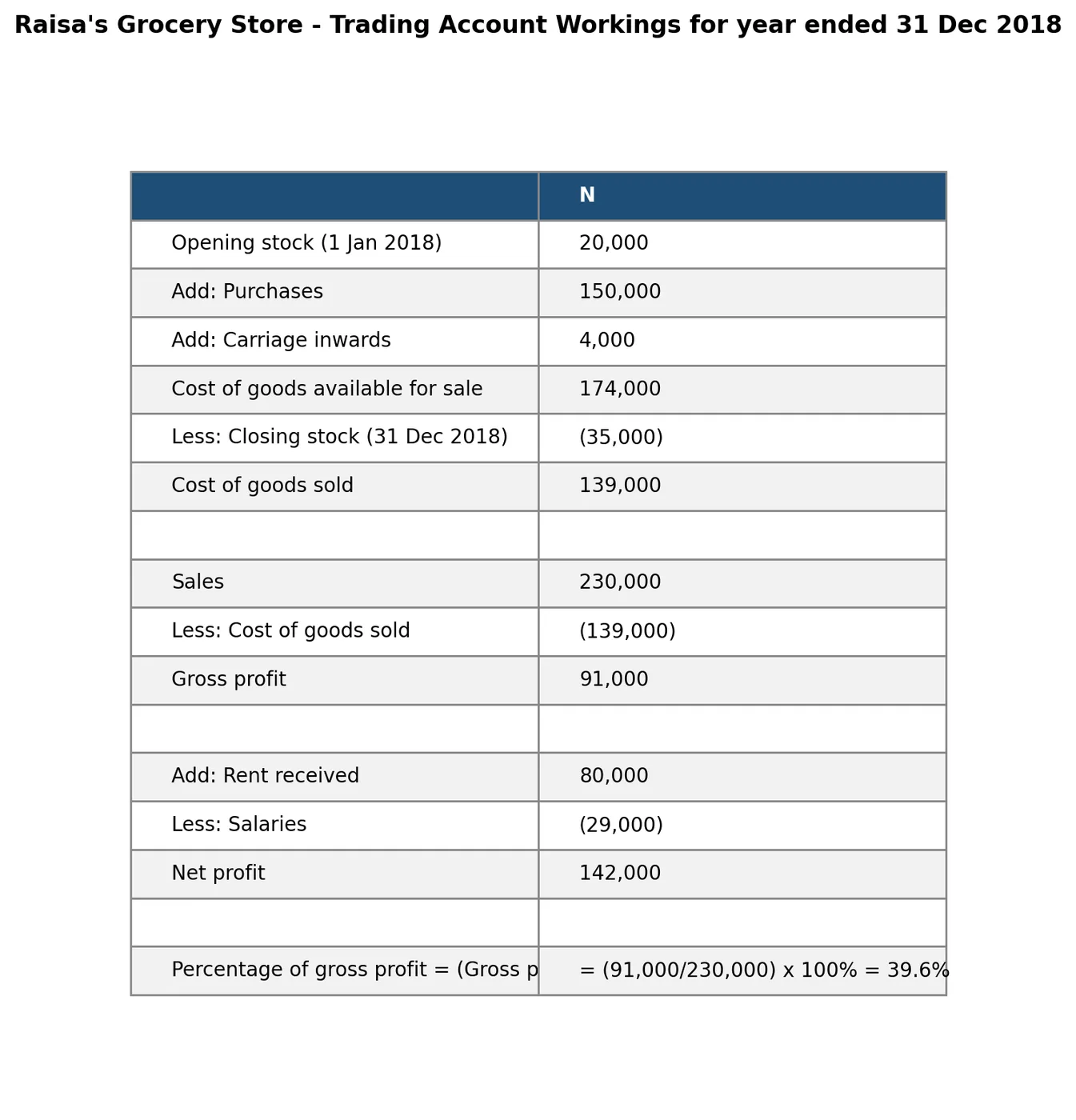
The following information relates to Raisa's grocery store as at 31st December 2018: Stock (1st January 2018) N20,000; Purchases N150,000; Sales N230,000; Carriage inwards N4,000; Rent received N80,000; Salaries N29,000; Stock (31st December 2018) N35,000. You are required to calculate: (a) Cost of goods sold; (b) Gross profit; (c) Net profit; (d) Percentage of gross profit.
Model answer
See the workings table in the Diagram column. (a) Cost of goods sold = Opening stock + Purchases + Carriage inwards - Closing stock = N(20,000+150,000+4,000-35,000) = N139,000.
(b) Gross profit = Sales - Cost of goods sold = N(230,000-139,000) = N91,000.
(c) Net profit = Gross profit + Rent received - Salaries = N(91,000+80,000-29,000) = N142,000.
(d) Percentage of gross profit = (Gross profit/Sales) x 100% = (91,000/230,000) x 100% = 39.6%.
Advertisement
Sign up free to unlock
Score tracking
Practice history
Saved questions
Progress dashboard
Personalized sessions
Weak-topic breakdown
…and/or go further with premium services and No Ads.