All 25 questions from the West African Examinations Council (WAEC) Economics 2011 Theory paper, with the correct answer and a full explanation for each. Free, no signup needed.
SECTION A - 1(a) The supply situation for rice in country x over a period is shown in the table below:
Period: December 2004, Price $30, Quantity supplied 100 bags | January 2007, Price $40, Quantity supplied 150 bags | April 2009, Price $50, Quantity supplied 160 bags.
Calculate the co-efficient of price elasticity of supply for rice between December 2004 and January 2007.
Model answer
Elasticity of supply of rice measures the degree of responsiveness in quantity supplied of rice to a change in price. Formula: %change in quantity of rice / %change in price of rice = %Δq/%Δp.
Between 2004 and 2007: %Δq = (150-100)/100 x 100 = 50%. %Δp = (40-30)/30 x 100 = 33.3%.
Coefficient of elasticity = 50/33.3 = 1.5.
1(b) Is the supply of rice elastic? Give a reason for your answer.
Model answer
The supply of rice is elastic. The reason is that the coefficient is greater than 1, which means the percentage change in price brought about a greater percentage change in quantity supplied of rice.
1(c) State any three reasons which may cause an increase in the supply of rice.
Model answer
Increase in supply of rice means a rise in supply i.e. a rightward shift in the supply curve. Reasons: (i) increase in number of rice farmers, (ii) favourable weather or season, (iii) favourable government policy, (iv) low cost of input, such as fertilizer (any three).
2(a) The following are the loans granted by a commercial bank to different categories of individuals: Bankers $8,000, Farmers $8,000, Retailers $5,000, Miners $7,000, Teachers $6,000, Drivers $4,000, Fishermen $3,000. Arrange the information in the form of a table grouping the individuals into: (i) Primary sector (ii) Secondary sector (iii) Tertiary sector.
Model answer
A table is the arrangement of data in rows and columns.
Primary sector: Farmer $8,000; Miners $7,000; Fishermen $3,000 = Total $18,000
Secondary sector: Tailors $4,000 = Total $4,000
Tertiary sector: Retailers $5,000; Drivers $4,000; Bankers $8,000 = Total $23,000
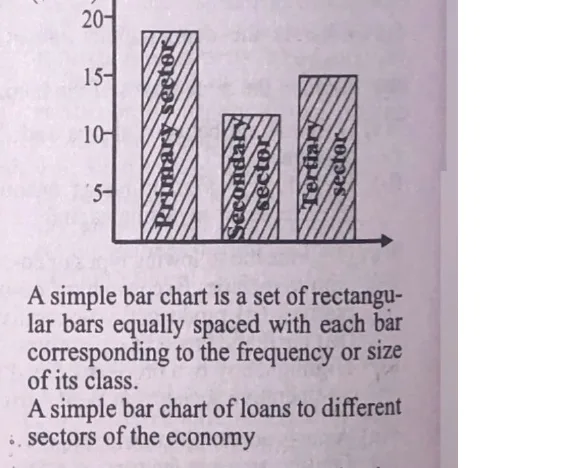
2(c) Present the total loans granted to the sectors in a simple bar chart. (Use of graph sheet is essential)
Model answer
A simple bar chart is a set of rectangular bars, equally spaced, with each bar corresponding to the frequency or size of its class - here showing loans of approximately $18,000 (primary), $4,000 (secondary) and $23,000 (tertiary) to the different sectors of the economy.
A centrally planned economy is also known as a socialist economic system. It is one in which ownership and control of the means of production are done by the state. Decisions about production and distribution are made at the centre by the government.
3(b) Outline any four features of a capitalist economy.
Model answer
Features of a capitalist economy include: (i) private ownership and control of means of production, (ii) private individuals dominate decision making about production and distribution, (iii) there is consumer sovereignty, (iv) economic activities are driven by profit motive, (v) disparity in income and wealth distribution (any four).
4(b) Describe any four factors influencing the supply of labour.
Model answer
The supply of labour can be influenced by: (i) the size of the population which determines the size of the labour force, (ii) age structure and sex distribution of the population, (iii) official school leaving age, (iv) official retirement age, (v) the wage rate, (vi) availability or non-availability of incentives, (vii) condition of work (any four).
5(b) Explain any four advantages of international trade.
Model answer
Advantages of international trade include: (i) increase in the world's total output as a result of specialization, (ii) efficient allocation of world resources, (iii) efficiency in production because of specialization and competition, (iv) improved standard of living as a result of access to varieties of goods, (v) it enhances co-operation among countries (any four).
6. Outline any five reasons why small scale firms are common in West Africa.
Model answer
Small scale firms are common in West Africa because: (i) setting up small scale firms does not require large capital, (ii) it requires simple tools and techniques, not sophisticated machine like big firms, (iii) it requires small legal and administrative procedures to set up, (iv) it does not require much skill to manage and control like big firms, (v) government policy to create jobs for the ever-growing population, (vi) the size of the market - goods are small, therefore large scale production would lead to much waste (any five).
7(a) Explain with examples the terms competitive demand and complementary demand.
Model answer
Competitive demand is the type of demand that exists when two commodities are substitutes to each other. The demand for one will reduce or cancel the demand for the other, e.g. demand for Milo and Bournvita. Complementary demand is one in which the demand for one commodity necessitates the demand for the other commodity. In other words, the two commodities are complements, e.g. car and petrol, exercise book and biro.
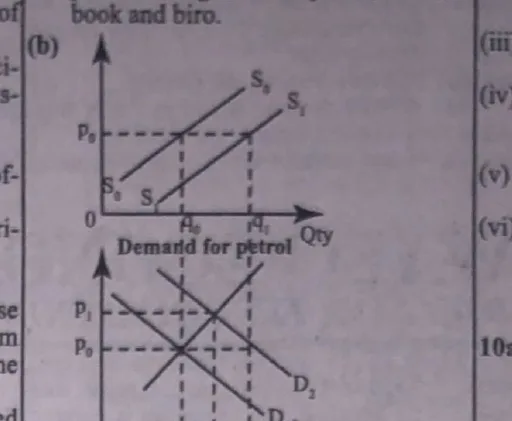
7(b) With the aid of diagrams, analyse the effect of a decrease in the import duty on cars on the price and consumption of petrol.
Model answer
Car and petrol are complementary goods. A decrease in import duty on cars will lead to an increase in supply of cars (S0 to S1) as a result of a decrease in import duties, and increase in quantity of car demanded from q0 to q1. This leads to increase in demand for petrol from D0 to D1. The price of petrol increases from P0 to P1 and the quantity from q0 to q1.
Demographic transition theory provides historical insight into the population problem of countries, especially developing countries. It tries to explain different stages or phases of population growth.
(i) Pre-industrial or pre-transition stage: The country has a high birth rate and a high death rate but not stable. This results in a slow growing population. (ii) Transition stage: The country has a high birth rate and a low death rate, resulting in a fast growing population. It is a feature of a country at the industrial take off; there are better medical facilities, better diet and high income to earn good standard of living. (iii) Post-transition stage: In this stage both fertility and mortality rates are low. There is low birth rate because fertility is controlled and death rate is low because there are better medical facilities, good diet. The population becomes relatively stable. It is the feature of advanced economy.
A share is a unit of ownership of a business concern. A shareholder therefore partly owns the firm. The reward is called dividends. While debenture is a loan capital and does not confer ownership on its holder. A debenture holder is a creditor and he collects interests.
9(b) Highlight any two problems faced by firms in raising capital.
Model answer
Problems firms face in raising capital: (i) lack of collateral security required by banks before they can grant loans, (ii) high interest rates - interest is the cost of borrowing and when they are high, borrowing becomes difficult, (iii) low savings which reduce the size of loanable funds, (iv) underdeveloped financial markets which reduce firms' ability to raise capital, (v) lack of trust, poor business experiences and practices, (vi) rules and regulations of the central bank such as credit ceiling and special directives to commercial banks (any two).
10(a)(i) Describe the following types of co-operative societies: (i) consumers' co-operatives (ii) producers' co-operatives (iii) thrift and credit co-operatives.
Model answer
Consumers' co-operative: an association of consumers who pool their resources together, buy goods in bulk at wholesale prices from producers and then sell the goods at retail prices to members and non-members - this is done to by-pass the middlemen and enjoy low prices. Producers' co-operative: an association of producers of similar commodities who come together for the purpose of producing or marketing their products, e.g. agricultural co-operative society. Thrift or credit co-operative society: an association of people who come together for the purpose of saving money together or making it possible for them to borrow money easily from banks; this association encourages savings and also provides access to lower interest loans; they also give loans to non-members but with higher interest. Members share profits in the form of dividends based on their contributions.
10(b) Highlight any two problems faced by co-operative societies in West Africa.
Model answer
Problems of cooperative societies include: (i) lack of commitment to the association because of other commitments, (ii) lack of experts to run or manage the affairs of the association - if members are not skilful in the business they do, the association will be affected, (iii) corruption and embezzlement of the association's fund, (iv) competition from other outlets (any two).
Economic development is the process by which a country experiences a sustained increase in its real output accompanied with other positive changes such as reduction in poverty, level of unemployment rate and income inequality.
11(b) Outline any five features of developing countries.
Model answer
Features of developing countries: (i) high level of poverty, (ii) high population growth rate, (iii) low capital formation, (iv) political instability, (v) high level of illiteracy, (vi) low per capital income, (vii) low standard of living, (viii) low life expectancy (any five).
12(a) Outline any three objectives of the African Development Bank (ADB).
Model answer
Objectives of ADB: (i) to finance projects aimed at promoting the social socio-economic development of African countries, (ii) to aid mobilization of funds from within and outside the continent, (iii) to undertake activities and provide services aimed at improving the welfare of African people, (iv) to provide technical assistance to African nations in areas of project appraise, finance and execution, (v) to participate in selecting projects for member nations to ensure their orderly development (any three).
12(b) State any two achievements of the African Development Bank (ADB).
Model answer
Achievements of the ADB: (i) it has helped to mobilize funds from within and outside the continent, (ii) it has contributed to improvement of welfare of African people, provision of basic amenities and reduction of unemployment, (iii) it has provided technical assistance to African nations in technical areas, (iv) it has granted loans to member nations which have been used for various development projects (any two).
Advertisement
Sign up free to unlock
Score tracking
Practice history
Saved questions
Progress dashboard
Personalized sessions
Weak-topic breakdown
…and/or go further with premium services and No Ads.