All 22 questions from the West African Examinations Council (WAEC) Economics 2015 Theory paper, with the correct answer and a full explanation for each. Free, no signup needed.
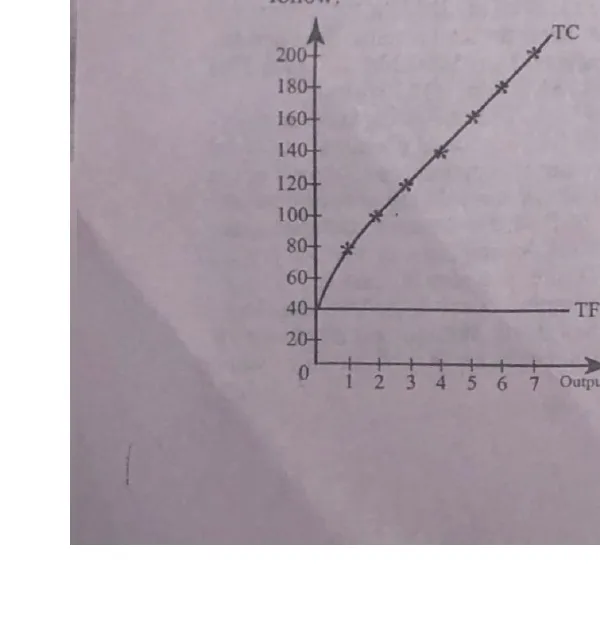
The total fixed cost (TFC) and total cost (TC) functions of a hypothetical firm are shown in the graph above (Section A, Q1). (a) Determine the firm's: (i) variable cost at output levels 2, 4 and 6; (ii) average total cost at output levels 2 and 3; (iii) marginal cost at output levels 4 and 6. (b) If the price of the firm's product is $40, calculate the firm's profit or loss when the following units are sold: (i) 2 units; (ii) 4 units.
Model answer
(a)(i) Variable cost = Total cost − Fixed cost. From the graph: at output 0, FC=$40. At output 2, TC=$100, so VC=100−40=$60. At output 4, TC=$140, so VC=140−40=$100. At output 6, TC=$180, so VC=180−40=$140.
(ii) Average total cost (ATC) = TC/Output. At output 2: ATC=100/2=$50. At output 3: TC=$120, ATC=120/3=$40.
(iii) Marginal cost = change in TC/change in output. Between output 3 and 4: MC=(140−120)/(4−3)=$20. Between output 5 and 6: TC at 5=$160, MC=(180−160)/(6−5)=$20.
(b)(i) At 2 units: TR=$40×2=$80; TC=$100; Loss = TC−TR = 100−80 = $20 loss.
(ii) At 4 units: TR=$40×4=$160; TC=$140; Profit = TR−TC = 160−140 = $20 profit.
2(a). The table below shows the incomes and rates of income tax levied on four professionals in an economy (Director: income $8,000, tax rate 10%; Engineer: income $7,000, tax rate 12%; Civil Servant: income $5,000, tax rate 18%; Nurse: income $6,000, tax rate 15%). Calculate the disposable incomes of the four individuals.
Model answer
Disposable income = Income − Tax.
Director: Tax=10%×8000=$800; Disposable income = 8000−800 = $7,200.
Engineer: Tax=12%×7000=$840; Disposable income = 7000−840 = $6,160.
Civil Servant: Tax=18%×5000=$900; Disposable income = 5000−900 = $4,100.
Nurse: Tax=15%×6000=$900; Disposable income = 6000−900 = $5,100.
2(b). What system of taxation was employed [in the table above]?
Model answer
A regressive system of taxation was employed, since the tax rate (%) decreases as income increases (e.g. the Director, who earns the most, has the lowest tax rate of 10%, while the Civil Servant, who earns less, has the highest rate of 18%).
This is because the tax rate decreases as income increases (and correspondingly increases as income decreases) - which is the defining characteristic of a regressive tax system, as shown by the falling tax-rate curve against rising income.
2(d). With the aid of a graph, explain the system of taxation employed in 2(b).
Model answer
A regressive tax is a system of taxation in which the tax rate charged decreases as the income of the payer increases, and vice versa. On a graph with income on the x-axis and tax rate (%) on the y-axis, the curve slopes downward from left to right - starting high at low income levels and falling continuously as income rises, illustrating that lower earners pay proportionately more of their income in tax than higher earners.
A trade union is an organized body/association of employees, or a professional body, established to protect and promote the interests of its members in matters relating to their employment.
3(b). Describe any four functions of trade unions.
Model answer
(i) They negotiate with employers on behalf of their members over wages, conditions of service, and other employment terms.
(ii) They serve as a pressure group to the government, lobbying for policies favourable to workers.
(iii) They regulate the affairs and conduct of their members, maintaining professional/occupational standards.
(iv) In some cases, they protect the interest of their members against unfair treatment or dismissal by employers.
3(c). Outline any two weapons used by trade unions to achieve their objectives.
Model answer
(i) Strike action - a total or partial withdrawal of labour/services by workers to press home their demands.
(ii) Court action - taking legal action against an employer to enforce workers' rights.
(Also acceptable: protest/demonstration.)
4(a). Outline any four objectives of a price control policy.
Model answer
(i) It could be used to control (curb) inflation in the economy.
(ii) It could be used to protect consumers from the exploitation of producers/suppliers who might otherwise charge them exorbitant prices.
(iii) It helps stabilize the price of essential goods and services.
(iv) It protects the income/purchasing power of low income earners.
4(b). Highlight any four effects of a maximum price control policy.
Model answer
(i) It usually fixes the price below the equilibrium level, and this will lead to excess demand in the economy.
(ii) It will lead to hoarding of goods by the producer, as sellers withhold goods hoping for higher (black market) prices.
(iii) It may lead to a fall in quality, since producers cut corners to keep costs down at the fixed low price.
(iv) It will discourage producers from producing more output, since profitability is reduced, potentially leading to shortages.
Infant industries are new (young) industries that are in the early stage of their development and which may not yet be able to compete with well-established (older) firms/industries, whether domestic or foreign.
5(b). State any four reasons for protecting infant industries.
Model answer
(i) To promote local production so as not to remain dependent on foreign products.
(ii) To help create healthy competition in the economy over time as the industry matures.
(iii) To reduce unemployment, because if infant industries fail, their workers will join the already large unemployed workforce.
(iv) To attract foreign investment into the economy, since investors will see the local industries are protected and may prefer to invest in the country.
5(c). Outline any three ways by which industries can be financed in West Africa.
Model answer
(i) Government subsidies.
(ii) Bank loans and overdrafts.
(iii) Credit purchases and trade credit. (Also acceptable: issue of shares, personal savings, cooperative societies.)
Balance of payment disequilibrium refers to a situation where the total payments of a country for foreign products is not equal to the total receipts from exports; it could be a favourable (surplus) or unfavourable (deficit) disequilibrium.
6(b). Explain the two types of balance of payment disequilibrium.
Model answer
(i) Favourable balance of payment (surplus balance of payment): this is a situation where the total receipts/payments for foreign goods received by a country are greater than the total payments made for imports - i.e. total payments for foreign goods are less than the total receipts from exports.
(ii) Unfavourable balance of payment (deficit balance of payment): this is a situation where the total payments for foreign products are greater than the total receipts from exportation.
6(c). Highlight any four reasons most West African countries are experiencing balance of payment problems.
Model answer
(i) Over-dependence on foreign goods (high import demand).
(ii) Low level of domestic production/manufacturing capacity.
(iii) Over-dependence on a single export product (lack of export diversification), making export earnings vulnerable to price swings.
(iv) High cost of servicing external debts.
Deflation can be defined as a persistent and sustained decrease in the general price level of goods and services, usually as a result of an excess supply of goods relative to demand in the economy.
7(b). Outline any three positive effects of deflation.
Model answer
(i) Pensioners and creditors gain, since the value of money increases as prices fall.
(ii) It also encourages saving, because money's value as a store for deferred payment increases (people don't need to spend quickly to avoid losing value, so they continue saving).
(iii) The balance of payments position will improve as a result of a decrease in imports and an increase in exports (as domestic goods become relatively cheaper). Savings will also increase as a result of the increase in the value of money.
7(c). Explain the ways in which inflation affects the functions of money.
Model answer
(i) It discourages the use of money as a store of value, because the value of money falls consistently over time, making it not worthwhile to continue holding wealth in money form.
(ii) It discourages money as a standard for deferred payment, because people will not want to wait to receive money (as it loses value over time) and will demand instant payment instead.
A protective tariff is a duty (tax) that is imposed on certain imported goods, or removed/lifted on certain locally produced goods, so as to promote local industries against foreign competition.
8(b). State any two reasons in favour of protective tariffs.
Model answer
(i) To promote local industries, because in most cases the local industries in West African countries cannot yet compete favourably with foreign products without some protection.
(ii) To restrict the importation of harmful goods into the country, and to help correct balance of payments problems by discouraging excessive imports.
8(c). State any two reasons against protective tariffs.
Model answer
(i) It may cause a retaliatory measure/response against the country from its trading partners, who may impose their own tariffs in return.
(ii) It does not promote healthy competition, and may shield inefficient local industries from the pressure to improve, potentially leading to higher domestic prices for consumers.
Advertisement
Sign up free to unlock
Score tracking
Practice history
Saved questions
Progress dashboard
Personalized sessions
Weak-topic breakdown
…and/or go further with premium services and No Ads.