All 26 questions from the West African Examinations Council (WAEC) Economics 2021 Theory paper, with the correct answer and a full explanation for each. Free, no signup needed.
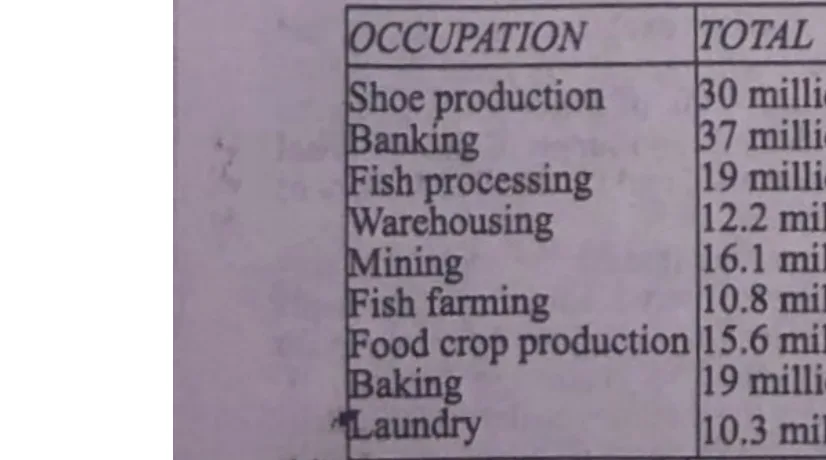
1(a). Table 1 below shows the distribution of the population of a country in various occupations. Study it and calculate the size of the entire labour force in the country.
Model answer
The labour force is the total number of people actively employed across all the occupation categories shown in the table. This is found by adding together the population figures given for every occupation/sector listed in Table 1.
1(b). What percentage of the labour force is engaged in the: (i) primary sector; (ii) secondary sector; (iii) tertiary sector?
Model answer
(i) Primary sector (deals with natural resources and primary production, e.g. food production, mining): percentage = (sum of primary-sector figures ÷ total labour force) × 100%.
(ii) Secondary sector (deals with converting resources into more useful/finished forms, e.g. manufacturing, baking): percentage = (sum of secondary-sector figures ÷ total labour force) × 100%.
(iii) Tertiary sector (deals with services, e.g. laundry, warehousing): percentage = (sum of tertiary-sector figures ÷ total labour force) × 100%.
1(c). Calculate the ratio of the workers in mining to the workers in shoe production.
Model answer
The ratio is found by dividing the number of workers recorded under mining by the number of workers recorded under shoe production in Table 1, then simplifying to lowest terms.
1(e). (i) Identify the type of economy depicted in the table. (ii) Give a reason for your answer in (i).
Model answer
(i) It is an industrialized economy.
(ii) The number of people engaged in the production sector is the highest among all the occupation categories shown, indicating that manufacturing/industry dominates the economy.
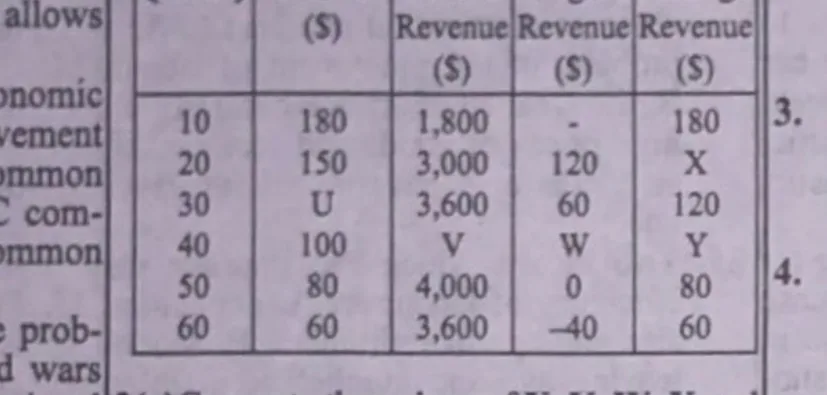
2(a). Table 2 below shows the unit prices and quantities of hats produced by a firm. Study it and compute the values of U, V, W, X and Y.
Model answer
Using Total Revenue (TR) = Price (P) × Quantity (Q): for example, if TR=3,600 at a price of 30, then quantity U = 3,600÷30 = 120. Similarly, V = 100×40 = 4,000. Marginal Revenue (MR) = TRₙ − TRₙ₋₁, e.g. W = 4,600−3,600 = 400. Average Revenue (AR) = TR÷Q, e.g. X = 3,600÷120 = 30. Each unknown (U, V, W, X, Y) is found by applying the appropriate revenue formula to the adjacent known values in the table.
2(b). In what type of market is the firm operating? Explain your answer.
Model answer
It is a monopoly. This is because Average Revenue (AR) is greater than Marginal Revenue (MR) at most output levels shown in the table — a pattern characteristic of a single seller facing the entire (downward-sloping) market demand curve.
2(c). If the firm's marginal cost is $60.00 at all levels of output, at what level of output will it be in equilibrium? Explain your answer.
Model answer
A firm is at equilibrium (profit-maximising) where MR = MC. Since MC = $60, the firm will be at equilibrium at the level of output where MR from the table also equals $60 — from the given data, this occurs at 30 units of output.
Economies of scale is the cost advantage that accrues to a firm as a result of expansion — i.e. all the advantages a firm enjoys as it grows/expands its scale of operation.
3(b). Outline three internal economies of scale a firm can enjoy.
Model answer
(i) Managerial economies of scale — improvement in management skills, and management costs staying relatively constant as output/scale increases.
(ii) Financial economies of scale — larger firms can access loans at a more favourable, more constant rate of interest.
(iii) Technical know-how economies of scale — improved technical skills and efficiency as the firm expands.
3(c). State three factors that can influence where a firm is sited.
Model answer
(i) Proximity to sources of raw materials.
(ii) Closeness to the market for the firm's products.
(iii) Availability of infrastructural facilities (e.g. power, roads, water).
Product retailing is the act of breaking down large quantities of a product into smaller units so that it can reach the final consumer — it describes the relationship between the retailer and the final consumer.
4(b). Outline any three roles performed by the wholesaler to the manufacturer.
Model answer
(i) Provision of storage facilities, helping to ensure continuous production.
(ii) Provision of financial assistance, helping to avoid delays in production.
(iii) Serving as a link between the manufacturer and the retailer/final consumer.
4(c). Identify any three problems associated with distribution of products.
Model answer
(i) Poor road network — creates difficulty in reaching customers at the right time.
(ii) Inadequate storage/transport facilities — can delay or damage goods in transit.
(iii) Poor communication network — makes it difficult to coordinate efficiently between buyer and seller, hindering effective distribution.
5(b). Distinguish between elastic demand and inelastic demand.
Model answer
Elastic demand is where the percentage change in quantity demanded is greater than the percentage change in price. Inelastic demand is where the percentage change in quantity demanded is always less than the percentage change in price.
5(c). Using diagrams, explain what happens to a trader's total revenue when his price falls, given that demand for his product is: (i) elastic; (ii) inelastic.
Model answer
(i) Elastic demand: the demand curve is relatively flat. When price falls, the percentage increase in quantity sold is larger than the percentage fall in price, so the revenue gained from extra sales outweighs the revenue lost from the lower price — total revenue increases.
(ii) Inelastic demand: the demand curve is relatively steep (close to vertical). When price falls, the percentage increase in quantity sold is smaller than the percentage fall in price, so the revenue lost from the lower price outweighs the revenue gained from extra sales — total revenue falls.
6(a). State three characteristics of perfect competition.
Model answer
(i) Homogeneity of products in the market (products are identical).
(ii) Free entry into and exit from the market.
(iii) Perfect information available to both buyers and sellers about the market.
6(b). With the aid of diagrams, explain the equilibrium positions of a perfectly competitive firm in the: (i) short-run; (ii) long-run.
Model answer
(i) Short-run: the firm is in equilibrium at the output where SMC (short-run marginal cost) = SAC (short-run average cost) = AR = MR. Where SAC is above SMC, SMC pulls the average cost down until this equilibrium point is reached.
(ii) Long-run: since firms are free to enter or exit, abnormal profits attract new entrants (increasing supply and lowering price) until price falls to the minimum point of the long-run average cost curve, where AR=MR=LAC=LMC and firms earn only normal profit.
7(a). Explain how the Central Bank controls money supply through the use of: (i) open market operations; (ii) bank rate.
Model answer
(i) Open Market Operations (OMO): the Central Bank buys or sells government securities. To increase money supply, it buys securities from the public (injecting cash); to reduce money supply, it sells securities to the public (withdrawing cash).
(ii) Bank Rate: the Central Bank raises or lowers the interest rate it charges commercial banks. Lowering the bank rate makes borrowing from the Central Bank cheaper, encouraging commercial banks to lend more, increasing money supply; raising the bank rate discourages borrowing/lending, reducing money supply.
7(b). Outline four functions performed by the Central Bank of your country.
Model answer
(i) Serves as banker to the government.
(ii) Serves as banker to the commercial banks.
(iii) Serves as lender of last resort to financial institutions.
(iv) Serves as the regulating agency for financial institutions.
8(a). Distinguish between domestic trade and external trade.
Model answer
Domestic trade is trade carried out within the borders of a single country/territory. External trade is trade that involves the exchange of goods and services between two or more countries.
8(b). Distinguish between terms of trade and balance of trade.
Model answer
Terms of trade is the rate/ratio at which a country's exports exchange for its imports (comparing export prices to import prices). Balance of trade is the difference between the value of a country's visible exports and the value of its visible imports.
8(c). Outline four causes of balance of payments deficit in a country.
Model answer
(i) Excessive importation of goods not matched by exportation.
(ii) Low/inadequate direct foreign investment in the economy.
(iii) High cost of foreign currency.
(iv) Decline in the foreign reserves of the economy.
Advertisement
Sign up free to unlock
Score tracking
Practice history
Saved questions
Progress dashboard
Personalized sessions
Weak-topic breakdown
…and/or go further with premium services and No Ads.