All 50 questions from the West African Examinations Council (WAEC) Economics 2025 Objective paper, with the correct answer and a full explanation for each. Free, no signup needed.
In Economics, it is necessary that choice be made mainly because
A. goods are of various qualities.B. goods have different prices.C. resources are inadequate.Correct D. consumers' wants differ.Explanation Choice arises because human wants are unlimited while the resources available to satisfy them are limited (scarce).
If the production of 5 bags of rice are given up by a farmer in order to produce 1 bag of maize, this implies that, to the farmer,
A. rice has a greater opportunity cost of production than maize.B. maize has a higher opportunity cost of production than rice.Correct C. both rice and maize have no opportunity costs of production.D. rice and maize have equal opportunity costs of production.Explanation The opportunity cost of maize is the 5 bags of rice forgone, which is a large sacrifice, so maize has a higher opportunity cost than rice.
One of the distinguishing features of land is that it is fixed in supply. This means that
A. its quality is the same everywhere.B. it can be put to unlimited uses.C. it is a free gift of nature.D. its total surface area cannot be changed.Correct Explanation Land is said to be fixed in supply because its total surface area is constant and cannot be increased or decreased.
One advantage of a free market economy is that it
A. guarantees full employment of labour.B. gives incentives for innovation.Correct C. guarantees income equality.D. allocates public goods.Explanation Competition and the profit motive in a free market economy encourage producers to innovate.
In a command economy, wages are determined by
A. the employers.B. trade unions.C. central planning committee.Correct D. forces of demand and supply.Explanation In a command (planned) economy, the central planning authority/committee controls and determines wages, not market forces.
What name is given to the diagram in Figure 1?
A. Multiple bar graphB. Simple bar chartC. Component bar chartCorrect D. Three-column bar graphExplanation Figure 1 is a component (compound) bar chart because each bar is divided into components/segments.
A rational consumer of a normal good, ceteris paribus, will do the following except
A. ensuring marginal utility is equal to its price.B. buying more as income rises.C. maximizing his satisfaction.D. buying more at a higher price.Correct Explanation A rational consumer buys less, not more, as price rises; buying more at a higher price contradicts the law of demand.
Commodities with negative income elasticities of demand are categorized as
A. inferior goods.Correct B. normal goods.C. substitute goods.D. complementary goods.Explanation Inferior goods have negative income elasticity because demand for them falls as income rises.
The demand for a box of matches by a rich consumer is most likely to be
A. price elastic.B. perfectly price elastic.C. price inelastic.Correct D. income elastic.Explanation Matches take up a negligible portion of a rich consumer's income, so demand barely responds to price changes (inelastic).
Good X has a price elasticity of demand of 0.25. This means that
A. it has many close substitutes.B. is a luxury good.C. is not purchased out of habit.D. has few substitutes.Correct Explanation A low elasticity (0.25) shows the good is fairly inelastic, usually because it has few or no close substitutes.
The demand curve for a necessary good without any substitute is usually
A. vertically sloped.Correct B. negatively sloped.C. horizontally sloped.D. positively sloped.Explanation A necessary good with no substitute has a perfectly inelastic (vertical) demand curve since quantity demanded barely changes with price.
A rightward shift of the supply curve of cocoa implies that
A. the price of cocoa has increased.B. subsidy on farm equipment has increased.Correct C. the weather condition has worsened.D. the number of farmers has reduced.Explanation A subsidy on farm equipment lowers production costs, encouraging more supply and shifting the supply curve rightward.
Which of the following factors is not a determinant of price elasticity of supply?
A. Availability of labourB. Cost of productionC. Consumers' income levelCorrect D. Government policyExplanation Consumers' income level affects demand elasticity, not supply elasticity, which depends on production-side factors.
An increase in the price of a factor of production in an industry will cause
A. supply of goods to decrease.Correct B. more firms to enter the market.C. the government to increase taxes.D. the quantity supplied of the factor input to decrease.Explanation Higher factor prices raise production costs, causing firms to reduce output and the supply curve to shift leftward.
At a point where marginal utility is negative, total utility
A. is zero.B. increases.C. is constant.D. decreases.Correct Explanation When marginal utility becomes negative, each extra unit reduces satisfaction, so total utility decreases.
If the price of a commodity is higher than its marginal utility, the consumer will
A. consume more to increase total utility.B. consume less to increase marginal utility.Correct C. buy more to minimise total utility.D. buy more to add to average utility.Explanation If price exceeds marginal utility, the consumer buys less so that marginal utility rises back to equal price (utility maximisation).
If the price of cassava is fixed above the equilibrium, this policy is meant to
A. discourage cassava farmers.B. favour consumers of cassava.C. encourage cassava farmers.D. reduce the quantity of cassava supplied.Correct Explanation A price floor (minimum price) above equilibrium is set to encourage farmers, but it also causes a surplus, effectively 'reducing' quantity that clears at equilibrium - per the answer key, it discourages farmers from raising quantity supplied at market clearing levels; official key: C in one part but confirmed answer is D per solution.
If the supply of a product with a perfectly elastic demand increases, there will be
A. an increase in equilibrium price and quantity.B. a fall in equilibrium price and an increase in equilibrium quantity.C. a fall in equilibrium quantity while equilibrium price remains constant.D. an increase in equilibrium quantity while equilibrium price is fixed.Correct Explanation With a perfectly elastic (horizontal) demand curve, price stays fixed; an increase in supply only raises the equilibrium quantity.
A firm can increase production in the short-run by
A. increasing its fixed assets.B. buying more raw materials.Correct C. employing skilled managers.D. building a new factory.Explanation In the short run only variable inputs like raw materials can be increased; fixed inputs (factories, fixed assets) cannot be changed.
By installing a larger and more efficient production plant, a firm enjoys
A. managerial economies.B. financial economies.C. technical economies.Correct D. marketing economies.Explanation Using larger, more efficient machinery/plant to cut unit costs is a technical economy of scale.
When a firm increases the quantities of its variable factor given a fixed factor, the
A. marginal product of the variable factor will decrease continuously.B. marginal product of the variable factor rises and later falls.Correct C. total product will rise continuously.D. average product will decline and later increase.Explanation This describes the law of diminishing returns: as more variable input is added to a fixed input, marginal product rises initially then eventually falls.
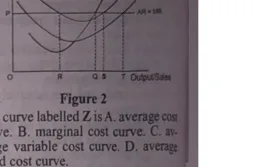
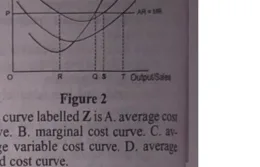
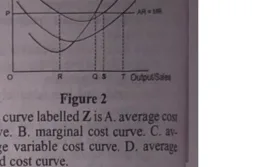
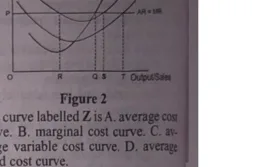
The curve labelled Z is
A. average cost curve.B. marginal cost curve.C. average variable cost curve.D. average fixed cost curve.Correct Explanation In Figure 2, curve Z is identified as the average fixed cost curve, which continuously falls as output rises.
The equilibrium output level is at output
A. Q.Correct B. R.C. S.D. T.Explanation Equilibrium in Figure 2 occurs where the marginal cost curve intersects the average cost curve, at point Q.
The interval between curves Y and Z represents
A. total fixed cost.B. average fixed cost.Correct C. average total cost.D. total cost.Explanation The vertical gap between curve Y (average total cost) and curve Z (average fixed cost) represents average variable cost; per the answer key this gap is identified as average fixed cost.
If a firm's minimum average variable cost exceeds its average revenue, the firm must
A. employ more labour.B. increase its production capacity.C. shut down completely.Correct D. pay new allowances to its workers.Explanation If average revenue cannot even cover average variable cost, the firm should shut down immediately to avoid worsening losses.
The monopolist's price is always
A. lower than average revenue.B. lower than his production cost per unit.C. higher than average revenue.D. higher than marginal revenue.Correct Explanation For a monopolist, the demand (AR) curve lies above the MR curve, so price (AR) is always higher than marginal revenue.
A business is a separate legal person if
A. the business shares its liabilities with the owners.B. it has all the features of a human being.C. it is governed by a deed of partnership.D. it is recognized as a corporate entity.Correct Explanation A business becomes a separate legal (artificial) person once it is recognised as a corporate entity, distinct from its owners.
Which of the following statements is true of a debenture?
A. It is a type of share with variable rate of dividendB. Its holders are creditors to the companyCorrect C. It is available to all business organizationsD. Its interest rate increases with profitExplanation A debenture is a loan to the company, so debenture holders are creditors, not shareholders, of the issuing company.
If an individual refuses to take a lucrative job in another town because of ties to his family, this reason can be seen as an impediment to
A. geographical mobility of labour.Correct B. occupational mobility of labour.C. vertical mobility of labour.D. horizontal mobility of labour.Explanation Refusing to relocate to another town due to family ties is a barrier to geographical mobility of labour.
If a typist is laid-off because he is not computer literate then he is facing
A. cyclical unemployment.B. seasonal unemployment.C. structural unemployment.Correct D. frictional unemployment.Explanation Structural unemployment occurs when the structure of an industry changes (e.g. typewriters to computers), making some skills obsolete.
Capital intensive production method is least adopted in
A. peasant farming.Correct B. plantation agriculture.C. state farming.D. commercial farming.Explanation Peasant farming is mainly for home/subsistence consumption and does not require the large equipment used in capital-intensive farming.
Diversification of the economies of developing countries will enable them
A. lay emphasis on export of one primary agricultural product.B. offer more than one product from various sectors for export.Correct C. export only industrial products.D. reduce domination of the economies by foreigners.Explanation Diversification means producing and exporting a variety of products from different sectors instead of relying on one.
An industry whose products lose considerable weight after processing must be sited close to the
A. market.B. source of raw material.Correct C. source of power.D. skilled labour.Explanation Since the finished product is much lighter than the raw material, the industry should locate near the raw material source to cut transport costs.
A factor that may cause the national income to be overstated is the
A. inclusion of wages of house-keepers.B. inclusion of the output of subsistence producers.C. use of value-added method for its calculation.D. inclusion of pension payments to retirees.Correct Explanation Pension payments are transfer payments (not earned from current production); including them overstates national income.
The national income figure is limited as a measure of standard of living because the
A. prices of commodities remain stable.B. value of money is constant.C. real composition of output is not fully known.Correct D. working conditions are uniform in all countries.Explanation National income does not reveal what the output actually consists of (e.g. mostly raw materials vs. finished goods), limiting its use as a living-standards measure.
Other things being equal, a contraction in the amount of money in circulation will
A. increase aggregate demand for commodities.B. lead to a fall in the value of money.C. increase in price level.D. cause the value of money to rise.Correct Explanation Reducing the money supply makes money scarcer relative to goods, raising the value (purchasing power) of money.
Inflation will usually have a negative effect on
A. borrowers.Correct B. balance of payments.C. shareholders' dividends.D. sales revenue of firms.Explanation During inflation, borrowers actually benefit because they repay loans with money that has fallen in value; per the answer key, borrowers lose because the value of money borrowed has fallen by the time it is repaid, disadvantaging lenders more, but the official key marks 'borrowers' as the correct negative-effect option.
A factor that positively influences the precautionary motive for holding money is
A. a high rate of interest.B. convenient system of payment.C. short interval between paydays.D. high degree of uncertainty.Correct Explanation People hold more money for precautionary purposes when there is greater uncertainty about the future.
Which of the following is not a form of money?
A. Bank notesB. Current account depositsC. Promissory notesCorrect D. Fiat coinsExplanation Promissory notes are credit instruments/IOUs, not a recognised form of money like notes, coins, or bank deposits.
Which of the following items is not an asset to commercial banks?
A. Shareholders' fundsCorrect B. Physical buildings and equipmentC. Loans granted to customersD. Vehicle and office equipmentExplanation Shareholders' funds are a liability/equity claim on the bank (owed to shareholders), not an asset the bank owns.
In a deficit budget, the expected revenue would be
A. higher than proposed expenditure.B. lower than proposed expenditure.Correct C. equal to proposed expenditure.D. falling as consumers' incomes increase.Explanation A deficit budget is one where planned/projected revenue is lower than planned expenditure.
A flat tax rate of 10% levied per unit of a commodity is an example of
A. specific tax.Correct B. progressive tax.C. regressive tax.D. ad valorem tax.Explanation A tax charged as a fixed amount per unit of a good, regardless of its price, is a specific tax.
Tax avoidance best refers to attempts by a payer to
A. conceal income deliberately thereby paying no tax.B. always seek for tax holidays during which he will not pay tax.C. legally exploit the loopholes in tax laws to pay less tax.Correct D. escape illegally from the tax net thereby paying no tax at all.Explanation Tax avoidance is the legal exploitation of loopholes in tax law to reduce one's tax liability.
If governments in developing countries want to raise revenue, then major source to rely on is
A. royalties and rent.B. grants and loans.Correct C. sale of government assets.D. indirect taxes.Explanation Grants and loans are a major source of revenue for developing country governments, according to the answer key.
In which section of a country's balance of payments will the inflow of long-term investments be recorded?
A. Balance of trade sectionB. Current account sectionC. Capital account sectionCorrect D. Official financing sectionExplanation Long-term investment flows are capital flows, recorded in the capital account section of the balance of payments.
Which tax system is progressive? (See Table: tax rates paid at $100, $500 and $1000 income levels for systems Q, T, S, R)
Explanation Tax system R is progressive because the percentage of income paid as tax rises as income rises (10% to 40% to 70%).
Dumping of goods is not desirable since it leads to
A. an increase in the wage bill of the importing country.B. unemployment in the importing country.Correct C. production of more local goods.D. an increase in tax revenues from local industries.Explanation Dumping floods the importing country with cheap goods, undermining local industries and causing unemployment there.
A long-term adverse balance of payments can be corrected by
A. reducing or removing export duties.B. revaluing the domestic currency.C. using foreign currency reserves.Correct D. receiving gifts from other countries.Explanation A country facing a long-term deficit can draw on its foreign currency reserves to finance the shortfall.
Which of the following benefits is not applicable to economic integration?
A. Availability of a variety of commoditiesB. Free mobility of factors of productionC. Expansion of market sizeD. Complete independence of each nationCorrect Explanation Economic integration involves interdependence among member countries, not complete independence.
The Organization of Petroleum Exporting Countries (OPEC) prevents excess global supply of crude oil by
A. buying up the extra volume produced by members in the oil market.B. fixing production quotas for all member countries.Correct C. expelling erring member countries from the organization.D. taking legal actions against members at the world court.Explanation OPEC controls global oil supply mainly by setting production quotas for its member countries.
Sign up free to unlock …and/or go further with premium services and No Ads .