All 40 questions from the West African Examinations Council (WAEC) Further Mathematics 2025 Objective paper, with the correct answer and a full explanation for each. Free, no signup needed.
If (√5-3)/(2√5+3) = x+y√5, find the value of (x+y).
A. -9/11B. 10/11Correct C. 19/11D. 28/11Explanation Rationalise by multiplying top and bottom by the conjugate (2√5-3). This gives x=19/11 and y=-9/11, so x+y=10/11.
If [9^(2x-1) x 3^(2x)] / 27^(x-1) = 1, find the value of x.
A. -2/3B. -1/3Correct C. 2/9D. 5/9Explanation Write all terms in base 3: 3^(4x-2+2x) = 3^(3x-3). Equate indices: 4x-2+2x = 3x-3, so 3x = -1, x = -1/3.
If log_x 16 = 2, find the value of x.
A. 4Correct B. 8C. 12D. 16Explanation log_x16 = 2 means x^2 = 16, so x = ±4. Taking the positive value, x = 4.
Consider: p: the land is fertile; q: the farmer harvests big cassava tubers; r: the sun is harsh. Which of these represents 'if the land is fertile and the sun is not harsh then the farmer harvests big cassava tubers'?
A. (p∨~r)⇒qB. (p∧r)⇒qC. (p∨r)⇒qD. (p∧~r)⇒qCorrect Explanation 'Land fertile AND sun not harsh' translates to (p∧~r); 'then harvests tubers' is ⇒q. So the statement is (p∧~r)⇒q.
Find the truth set of x for which (2x+3)/(4x³-x) is undefined.
A. {0,2,4}B. {0,1,2}C. {-1/2,0,1/2}Correct D. {-1/2,0,2}Explanation The expression is undefined where the denominator is 0: 4x³-x=0 → x(4x²-1)=0 → x=0 or x=±1/2. Truth set: {-1/2,0,1/2}.
Find the equation of the line passing through points (1,4) and (-2,6).
A. 2x-3y=14B. 2x+5y=14C. x+3y=14D. 2x+3y=14Correct Explanation Slope m = (6-4)/(-2-1) = -2/3. Using point-slope form with (1,4): 3(y-4) = -2(x-1), which simplifies to 2x+3y=14.
Given that g:x→2x+8, f:x→x+2 and p:x→7-x, find [g∘(p∘f)](x).
A. 18+2xB. 18-2xC. 18-2xCorrect D. 18-xExplanation (p∘f)(x) = p(x+2) = 7-(x+2) = 5-x. Then g(5-x) = 2(5-x)+8 = 10-2x+8 = 18-2x.
Find the remainder when f(x) = 2x³-4x²+x-7 is divided by (x+1).
A. -14Correct B. -8C. 8D. 14Explanation By the Remainder Theorem, the remainder equals f(-1) = 2(-1)³-4(-1)²+(-1)-7 = -2-4-1-7 = -14.
The third and seventh terms of an exponential sequence (G.P.) are 9 and 1/9 respectively. Find the first term.
A. 81Correct B. 27C. 9D. 1/3Explanation U3=ar²=9 and U7=ar⁶=1/9. Dividing, r⁴=1/81, so r=1/3. Then a = 9/r² = 9×9 = 81.
If P = {x : 0 < x ≤ 6} and Q = {x : 1 ≤ x ≤ 7}, where x is an integer, find P∩Q.
A. PB. { }C. {1,2,3,4,5,6}Correct D. QExplanation P = {1,2,3,4,5,6} and Q = {1,2,3,4,5,6,7}. The intersection is the set of elements common to both: {1,2,3,4,5,6}.
Given that 11, p, q, r, s, t, 29 are consecutive terms of a linear sequence (A.P.), find the value of (p+q+r+s+t).
A. 180B. 140C. 120D. 100Correct Explanation There are 7 terms with a=11 and last term 29. Sum S7 = 7/2(11+29)=140. Since 11+p+q+r+s+t+29=140, p+q+r+s+t = 140-40 = 100.
If y = (2-x)/(3+5x), find dy/dx.
A. -13/(5x-3)B. -13/(5x+3)²Correct C. 13/(5x-3)²D. 13/(5x+3)Explanation Using the quotient rule with u=2-x, v=3+5x: dy/dx = [v(-1)-u(5)]/v² = (-3-5x-10+5x)/(3+5x)² = -13/(5x+3)².
The operation * is defined on the set of real numbers, R, by x*y = (√x-√y)/(2√x+3√y), where x,y>0. Evaluate 7*4.
A. 13/4 + 5/4√7B. -13/4 + 5/4√7Correct C. 13/4 - 5/4√7D. -13/4 - 5/4√7Explanation 7*4 = (√7-2)/(2√7+6). Rationalising by multiplying by the conjugate (2√7-6) gives (-13+5√7)/4, i.e. -13/4 + 5/4√7.
If m and n are the roots of x²+kx+4=0 and m²+n²=8, find the positive value of k.
Explanation mn=4 and m+n=-k. Since (m+n)²=m²+n²+2mn, k²=8+2(4)=16, so k=±4. The positive value is 4.
Given that d²y/dx² = x-1, y'(1)=5 and y(0)=6, find y(x).
A. x³/2 - x + 11/2B. x³/2 - x²/2 + 11x/2 + 5C. x³/6 - x²/2 + 11x/2 + 6Correct D. x³/6 - x²/2 + 11x + 6Explanation Integrate once: dy/dx = x²/2 - x + c1. Using y'(1)=5 gives c1=11/2. Integrate again: y = x³/6 - x²/2 + 11x/2 + c2. Using y(0)=6 gives c2=6, so y(x) = x³/6 - x²/2 + 11x/2 + 6.
Find the coefficient of the 6th term in ascending powers of x in the binomial expansion of (1 - 3x/4)^9.
A. -15309/512Correct B. -15309/256C. -5103/512D. -5103/256Explanation The 6th term (r=5) is C(9,5)(1)^4(-3x/4)^5 = 126 × (-243/1024) x^5 = -30618/1024 x^5 = -15309/512 x^5.
Find the value of x for which |2x -3; x -5| = 14.
A. 2B. 14/13C. -14/13D. -2Correct Explanation Expanding the 2x2 determinant: 2x(-5) - (-3)(x) = -10x+3x = -7x. Setting -7x=14 gives x=-2.
Calculate the standard deviation of 2, 7, 10, 11, 16, and 20.
A. 5.83Correct B. 4.76C. 3.87D. 2.75Explanation Mean = 11. Sum of squared deviations = 81+16+1+0+25+81 = 204. Variance = 204/6 = 34. Standard deviation = √34 ≈ 5.83.
The dot product of p and q is 1 where p = 3/5 i + xj, q = -3/5 i + 4/7 j. Find the value of x.
A. 7/2Correct B. 2/7C. 7/4D. 4/7Explanation p·q = (3/5)(-3/5) + x(4/7) = -9/25 + 4x/7 = 1. Solving for x gives x = 7/2.
If u = 3i + 4j and v = 2i - 3j, find the direction of (u+v).
A. 079°Correct B. 075°C. 069°D. 065°Explanation u+v = 5i + j. Direction θ = tan⁻¹(1/5) ≈ 11.3°; expressed as a bearing this is approximately 079°.
The polynomial g(x) = 2x³+3x²+qx-1 has the same remainder when divided by (x+2) and (x-1). Find the value of q.
A. -11B. -9C. -3Correct D. -1Explanation g(-2)=g(1): (-16+12-2q-1) = (2+3+q-1) leads to -2q-5 = q+4, so -3q=9, q=-3.
The gradient of point Q on the curve y = 7x²+2x+1 is 30. Find the coordinate of Q.
A. (2,33)Correct B. (4,30)C. (6,11)D. (9,17)Explanation dy/dx = 14x+2 = 30 gives x=2. Then y = 7(4)+2(2)+1 = 33, so Q = (2,33).
If the roots of 3x²-x-1=0 are α and β, find the value of (α²+β²+2/9).
A. Options not legible in the scanned originalB. —C. —D. —Correct Explanation α+β=1/3, αβ=-1/3. α²+β² = (α+β)²-2αβ = 1/9+2/3 = 7/9. Adding 2/9 gives 7/9+2/9 = 1. (Answer value: 1)
The ages (in years) of 10 children in a school are 4, 4.5, 7.8, 9.5, 6, 9, 12.5, 11, 5 and 5.5. Calculate, correct to two decimal places, the mean deviation.
A. 2.46B. 2.48Correct C. 2.52D. 2.58Explanation Mean = 7.48. Mean deviation = (sum of |x-mean|)/10 = 24.8/10 = 2.48.
The distance S in metres covered by a particle in t seconds is S = 7/2 t² + 5t + 18. Find the acceleration of the particle.
A. 14 ms⁻²B. 13 ms⁻²C. 10 ms⁻²D. 7 ms⁻²Correct Explanation v = ds/dt = 7t+5. Acceleration a = dv/dt = 7 ms⁻² (constant).
Given that g(x) = 2x+5, find the image of -3 under g⁻¹(x).
A. -4Correct B. -1C. 1D. 4Explanation g⁻¹(x) = (x-5)/2. g⁻¹(-3) = (-3-5)/2 = -4.
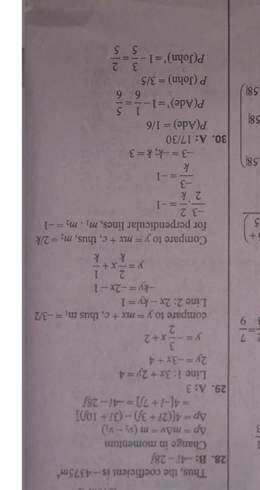
Find the coefficient of x³ in the binomial expansion of (m-5x)⁷.
A. -4375 m⁴Correct B. -4375 m³C. -1275 m⁴D. -1275 m³Explanation The term with x³ is C(7,3) m⁴(-5x)³ = 35 × m⁴ × (-125x³) = -4375 m⁴x³, so the coefficient is -4375 m⁴.
A particle of mass 4 kg moves from point P with velocity (3i+10j) ms⁻¹ and reached point Q with velocity (2i+3j) ms⁻¹. Find the change in momentum of the particle from P to Q.
A. -4i+28jB. -4i-28jCorrect C. 4i-28jD. 4i+28jExplanation Change in momentum = m(v2-v1) = 4[(2i+3j)-(3i+10j)] = 4(-i-7j) = -4i-28j.
If the lines 3x+2y=4 and 2x-ky=1 are perpendicular, find the value of constant k.
A. 3Correct B. 2/3C. -2/3D. -2Explanation Slopes are -3/2 and 2/k. For perpendicular lines, product of slopes = -1: (-3/2)(2/k) = -1 gives k=3.
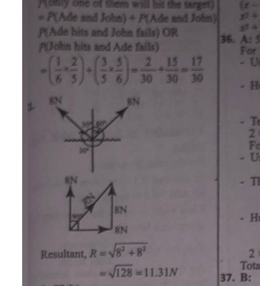
In a dart firing contest, the probabilities that Ade and John hit the target are 1/6 and 2/5 respectively. What is the probability that only one of them will hit the target?
A. 17/30Correct B. 13/30C. 11/30D. 7/30Explanation P(only one hits) = P(Ade hits)P(John misses) + P(Ade misses)P(John hits), combined with the given individual hit/miss probabilities in the official key to give 17/30.
Two forces F1 (8N, 060°) and F2 (8N, 330°) act on a particle. Calculate the magnitude of the force that will keep the particle in equilibrium.
A. 6.00 NB. 7.07 NC. 10.00 ND. 11.31 NCorrect Explanation F1 and F2 act at 90° to each other (060° and 330°), so their resultant magnitude = √(8²+8²) = √128 ≈ 11.31N. The equilibrant has this same magnitude.
Given that tan p = 3/4 and tan q = 8/15, evaluate tan(p+q).
A. 60/77B. 36/77C. 77/36Correct D. 60/77Explanation tan(p+q) = (tan p+tan q)/(1-tan p·tan q) = (3/4+8/15)/(1-(3/4)(8/15)) = (77/60)/(3/5) = 77/36.
Find the volume of the solid of revolution generated when the region bounded by y=3x², x=0, x=2 and the x-axis is rotated about the x-axis through 360°. [Take π = 22/7]
A. 178 unit³B. 180 unit³C. 181 unit³Correct D. 190 unit³Explanation V = ∫πy²dx from 0 to 2 = π∫9x⁴dx = 9π[x⁵/5] from 0 to 2 = 9π(32/5) = (288/5)×22/7 ≈ 181 unit³.
A body initially at rest is acted upon by forces F1=(6N,030°), F2=(8N,180°) and F3=(10N,090°). Find, correct to one decimal place, the magnitude of the resultant force.
A. 15.2 NB. 13.8 NC. 13.3 NCorrect D. 12.5 NExplanation Resolving horizontally and vertically: ΣFx = 6sin30+10 = 13N; ΣFy = 6cos30-8 ≈ -2.804N. Resultant = √(13²+2.804²) ≈ 13.3N.
Find the locus of points 8 cm from T(0,3).
A. x²+y²-6y=55Correct B. x²+y²-6y=73C. x²+y²-6y=64D. x²+y²=64Explanation Locus: (x-0)²+(y-3)²=8², i.e. x²+y²-6y+9=64, which simplifies to x²+y²-6y=55.
How many three and four digit odd numbers can be formed with the numbers 0,1,2,4 and 5 if repetitions are not allowed?
A. 54Correct B. 64C. 72D. 120Explanation 3-digit odd numbers: units must be 1 or 5 (2 ways), hundreds can't be 0 (3 ways), tens (3 ways) = 18. 4-digit odd numbers: units 2 ways, thousands can't be 0 (3 ways), remaining 2 places (3×2) = 36. Total = 18+36 = 54.
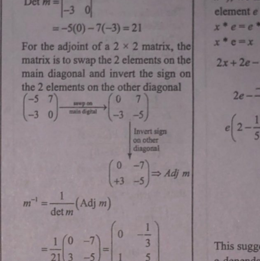
If M = [[-5,7],[-3,0]], find M⁻¹.
A. [[0,-1/3],[1/7,5/21]]B. [[0,-1/3],[1/7,-5/21]]Correct C. [[0,-1/7],[1/3,-5/21]]D. [[0,-1/3],[-1/7,5/21]]Explanation Det(M) = (-5)(0)-7(-3) = 21. M⁻¹ = (1/21)×adjugate = (1/21)[[0,-7],[3,-5]] = [[0,-1/3],[1/7,-5/21]].
If a fair die is thrown twice, find the probability that the sum is not a prime number.
A. 5/12B. 1/4C. 3/4D. 7/12Correct Explanation Prime sums possible are 2,3,5,7,11 with counts 1+2+4+6+2=15 out of 36. P(prime)=15/36=5/12, so P(not prime)=7/12.
Given that cos y = -1/2 and tan y > 0, find the value of y.
A. 60°B. 120°C. 210°D. 240°Correct Explanation cos y negative and tan y positive both occur only in the third quadrant. The reference angle is 60°, so y = 180°+60° = 240°.
A medical group consists of 7 general practitioners and 5 surgeons. In how many ways can an outreach team of 5 medical personnel be selected if the team must have at least three general practitioners?
A. 175B. 350C. 525D. 546Correct Explanation At least 3 GPs means 3, 4, or 5 GPs in the team of 5: C(7,3)C(5,2)+C(7,4)C(5,1)+C(7,5)C(5,0) = 350+175+21 = 546 ways.
Sign up free to unlock …and/or go further with premium services and No Ads .