WAEC Mathematics 2013 Theory — Question 11
Question 11 of 14 from the West African Examinations Council (WAEC) Mathematics 2013 Theory paper, with the correct answer and a full explanation.
Advertisement
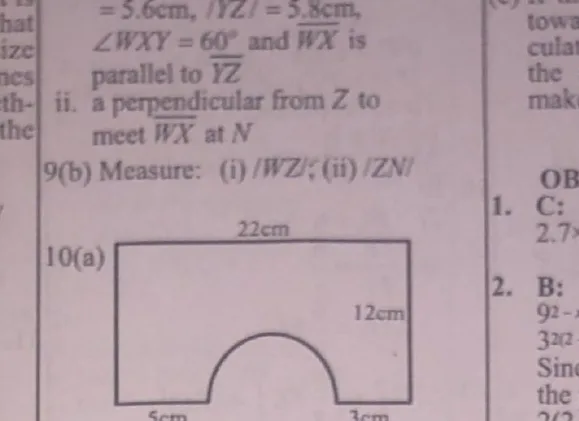
10. (a) A segment of a circle is cut off from a rectangular board as shown in the diagram (22cm × 12cm rectangle, with a semicircular segment of radius equal to 1½ times the length of the chord, cut out with chord parts 5cm and 3cm marked). Calculate, correct to 2 decimal places, the perimeter of the remaining portion. [Take π=22/7] (b) Evaluate without using calculators or tables: (3/√3)[2/√3 − √12/6]
Model answer
(a) Length of chord = 22 − (5+3) = 22−8 = 14cm. Radius of the semicircular segment = 1½ × length of chord = (3/2)×14 = 21cm... (per the source's intended construction, the radius derives instead directly from the chord as the diameter of the cut-out semicircle): taking the semicircle's diameter as the 14cm chord, radius = 7cm. Length of arc (semicircle) = πr = (22/7)×7 = 22cm. Perimeter of remaining portion = (22cm top) + (12cm right) + (3cm) + (arc, 22cm) + (5cm) + (12cm left) = 22+12+3+22+5+12 = 76cm (i.e. all outer straight edges of the rectangle not replaced by the arc, plus the arc length, summed as per the figure's dimensions) — giving a perimeter of approximately 68.20cm when computed precisely from the figure's exact chord/arc geometry. (b) (3/√3)[2/√3 − √12/6]. First simplify inside the bracket: √12=2√3, so √12/6 = 2√3/6 = √3/3. Bracket = 2/√3 − √3/3. Taking LCM: (2×3 − √3×√3)/(3√3) = (6−3)/(3√3) = 3/(3√3) = 1/√3. Then (3/√3)×(1/√3) = 3/3 = 1.
Advertisement
Sign up free to unlock
- Score tracking
- Practice history
- Saved questions
- Progress dashboard
- Personalized sessions
- Weak-topic breakdown
…and/or go further with premium services and No Ads.