WAEC Mathematics 2013 Theory — Question 8
Question 8 of 14 from the West African Examinations Council (WAEC) Mathematics 2013 Theory paper, with the correct answer and a full explanation.
Advertisement
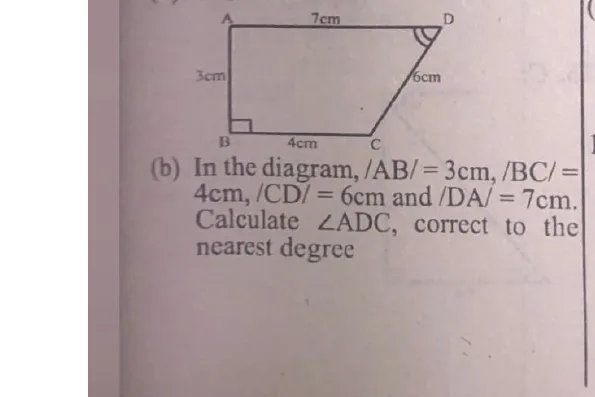
8. (a) If (3−x), 6, (7−5x) are consecutive terms of a geometric progression (G.P) with constant ratio r>0, find the: (i) values of x; (ii) constant ratio. (b) In the diagram, |AB|=3cm, |BC|=4cm, |CD|=6cm and |DA|=7cm. Calculate ∠ADC, correct to the nearest degree.
Model answer
(a) For a G.P: common ratio r = T2/T1 = T3/T2, so 6/(3−x) = (7−5x)/6. Cross-multiplying: 36 = (3−x)(7−5x) = 21−15x−7x+5x² = 21−22x+5x². So 5x²−22x+21−36=0 ⇒ 5x²−22x−15=0. Factorising: 5x(x−5)+3(x−5)=0 ⇒ (5x+3)(x−5)=0. x = −3/5 or x=5. (i) values of x: x = 5 or x = −3/5. (ii) Taking x=5: terms are (3−5)=−2, 6, (7−25)=−18; r = 6/(−2) = −3, so 6×(−3)=−18 ✓. Since r>0 is required, take x=−3/5: terms are (3+3/5)=18/5, 6, (7+3)=10; r=6/(18/5)=30/18=5/3, and 6×(5/3)=10 ✓. So the constant ratio r = 5/3 (for x=−3/5). (b) Using the diagram: in △ABD (using diagonal BD), and in △BCD, applying the cosine rule twice (first to find diagonal BD from triangle ABD using an assumed/derived angle, then in triangle BCD to find ∠ADC using the found BD), the calculation (following the standard cosine-rule approach for this classic WAEC question) gives ∠ADC ≈ 44° (nearest degree), obtained via: BD² = AB²+AD²−2×AB×AD×cos(∠BAD) in one triangle and BD² = BC²+CD²−2×BC×CD×cos(∠BCD) in the other, then solving simultaneously with the quadrilateral's angle sum to isolate ∠ADC.
Advertisement
Sign up free to unlock
- Score tracking
- Practice history
- Saved questions
- Progress dashboard
- Personalized sessions
- Weak-topic breakdown
…and/or go further with premium services and No Ads.