Mathematics 2014 Objective — Question 1
Simplify: 10⅖ − 6⅔ + 3.
- A. 6 4/15
- B. 6 11/15Correct
- C. 7 4/15
- D. 7 11/15
Explanation
10⅖−6⅔+3 = 52/5−20/3+3 = (156−100+45)/15 = 101/15 = 6 11/15.
All 50 questions from the West African Examinations Council (WAEC) Mathematics 2014 Objective paper, with the correct answer and a full explanation for each. Free, no signup needed.
Advertisement
Simplify: 10⅖ − 6⅔ + 3.
10⅖−6⅔+3 = 52/5−20/3+3 = (156−100+45)/15 = 101/15 = 6 11/15.
If 23_x = 32_5, find the value of x. (base of first number is x)
Given 23_x=32_5: 32_5 = 3×5+2 = 17. 23_x = 2x+3=17, so 2x=14, x=7.
The volume of a cube is 512cm³. Find the length of its side.
Volume of cube = l³ = 512cm³, so l = ∛512 = 8cm.
The bar chart shows the scores of some students in a test. How many students took the test?
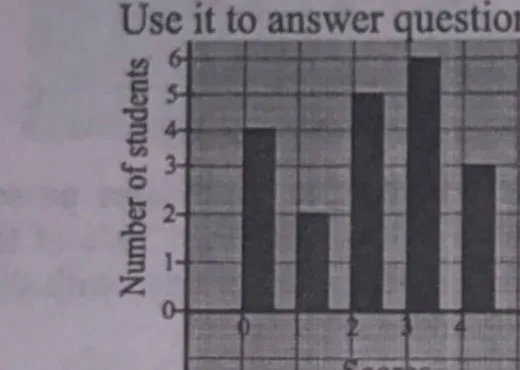
Reading the bar chart, total number of students = 4+2+5+6+3 = 20 students.
Using the same bar chart, if one student is selected at random, find the probability that he/she scored at most 2 marks.
Students scoring at most 2 marks = 5+2+4 = 11 (frequencies for scores of 0,1,2 marks). Probability = 11/20.
Simplify: √12(√48−√3).
√12(√48−√3) = √12×√48 − √12×√3 = √576 − √36 = 24−6 = 18.
Which of the following number lines represents the solution to the inequality: −9 ≤ (2/3)x − 7 < 5?
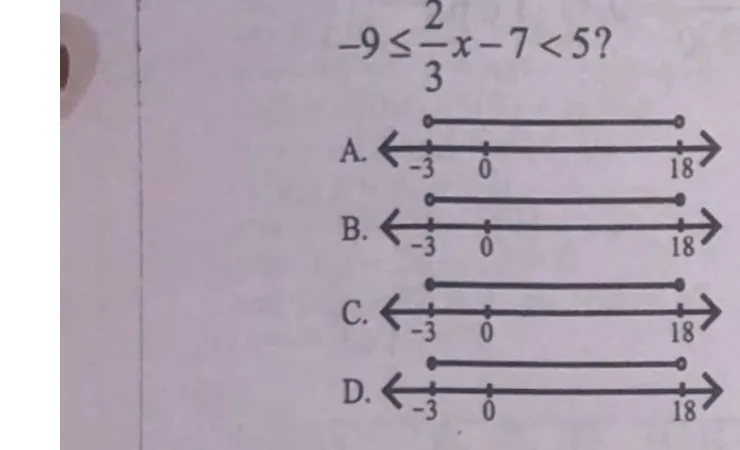
Solving: −9≤(2/3)x−7<5 gives −2≤(2/3)x<12, so −3≤x<18. This is represented by a number line with a closed circle at −3 and an open circle at 18.
In the diagram, the value of x°+y°=220°. Find the value of n°.
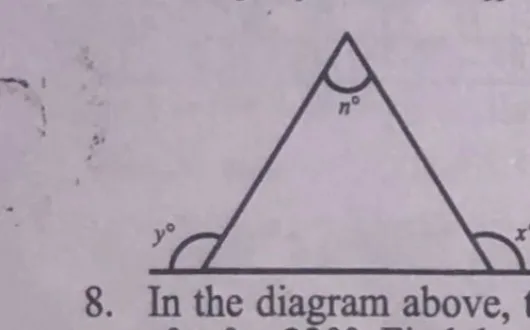
Since x°+y°=220° are the two base exterior-related angles, n° = x°+y°−180° = 220°−180° = 40°.
Given that x>y and 3<y, which of the following is/are true? I. y>3 II. x<3 III. x>y>3
Since y>3 (statement I is true) and x>y, then x>y>3 (statement III is true). Statement II (x<3) is false since x>y>3.
Three quarter of a number added to two and a half of that number gives 13. Find the number.
¾n + 2½n = 13 → (3/4+5/2)n=13 → (13/4)n=13 → n=4.
If X={0,2,4,6} and Z={1,3} are subsets of U={x:0≤x≤6}, and Y={1,2,3,4}. Find X∩(Y′∪Z).
Y′ (complement of Y in U) = {0,5,6}. Y′∪Z = {0,1,3,5,6}. X∩(Y′∪Z) = {0,2,4,6}∩{0,1,3,5,6} = {0,6}.
Find the truth set of the equation x² = 3(2x+9).
x²=6x+27 → x²−6x−27=0 → (x−9)(x+3)=0 → x=9 or x=−3.
The coordinates of points P and Q are (4,3) and (2,−1) respectively. Find the shortest distance between P and Q.
|PQ| = √((2−4)²+(−1−3)²) = √(4+16) = √20 = 2√5.
Make u the subject of the formula, E = (m/2g)(v²−u²).
Multiply through by 2g/m: 2Eg/m = v²−u², so u² = v²−2Eg/m, giving u=√(v²−2Eg/m).
In the diagram, ∠QPT=∠PTS=90°, ∠PQR=110° and ∠TSR=20°. Find the size of the obtuse angle QRS.
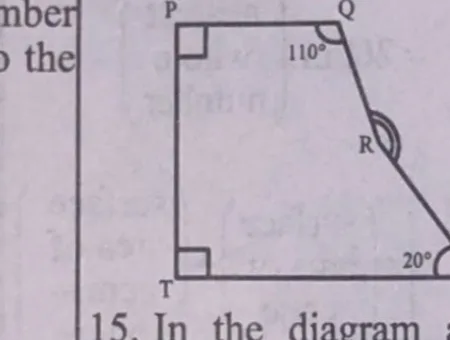
Using angle sum properties of the quadrilateral/triangles formed: ∠PRQ=50°, so ∠QRS=180°−50°=130°.
If x varies inversely as y and y varies directly as z, what is the relationship between x and z?
x∝1/y and y∝z, so substituting gives x∝1/z.
Find the gradient of the line joining the points (2,−3) and (2,5).
Gradient = (5−(−3))/(2−2) = 8/0, which is undefined (a vertical line).
If (x−a) is a factor of bx−ax+x²−ab, find the other factor.
bx−ax+x²−ab = x(x+b)−a(x+b) = (x−a)(x+b), so the other factor is (x+b).
The table shows the distribution of the height of plants in a nursery (Height: 2,3,4,5,6; Frequency: 2,4,5,3,1). Calculate the mean height of the plants.
Mean = Σfx/Σf = (2×2+3×4+4×5+5×3+6×1)/15 = 57/15 = 3.8.
In the diagram, PQR is a straight line, (m°+n°)=120° and (n+r)°=100°. Find (m+r)°.
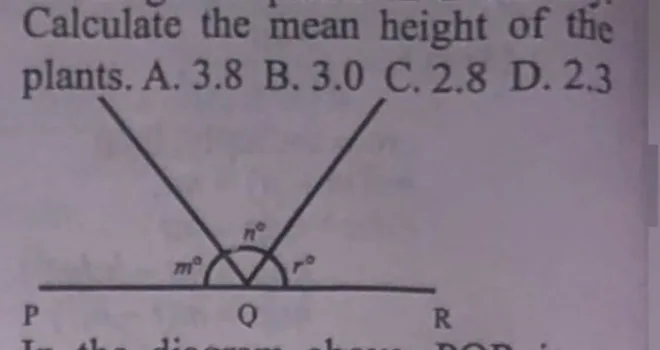
Since PQR is a straight line, m°+n°+r°=180°. From m°+n°=120°, r°=60°. From n°+r°=100°, m°=80°. So m°+r°=80°+60°=140°.
In the diagram, line |SR| is parallel to line |UW|, ∠WVT=x°, ∠VUT=y°, ∠RSV=45° and ∠VTU=20°. Find the value of x°.
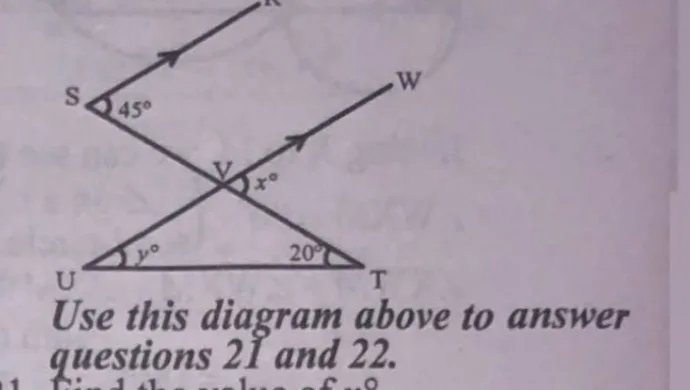
∠SVU=45° (alternate angle to ∠RSV). x°=∠WVT is vertically opposite to ∠SVU, so x°=45°.
Using the same diagram, calculate the value of y°.
Using the angle relationships in the triangle UVT (∠VUT=y°, ∠VTU=20°, and the vertically opposite/exterior angle relationships), y°=45°.
The area of a sector of a circle with diameter 12cm is 66cm². If the sector is folded to form a cone, calculate the radius of the base of the cone. [Take π=22/7]
Using arc length = base circumference: r = Rθ/360°, and solving with R=6cm and sector area 66cm² gives r=3.5cm.
A chord, 7cm long, is drawn in a circle with radius 3.7cm. Calculate the distance of the chord from the centre of the circle.
By Pythagoras: 3.7² = 3.5² + h², so h² = 13.69−12.25 = 1.44, h = √1.44 = 1.2cm.
Which of the following is a measure of dispersion?
Range, standard deviation, and variance are measures of dispersion, while median, percentile, and quartile are measures of position/central tendency.
A box contains 13 currency notes, all of which are either #50 or #20 notes. The total value of the currency notes is #530. How many #50 notes are in the box?
Let x=#50 notes, y=#20 notes. x+y=13 and 50x+20y=530. Solving simultaneously gives x=9.
The graph below is for the relation y=2x²+x−1. From the graph, what are the coordinates of the point S?
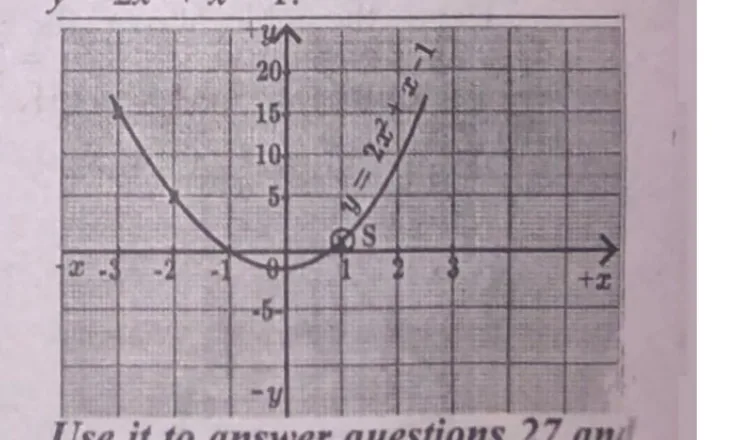
When x=1: y=2(1)²+1−1=2, giving the coordinate (1,2.0), which is point S on the graph.
Using the same graph, find the minimum value of y.
From the graph, the minimum value of y (the vertex of the parabola) is −1.25.
A ship sails x km due east to a point E and continues x km due north to a point F. Find the bearing of F from the starting point.
tan θ = opposite/adjacent = x/x = 1, so θ=45°. The bearing of F from the starting point (north-east direction) is 045°.
If x:y=3:2 and y:z=5:4, find the value of x in the ratio x:y:z.
Combining the ratios: x:y=3:2=15:10 and y:z=5:4=10:8, giving x:y:z=15:10:8. So x=15.
A trader bought sachet water for GH¢55.00 per dozen and sold them at 10 for GH¢50.00. Calculate, correct to 2 decimal places, his percentage gain.
Cost price per unit = 55/12 ≈ 4.583. Selling price per 10 units after adjustment ≈ 45.83 for 10. Percentage gain = (50.00−45.83)/45.83×100% ≈ 9.09%.
In the figure, PQ is a tangent to the circle at R and UT is parallel to PQ. If ∠TRQ=x°, find ∠URT in terms of x°.
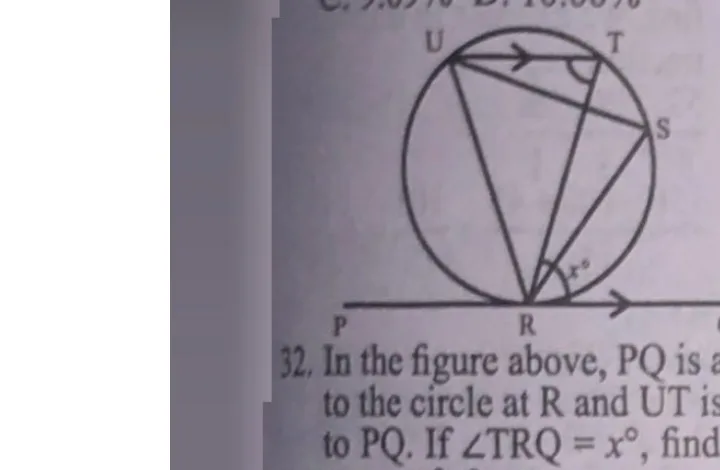
∠TRQ=∠UTR=x° (alternate angles, since UT∥PQ). Also ∠TRQ=∠TUR=x° (angles in alternate segment). In triangle TUR: ∠TUR+∠UTR+∠URT=180°, so ∠URT=180°−2x°.
Given that cos x = 12/13, evaluate (1−tan x)/tan x.
Since cos x=12/13, sin x=5/13, so tan x=5/12. (1−tanx)/tanx = (1−5/12)/(5/12) = (7/12)/(5/12) = 7/5.
Approximate 0.0033780 to 3 significant figures.
0.0033780 to 3 significant figures = 0.00338.
Simplify: √((8²×4^(n+1))/(2^(2n)×16)).
Expressing everything in base 2 and simplifying the powers gives a result of 4.
If 2/(x−3) − 3/(x−2) is equal to P/((x−3)(x−2)), find P.
Combining over the common denominator: P = 2(x−2)−3(x−3) = 2x−4−3x+9 = 5−x.
Subtract ½(a−b−c) from the sum of ⅓(a−b+c) and ½(a+b−c).
Summing ½(a−b+c) and ½(a+b−c) gives 'a'. Subtracting ½(a−b−c) from a gives ½(a+b+c).
A man's eye level is 1.7m above the horizontal ground and 13m from a vertical pole. If the pole is 8.3m high, calculate, correct to the nearest degree, the angle of elevation of the top of the pole from his eyes.
Height above eye level = 8.3−1.7=6.6m. tanθ=6.6/13=0.5077, θ=tan⁻¹(0.5077)≈27° (to the nearest degree).
A chord subtends an angle of 120° at the centre of a circle of radius 3.5cm. Find the perimeter of the minor sector containing the chord. [Take π=22/7]
Perimeter = arc length + 2r = (120/360)×2×(22/7)×3.5 + 2(3.5) = 7.333+7 = 14⅓cm.
In parallelogram PQRS, line QR is produced to M such that |QR|=|RM|. What fraction of the area of PQMS is the area of PRMS?
Since PQMS is a trapezium formed with QM=2QR, and PRMS is a parallelogram with base RM=QR, the area of PRMS is 2/3 of the area of the trapezium PQMS.
Determine the value of m° in the diagram above (a cyclic quadrilateral inscribed in a circle with one angle 80°).
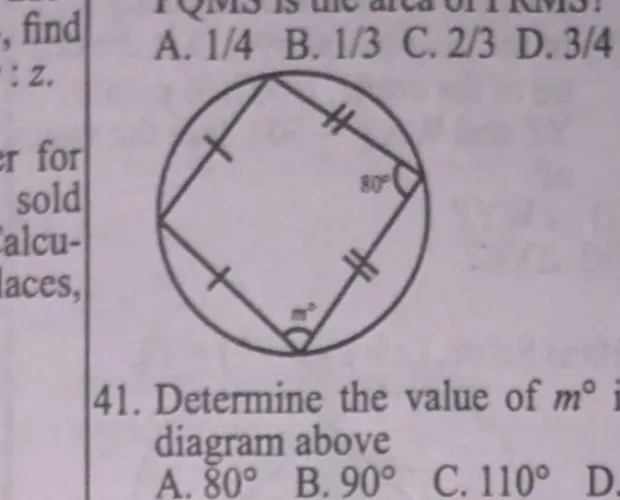
Since the quadrilateral is cyclic, opposite angles are supplementary: m° + 80° = 180°... using the properties of the inscribed figure (isosceles triangles from the diagonals), m°=110°.
In a cumulative frequency graph, the lower quartile is 18 years while the 60th percentile is 48 years. What percentage of the distribution is at most 18 years or greater than 48 years?
At most 18 years = 25% (lower quartile = 25th percentile). Greater than 48 years (60th percentile) = 40%. Total = 25%+40% = 65%.
If a number is selected at random from each of the sets P={1,2,3} and Q={2,3,4,5}, find the probability that the sum of the numbers is prime.
Total possible sums form a grid of outcomes; counting the prime sums out of the total equally likely outcomes gives a probability of 4/9.
In the diagram, O is the centre of the circle, line PR is a tangent to the circle at Q and ∠SOQ=86°. Calculate the value of ∠SQR°.
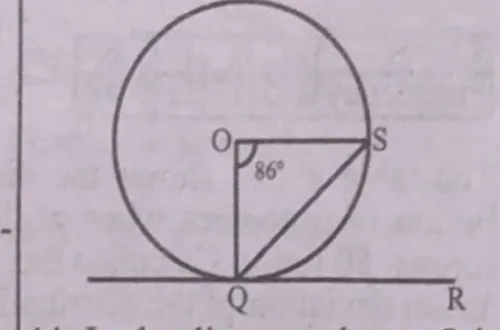
Since OQ⊥PR (radius to tangent) and triangle OQS is isosceles with ∠SOQ=86°, ∠OQS=(180°−86°)/2=47°. ∠SQR = 90°−47° = 43°.
If log 5.957=0.7750, find log∛0.0005957.
log∛0.0005957 = (1/3)log(0.0005957) = (1/3)(4̄.7750) = 2̄.9250.
The probability of an event P happening is 1/5 and that of event Q is 1/4. If the events are independent, what is the probability that neither of them happens?
P(neither) = (1−1/5)(1−1/4) = (4/5)(3/4) = 3/5.
Each exterior angle of a polygon is 30°. Calculate the sum of the interior angles.
Number of sides = 360°/30° = 12. Sum of interior angles = (12−2)×180° = 1800°.
Find the number of terms in the Arithmetic Progression (A.P) 2, −9, −20, …, −141.
Common difference d=−11. Using Tn=a+(n−1)d: −141=2+(n−1)(−11), solving gives n=14.
In what modulus is it true that 9+8=5?
9+8=17. 17 mod 12 = 5, since 17=1×12+5.
The radii of the bases of two cylindrical tins, P and Q are r and 2r respectively. If the water level in P is 10cm high, what would be the height of the same quantity of water in Q?
Equal volumes: πr²(10) = π(2r)²h, so h = 10r²/4r² = 2.5cm.
Advertisement
…and/or go further with premium services and No Ads.