All 23 questions from the West African Examinations Council (WAEC) Mathematics 2014 Theory paper, with the correct answer and a full explanation for each. Free, no signup needed.
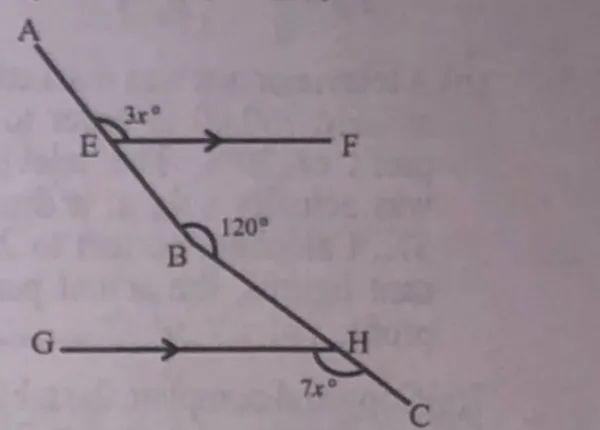
1(b). In the diagram, line EF is parallel to line GH. If ∠AEF=3x°, ∠ABC=120° and ∠CHG=7x°, find the value of ∠GHB.
Model answer
Draw a line through B parallel to EF and GH.
Corresponding angles: the part of ∠ABC nearest EF equals ∠AEF = 3x°.
So the remaining part, ∠NBH = 120°−3x° (alternate angle to ∠GHB).
Also, by vertically opposite/co-interior relations at H, using ∠CHG=7x°: ∠GHB=180°−7x°.
Equating: 180−7x = 120−3x ⟹ 60=4x ⟹ x=15.
∠GHB = 120−3(15) = 120−45 = 75°.
3(b). A man drives from Ibadan to Oyo, a distance of 48km, in 45 minutes. If he drives at 72km/h where the surface is good and 48km/h where it is bad, find the number of kilometers of good surface.
Model answer
Let d = distance of good surface, so (48−d) = distance of bad surface.
Time = distance/speed. Total time = 45min = 0.75h.
d/72 + (48−d)/48 = 0.75
Multiply through by 144 (LCM of 72,48):
2d + 3(48−d) = 108
2d+144−3d=108
−d=−36
d=36km
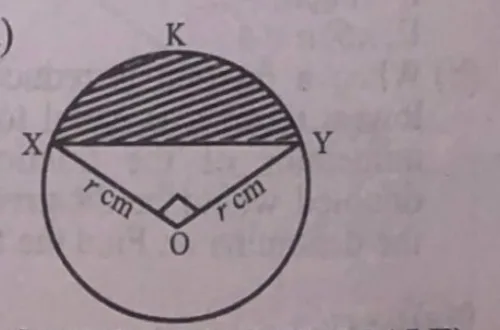
4(a). In the diagram, O is the centre of the circle radius r cm and ∠XOY=90°. If the area of the shaded part is 504cm², calculate the value of r. [Take π=22/7]
Model answer
Sector area (90°) = (90/360)πr² = πr²/4
Triangle XOY area = ½r²sin90° = ½r²
Shaded (segment) area = sector − triangle = r²(π/4 − 1/2)
Using π=22/7: π/4−1/2 = 11/14 − 7/14 = 2/7
So: r²×(2/7) = 504
r² = 504×7/2 = 1764
r = √1764 = 42cm
4(b). Two isosceles triangles PQR and PQS are drawn on opposite sides of a common base PQ. If ∠PQR=66° and ∠PSQ=109°, calculate the value of ∠RQS.
Model answer
Triangle PQR is isosceles on base PQ, with ∠PQR=∠QPR=66° (base angles equal).
Triangle PQS is isosceles on base PQ, with apex ∠PSQ=109°, so base angles ∠PQS=∠QPS=(180−109)/2=35.5°.
Since R and S are on opposite sides of PQ, ∠RQS = ∠PQR + ∠PQS = 66°+35.5° = 101.5°
5. A building contractor tendered for two independent contracts, X and Y. The probability that he will win contract X is 0.5, and the probability that he will not win contract Y is 0.3. What is the probability that he will win: (a) both contracts; (b) exactly one of the contracts; (c) neither of the contracts?
6(b). A television set was marked for sale at GH¢760.00 in order to make a profit of 20%. The television set was actually sold at a discount of 5%. Calculate, correct to 2 significant figures, the actual percentage profit.
7(a). Copy and complete the table of values for the relation y=2sinx+1 for x=0° to 270° in steps of 30°.
7(b). Using scales of 2cm to 30° on the x-axis and 2cm to 1 unit on the y-axis, draw the graph of y=2sinx+1 for 0°≤x≤270°.
7(c). Use the graph to find the values of x for which sinx=1/4.
Model answer
(a) Computed table: x: 0°,30°,60°,90°,120°,150°,180°,210°,240°,270°
y: 1.0, 2.0, 2.7, 3.0, 2.7, 2.0, 1.0, 0.0, −0.7, −1.0
(b) Plot these points on the given scale and draw a smooth sine curve through them.
(c) sinx=1/4 corresponds to y=2(1/4)+1=1.5. Reading from the graph where the curve crosses y=1.5 gives x≈14.5° and x≈165.5°.
8(a). Copy and complete the following table for multiplication modulo 11 (values: 1, 5, 9, 10). Use the table to: (i) evaluate (9⊗5)⊗(10⊗10); (ii) find the truth set of I. 10⊗m=2 II. n⊗n=4.
Model answer
Completed table (mod 11): 5⊗5=3, 5⊗9=1, 5⊗10=6, 9⊗5=1, 9⊗9=4, 9⊗10=2, 10⊗5=6, 10⊗9=2, 10⊗10=1
(i) (9⊗5)⊗(10⊗10) = 1⊗1 = 1
(ii) I. 10⊗m=2 ⟹ from the table, m=9. II. n⊗n=4 ⟹ n=9.
8(b). When a fraction is reduced to its lowest term, it is equal to ¾. The numerator of the fraction when doubled would be 34 greater than the denominator. Find the fraction.
Model answer
Let the fraction be 3k/4k (lowest terms 3:4).
Doubling numerator: 2(3k) = 6k. This is 34 greater than the denominator:
6k = 4k+34
2k=34
k=17
Fraction = 3(17)/4(17) = 51/68
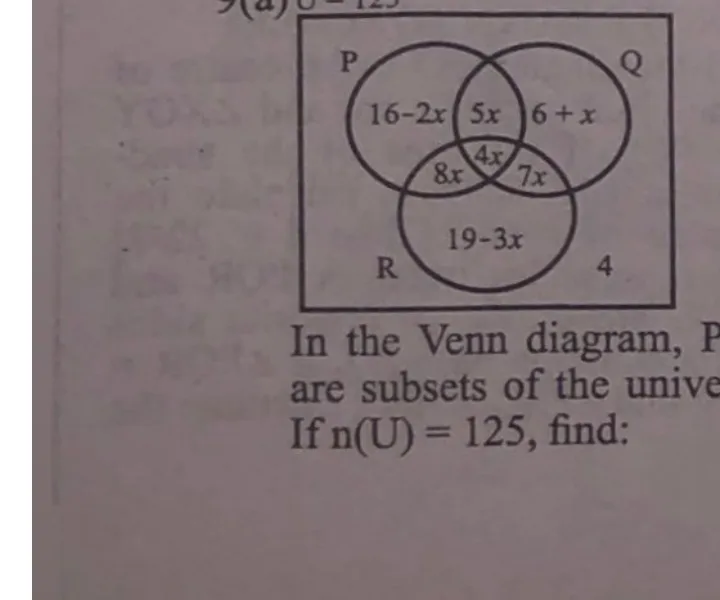
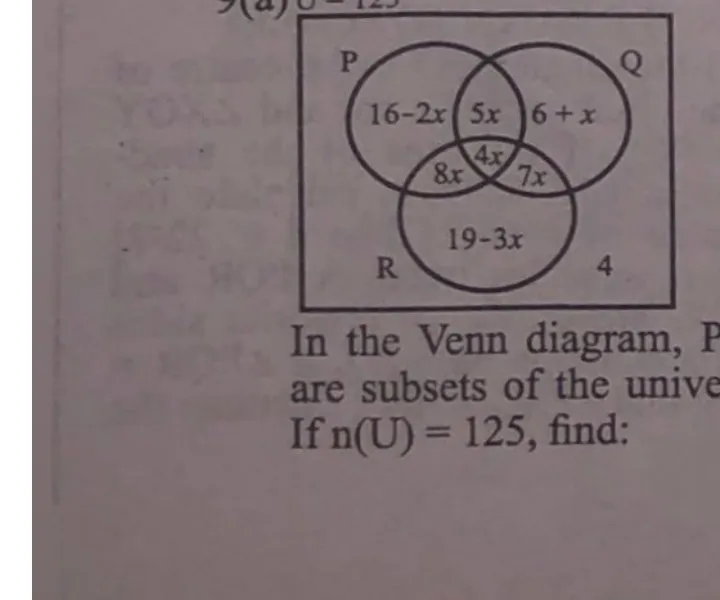
9(a). In the Venn diagram, P, Q and R are subsets of the universal set U. If n(U)=125, find: (i) the value of x; (ii) n(P∩Q∩R′).
Model answer
Sum of all regions = 125:
(16−2x)+5x+(6+x)+8x+4x+7x+(19−3x)+4 = 125
Constants: 16+6+19+4=45. x-terms: −2x+5x+x+8x+4x+7x−3x=20x
45+20x=125 ⟹ 20x=80 ⟹ x=4
(ii) n(P∩Q∩R′) = the region in both P and Q but not R = 5x = 5(4) = 20
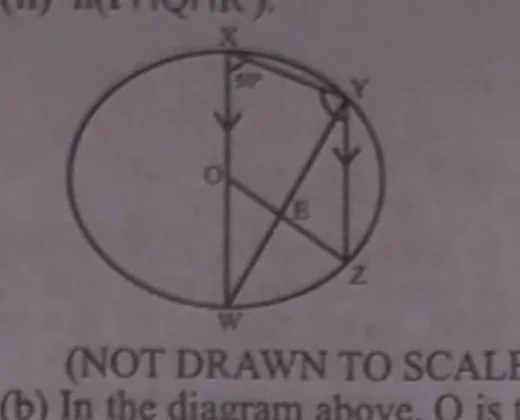
9(b). In the diagram, O is the centre of the circle. If WX is parallel to YZ and ∠WXY=50°, find the value of: (i) ∠WYZ; (ii) ∠YEZ.
Model answer
(i) Since WX∥YZ, with XY as transversal, ∠WYZ = ∠WXY = 50° (alternate angles).
(ii) In triangle EYZ (E is the intersection of the diagonals), by the isosceles symmetry of the trapezium, the base angles at Y and Z are each 50°.
Sum of angles in triangle EYZ: ∠YEZ = 180°−50°−50° = 80°
10(b). In the diagram, M and N are the centres of two circles of equal radii 7cm. The circles intersect at P and Q. If ∠PMQ=∠PNQ=60°, calculate, correct to the nearest whole number, the area of the shaded portion. [Take π=22/7]
Model answer
Sector area (60°, r=7) = (60/360)×(22/7)×7² = (1/6)×154 = 25.67cm²
Triangle MPQ is equilateral (MP=MQ=7=radius, angle 60°): Area = (√3/4)×7² ≈ 21.22cm²
Segment area (one side) = 25.67−21.22 = 4.45cm²
Total shaded (lens) area = 2×4.45 ≈ 8.9cm² ≈ 9cm²
11. The table shows the distribution of outcomes when a die is thrown 50 times (Scores 1–6; Frequencies 2,5,13,11,9,10). Calculate the: (a) mean deviation of the distribution; (b) probability that a score selected at random is at least 4.
12(b). The bearing of Q from P is 150° and the bearing of P from R is 015°. If Q and R are 24km and 32km respectively from P: (i) represent this information in a diagram; (ii) calculate the distance between Q and R, correct to two decimal places; (iii) find the bearing of R from Q, correct to the nearest degree.
Model answer
(i) Sketch P with PQ=24km at bearing 150°, and PR=32km at bearing 195° (since bearing of P from R is 015°, bearing of R from P = 015+180=195°).
(ii) Angle QPR = 195°−150° = 45°.
By cosine rule: QR² = 24²+32²−2(24)(32)cos45° = 576+1024−1536×0.7071 ≈ 513.9
QR ≈ 22.67km
(iii) By sine rule: sin(PQR)/32 = sin45°/22.67 ⟹ sin(PQR) ≈ 0.998 ⟹ ∠PQR ≈ 86.6°
Bearing of P from Q = 150+180 = 330°. Bearing of R from Q = 330°−86.6° ≈ 243° (to the nearest degree).
13(a). Two functions, f and g, are defined by f:x→2x²−1 and g:x→3x+2, where x is a real number. (i) If f(x−1)−7=0, find the values of x; (ii) Evaluate f(−½)·g(3) / (f(4)−g(5)).
Model answer
(i) f(x−1) = 2(x−1)²−1 = 7 ⟹ (x−1)²=4 ⟹ x−1=±2 ⟹ x=3 or x=−1
(ii) f(−½)=2(¼)−1=−0.5; g(3)=3(3)+2=11; f(4)=2(16)−1=31; g(5)=3(5)+2=17
f(4)−g(5)=31−17=14
Result = (−0.5×11)/14 = −5.5/14 ≈ −0.39 (= −11/28)
13(b). An operation (*) is defined on the set R of real numbers by m(*)n = −n/(m²+1), where m,n∈R. If −3,−10∈R, show whether or not (*) is commutative.
Model answer
m*n = −n/(m²+1). Test with m=−3, n=−10:
m*n = −(−10)/((−3)²+1) = 10/10 = 1
n*m = −(−3)/((−10)²+1) = 3/101 ≈ 0.0297
Since m*n ≠ n*m (1 ≠ 0.0297), the operation (*) is NOT commutative.
Advertisement
Sign up free to unlock
Score tracking
Practice history
Saved questions
Progress dashboard
Personalized sessions
Weak-topic breakdown
…and/or go further with premium services and No Ads.