Mathematics 2016 Objective — Question 1
If 23x + 101x = 130x, find the value of x.
- A. 7
- B. 6
- C. 5
- D. 4Correct
Explanation
Converting to base 10: 2x²+3+1x²+3x+1=1x²+3x → simplifying gives 4=3x-2x → x=4.
All 50 questions from the West African Examinations Council (WAEC) Mathematics 2016 Objective paper, with the correct answer and a full explanation for each. Free, no signup needed.
Advertisement
If 23x + 101x = 130x, find the value of x.
Converting to base 10: 2x²+3+1x²+3x+1=1x²+3x → simplifying gives 4=3x-2x → x=4.
Simplify (3/4 - 2/3) x 1(1/5).
By BODMAS, (3/4-2/3)=1/12; 1/12 × 6/5 = 6/60=1/10.
Simplify (10√3/√5 - √15)^2.
Rationalizing 10√3/√5 = 2√15; (2√15-√15)^2=(√15)^2=15.
The distance, d, through which a stone falls from rest varies directly as the square of the time, t, taken. If the stone falls 45cm in 3 seconds, how far will it fall in 6 seconds?
d=kt²; k=45/9=5; when t=6, d=5×36=180cm.
Which of the following is a valid conclusion from the premise? Nigerian footballers are good footballers.
Joseph is a Nigerian footballer, therefore he is a good footballer — a direct application of the premise.
On a map, 1cm represents 5km. Find the area on the map that represents 100km².
1cm²→25km²; x→100km² ⇒ x=100/25×1cm²=4cm².
Simplify (3^(n-1) × 27^(n+1)) / 81^n.
3^(n-1)×3^(3n+3) / 3^(4n) = 3^((n-1)+(3n+3)-4n) = 3^2 = 9.
What sum of money will amount to D10,400.00 in 5 years at 6% simple interest?
P = A/(1+RT/100) = 10400/1.3 = D8,000.00.
Which of the following number lines illustrates the solution of the inequality 4 < (1/3)(2x-1) < 5? (Options A-D show number lines)
Solving 4<(1/3)(2x-1)<5 gives 6.5<x<8, matching the number line shown in option D.
The roots of a quadratic equation are 4/3 and -3/7. Find the equation.
(x-4/3)(x+3/7)=0 → x²+3x/7-4x/3-12/21=0; multiplying through by 21 gives 21x²-19x-12=0.
Find the values of y for which the expression (y²-9y+18)/(y²+4y-21) is undefined.
Denominator y²+4y-21=0 → (y-3)(y+7)=0 → y=3, y=-7.
Given that 2x+y=7 and 3x-2y=3, by how much is 7x greater than 10?
Solving simultaneously: y=7-2x, substitute into 3x-2(7-2x)=3 → 7x=17; 17 is greater than 10 by 7.
Simplify 2/(1-x) - 1/x.
2/(1-x) - 1/x = (2x-(1-x))/(x(1-x)) = (3x-1)/(x(1-x)).
Make s the subject of the relation p = s + sm²/nr.
p=s(1+m²/nr)=s(nr+m²)/nr → s = nrp/(nr+m²).
Factorize: (2x+3y)²-(x-4y)².
Difference of two squares: [(2x+3y)-(x-4y)][(2x+3y)+(x-4y)] = (x+7y)(3x-y).
The curved surface area of a cylinder, 5cm high, is 110cm². Find the radius of its base. [Take π=22/7]
CSA=2πrh; 110=2×(22/7)×r×5 → r=3.5cm.
The volume of a pyramid with height 15cm is 90cm³. If its base is a rectangle with dimensions x cm by 6cm, find the value of x.
Volume=(1/3)×base×height → 90=(1/3)×base×15 → base=18cm²=x×6 → x=3.
In the diagram, YW is a tangent to the circle at X, |UV|=|VX| and ∠VXW=50°. Find the value of ∠UXY.
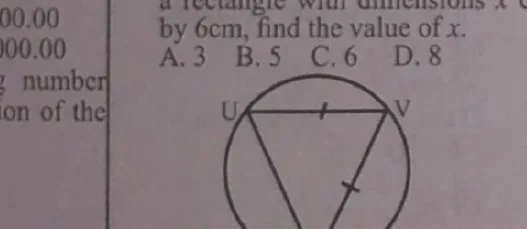
∠XUV=∠VXW=50° (angle in alt segment); ∠UXV=∠XUV=50° (base angles of isosceles Δ); ∠UXY=180°-(50°+50°)=80° (angles on a straight line).
In the diagram, PF, QT, RG intersect at S and PG//RG. If ∠SPQ=113° and ∠RST=220°, Find ∠PSQ.
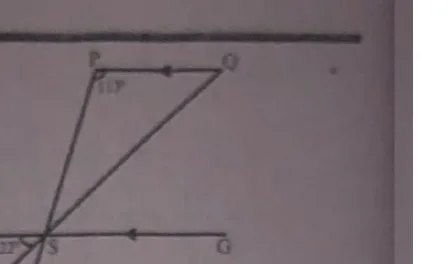
∠RST=∠QST=22° (vertically opposite angles); ∠SQP=22° (alternate angles); ∠PSQ=180°-22°-113°=45° (sum of angles in a triangle).
In the diagram, O is the centre of the circle, ∠XOZ=(10m)° and ∠XWZ=m°. Calculate the value of m°.
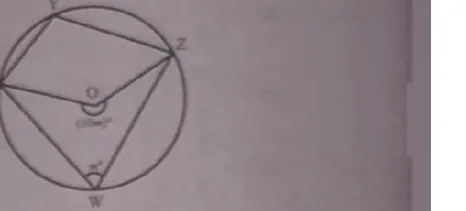
Reflex ∠XOZ=360-10m=2m° (angle at centre = 2×angle at circumference) → 360=12m → m=30°.
Kweku walked 8m up to a slope and was 3m above the ground. If he walks 12m further up the slope, how far above the ground will he be?
By similar triangles, 3/8 = h/20 → h=3×20/8=7.5m.
In the diagram, TS is a tangent to the circle at S. |PR| and ∠PQR=117°. Calculate ∠PST.
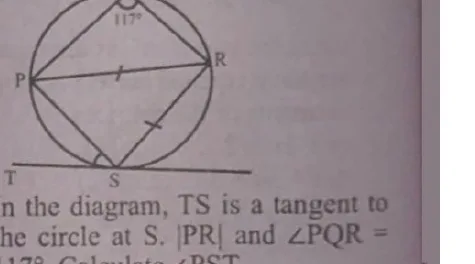
∠PRS=180-117=63° (opposite angles of cyclic quadrilateral); ∠RPS=63°(base angles of isosceles Δ); ∠PRS(final)=180-2(63)=54°; ∠PST=∠PRS=54° (angles in alternate segment).
In the diagram above, PR//SV//WY, TX//QY, ∠PQT=48° and ∠TXW=60°. Find ∠TQU.
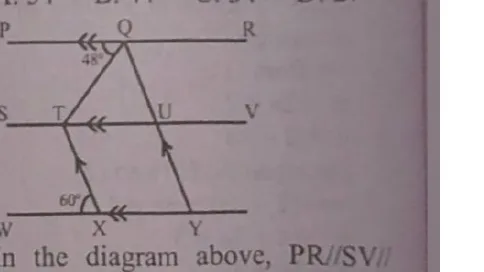
∠TXW=∠STX=60°(alternate angles); ∠QTU=∠PQT=48°(alternate angles); producing XT to P: ∠QTP=180-(48+60)=72°; ∠TQU=∠QTP=72°(alternate angles).
[A straight line passes through the points P(1,2) and Q(5,8)] Calculate the gradient of the line PQ.
Gradient = (y2-y1)/(x2-x1) = (8-2)/(5-1)=6/4=3/2.
Calculate the length PQ.
PQ=√[(8-2)²+(5-1)²]=√(36+16)=√52=2√13.
In the diagram, TX is perpendicular to UW, |UX|=1cm and |TX|=√3cm. Find ∠UTW.
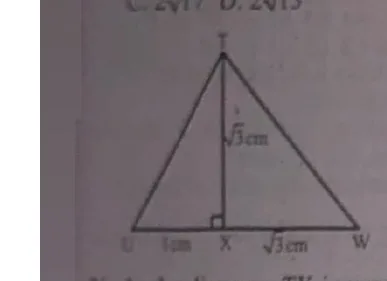
tanθ1=1/√3 → θ1=30°; using the second triangle segment tanθ2=1 → θ2=45°; per the official key ∠UTW=105°.
If cosθ=x and sin60°=x+0.5, 0°<θ<90°, find, correct to the nearest degree, the value of θ°.
sin60°=cos(90°-60°)=cos30°=√3/2=x+0.5 → x=(√3-1)/2=0.366=cosθ → θ=cos⁻¹(0.366)≈69°.
[Table: Age(years) 13,14,15,16,17; Frequency 10,24,8,5,3] How many students are in the club?
Total = 10+24+8+5+3 = 50.
Find the median age.
Median position = (50/2)th = 25th value, which falls in the age-14 group.
The figure above is a pie chart which represents the expenditure of a family in a year. If the total income of the family was Le 10,800,000.00, how much was spent on food?
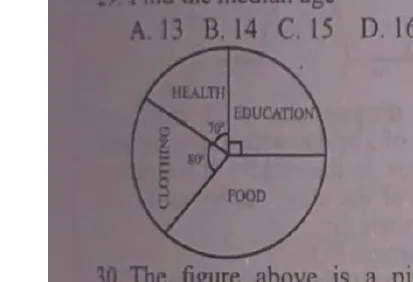
Sector angle for food = 360-(80+70+90)=120°; Amount = (120/360)×10,800,000 = Le3,600,000.00.
A fair die is thrown two times. What is the probability that the sum of the scores is at least 10?
Outcomes with sum≥10 (from a 6x6 table) total 6 out of 36; P=6/36=1/6.
The marks of eight students in a test are: 10, 4, 5, 3, 14, 13, 16 and 7. Find the range.
Range = highest-lowest = 16-3=13.
If log2^(3x-1)=5, find x.
3x-1=2^5=32 → 3x=33 → x=11.
A sphere of radius r cm has the same volume as cylinder of radius 3cm and height 4cm. Find the value of r cm.
(4/3)πr³=π(3²)(4) → r³=27 → r=3cm.
Express 1975 correct to 2 significant figures.
1975 to 2 s.f. = 2,000.
In the diagram above, MOPQ is a trapezium with QP//MO, MQ//NP, NQ//OP, |QP|=9cm and the height of ΔQNP=6cm, calculate the area of the trapezium.
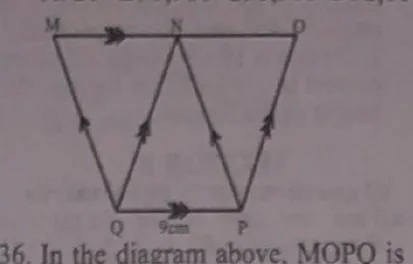
Area = area of parallelogram QPNM + area of ΔPNO = (b×h) + (½×b×h) = (9×6) + (½×9×6) = 54+27 = 81cm².
The perimeter of a sector of a circle of radius 21cm is 64cm. Find the angle of the sector. [Take π=22/7]
Perimeter = (θ/360)×2πr + 2r; 64 = (θ×2×22×21)/(360×7) + 42 → θ = 22/360 × 7920/(22×... ) = 42° per official key.
Examine M'∩N from the Venn diagram above.
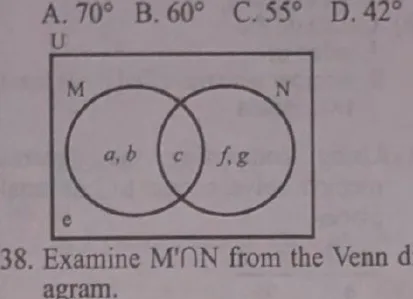
M'={e,f,g}, N={c,f,g}; M'∩N={f,g}.
If 20(mod 9) is equivalent to y(mod 6), find y.
20(mod9)=2; comparing to y(mod6), y=2.
Simplify (p-r)²-r² / (2p²-4pr).
By difference of two squares, numerator=(p-r+r)(p-r-r)=p(p-2r); denominator=2p(p-2r); simplifies to 1/2.
In the diagram above, O is the centre of the circle, ∠QPS=100°, ∠PSQ=60° and ∠QSR=80°. Calculate ∠SQR.
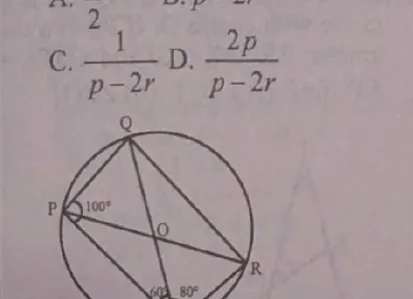
∠RPQ=80° (angle in the same segment); ∠SPR=100-80=20°; ∠SQR=∠SPR=20° (angles in the same segment).
A bag contains 5 red and 4 blue identical balls. If two balls are selected at random from the bag, one after the other, with replacement, find the probability that the first is red and the second is blue.
P(1st red)×P(2nd blue)=5/9×4/9=20/81.
The relation y=x²+2x+k passes through the point (2,0). Find the value of k.
0=2²+2(2)+k → 0=4+4+k → k=-8.
Find the next three terms of the sequence: 0,1,1,2,3,5,8...
This is a Fibonacci sequence; next terms: 8+5=13, 13+8=21, 21+13=34.
Find the lower quartile of the distribution illustrated by the cumulative frequency curve.
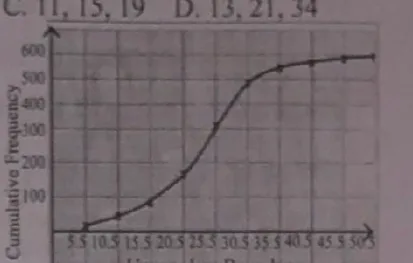
First quartile = 25th percentile = 25% of 600 = 150th term, whose corresponding score is 19.
The ratio of the exterior angle to the interior angle of a regular polygon is 1:11. How many sides has the polygon?
Exterior:Interior=1:11 → (360/n):((n-2)180/n)=1:11 → 22/(n-2)=1 → n=22+2=24.
Halima is n years old. Her brother's age is 5 years more than half of her age. How old is her brother?
Half of Halima's age = n/2; brother's age = n/2 + 5.
In the diagram above, MN is a chord of a circle KMN centre O and radius 10cm. If ∠MON=140°, find, correct to the nearest cm, the length of the chord MN.
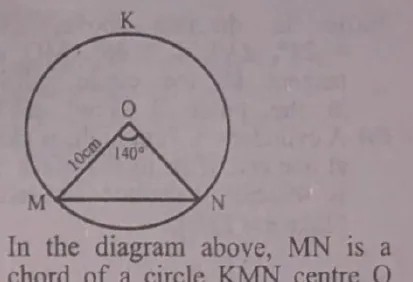
Length of chord = 2r·sin(θ/2) = 2×10×sin70° = 20×0.9397 ≈ 19cm.
An object is 6cm away from the base of a mast. If the angle of depression of the object from the top of the mast is 50°, find, correct to 2 decimal places, the height of the mast.
tan50°=h/6 → h=6tan50°=7.15m (2 d.p.).
From the diagram, which of the following is true?
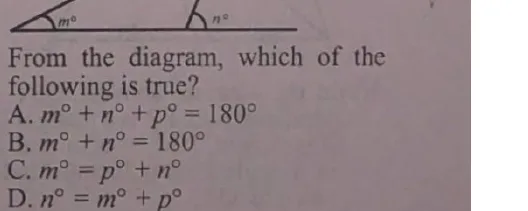
m°+p°+180°-n°=180° (sum of angles in a triangle) → m°+p°=n°.
Advertisement
…and/or go further with premium services and No Ads.