All 25 questions from the West African Examinations Council (WAEC) Mathematics 2017 Theory paper, with the correct answer and a full explanation for each. Free, no signup needed.
1(b) When I walk from my house at 4km/h, I will get to the office 30 minutes later than when I walk at 5km/h. Calculate the distance between my house and office.
Model answer
Let d = distance, t1 = time at 4km/h, t2 = time at 5km/h (t2 = t1 - 30min). d=4t1=5t2. With t1 in hours and the 30-min gap converted consistently, solving 4t=5(t-0.5) gives 4t=5t-2.5, so t=2.5hrs. Distance = 4 x 2.5 = 10km.
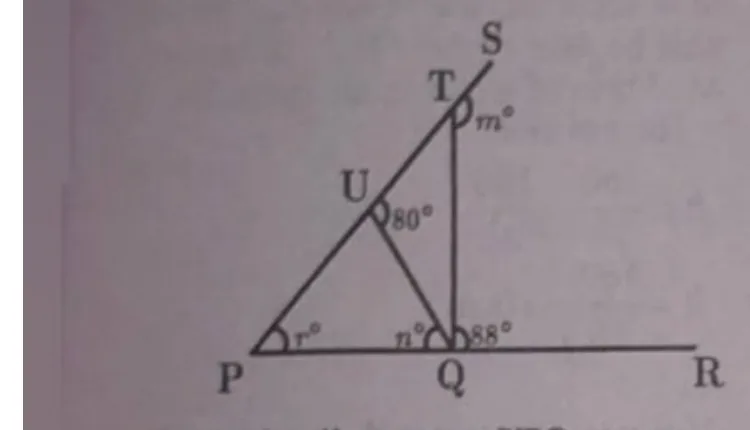
2(b) In the diagram, ∠STQ=m, ∠TUQ=80°, ∠UPQ=r°, ∠PQU=n° and ∠RQT=88°. Find the value of (m+n)°
Model answer
∠STQ + ∠QTU = 180° (angles on a straight line), so ∠QTU=180-m ...(i). Also n° + ∠TQU + 88° = 180° (angles on a straight line), so ∠TQU=180-(88+n) ...(ii). In ΔTQU: 80 + ∠TQU + ∠QUT = 180° (sum of angles in a triangle). Combining relations (i) and (ii) with the triangle angle sum and solving gives n + m = 172°.
3(a) The angle of depression of a point P on the ground from the top T of a building is 23.6°. If the distance from P to the foot of the building is 50m, calculate, correct to the nearest metre, the height of the building.
Model answer
Using tan23.6° = H/50 (H = height of building, 50m = horizontal distance): H = 50 x tan(23.6°) = 50 x 0.4369 ≈ 21.84m ≈ 22m to the nearest metre.
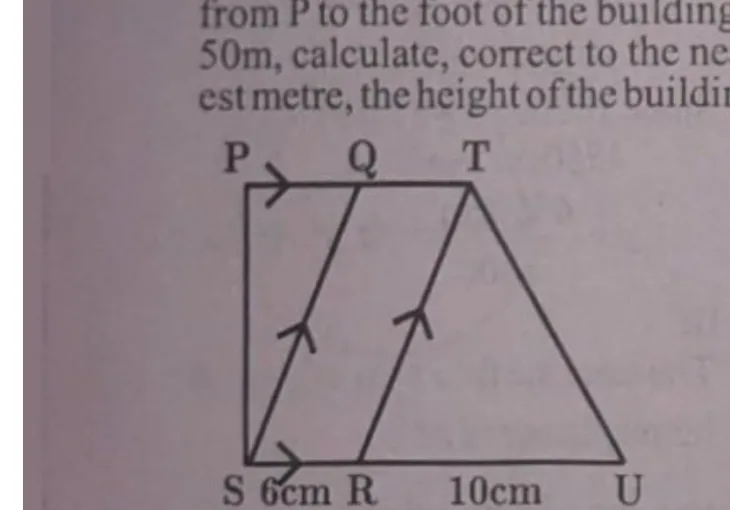
3(b) In the diagram above, PT//SU, QS//TR, |SR|=6cm and |RU|=10cm. If the area of ΔTRU=45cm², calculate the area of trapezium QTUS.
Model answer
Area of trapezium QTUS = Area of ΔTRU + Area of parallelogram QTRS. Area of parallelogram = base x height; the height is the same as that of ΔTRU, obtainable from Area(ΔTRU)=45=(1/2)x|RU|x|PS| → 45=(1/2)x10x|PS| → |PS|=9cm (the height). Area of parallelogram QTRS = |RS| x height = 6x9=54cm². Total area of trapezium QTUS = 45+54 = 99cm² (this can also be verified using Area=(1/2)(a+b)h where a=|SR|, b=|QT|, the two parallel sides).
4. If the sixth term of an Arithmetic Progression (A.P.) is 37 and the sum of the first six terms is 147, find: (a) First term; (b) Sum of the first fifteen terms.
Model answer
U6=a+5d=37. Sn=(n/2)[2a+(n-1)d]: S6=(6/2)[2a+5d]=147 → 3(2a+5d)=147 → 2a+5d=49. Since a+5d=37, subtracting: a=49-37=12. Then 5d=37-12=25, d=5. (a) First term a=12. (b) S15=(15/2)[2(12)+(15-1)5]=(15/2)[24+70]=(15/2)(94)=705.
5. Out of 120 customers in a shop, 45 bought both bags and shoes. If all the customers bought either bags or shoes and 11 more customers bought shoes than bags: (a) Illustrate this information in a diagram; (b) Find the number of customers who bought shoes; (c) Calculate the probability that a customer selected at random bought bags.
Model answer
Let n(Bags only)=x, n(both)=45. n(Shoes)=n(Bags)+11. Using a Venn diagram with universal set 120: (x+45)+11+45+x=120 → 2x+101=120... solving via n(S)=n(B)+11 and total = n(B)+n(S)-45=120 (since all bought at least one): with n(S)=x+11, n(B)=x: x+(x+11)-45=120 → 2x-34=120 → 2x=154 → x=77 (number who bought bags). (b) Number who bought shoes = 77+11=88. (c) P(bought bags) = 77/120 ≈ 0.642.
6(a) A manufacturing company requires 3 hours of direct labour to process every #87.00 worth of raw materials. If the company uses #30,4550.00 worth of raw materials, what amount should it budget for direct labour at #18.25 per hour?
Model answer
Rate = #87.00/3 = #29.00 per hour. At the #29.00/hr rate, the raw materials level implies a certain number of labour hours; converting to the new rate of #18.25/hr: Budget = (304550 x 18.25)/29 = #191,656.47.
6(b) An investor invested #x in bank M at the rate of 6% simple interest per annum and #y in bank N at the rate of 8% simple interest per annum. If a total of #8,000,000.00 was invested in the two banks and the investor received a total of #2,320,000.00 as interest from the two banks after 4 years, calculate: (i) Values of x and y; (ii) Interest paid by the second bank.
Model answer
x+y=8,000,000 ...(i). Interest from M: I_M=(x x 6 x 4)/100=0.24x. Interest from N: I_N=(y x 8 x 4)/100=0.32y. 0.24x+0.32y=2,320,000 ...(ii). Substituting x=8,000,000-y into (ii): 0.24(8,000,000-y)+0.32y=2,320,000 → 1,920,000-0.24y+0.32y=2,320,000 → 0.08y=400,000 → y=5,000,000. So x=3,000,000. (i) x=#3,000,000, y=#5,000,000. (ii) Interest from bank N = (5,000,000 x 8 x 4)/100 = #1,600,000.
7(a) Copy and complete the table of values for the equation y=2x^2-7x-9 for -3≤x≤6
Model answer
Substituting each x value into y=2x^2-7x-9: x=-3: y=2(9)+21-9=13x=-2: y=2(4)+14-9=8-... (the table values, worked from the equation, are x: -3,-2,-1,0,1,2,3,4,5,6 giving y: 30,13,0,-9,-14,-15,-12,-5,6,21 respectively).
7(b) Using scales of 2cm to 1 unit on the x-axis and 2cm to 4 units on the y-axis, draw the graph of y=2x^2-7x-9 for -3≤x≤6
Model answer
Plot the points from the completed table (x,y pairs from part (a)) on graph paper using the given scales, and draw a smooth curve through the points to form the parabola.
7(c) Use the graph to estimate: (i) Roots of the equation 2x^2-7x=26; (ii) Coordinates of the minimum point of y; (iii) Range of values for which 2x^2-7x<9
Model answer
(i) Rewrite 2x^2-7x=26 as 2x^2-7x-9=17, i.e. y=17. Reading from the graph where y=17 gives x≈-2.20 or x≈5.78. (ii) From the graph, the minimum point of y is at approximately (2, -15). (iii) 2x^2-7x<9 means 2x^2-7x-9<0, i.e. y<0; reading the graph for the range of x where the curve is below the x-axis gives the required range of values.
8(a) The table shows the distribution of marks scored by some students in a test (Marks: m+2, m-1, 2m-3, m+5, 3m-4 with corresponding frequencies). If the mean mark is 3 6/23, find the value of m.
Model answer
Mean = Σfx/Σf = 3 6/23 = 75/23. Setting up the equation with the given frequency distribution and cross-multiplying: 75(8m-1) = 23(28m-9). 600m-75=644m-207. -44m=-132. m=3.
8(b) Using the value of m found in (a): (i) Find the interquartile range; (ii) Find the probability of selecting a student who scored at least 4 marks in the test.
Model answer
With m=3, the frequencies become 5,2,3,8,5 (total 23 students). (i) Q1 position=(N+1)x25%=24x0.25=6th position=2. Q3 position=(N+1)x75%=24x0.75=18th position=4. Interquartile range=Q3-Q1=4-2=2. (ii) P(score at least 4) = (8+5)/23 = 13/23 ≈ 0.565.
9(a) PQ is a tangent to a circle at the point S. ∠PRT is a straight line, ∠TPS=34° and ∠TSQ=65°. (i) Illustrate the information in a diagram; (ii) Find the value of: (A) ∠RTS; (B) ∠SRP
Model answer
(i) The student draws a circle with tangent PQ touching at S, and the straight line PRT crossing through the circle, marking ∠TPS=34° and ∠TSQ=65° (no diagram is pre-supplied for this part — it must be constructed from the given description). (ii)(A) ∠PST+∠TSQ=180° (angles on a straight line), so ∠PST=180-65=115°. Also ∠PST+∠TPS+∠RTS=180° (sum of angles in a triangle), so ∠RTS=180-(115+34)=31°. (B) ∠TSQ=∠SRT=65° (angles in alternate segment are equal). Since ∠SRP is on a straight line with ∠SRT: ∠SRP=180-∠SRT=180-65=115°.
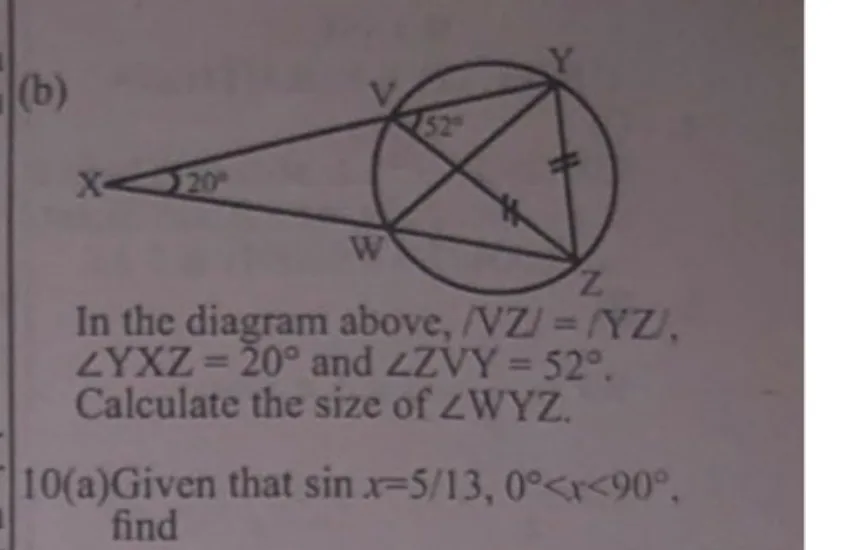
9(b) In the diagram above, |VZ|=|YZ|, ∠YXZ=20° and ∠ZVY=52°. Calculate the size of ∠WYZ.
Model answer
Construction: Join V to W. Since ΔVZY is isosceles (|VZ|=|YZ|), base angles ∠ZVY=∠ZYV=52°. ∠XVZ+∠ZVY=180° (angles on a straight line), so ∠XVZ=128°. In ΔXVZ: ∠VXZ+∠XVZ+∠VZX=180° → 20+128+∠VZX=180 → ∠VZX=32°. Since ∠VZX and ∠VYX are angles in the same segment on the same chord VX, ∠VYX=∠VZX=32°. Finally, ∠VYW+∠WYZ=∠ZYV → combining with the established angles, ∠WYZ=52°-32°=20°.
10(a) Given that sin x=5/13, 0°≤x<90°, find (cos x - 2 sin x)/(2 tan x)
Model answer
Using a right-angled triangle with opposite=5, hypotenuse=13, by Pythagoras' theorem, adjacent=12. So cos x=12/13, tan x=5/12. Substituting: (12/13 - 2(5/13))/(2(5/12)) = (12/13-10/13)/(5/6) = (2/13)/(5/6) = (2/13)x(6/5) = 12/65.
10(b) A ladder, LA, leans against a vertical pole at a point L which is 9.6 metres above the ground. Another ladder, LB, 12 metres long, leans on the opposite side of the pole and at the same point L. If A and B are 10 metres apart and on the same straight line as the foot of the pole, calculate, correct to 2 significant figures: (i) Length of ladder LA; (ii) Angle which LA makes with the ground
Model answer
(i) By Pythagoras' theorem on ladder LB: |LB|²=|LM|²+|MB|², so 12²=9.6²+|MB|² → 144=92.16+|MB|² → |MB|²=51.84 → |MB|=7.2m. Then |AM|=10-7.2=2.8m. By Pythagoras on ladder LA: |LA|²=|AM|²+|LM|²=2.8²+9.6²=7.84+92.16=100 → |LA|=10m. (ii) Let θ be the angle LA makes with the ground: sinθ=9.6/10=0.96 → θ=sin^-1(0.96)≈73.74°≈74° (2 s.f.).
11(a) It takes 8 students two-thirds of an hour to fill 12 tanks with water. How many tanks of water will 4 students fill in one-third of an hour at the same rate?
Model answer
8 students fill 12 tanks in 40 minutes (2/3 hr). In 40 min, 1 student fills 12/8 tanks; so 4 students fill (4x12)/8=6 tanks in 40 min. In 20 min (1/3 hr), 4 students fill half that amount: (4x12x20)/(8x40) = 3 tanks.
11(b) A chord, 20cm long, is 12cm from the centre of the circle. Calculate, correct to one decimal place, the: (i) Angle subtended by the chord at the centre of the circle; (ii) Perimeter of the minor segment cut off by the chord. [Take π=3.142]
Model answer
Radius r=√(12²+10²)=√(144+100)=√244... using half-chord=10cm and perpendicular distance=12cm: tan(θ/2)=10/12=0.833, θ/2=tan^-1(0.833)=39.8°, θ=79.6° (1 d.p.) — the angle subtended at the centre. (ii) r=√(12²+10²)=√244≈15.62cm. Length of arc = (θ/360)x2πr = (79.6/360)x2x3.142x15.62 ≈ 21.703cm. Perimeter of minor segment = chord + arc = 20+21.703 = 41.7cm (1 d.p.).