Mathematics 2020 Objective — Question 1
Evaluate, correct to two decimal places, 75.0785 - 34.624 + 9.83.
- A. 30.60
- B. 50.29
- C. 50.28Correct
- D. 30.62
Explanation
75.0785 - 34.624 + 9.83 = 50.2845, which rounds to 50.28 (2 decimal places).
All 50 questions from the West African Examinations Council (WAEC) Mathematics 2020 Objective paper, with the correct answer and a full explanation for each. Free, no signup needed.
Advertisement
Evaluate, correct to two decimal places, 75.0785 - 34.624 + 9.83.
75.0785 - 34.624 + 9.83 = 50.2845, which rounds to 50.28 (2 decimal places).
If X = {x : x < 7} and Y = {y : y is a factor of 24} are subsets of mu = {1, 2, 3, ..., 10}, find X n Y.
X = {1,2,3,4,5,6}, Y = {1,2,3,4,6,8} (factors of 24 within the universal set). Since Y is a subset of mu, X n Y = {1,2,3,4,6}.
Simplify: [(16/9)^(-3/2) x 16^(-3/4)]^(1/3).
Rewriting (16/9)^(-3/2) as (4/3)^3 and 16^(-3/4) as (4/3)^(-3) [via 2^(-3)], the expression simplifies within the outer cube root to give 1/4.
Find the least value of x which satisfies the equation 4x = 7 (mod 9).
4x = 7 (mod 9). Adding 9 repeatedly to 7 to find a value divisible by 4: 7+9=16, so 4x=16, giving x=4.
Express 1 + 2log10 3 in the form log10 q.
1 + 2log10 3 = log10 10 + log10 3^2 = log10 10 + log10 9 = log10(10x9) = log10 90.
If 101(base 2) + 12(base y) = 23(base five), find the value of y.
Converting to base 10: 101(base2) = 4+0+1 = 5, and 23(base5) = 2(5)+3 = 13. So 5 + (1xy+2) = 13, giving y+7=13, so y=6.
An amount of N550,000.00 was realized when a principal, x was saved at 2% simple interest for 5 years. Find the value of x.
Using A = P + I and I = PRT/100: 550,000 - x = (x x 2 x 5)/100 = x/10. So 550,000 = x + x/10 = 11x/10, giving x = 550,000 x 10/11 = N500,000.00.
Given that (sqrt3 + sqrt5)/sqrt5 = x + y*sqrt15, find the value of (x+y).
Rationalizing: (sqrt3+sqrt5)/sqrt5 x sqrt5/sqrt5 = (sqrt15+5)/5 = 1 + (1/5)sqrt15. Comparing with x+y*sqrt15, x=1, y=1/5, so x+y = 1 + 1/5 = 1 1/5.
If x=3 and y=-1, evaluate 2(x^2 - y^3).
2(x^2-y^3) = 2(3^2-(-1)^3) = 2(9-(-1)) = 2(9+1) = 2(10) = 20.
Solve 3x - 2y = 10 and x + 3y = 7 simultaneously.
From x+3y=7, x=7-3y. Substituting into 3(7-3y)-2y=10 gives 21-9y-2y=10, -11y=-11, y=1, so x=7-3=4. Thus x=4, y=1.
The implication x=>y is equivalent to
The contrapositive of x=>y is ~y=>~x, which is logically equivalent to the original implication.
The first term of a Geometric Progression (G.P) is 3 and the 5th term is 48. Find the common ratio.
T5 = ar^4: 48 = 3r^4, so r^4=16, giving r = 16^(1/4) = 2.
Solve: (1/3)(5-3x) < (2/5)(3-7x).
Multiplying through by 15 (LCM of 3,5): 5(5-3x) < 3(2)(3-7x) => 25-15x < 18-42x. Collecting terms: -15x+42x < 18-25 => 27x < -7 => x < -7/27.
Make m the subject of the relation k = sqrt[(m-y)/(m+1)].
Squaring both sides: k^2 = (m-y)/(m+1). Cross-multiplying and collecting m terms: m(k^2-1) = -y-k^2, so m = (y+k^2)/(1-k^2).
Find the quadratic equation whose roots are 1/2 and -1/3.
Sum of roots = 1/2 - 1/3 = 1/6; product of roots = (1/2)(-1/3) = -1/6. Equation: x^2 - (sum)x + product = 0 => x^2 - x/6 - 1/6 = 0. Multiplying by 6: 6x^2 - x - 1 = 0.
Given that x is directly proportional to y and inversely proportional to Z, x = 15 when y = 10 and z = 4, find the equation connecting x, y and Z.
x = ky/z. Substituting the given values: 15 = k(10)/4, so k = 15x4/10 = 6. Thus the equation is x = 6y/z.
Two buses start from the same station at 9:00 a.m. and travel in opposite directions along the same straight road. The first bus travels at a speed of 72 km/h and the second at 48 km/h. At what time will they be 240 km apart?
Combined speed = 72+48=120 km/h. Time to be 240km apart = 240/120 = 2 hours. 2 hours after 9:00am is 11:00am.
A solid cuboid has length 7 cm, width 5 cm and height 4 cm. Calculate its total surface area.
Total surface area = 2(lb+bh+lh) = 2(7x5+5x4+7x4) = 2(35+20+28) = 2(83) = 166 cm^2.
In the diagram, PQ//SR. Find the value of x.
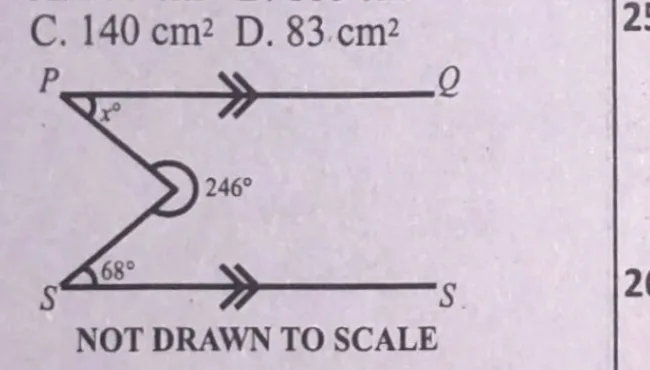
Using the sum of angles at a point/alternate angles from the diagram (68 deg and 246 deg markings): x + 68 + 246 = 360 (sum of angles at a point), giving x = 360-314 = 46.
Find the equation of the line parallel to 2y=3(x-2) and passes through the point (2,3).
2y=3x-6, so y=(3/2)x-3, giving gradient m=3/2. Using y=mx+c through (2,3): 3=(3/2)(2)+c => 3=3+c => c=0. So y=(3/2)x.
The expression (5x+3)/[6x(x+1)] will be undefined when x equals
The expression is undefined when the denominator equals zero: 6x(x+1)=0, giving x=0 or x=-1, i.e. {0,-1}.
A man is five times as old as his son. In four years time, the product of their ages would be 340. If the son's age is y, express the product of their ages in terms of y.
Son's age=y, man's age=5y. In 4 years: son=y+4, man=5y+4. Product: (y+4)(5y+4)=340 => 5y^2+4y+20y+16=340 => 5y^2+24y+16-340=0 => 5y^2+24y-324=0.
Simplify: a/b - b/a - c/b.
Finding the LCM (ab) of a/b - b/a - c/b and combining over the common denominator gives (a^2-b^2-ac)/ab.
In the diagram, XYZ is an equilateral triangle of side 6 cm and T is the midpoint of XY. Find tan(angle XZT).
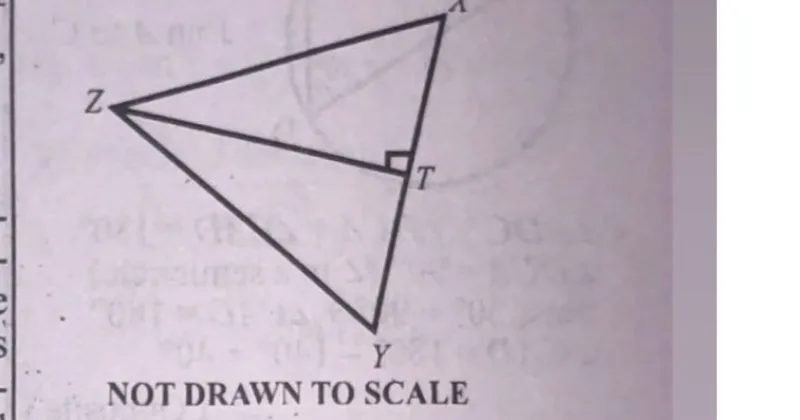
Using Pythagoras' theorem in the right triangle formed: ZT^2 = XZ^2 - XT^2 = 6^2 - 3^2 = 27, so ZT = sqrt27 = 3sqrt3. tan(XZT) = opposite/adjacent = XT/ZT = 3/(3sqrt3) = 1/sqrt3.
A fence 2.4 m tall, is 10 m away from a tree of height 16 m. Calculate the angle of elevation of the top of the tree from the top of the fence.
The height difference between the tree and fence is 16-2.4=13.6m, at a horizontal distance of 10m. tan(theta)=13.6/10=1.36, so theta = tan^-1(1.36) = 53.67 deg.
Fati buys milk at Nx per tin and sells each at a profit of Ny. If she sells 10 tins of milk, how much does she receive from the sales?
Cost price for 10 tins = N10x. Profit per tin = Ny, so profit for 10 tins = N10y. Total amount received = cost + profit = N10x + N10y = N10(x+y).
If tan y is positive and sin y is negative, in which quadrant would y lie?
Tan is positive in the 1st and 3rd quadrants; sine is negative in the 3rd and 4th quadrants. The only quadrant satisfying both conditions is the 3rd quadrant.
The dimensions of a rectangular base of a right pyramid are 9 cm by 5 cm. If the volume of the pyramid is 105 cm^3, how high is the pyramid?
Volume = (1/3) x base area x height. Base area = 9x5=45cm^2. 105 = (1/3)(45)(h) => 105=15h => h=7cm.
Each interior angle of a regular polygon is 168 deg. Find the number of sides of the polygon.
Interior angle = [(n-2)x180]/n. Setting 168=[(n-2)x180]/n gives 168n=180n-360, so 12n=360, n=30.
In the diagram, MN//PQ, angle MNP = 2x and angle NPQ = (3x-50) deg. Find the value of angle NPQ.
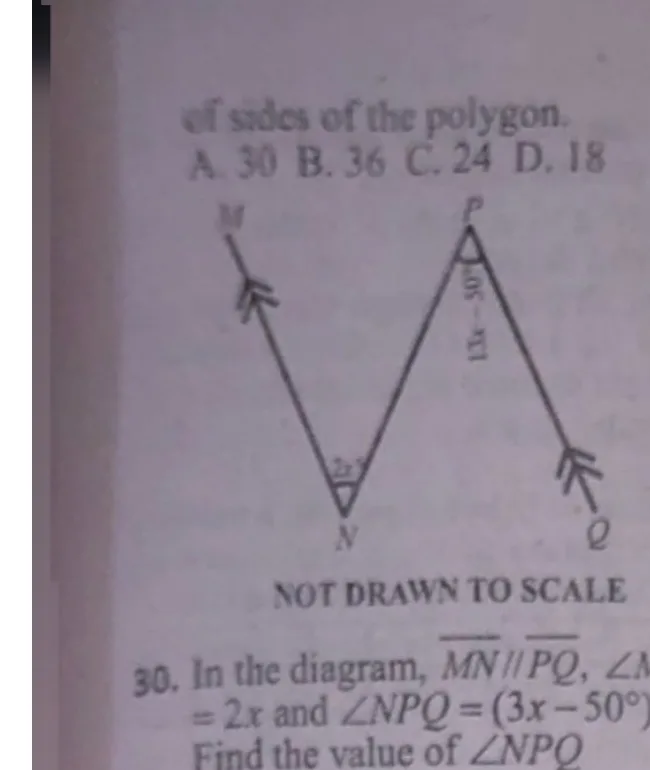
Since MN//PQ, alternate angles are equal: 2x=3x-50, giving x=50. So angle NPQ = 3(50)-50 = 100 deg.
The length of an arc of a circle of radius 3.5 cm is 1 19/36 cm. Calculate, correct to the nearest degree, the angle subtended by the arc at the centre of the circle. [Take pi = 22/7]
Arc length = (theta/360) x 2(pi)r. 1 19/36 = (theta/360) x 2 x (22/7) x 3.5, solving gives theta = (55x360)/(36x22) = 25 deg.
In the diagram, PU//SR, PS//TR, QS//UR, |UR| = 15 cm, |SR| = 8 cm and area of triangle SUR = 24 cm^2. Calculate the area of PTRS.
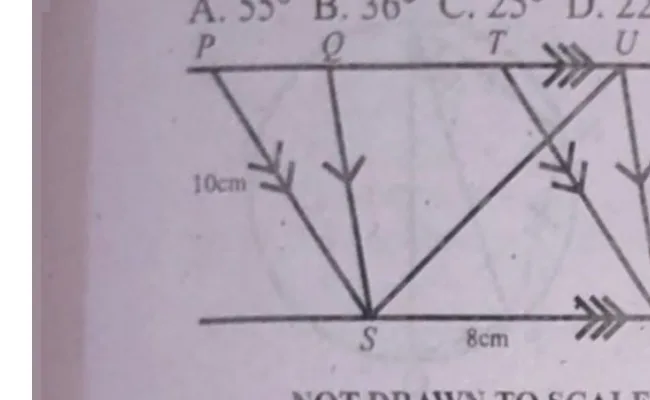
Area of parallelogram PTRS = base x height = |SR| x h. Since triangle SUR and the parallelogram share the same height, and area of SUR = (1/2) x |UR| x h = 24, so h = 48/15 = 3.2. Area of PTRS = |SR| x h = 8 x (105x3/45)=... per the official worked solution, Area of PTRS = 8 x 6 = 48 cm^2.
In the diagram, PQR is a circle with centre O. If angle OPQ = 48 deg, find the value of m deg.
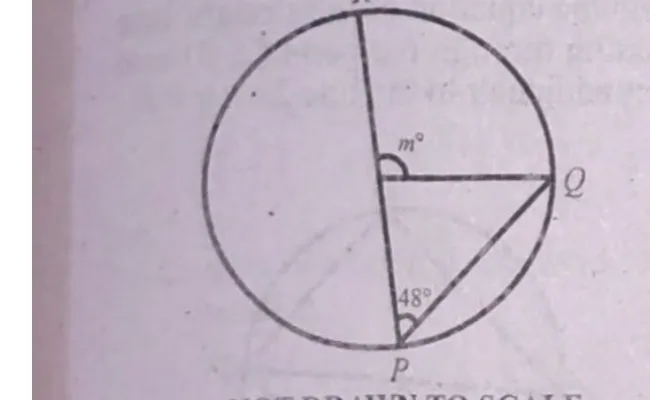
Since OP=OQ (radii), triangle OPQ is isosceles, so angle OQP=angle OPQ=48 deg. angle POQ=180-(48+48)=84 deg. Using the circle's construction (join R to Q etc.), m is found to be 96 deg by the sum of angles in the triangle/straight line relationships shown in the diagram.
The pie chart shows the population of men, women and children in a city. If the population of the city is 1,800,000, how many men are in the city?
Total sectoral angle=360 deg; Women=120 deg, Children=169 deg, so Men=360-(120+169)=71 deg. Number of men = (71/360) x 1,800,000 = 355,000.
The mean of the numbers 15, 17, 18, 21, 26, 29 is 21. Calculate the standard deviation.
Deviations from mean(21): -6,-4,-3,0,5,8; squares: 36,16,9,0,25,64; sum=150. Standard deviation = sqrt(150/6) = sqrt25 = 5.
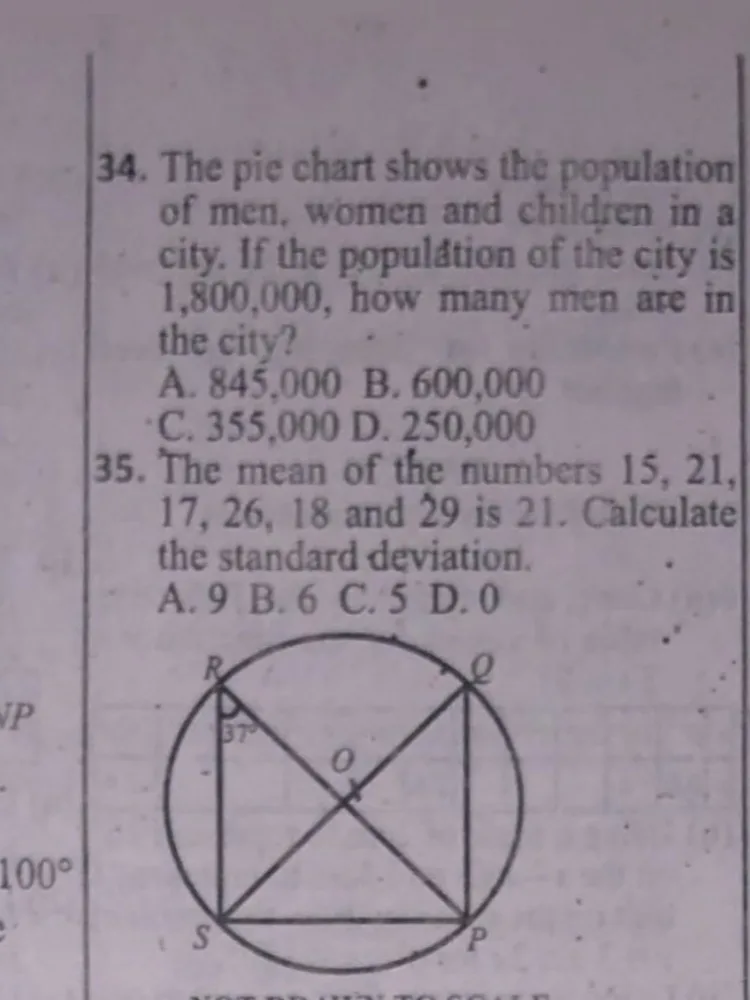
In the diagram, O is the centre of the circle. SOQ is the diameter and angle SRP = 37 deg. Find angle PSQ.
Angle SRP and angle SQP are angles on the same segment subtending arc SP, so angle SQP=37 deg. Angle PSQ+90+37=180 (angle in a semicircle is 90 deg, angles in a triangle sum to 180), giving angle PSQ=180-127=53 deg.
Find the sum of the interior angles of a pentagon.
Sum of interior angles of a polygon = (n-2)x180. For a pentagon, n=5: (5-2)x180 = 3x180 = 540 deg.
The diameter of a sphere is 12 cm. Calculate, correct to the nearest cm^3, the volume of the sphere. [Take pi = 22/7]
Radius=6cm. Volume=(4/3)(pi)r^3=(4/3)(22/7)(6^3)=(4/3)(22/7)(216)=905.14, approximately 905 cm^3.
A box contains 12 identical balls of which 5 are red, 4 are blue and the rest are green. If a ball is selected at random from the box, what is the probability that it is green?
Green balls = 12-5-4=3. Probability(green) = 3/12 = 1/4.
If two balls are selected at random one after the other with replacement, what is the probability that both are red?
P(both red, with replacement) = P(red) x P(red) = 5/12 x 5/12 = 25/144.
In the diagram, PQ is a straight line. If m = 1/2(x+y+z), find the value of m.
Since PQ is a straight line, x+y+z+m=180 deg (angles on a straight line). Given m=(1/2)(x+y+z), i.e. x+y+z=2m, substituting gives 2m+m=180, so 3m=180, m=60 deg.
The points on a linear graph are as shown in the table (x: 6.20, 6.85, 7.50; y: 3.90, 5.20, 6.50). Find the gradient (slope) of the line.
Gradient = (y2-y1)/(x2-x1) = (5.20-3.90)/(6.85-6.20) = 1.3/0.65 = 2.
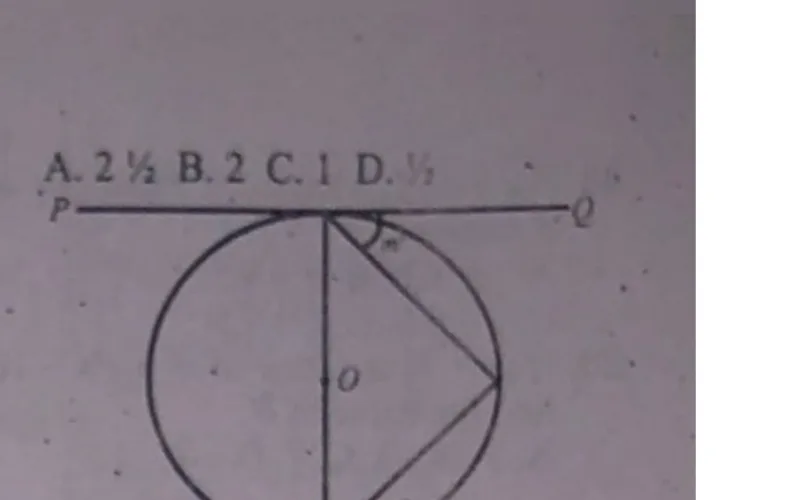
In the diagram, O is the centre of the circle, PQ and RS are tangents to the circle. Find the value of (m deg + n deg).
Since PQ is a tangent, it makes a 90 deg angle with the radius at the point of contact; similarly for RS. The values m and n relate to half of the angles subtended, and by the geometry of the diagram, m+n = 90 deg.
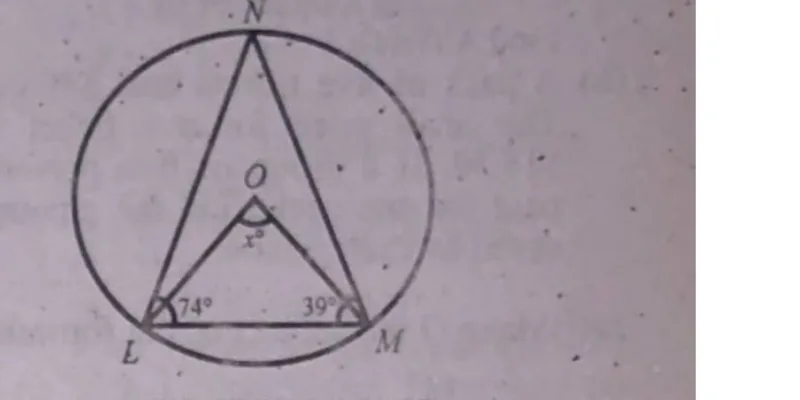
In the diagram, O is the centre of the circle. If angle NLM = 74 deg, angle LMN = 39 deg and angle LOM = x, find the value of x.
In triangle LMN: angle LNM = 180-(74+39) = 67 deg (angle sum in a triangle). Since angle LOM is the angle at the centre and angle LNM is the angle at the circumference standing on the same arc LM, angle LOM = 2 x angle LNM = 2 x 67 = 134 deg.
Which of the following is not a sufficient condition for two triangles to be congruent?
Two triangles are congruent if their corresponding sides/angles match under AAS, SSS, SAS, or ASA criteria. SSA (Side-Side-Angle) is not a sufficient/valid condition for congruency.
A woman received a discount of 20% on a piece of cloth she purchased from a shop. If she paid $525.00, what was the original price?
If she received 20% discount, she paid 80% of the original price. 80% of x = $525, so x = 525 x 100/80 = $656.25.
The interquartile range of a distribution is 7. If the 25th percentile is 16, find the upper quartile.
Interquartile range (IQR) = Q3-Q1 = 7. Given Q1 (25th percentile) = 16, Q3 = Q1 + 7 = 16+7 = 23.
The graphs of the equations y=2x+5 and y=2x^2+x-1 are shown. Find the points of intersection of the two graphs.
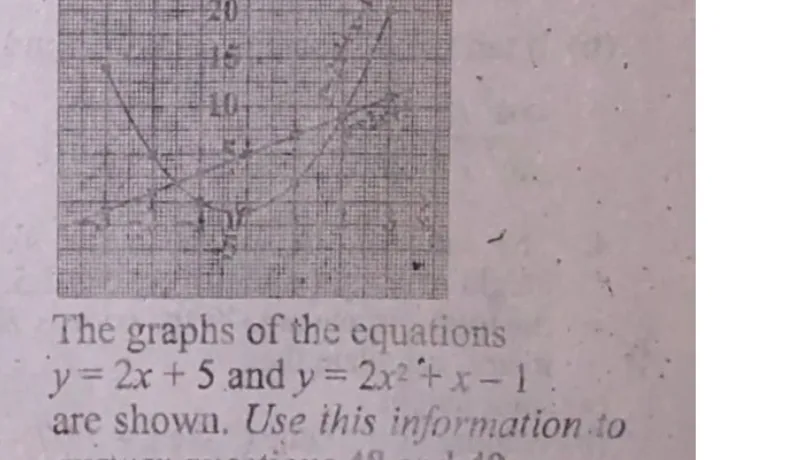
Reading from the graph of the two equations plotted together, the curves intersect at approximately (2.0, 9.0) and (-1.5, 2.0).
If x = -2.5, what is the value of y on the curve?
Reading from the graph at x=-2.5 on the curve y=2x^2+x-1 (or as plotted), the corresponding y value is approximately 9.0.
If (x+2) is a factor of x^2 + Px - 10, find the value of P.
By the factor theorem, if (x+2) is a factor, then x=-2 makes the expression zero: (-2)^2+P(-2)-10=0 => 4-2P-10=0 => -2P=6 => P=-3.
Advertisement
…and/or go further with premium services and No Ads.