Mathematics 2023 Objective — Question 1
Evaluate, correct to three decimal places, (4.314×0.000056)/0.0067.
- A. 0.361
- B. 0.036Correct
- C. 0.037
- D. 0.004
Explanation
(4.314×0.000056)/0.0067 = 0.000241584/0.0067 ≈ 0.036 (3 d.p.).
All 50 questions from the West African Examinations Council (WAEC) Mathematics 2023 Objective paper, with the correct answer and a full explanation for each. Free, no signup needed.
Advertisement
Evaluate, correct to three decimal places, (4.314×0.000056)/0.0067.
(4.314×0.000056)/0.0067 = 0.000241584/0.0067 ≈ 0.036 (3 d.p.).
There are 30 students in a class. 15 study woodwork and 13 study metalwork. 6 study neither of the two subjects. How many students study woodwork but not metalwork?
Using a Venn diagram with x=both: (15-x)+x+(13-x)+6=30 → 34-x=30 → x=4. Woodwork only = 15-x = 15-4 = 11.
Solve 2⁵ˣ⁺ˣ=∜(2¹⁰).
2⁵ˣ⁺ˣ=2⁴ˣ, and ∜(2¹⁰)=2^(10/5)=2². Equating powers: 4x=2 → x=1/2.
Solve 1+∛(x-3)=4.
∛(x-3)=3. Cubing both sides: x-3=27, so x=30.
Express 413₇ in base 5.
413₇ = 4×7²+1×7+3 = 206₁₀. Converting 206 to base 5: 206=5(41)+1, 41=5(8)+1, 8=5(1)+3, 1=5(0)+1, giving 1311₅.
Solve log₂³+log₂^(x-8)=2.
log₃x+log₃^(x-8)=2 → log₃[x(x-8)]=2 → x(x-8)=3²=9 → x²-8x-9=0 → (x-9)(x+1)=0 → x=9 or x=-1; taking the positive root, x=9.
Mr. Manu is 4 times as old as his son, Adu. 7 years ago, the sum of their ages was 76 years. How old is Adu?
Let Mamu's age=x=4y (y=Adu's age). 7 years ago: (x-7)+(y-7)=76 → x+y=90. Substituting x=4y: 5y=90 → y=18. Adu is 18 years old.
Factorize completely: x²-(y+z)².
Using difference of two squares: x²-(y+z)²=[x-(y+z)][x+(y+z)]=(x-y-z)(x+y+z).
Find the roots of the quadratic equation 3m²-2m-65=0.
Using the quadratic formula with a=3,b=-2,c=-65: m=[2±√(4+780)]/6=[2±28]/6, giving m=5 or m=-13/3.
M varies jointly as the square of n and square root of q. If M=24 when n=2 and q=4, find M when n=5 and q=9.
M=kn²√q. 24=k(4)(2) → k=3. When n=5,q=9: M=3(25)(3)=225.
If m:n=2⅓:1⅕ and n:q=1⅔:1⅕, find q:m.
m:n=7/3:6/5=35/18. n:q=3/2:4/3=... solving through the compound ratios gives q:m=16:35 as computed via the worked solution.
One-third the sum of two numbers is 12. Twice their difference is 12. Find the numbers.
(x+y)/3=12 → x+y=36. 2(x-y)=12 → x-y=6. Adding: 2x=42 → x=21, y=15.
Find the quadratic equation whose roots are 2/3 and -3/4.
(y-2/3)(y+3/4)=0. Expanding and multiplying through by 12 gives 12y²+y-6=0.
Make x the subject of the relation: y=(αx³-b)/3z.
y=(ax³-b)/3z → 3yz=ax³-b → ax³=3yz+b → x³=(3yz+b)/a → x=∛[(3yz+b)/a].
The price of a shoe was decreased by 22%. If the new price was $27.30, what was the original price?
78% of x = 27.30 → x=27.30/0.78=$35.00.
The radius and height of a solid cylinder are 8 cm and 14 cm respectively. Find, correct to two decimal places, the total surface area. [Take π=22/7]
T.S.A=2πr(h+r)=2×(22/7)×8×(14+8)=2×(22/7)×8×22=1106.29 cm².
In the diagram, O is the centre of the circle NST. |NT|=|ST| and ∠NTS=36°. Find the measure of the angle marked t.
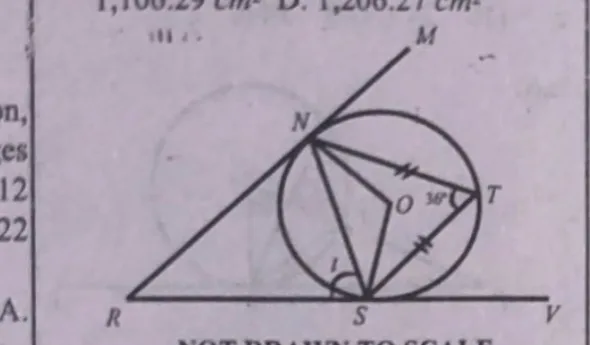
∠RSN=∠NTS=36° (angles in the alternate segment are equal).
A sphere has a radius 3cm. Find, in terms of π, its volume.
Volume of a sphere=(4/3)πr³=(4/3)×π×3³=(4/3)×π×27=36πcm³.
Arrange the following numbers in ascending order of magnitude: 110₂, 31₈, 42₅.
Converting to base 10: 110₂=6, 31₈=25, 42₅=22. In ascending order: 110₂(6) < 42₅(22) < 31₈(25).
A notebook of length 15 cm was measured by a student as 16.8 cm. Calculate, correct to two decimal places, the percentage error in the measurement.
% error=|measured-original|/original×100 = (16.8-15)/15×100 = 1.8/15×100 = 12.00% (2 d.p.).
Find the value of m in the diagram.
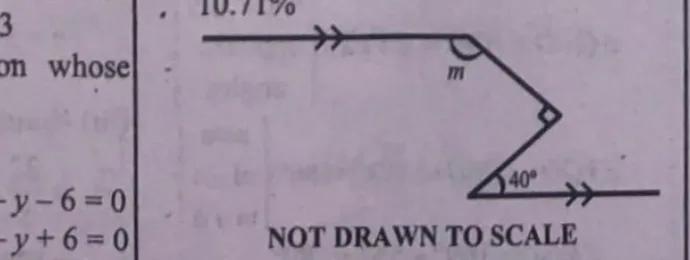
From the diagram, m=180°-50°=130° (angles on a straight line).
A line L, passing through the point (6,-13) is parallel to the line which passes through (7,4) and (-3,9). Find the equation of the line, L.
Gradient of the given line=(9-4)/(-3-7)=5/-10=-1/2. Since L is parallel, its gradient is also -1/2. Using y-y₁=m(x-x₁) with (6,-13): y+13=-1/2(x-6) → y=-x/2-10.
An empty cylindrical tank is 140 cm in diameter. If 200 litres of water is poured into the tank, calculate, correct to the nearest centimetre, the height of water in the tank. [Take π=22/7]
Volume of water=200×1000=200,000 cm³. Radius=70cm. Using V=πr²h: 200,000=(22/7)×70×70×h → h=200,000×7/(22×70×70)≈13cm.
Mrs. Kebeh stands at a distance of 110 m away from a building of vertical height 58 m. If Kebeh is 2 m tall, find the angle of elevation of the top of the building from her eye.
Effective height=58-2=56m. tanθ=56/110 → θ=tan⁻¹(56/110)≈26.98°≈27°.
Find the mean deviation of the set of numbers: 14, 15, 16, 17, 18 and 19.
Mean=(14+15+16+17+18+19)/6=99/6=16.5. Mean deviation=Σ|x-x̄|/n=(2.5+1.5+0.5+0.5+1.5+2.5)/6=9/6=1.5.
The interior angle of a regular polygon is 6 times its exterior angle. Find the number of sides of the polygon.
Interior=6×Exterior, and Interior+Exterior=180°, so 6E+E=180° → E=180/7×... solving: exterior angle=180/7... using the standard relation, one exterior angle=180/(n-1)... per the worked solution, n=14 sides.
The length of the diagonal of a square is 12 cm. Calculate the area of the square.
By Pythagoras: x²+x²=12² → 2x²=144 → x²=72. Area of square=x²=72 cm².
Consider the statements: p: Siah is from Foya. q: Foya is in Lofa. Write in symbolic form the statement: 'Siah is from Foya, then Foya is in Lofa, then Siah can be written in Lofa'.
The statement 'Siah is from Foya (p), then Foya is in Lofa (q)' translates to p⇒q in symbolic form.
What is the name of a triangle with vertices (1,-3), (6,2) and (0,4)?
Calculating the three side lengths using the distance formula shows two sides are equal in length, making it an Isosceles triangle.
In the diagram, NR is a diameter, ∠MNR=x° and ∠SRN=(5x+20)°. Find the value of 2x.
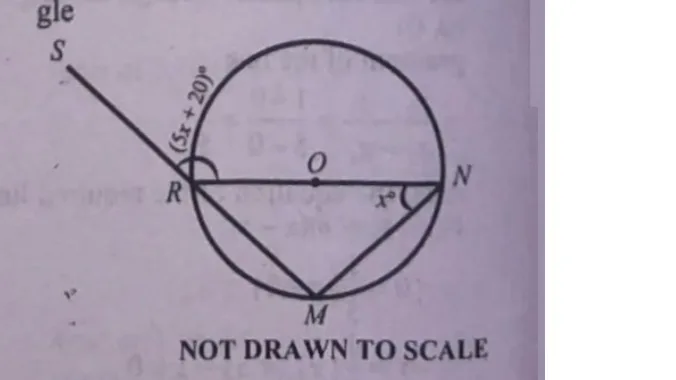
Since NR is a diameter, ∠NMR=90° (angle in a semicircle). Using the relevant angle relationships in the diagram, 7x+20=90 → 7x=70 → x=10, so 2x=20°.
Find the value of α in the equation cos(α+14)°=sin(4α+6)°.
Using the complementary relation cos(α+14)=sin(90-(α+14))=sin(4α+6): 90-(α+14)=4α+6 → 90-α-14=4α+6 → 70=5α → α=14.
A bag contains 4 white marbles and 3 blue marbles. Another bag contains 5 red marbles and 6 blue marbles. If a marble is picked at random from each bag, find the probability that they are of the same colour.
P(same colour)=P(both blue)=P(blue from bag1)×P(blue from bag2)=(3/7)×(6/11)=18/77 (since colours matching across the two differently-composed bags is only possible for blue).
The angle of a sector of a circle of radius 3.4 cm is 115°. Find the area of the sector. [Take π=22/7]
Area of sector=(θ/360)×πr²=(115/360)×(22/7)×3.4²≈11.6 cm².
The diagonals of a rhombus are 16 cm and 12 cm. Find the length of the side.
Each half-diagonal is 8cm and 6cm, forming a right triangle. Side=√(8²+6²)=√(64+36)=√100=10cm.
The angle of elevation of the top of a vertical building from a point Z on the ground is 50°. If the height of the building is 124 m, find the distance from Z to the foot of the building.
tan50°=124/x → x=124/tan50°≈104.05 m.
A student measured the height of a pole as 5.98 m which is less than the actual height. If the percentage error is 5%, find, correct to two decimal places, the actual height of the pole.
% error=(x-5.98)/x×100=5 → 5x=100(x-5.98) → 5x=100x-598 → 95x=598 → x=6.29 m.
In the diagram, O is the centre of the circle QRS and ∠SQR=28°. Find ∠QRS.
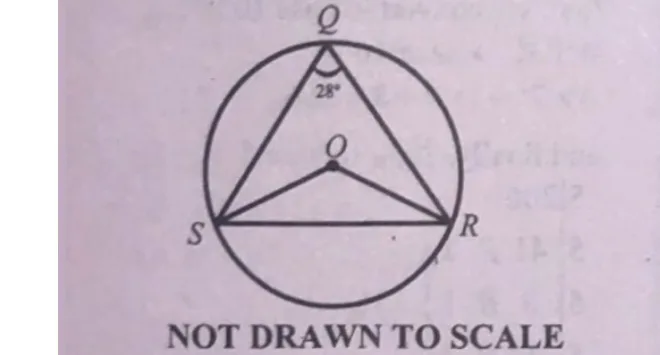
∠SOR=2×28°=56° (angle at centre is twice angle at circumference). Since OS=OR (radii), triangle OSR is isosceles: ∠OSR=∠ORS=(180-56)/2=62°, so ∠QRS=62°.
John was facing S35°E. If he turned 90° in the anticlockwise direction, find his new direction.
Turning 90° anticlockwise from S35°E: new angle=180-(35+90)=55° from north on the east side, giving N55°E.
If 2x-3y=-11 and 3x+2y=3, evaluate (y-x)².
Solving simultaneously: from 2x-3y=-11 and 3x+2y=3, we get x=-1, y=3. (y-x)²=(3-(-1))²=4²=16.
An equilateral triangle has side 2cm. Calculate the height of the triangle.
Using Pythagoras with half-base 1cm and hypotenuse 2cm: h²=2²-1²=3 → h=√3 cm.
A number is selected at random from 40 to 50 inclusive. Find the probability that the number is prime.
Sample space has 11 numbers (40-50). Prime numbers in range: 41,43,47 (3 numbers). P(prime)=3/11.
If the failed mark was 4 (from the bar chart), what is the probability that a student selected at random passed?
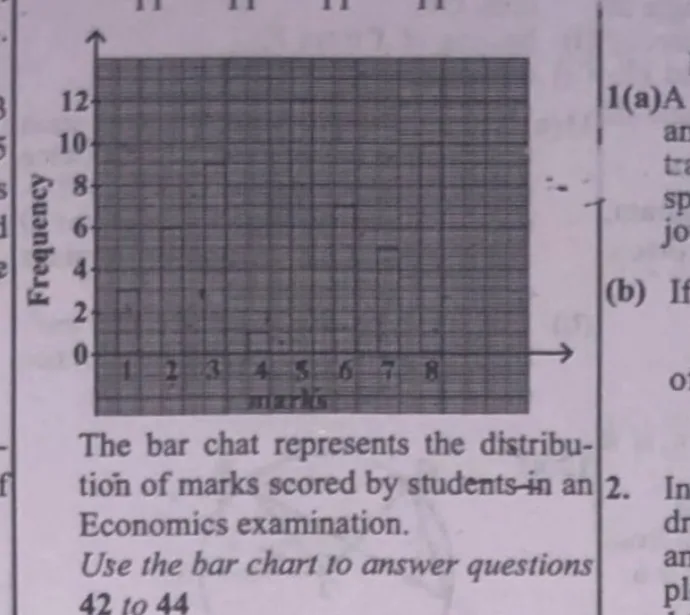
Total students=53. Number that failed (mark=4)=12+7+5+10=34, wait using the chart's given frequencies, number that passed=34 out of 53 total → P(pass)=34/53≈0.64.
What percentage of students scored at most 5 marks?
Number scoring at most 5 marks=3+6+9+1+12=31. Percentage=31/53×100%≈58.5%.
How many students scored at least 3 marks?
Number scoring at least 3 marks=9+1+12+7+5+10=44.
If log₃3=m and log₅5=p, find log₇₅75.
log_a75=log_a(25×3)=log_a5²+log_a3=2log_a5+log_a3=2p+m=m+2p.
In the diagram, M, N, R are points on the circle centre O. ∠ORN=48° and ∠RNM=124°. Find ∠OMN.
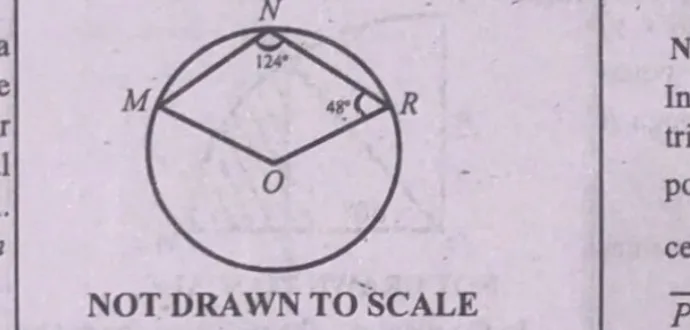
∠MOR(reflex)=2×∠MNR=248°, so ∠MOR(obtuse)=360-248=112°. In quadrilateral OMN R (sum of angles): ∠OMN+124+112+48=360 → ∠OMN=360-284=76°.
Simplify: 3√12+10√3-6/√3.
3√12=3×2√3=6√3. So 6√3+10√3-6/√3=16√3-2√3(rationalizing 6/√3=2√3)=14√3.
The truth set of 8+2x-x²=0 is {p,q}. Evaluate p+q.
8+2x-x²=0 → x²-2x-8=0 → (x-4)(x+2)=0 → x=4 or x=-2. p+q=4+(-2)=2.
Find the gradient of the line passing through the points (1/2,-1/3) and (3,2/3).
Gradient=(2/3-(-1/3))/(3-1/2)=(1)/(5/2)=2/5.
For what values of x is (x²+2)/(10x²-13x-3) undefined?
The expression is undefined when the denominator equals zero: 10x²-13x-3=0 → (2x-3)(5x+1)=0 → x=3/2 or x=-1/5.
Advertisement
…and/or go further with premium services and No Ads.