All 13 questions from the West African Examinations Council (WAEC) Mathematics 2023 Theory paper, with the correct answer and a full explanation for each. Free, no signup needed.
1(a). A car travels a distance of 112 km at an average speed of 70 km/h. It then travels further 60 km at an average speed of 50 km/h. Calculate the entire journey, the total time taken.
1(b). If x/y=2 and y/z=3, find the value of (x+y)/(y+z).
Model answer
(a) t₁=112/70=1.6hr. t₂=60/50=1.2hr. Total time=1.6+1.2=2.8 hr.
(b) Given x/y=2 → x=2y, and y/z=3 → y=3z (so z=y/3). Substituting: (x+y)/(y+z)=(2y+y)/(y+y/3)=3y/(4y/3)=3y×3/4y=9/4.
Let the total number of students be n(μ)=30; n(W)=number that study woodwork=15; n(M)=number that study metalwork=13; n(W∪M)'=number that study neither=6. Using a Venn diagram, find the number of students that study woodwork only.
Model answer
Using a Venn diagram with x = number that study both: (15-x)+x+(13-x)+6=30 → 28+6-x=30 → 34-x=30 → x=4. Number that study woodwork only (W only)=15-x=15-4=11.
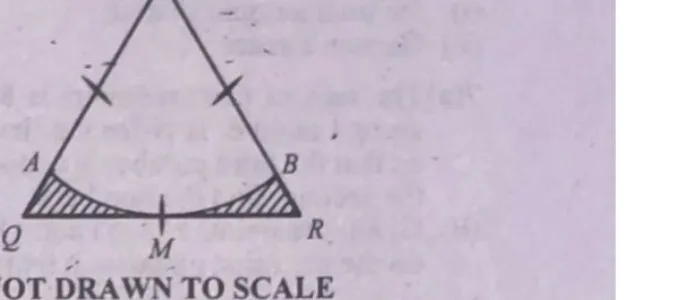
Since PQR is an equilateral triangle, all sides and angles are the same, thus each angle θ=60°. Area of triangle PQR = (1/2)|PQ||QR|sinθ.
Model answer
Area of triangle PQR=(1/2)×18×18×sin60°=(1/2)×18×18×(√3/2)=140.2961 cm².
Area of sector PAMB=(θ/360)×πr²=(60/360)×(22/7)×|mp|²=127.2857 cm² (using r=mp, the radius of the arc).
Area of shaded region=Area of triangle PQR - Area of sector PAMB=140.2961-127.2857=13.01 cm² (2 d.p.).
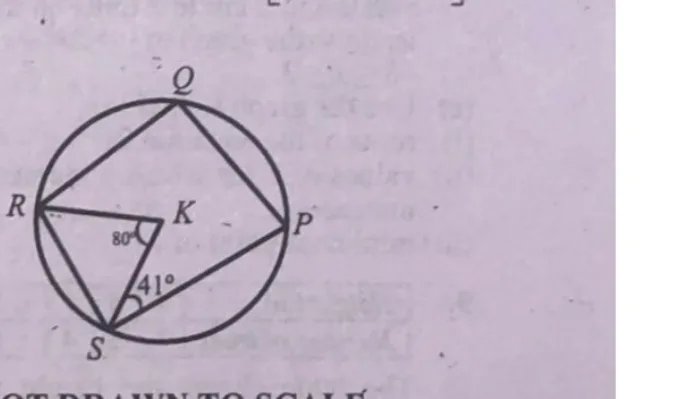
4(a). In the diagram, P, Q, R and S are points on the circle centre K. KR is a bisector of ∠SRQ, ∠KSP=41° and ∠SKR=80°. Find: (a) ∠RQP; (b) ∠SPQ.
Model answer
(a) Since triangle KSR is isosceles (KS=KR, radii) with base angles equal: ∠KSR=∠KRS. 2∠KSR+80°=180° → ∠KSR=50°. Since ∠ROP+∠RSP=180° (opposite angles of a cyclic quadrilateral): ∠RQP+∠RSP=180°. ∠RSP=∠RSK+∠KSP=50°+41°=91°. So ∠RQP=180°-91°=89°.
(b) ∠SRQ=2×∠KRS=2×50°=100° (since KR bisects ∠SRQ). ∠SRQ+∠SPQ=180° (opposite angles of a cyclic quadrilateral): 100°+∠SPQ=180° → ∠SPQ=80°.
5(a). A boy stands at a point M on the same horizontal level as the foot, T, of a vertical building. He observes an object on the top, P, of the building at an angle of elevation of 66°. He moves directly backwards to a new point C and observes the same object at an angle of elevation of 53°. If |MT|=50m, illustrate the information in a diagram.
5(b). Calculate, correct to one decimal place, the: (i) height of the building |PT|; (ii) |MC|.
Model answer
(a) The diagram shows a right triangle with T at the base of the building, P at the top, M at 50m from T with angle of elevation 66°, and C further back with angle of elevation 53°.
(b)(i) tan66°=|PT|/50 → |PT|=50×tan66°≈112.3 m.
(ii) tan53°=|PT|/(50+x), where x=|MC|. 112.3=(50+x)×tan53°=(50+x)(1.327) → 112.3=1.327x+66.35 → 1.327x=45.95 → x=34.6m. So |MC|≈34.6 m.
6(i). {n:2n-3≤37}, where n is a counting number. (a) Write down all the elements of M. (b) If a number is selected at random from M, what is the probability that it is a: (α) multiple of 3; (β) factor of 10.
6(ii). A shop owner gave an end-of-year bonus to two attendants, Kontor and Gapson, in the ratio of their ages. Kontor's age is one and half times that of Gapson who is 20 years old. If Kontor received Le 200,000.00, find: (i) the total amount shared; (ii) Gapson's share.
Model answer
(i)(a) 2n-3≤37 → 2n≤40 → n≤20. Since n is a counting number, M={1,2,3,4,...,20}.
(b)(α) Multiples of 3 in M={3,6,9,12,15,18} → 6 elements. P(multiple of 3)=6/20=3/10.
(β) Factors of 10 in M={1,2,5,10} → 4 elements. P(factor of 10)=4/20=1/5.
(ii) Kontor:Gapson=3:2 (since Kontor is 1.5× Gapson's age). Kontor's share=(3/5)×total=200,000 → total=200,000×5/3=Le 333,333.33.
(ii) Gapson's share=(2/5)×333,333.33=Le 133,333.33.
7(a). The sum of three numbers is 81. The second number is twice the first. Given that the third number is 6 more than the second, find the numbers.
7(b). Given the points P(3,5) and Q(-5,7) on the cartesian plane such that R(x,y) is the midpoint of PQ, find the equation of the line that passes through R and perpendicular to PQ.
Model answer
(a) Let the numbers be x,y,z. x+y+z=81. y=2x. z=y+6=2x+6. Substituting: x+2x+(2x+6)=81 → 5x+6=81 → 5x=75 → x=15. So the numbers are 15, 30 and 36.
(b) Midpoint R=((3-5)/2,(5+7)/2)=(-1,6). Gradient of PQ=(7-5)/(-5-3)=2/-8=-1/4. Since the required line is perpendicular to PQ, its gradient=4 (negative reciprocal). Equation: y-6=4(x-(-1)) → y-6=4x+4 → y=4x+10, or 4x-y+10=0.
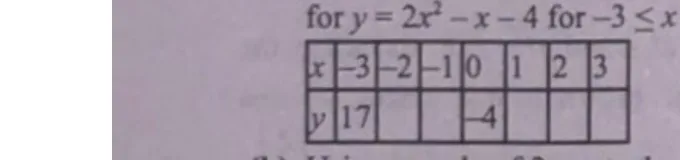
8(a). Copy and complete the table of values for y=2x²-x-4 for -3≤x≤3.
8(b). Using a scale of 2 cm to 1 unit on the x-axis and 2 cm to 2 units on the y-axis, draw the graph of y=2x²-x-4 for -3≤x≤3.
8(c). Use the graph to find the: (i) roots of the equation 2x²-x-4=0; (ii) values of x for which y increases as x increases; (iii) minimum point of y.
Model answer
(a) Completed table: x: -3,-2,-1,0,1,2,3 → y: 17,10,-1,-4,-3,2,11 (computed using y=2x²-x-4 for each x value).
(b) Plotting these points on the given scale produces a parabola (U-shaped curve) with a minimum point.
(c)(i) From the graph, the roots of the equation are the values of x where the graph cuts the x-axis, approximately x=-1.2 and x=1.7.
(ii) The values of x for which y increases as x increases is the right-hand side of the curve, approximately 0.1≤x≤3.
(iii) The minimum point of y is y=-4 (occurring around x=0.25 based on the curve's vertex).
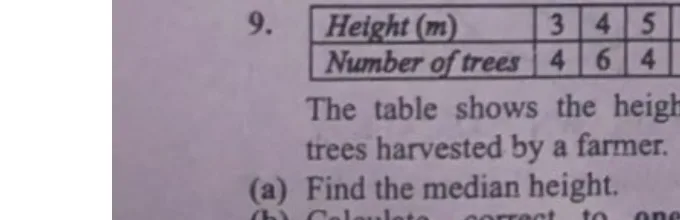
The table shows the height of teak trees harvested by a farmer.
(a) Find the median height.
(b) Calculate, correct to one decimal place, the: (i) mean; (ii) standard deviation.
Model answer
(a) Total number of trees=4+6+4+5+6+2=27 trees. Median position=(n+1)/2=(27+1)/2=14th position. Counting through the cumulative frequency, the median height=5 m.
(b)(i) Mean=Σfx/Σf=144/27≈5.3 m (using Σfx=144 and Σf=27 from the frequency table).
(ii) Standard deviation δ=√[(Σfx²/Σf)-(Σfx/Σf)²]=√[(834/27)-(144/27)²]=√(30.89-28.44)=√2.297≈1.6 (1 d.p.).
10(i). In a town, Chief X resides 60 m away on a bearing of 057° from the palace, P, while Chief Y resides on a bearing of 150° from the same palace, P. The residence of X and Y are 180 m apart. (a) Illustrate the information in a diagram. (b) Find, correct to three significant figures, the: (i) bearing of X from Y; (ii) distance between P and Y.
Model answer
(a) The diagram shows P at the palace, with X at 60m on bearing 057° from P, and Y at bearing 150° from P, with |XY|=180m.
(b) The angle XPY=150°-57°=93°. Using the sine rule: sinθ/60=sin93°/180 → θ=sin⁻¹(60sin93°/180)≈19.44°.
(i) Bearing of X from Y=270°+60°+19.44°=349° (approx, using the geometric relationships in the diagram).
(ii) Using the sine rule again: |PY|/sin(67.56°)=180/sin93° → |PY|=180sin67.56°/sin93°≈167 m.
11(a). Two regular polygons P and Q are such that the number of sides of P is twice the number of sides of Q. The difference between the exterior angle of Q and P is 45°. Find the number of sides of P.
11(b). The area of a semi-circle is 32π cm². Find, in terms of π, the circumference of the semi-circle.
Model answer
(a) Let sides of Q=n_q, sides of P=n_p=2n_q. Exterior angle of P=360/n_p, exterior angle of Q=360/n_q. Difference: 360/n_q - 360/n_p=45° → 360/n_q-360/2n_q=45 → 180/n_q=45 → n_q=4. So n_p=2×4=8 sides.
(b) Area of semicircle=(1/2)πr²=32π → r²=64 → r=8cm. Diameter=2r=16cm. Circumference of semicircle=D+length of arc of semicircle=16+πr=16+8π, or (16+8π) cm.
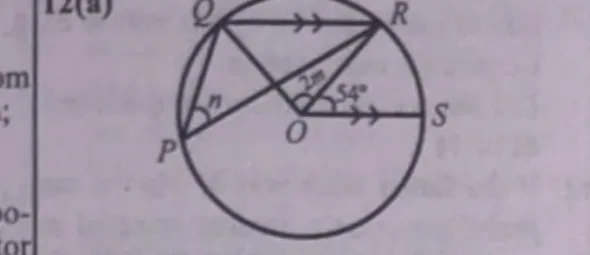
12(a). In the diagram, P, Q, R and S are points on the circle with centre O. ∠QOR=2m, ∠QPR=n and ∠SOR=54°. Find the values of m and n.
12(b). Let the width be W; the length is 4cm more than the width. If the perimeter is 40cm, find the area.
Model answer
(a) ∠SOR=∠QRO=54° (alternate angles are equal, per the diagram's parallel lines). From triangle ORQ: 2m+54+54=180° → 2m=72° → m=36°. Also, ∠QOR(2m)=2×∠QPR(n) since the angle at the centre equals twice the angle at the circumference on the same arc: 2m=2n → m=n=36°.
(b) Let width=W, length=L=4+W. Perimeter=2(L+W)=40 → 2(4+W+W)=40 → 2(4+2W)=40 → 8+4W=40 → 4W=32 → W=8cm. Length=4+8=12cm. Area=L×W=12×8=96 cm².
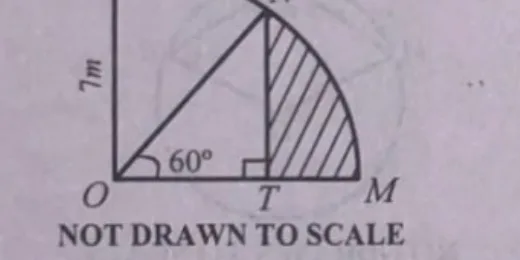
13(a). In the diagram, the radius of the sector of circle centre O, is 7 cm and ∠MON is 60°. Find, correct to one decimal place, the area of the shaded portion. [Take π=22/7]
13(b). The x and y intercepts of a straight line are -3/4 and 2/7 respectively. Find the equation of the line.
Model answer
(a) Area of sector ONM=(θ/360)×πr²=(60/360)×(22/7)×7²=25.67 cm². From triangle OTN: |OT|=7cos60°=3.5cm. |TN|=7sin60°=6.062cm (using the height from the triangle). Area of triangle ONT=(1/2)×3.5×6.062=10.61 cm². Area of shaded portion=Area of sector - Area of triangle=25.67-10.61=15.06≈15.1 cm² (1 d.p.).
(b) Using x/a+y/b=1 where a=-3/4 (x-intercept) and b=2/7 (y-intercept): x/(-3/4)+y/(2/7)=1 → -4x/3+7y/2=1. Multiplying through by 6: -8x+21y=6, or 21y=8x+6, giving y=(8x+6)/21 or 8x-21y+6=0.
Advertisement
Sign up free to unlock
Score tracking
Practice history
Saved questions
Progress dashboard
Personalized sessions
Weak-topic breakdown
…and/or go further with premium services and No Ads.