Mathematics 2024 Objective — Question 1
Multiply 3.4×10⁻⁵ by 7.1×10⁸ and leave the answer in standard form.
- A. 2.414×10²
- B. 2.414×10³
- C. 2.414×10⁴Correct
- D. 2.414×10⁵
Explanation
3.4×7.1 = 24.14; 10⁻⁵×10⁸ = 10³; 24.14×10³ = 2.414×10⁴.
All 50 questions from the West African Examinations Council (WAEC) Mathematics 2024 Objective paper, with the correct answer and a full explanation for each. Free, no signup needed.
Advertisement
Multiply 3.4×10⁻⁵ by 7.1×10⁸ and leave the answer in standard form.
3.4×7.1 = 24.14; 10⁻⁵×10⁸ = 10³; 24.14×10³ = 2.414×10⁴.
Given that P = {p : 1 < p < 20}, where p is an integer and R = {r : 0 ≤ r ≤ 25, where r is a multiple of 4}, find P∩R.
P = {2,3,...,19}; R = {0,4,8,12,16,20,24}; P∩R = {4, 8, 12, 16}.
The first term of an Arithmetic Progression (A.P) is 2 and the last term is 29. If the common difference is 3, how many terms are in the A.P?
Tn = a + (n-1)d → 29 = 2 + (n-1)3 → n = 10.
Express in index form: logₐˣ + logₐʸ = 3
logₐ(xy) = 3 ⇒ xy = a³ (since logₙᵖ = m ⇒ P = nᵐ).
Simplify: (2p - q)² - (p + q)²
Expand: 4p²-4pq+q² - (p²+2pq+q²) = 3p²-6pq = 3p(p-2q).
If (3 - 4√2)(1 + 3√2) = a + b√2, find the value of b.
Expanding: 3+9√2-4√2-24 = -21+5√2, so a=-21, b=5.
Find the time for which $1,250.00 will amount to $2,031.25 at 12.5% per annum simple interest.
I = 2031.25-1250 = 781.25; t = I×100/(P×R) = 781.25×100/(1250×12.5) = 5 years.
If log₃^(2x-1) = 5, find the value of x.
2x-1 = 3⁵ = 243 ⇒ x = 244/2 = 122.
The population of a town increases by 3% every year. In the year 2000, the population was 3,000. Find the population in the year 2003.
Pₙ = P₀(1+r/100)ⁿ = 3000(1.03)³ ≈ 3,278.
A trader gave a change of $540.00 instead of $570.00 to a customer. Calculate the percentage error.
Error = 570-540 = 30; %error = 30/570 × 100% = 5 5/19%.
An interior angle of a regular polygon is 168°. Find the number of sides of the polygon.
Exterior angle = 180-168 = 12°; n = 360/12 = 30.
If 3x - 2y = -5 and x + 2y = 9, find the value of (x - y)/(x + y).
Solving simultaneously: x=1, y=4; (1-4)/(1+4) = -3/5.
A variable W varies partly as M and partly inversely as P. Which of the following correctly represents the relation with k₁ and k₂ constants?
W ∝ M and W ∝ 1/P combine (partial variation) to give W = k₁M + k₂/P.
A cylindrical metallic barrel of height 2.5 m and radius 0.245 m is closed at one end. Find, correct to one decimal place, the total surface area of the barrel. [Take π = 22/7]
TSA = πr(2h+r) = (22/7)(0.245)[2(2.5)+0.245] ≈ 4.0 m² (1 d.p.).
Make R the subject of the relation V = πl(R² - r²).
R² = V/πl + r² ⇒ R = √(V/πl + r²).
Consider the following statements: m: Edna is respectful; n: Edna is brilliant. If m ⟹ n, which of the following is valid?
The contrapositive of m⟹n is ~n⟹~m, and a statement is always logically equivalent (valid) to its contrapositive.
A number is added to both the numerator and the denominator of the fraction 1/8. If the result is 1/2, find the number.
(1+x)/(8+x) = 1/2 → 2(1+x) = 8+x → x = 6.
Gifty, Justina and Frank shared 60 oranges in the ratio 5 : 3 : 7 respectively. How many oranges did Justina receive?
Total ratio = 15; Justina's share = (3/15) × 60 = 12.
Find the quadratic equation whose roots are 2/3 and -1.
Sum of roots = -1/3, product = -2/3; x² + (1/3)x - 2/3 = 0 → 3x² + x - 2 = 0.
A piece of rod of length 44 m is cut to form a rectangular shape such that the ratio of the length to the breadth is 7 : 4. Find the breadth.
Perimeter = 2(L+B) = 44 → L+B = 22; L:B = 7:4 → B = 8 m.
In the diagram, MN∥KL, ML and KN intersect at X. |MN| = 12 cm, |MX| = 10 cm and |KL| = 9 cm. If the area of ΔMXN is 16 cm², calculate the area of ΔLXK.
ΔMXN and ΔLXK are similar; ratio of areas = (KL/MN)² = (9/12)². Area LXK = 16×81/144 = 9 cm².
A ladder 15 m long leans against a vertical pole, making an angle of 72° with the horizontal. Calculate, correct to one decimal place, the distance between the foot of the ladder and the pole.
d = 15cos72° ≈ 4.6 m.
In the diagram, O is the centre of the circle. If |OA| = 25 cm and |AB| = 40 cm, find |OH|.
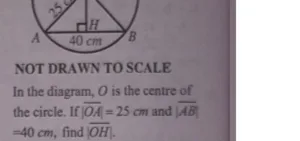
OH bisects AB, so AH = 20 cm. By Pythagoras: OH² = 25²-20² = 225 → OH = 15 cm.
Given that P is 25 m on a bearing of 330° from Q, how far south of Q is P?
d = 25 sin60° ≈ 21.7 m.
A car valued at $600,000.00 depreciates by 10% each year. What will be the value of the car at the end of two years?
Value = $600,000 × (0.9)² = $486,000.
The length and breadth of a cuboid are 15 cm and 8 cm respectively. If the volume of the cuboid is 1,560 cm³, calculate the total surface area.
H = 1560/(15×8) = 13 cm; TSA = 2(LB+BH+LH) = 2(120+104+195).
The number 1621 was subtracted from 6244 in base x. If the result was 4323, find x.
Converting to base 10 and solving gives x² - 7x = 0, so x = 7 (base seven).
Factorize completely: 27x² - 48y²
27x²-48y² = 3(9x²-16y²) = 3(3x+4y)(3x-4y).
For what values of x is (x-3)/4 + (x+1)/8 ≥ 2 ?
Multiply through by 8: 2(x-3)+(x+1) ≥ 16 → 3x-5 ≥ 16 → x ≥ 7.
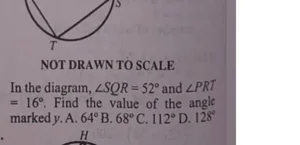
In the diagram, ∠SQR = 52° and ∠PRT = 16°. Find the value of the angle marked y.
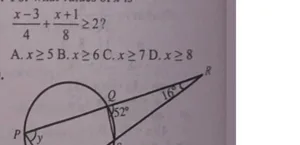
y is the exterior angle of cyclic quadrilateral RQST; y = 52°+16°+... = 112°.
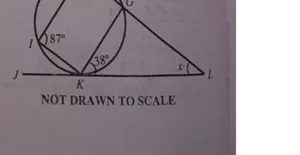
In the diagram, JKL is a tangent to the circle GHIK at K. ∠LKG = 38° and ∠KHG = 87°. Calculate the value of the angle marked x.
KĜL = 87° (exterior angle of cyclic quadrilateral); in ΔKGL: 87°+x+38° = 180° → x = 55°.
A cone and a cylinder are of equal volume. The base radius of the cone is twice the radius of the cylinder. What is the ratio of the height of the cylinder to that of the cone?
Equal volumes with R_cone = 2r_cyl gives h_cyl : h_cone = 4 : 3.
Find, correct to the nearest whole number, the value of h in the diagram.
Using the given side lengths and Pythagoras' theorem, h ≈ 23 m.
The gradient of the line joining the points P(2, -8) and Q(1, y) is -4. Find the value of y.
m = (y-(-8))/(1-2) = -4 → y = -4.
In the diagram, PQ∥RS, ∠WYZ = 44° and ∠WXY = 50°. Find ∠WTX.
∠XWY = ∠ZYW = 44° (alternate angles); in ΔWTX: ∠W+∠T+∠X = 180°, giving ∠WTX = 86°.
The perimeter of a rectangular garden is 90 m. If the width is 7 m less than the length, find the length of the garden.
2(L+(L-7)) = 90 → 2L-7 = 45 → L = 26 m.
Four of the angles of a hexagon sum up to 420°. If the remaining angles are equal, find the value of each of the angles.
Sum of interior angles of hexagon = 720°; remaining two = 300°; each = 150°.
Find the value of x in the diagram.
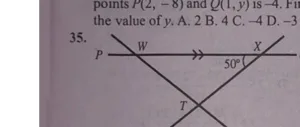
Using angles on a straight line and corresponding angles, x = 120°.
The following are the masses (in kg) of members in a club: 59, 44, 53, 57, 49, 40, 48 and 50. Calculate the mean mass.
Mean = (59+44+53+57+49+40+48+50)/8 = 400/8 = 50 kg.
Calculate the variance of the distribution of masses: 59, 44, 53, 57, 49, 40, 48 and 50.
Variance S² = Σf(x-x̄)²/Σf = 280/8 = 35.
Two opposite sides of a rectangle are (5x+3) m and (2x+9) m. If an adjacent side is (6x-7) m, find, in m², the area of the rectangle.
5x+3 = 2x+9 → x = 2; sides = 13 m and 5 m; Area = 65 m².
A die is tossed once. Find the probability of getting a prime number.
Prime outcomes on a die: {2,3,5}; P = 3/6 = 1/2.
The area of a sector of a circle with radius 7 cm is 51.3 cm². Calculate, correct to the nearest whole number, the angle of the sector. [Take π = 22/7]
θ = (51.3×360×7)/(22×7²) ≈ 120°.
A cliff on the bank of a river is 87 m high. A boat on the river is 22 m away from the foot of the cliff. Calculate, correct to the nearest degree, the angle of depression of the boat from the top of the cliff.
tan α = 87/22 = 3.9545; α = tan⁻¹(3.9545) ≈ 76°.
In the diagram, TU is a tangent to the circle SPQR at P. If ∠PTS = 44° and ∠SQP = 35°, find ∠PST.
∠SPT = 35° (angle in alternate segment); in ΔPST: 35°+44°+∠PST = 180° → ∠PST = 101°.
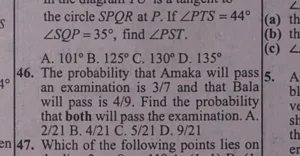
The probability that Amaka will pass an examination is 3/7 and that Bala will pass is 4/9. Find the probability that both will pass the examination.
P(both) = 3/7 × 4/9 = 12/63 = 4/21.
Which of the following points lies on the line 3x - 8y = 11?
3(1) - 8(-1) = 3 + 8 = 11 ✓.
Find the range of the following set of numbers: 28, 29, 39, 38, 33, 37, 26, 20, 15 and 25.
Range = maximum - minimum = 39 - 15 = 24.
The fourth and eighth terms of an Arithmetic Progression are 16 and 40 respectively. Find the common difference.
T₄=a+3d=16, T₈=a+7d=40; subtracting: 4d=24 → d=6.
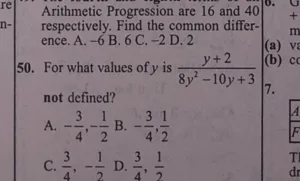
For what values of y is (y+2)/(8y² - 10y + 3) not defined?
Denominator = 0: 8y²-10y+3=0 → (4y-3)(2y-1)=0 → y = 3/4 or 1/2.
Advertisement
…and/or go further with premium services and No Ads.