Free account: track your progress — Sign up free

WAEC Physics 2013 Objective Past Questions

All 50 questions from the West African Examinations Council (WAEC) Physics 2013 Objective paper, with the correct answer and a full explanation for each. Free, no signup needed.

Advertisement

Physics 2013 Objective — Question 1

The rising of a liquid in an open ended glass tube of narrow bore is due to

  • A. osmosis
  • B. adhesion
  • C. capillarityCorrect
  • D. surface tension

Explanation

Capillarity is the tendency of a liquid to rise or fall in a narrow tube (capillary). A capillary is an open-ended glass tube.

Physics 2013 Objective — Question 2

Which of the following units is equivalent to the Watt?

  • A. kgms⁻²
  • B. kgm²s⁻³Correct
  • C. kgm²s⁻¹
  • D. kgms⁻¹

Explanation

Watt is the SI unit of power. Power = force × velocity = mass × acceleration × velocity. Therefore Watt = kg × ms⁻² × ms⁻¹ = kgm²s⁻³.

Physics 2013 Objective — Question 3

Which of the following statements about pressure in a liquid is correct?

  • A. The pressure in a liquid increases with depthCorrect
  • B. The higher the density of a liquid, the lower the pressure it exerts
  • C. Pressure in a liquid acts only in a direction perpendicular to the sides of the containing vessel
  • D. Pressure is independent of the acceleration due to gravity

Explanation

Pressure in a liquid increases in magnitude with depth. Pressure at any point acts in all directions, and depends on depth, density and gravity.

Physics 2013 Objective — Question 4

A block of wood of mass 5kg is pulled on a platform by a force 40N as illustrated in the diagram above. If the frictional force, F experienced by the block is 12N, calculate the magnitude of the acceleration of the block.

  • A. 2.4ms⁻²
  • B. 5.6ms⁻²Correct
  • C. 8.0ms⁻²
  • D. 10.4ms⁻²

Explanation

Net force = P − F = 40 − 12 = 28N. Acceleration a = F(net)/m = 28/5 = 5.6ms⁻².

Physics 2013 Objective — Question 5

Solid friction, like viscosity, is

  • A. independent of the surface areas in contact
  • B. independent of the relative motion between layers
  • C. dependent on normal reaction
  • D. in opposition to motionCorrect

Explanation

Both solid friction and viscosity oppose relative motion between surfaces/layers.

Physics 2013 Objective — Question 6

The slope of a linear distance-time graph represents

  • A. acceleration
  • B. displacement
  • C. speedCorrect
  • D. velocity

Explanation

The slope of a distance-time graph gives speed (the slope of a displacement-time graph gives velocity).

Physics 2013 Objective — Question 7

A body of mass 2kg is released from rest on a smooth plane inclined at an angle of 60° to the horizontal. Calculate the acceleration of the body down the plane. [g = 10ms⁻²]

  • A. 3.1ms⁻²
  • B. 5.2ms⁻²
  • C. 6.0ms⁻²
  • D. 8.7ms⁻²Correct

Explanation

On a smooth inclined plane, the only force acting down the plane is the component of gravity parallel to the plane: a = g sinθ = 10 × sin60° = 8.7ms⁻².

Physics 2013 Objective — Question 8

The total area under a force-velocity graph represents

  • A. energy
  • B. momentum
  • C. powerCorrect
  • D. pressure

Explanation

Power = force × velocity, so the area under a force-velocity graph (force on one axis, velocity on the other) represents power.

Physics 2013 Objective — Question 9

Use the following information to answer questions 9 and 10. A body of mass 20g projected vertically upwards in vacuum returns to the point of projection after 1.2s. [g=10ms⁻²] Calculate the speed of projection.

  • A. 0.6ms⁻¹
  • B. 1.2ms⁻¹
  • C. 6.0ms⁻¹Correct
  • D. 12.0ms⁻¹

Explanation

Time of flight T = 1.2s, so time to reach maximum height t = T/2 = 0.6s. Using v = u − gt with v=0 at max height: 0 = u − (10)(0.6), so u = 6.0ms⁻¹.

Physics 2013 Objective — Question 10

(Using the same information as Q9) Determine the potential energy of the body at the maximum height of its motion.

  • A. 0.36JCorrect
  • B. 0.72J
  • C. 360.00J
  • D. 720.00J

Explanation

P.E at maximum height = K.E at projection = ½mu² = ½ × 0.02 × 6² = 0.36J.

Physics 2013 Objective — Question 11

Four co-planar forces of magnitudes 10N, 17N, 6N and 20N act at point O as shown in the diagram above. Determine the magnitude of the resultant force.

Diagram for question 11
  • A. 53.0N
  • B. 21.0N
  • C. 7.0N
  • D. 5.0NCorrect

Explanation

Vertical component = (10−6)N = 4N. Horizontal component = (20−17)N = 3N. Resultant R = √(4²+3²) = √25 = 5N.

Physics 2013 Objective — Question 12

The maximum displacement on either side of the equilibrium position of an object in simple harmonic motion represents

  • A. period
  • B. amplitudeCorrect
  • C. wavelength
  • D. frequency

Explanation

The amplitude is the maximum displacement on either side of the equilibrium position.

Physics 2013 Objective — Question 13

From Newton's first law of motion,

  • A. a body can only undergo translational motion
  • B. once a body remains at rest no force acts on it
  • C. the net force acting on a body in uniform linear motion is zeroCorrect
  • D. a body's inertia is its weight

Explanation

Newton's first law implies that a body at constant velocity (including at rest) has zero net force acting on it. The addition of all forces on it sums to zero — that does not mean no forces act on it.

Physics 2013 Objective — Question 14

A body of mass 11kg is suspended from a ceiling by an aluminium wire of length 2m and diameter 2mm. Calculate the elastic energy stored in the wire [Young's modulus of aluminium = 7.0×10¹⁰Nm⁻²; g=10ms⁻², π=3.14]

  • A. 1.1×10⁻¹J
  • B. 5.5×10⁻²JCorrect
  • C. 1.1×10⁻⁴J
  • D. 5.5×10⁻⁵J

Explanation

Force on wire = weight = mg = 110N. Cross-sectional area = πd²/4 = 3.14×(2×10⁻³)²/4 = 3.14×10⁻⁶m². Extension e = Force×length/(Area×Y) = (110×2)/(3.14×10⁻⁶×7.0×10¹⁰) = 1×10⁻³m. Elastic energy E = ½Fe = ½×110×1×10⁻³ = 5.5×10⁻²J.

Physics 2013 Objective — Question 15

The velocity ratio of an inclined plane

  • A. increases with increase in the angle of inclination
  • B. increases with decrease in the angle of inclinationCorrect
  • C. decreases with decrease in the angle of inclination
  • D. is independent of the angle

Explanation

V.R = 1/sinθ. As θ decreases (first quadrant, θ≤90°), sinθ decreases, so V.R increases. Thus V.R increases with a decrease in the angle of inclination.

Physics 2013 Objective — Question 16

Which of the following types of thermometers is used for the calibration of other thermometers?

  • A. Liquid-in-glass thermometer
  • B. Constant volume gas thermometerCorrect
  • C. Optical pyrometer
  • D. Thermocouple

Explanation

Constant volume gas thermometers are very sensitive, consistent and have a wide range. They are also accurate, and due to this, they are used for calibrating other thermometers.

Physics 2013 Objective — Question 17

The magnitude of the expansion or contraction of a substance depends on the I. temperature change. II. nature of the substance. III. size of the substance. Which of the statements above are correct?

  • A. I and II only
  • B. II and III only
  • C. I and III only
  • D. I, II and IIICorrect

Explanation

The magnitude of thermal expansion/contraction of a substance depends on the temperature change, the nature (material) of the substance, and its size.

Physics 2013 Objective — Question 18

Highly polished silvery surfaces are

  • A. poor absorbers and poor emitters of radiationCorrect
  • B. good absorbers and good emitters of radiation
  • C. good absorbers but poor emitters of radiation
  • D. poor absorbers but good emitters of radiation

Explanation

Highly polished silvery surfaces are poor absorbers and poor emitters of radiation; dull, black surfaces are better absorbers and emitters of radiation.

Physics 2013 Objective — Question 19

The volume of a given mass of gas at 27°C and 800 mmHg is 76 cm³. Calculate its volume at s.t.p.

  • A. 100.0 cm³
  • B. 72.8 cm³Correct
  • C. 60.0 cm³
  • D. 36.4 cm³

Explanation

Using the general gas law: P1V1/T1 = P2V2/T2, with T1=300K, P1=800mmHg, V1=76cm³, T2=273K, P2=760mmHg: V2 = (800×76×273)/(300×760) = 72.8 cm³.

Physics 2013 Objective — Question 20

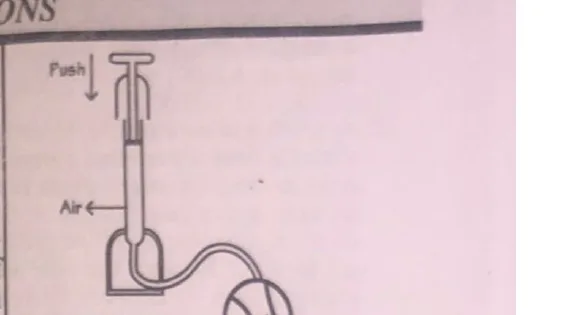
The outlet of a bicycle pump is used to inflate a football as illustrated in the diagram above. Why does the pressure of the air inside the pump increase as the pump handle is slowly pushed downward at constant temperature?

Diagram for question 20
  • A. Momentum of the air molecules is increased
  • B. Volume occupied by the molecules is increased
  • C. Frequency of collision of the air molecules with the walls of the pump is increasedCorrect
  • D. More air molecules are colliding with one another in the system

Explanation

When the pump handle is pushed down, the volume of the air in the pump decreases, causing more collisions between the air molecules and the pump's interior walls, increasing pressure. (The collisions responsible are between the air molecules and the walls, not between the air molecules themselves.)

Physics 2013 Objective — Question 21

Ice of mass 10g at −5°C was completely converted to water at 0°C. Calculate the quantity of heat used. [Specific heat capacity of ice = 2.1Jg⁻¹K⁻¹, specific latent heat of fusion of ice = 336Jg⁻¹]

  • A. 3465 JCorrect
  • B. 3255 J
  • C. 3465 J
  • D. 16821 J

Explanation

Heat needed = heat to warm ice from −5°C to 0°C + heat to melt ice at 0°C = mcΔT + mLf = (10×2.1×5) + (10×336) = 105 + 3360 = 3465J.

Physics 2013 Objective — Question 22

An electric heater has a resistance of 50Ω. When it is immersed in water and connected to mains source, it draws a current of 4.0A. Calculate the heat gained by the water if the heater is switched on for 2 minutes, assuming no heat losses to the surroundings.

  • A. 400 J
  • B. 1600 J
  • C. 24000 J
  • D. 96000 JCorrect

Explanation

Power = I²R = 4²×50 = 800W. Time = 2×60 = 120s. Heat gained = Power×time = 800×120 = 96000J.

Physics 2013 Objective — Question 23

When salt is dissolved in water, the freezing point of the water

  • A. increases
  • B. decreasesCorrect
  • C. remains the same
  • D. increases and later decreases

Explanation

Dissolving salt in water lowers (decreases) its freezing point — this is freezing-point depression.

Physics 2013 Objective — Question 24

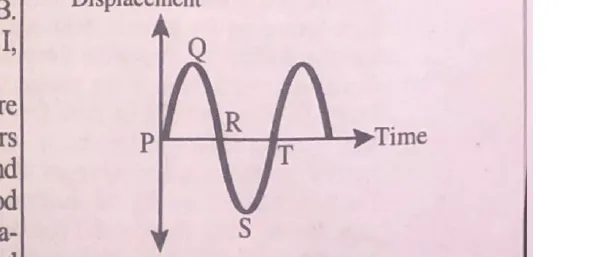
The diagram above illustrates a waveform. Which of the points on the waveform are in phase?

Diagram for question 24
  • A. P and R
  • B. R and T
  • C. P and TCorrect
  • D. Q and S

Explanation

Points that are the same vertical distance from the main line and moving in the same direction are in phase. P and T both lie on the main line moving in the same direction, so they are in phase.

Physics 2013 Objective — Question 25

The equation of a certain progressive transverse wave is y = 2sin2π(t/0.01 − x/30), where x and y are in cm and t in seconds. Calculate the period of the wave.

  • A. 0.001 s
  • B. 0.010 sCorrect
  • C. 10.000 s
  • D. 100.000 s

Explanation

Comparing with the standard form y = Asin2π(t/T − x/λ), the period T = 0.01s.

Physics 2013 Objective — Question 26

At which position should an object be placed in front of a concave mirror in order to obtain an image which is of the same size as the object?

  • A. At the centre of curvatureCorrect
  • B. At the principal focus
  • C. Between the pole and principal focus
  • D. Between the centre of curvature and principal focus

Explanation

When an object is placed at the centre of curvature of a concave mirror, the image formed is also at the centre of curvature, real, inverted, and the same size as the object.

Physics 2013 Objective — Question 27

Images formed by a convex mirror are always

  • A. magnified
  • B. behind the mirrorCorrect
  • C. real
  • D. inverted

Explanation

A convex mirror always forms a virtual, erect and diminished image located behind the mirror, regardless of the object's position.

Physics 2013 Objective — Question 28

The refractive index of a material is 1.5. Calculate the critical angle at the glass-air interface.

  • A. 19.0°
  • B. 21.0°
  • C. 39.0°
  • D. 42.0°Correct

Explanation

sinC = 1/n = 1/1.5 = 0.67. C = sin⁻¹0.67 = 42°.

Physics 2013 Objective — Question 29

A diverging lens of focal length 30cm produces an image 20cm from the lens. Determine the object distance.

  • A. 10 cm
  • B. 12 cm
  • C. 50 cm
  • D. 60 cmCorrect

Explanation

For a diverging lens, f=−30cm, v=−20cm (virtual image). Using 1/f = 1/u + 1/v: −1/30 = 1/u − 1/20; 1/u = 1/30+1/20 = 0.0167; u = 60cm.

Physics 2013 Objective — Question 30

Which of the following statements about the Galilean telescope is not correct?

  • A. The final image is invertedCorrect
  • B. It is shorter than terrestrial telescope
  • C. The final image is erect
  • D. It has a small field of view

Explanation

In a Galilean telescope, the final image is erect and virtual, not inverted — so statement A is the incorrect one.

Physics 2013 Objective — Question 31

Which of the following radiations has its frequency lower than that of infra-red radiation?

  • A. Ultra-violet rays
  • B. Gamma rays
  • C. X-rays
  • D. Radio wavesCorrect

Explanation

In the electromagnetic spectrum, radio waves have the lowest frequency, lower than infra-red.

Physics 2013 Objective — Question 32

A string under tension produces a note of frequency 14 Hz. Determine the frequency when the tension is quadrupled.

  • A. 14 Hz
  • B. 18 Hz
  • C. 28 HzCorrect
  • D. 56 Hz

Explanation

Frequency f ∝ √Tension. If tension is quadrupled (4T), new frequency = √4 × original = 2×14 = 28Hz.

Physics 2013 Objective — Question 33

Which of the following statements about waves in pipes is correct?

  • A. For open pipes, there is only one end correction to be accounted for
  • B. For closed pipes, there are two end corrections to be accounted for
  • C. Only odd harmonics are possible in closed pipesCorrect
  • D. All harmonics are possible in closed pipes

Explanation

Closed pipes (closed at one end) only support odd harmonics (f, 3f, 5f...); open pipes produce all harmonics.

Physics 2013 Objective — Question 34

When a person holds a negatively charged metal rod and stands bare-footed on the ground, how will the charges leak?

  • A. Negative charges flow to ground through the person's bodyCorrect
  • B. Positive charges flow from the ground through his body to neutralize the negative charges
  • C. Positive charges in the air neutralize the negative charges the person is holding
  • D. Negative charges will leak through the air

Explanation

The excess negative charges on the rod/person will flow through the body to the ground, where they can disperse.

Physics 2013 Objective — Question 35

A charge of 2.0×10⁻⁵C experiences a force of 80N in a uniform electric field. Calculate the magnitude of the electric field intensity.

  • A. 8.0×10⁵NC⁻¹
  • B. 4.0×10⁶NC⁻¹Correct
  • C. 4.0×10⁴NC⁻¹
  • D. 2.0×10⁴NC⁻¹

Explanation

E = F/q = 80/(2.0×10⁻⁵) = 4×10⁶ N/C.

Physics 2013 Objective — Question 36

An electric circuit is connected as illustrated above (three 2V cells in parallel, connected to a 2Ω resistor). Determine the equivalent Emf and current flowing through the circuit respectively, neglecting the internal resistance of the cells.

  • A. 2V, 1.0ACorrect
  • B. 2V, 4.0A
  • C. 6V, 0.3A
  • D. 6V, 3.0A

Explanation

Since the three cells are connected in parallel, the equivalent emf equals that of one cell: E = 2V (the potential difference/emf across any number of cells connected in parallel is the same as that across each of them). Current I = V/R = 2/2 = 1.0A.

Physics 2013 Objective — Question 37

A potential difference of 12V is applied across the ends of a 6Ω resistor for 10 minutes. Determine the quantity of heat generated.

  • A. 720 J
  • B. 1200 J
  • C. 14400 JCorrect
  • D. 43200 J

Explanation

Time = 10 minutes = 600s. Quantity of heat generated = (V²/R)×time = (12²/6)×600 = 24×600 = 14,400 J.

Physics 2013 Objective — Question 38

A galvanometer of internal resistance 10Ω has a full scale deflection with a current of 10 mA. Calculate the magnitude of the resistance required to convert it to a voltmeter capable of measuring up to 3V.

  • A. 290 ΩCorrect
  • B. 300 Ω
  • C. 333 Ω
  • D. 1000 Ω

Explanation

Using V = I(Rg+R): 3 = 10×10⁻³×(10+R); 300 = 10+R; R = 290Ω.

Physics 2013 Objective — Question 39

Which of the following instruments is used to determine the accurate value of the electromotive force of a cell?

  • A. Voltmeter
  • B. Meter bridge
  • C. Ammeter
  • D. PotentiometerCorrect

Explanation

A potentiometer is used to determine the accurate (true) emf of a cell, since at balance it draws no current from the cell.

Physics 2013 Objective — Question 40

The direction of motion of a current-carrying conductor placed within the opposite poles of a magnet is determined using

  • A. Fleming's left-hand ruleCorrect
  • B. Fleming's right-hand rule
  • C. Maxwell's corkscrew rule
  • D. Ampere's rule

Explanation

Fleming's left-hand rule: if the thumb, forefinger and middle finger of the left hand are held mutually at right angles, with the forefinger pointing in the direction of the magnetic field and the middle finger in the direction of current, the thumb points in the direction of motion (force).

Physics 2013 Objective — Question 41

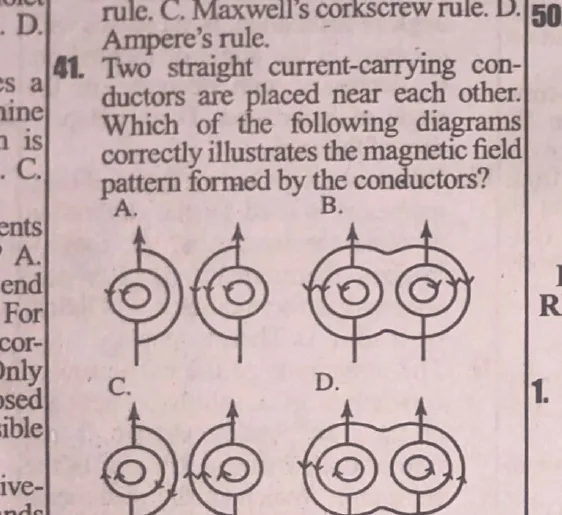
Two straight current-carrying conductors are placed near each other. Which of the following diagrams correctly illustrates the magnetic field pattern formed by the conductors?

Diagram for question 41
  • A. Diagram A
  • B. Diagram B
  • C. Diagram C
  • D. Diagram DCorrect

Explanation

Diagram D correctly shows the magnetic field pattern of two parallel current-carrying conductors, with the fields merging/interacting between the conductors as expected.

Physics 2013 Objective — Question 42

The capacitance of parallel plates capacitors varies

  • A. inversely as the square of the distance between the plates
  • B. directly as the square of the distance between the plates
  • C. inversely as the distance between the platesCorrect
  • D. directly as the distance between the plates

Explanation

Capacitance C = εA/d. As the separation distance d between the plates increases, capacitance decreases — C is inversely proportional to d.

Physics 2013 Objective — Question 43

Which of the following devices works on the principle of electromagnetic induction?

  • A. Carbon microphoneCorrect
  • B. Electric heater
  • C. Moving iron ammeter
  • D. Simple d.c. motor

Explanation

Electromagnetic devices working on the principle of electromagnetic induction include the electric bell, telephone earpiece, magnetic relay, circuit breaker, and carbon microphone.

Physics 2013 Objective — Question 44

Which of the following devices does not make use of eddy current for its action?

  • A. A/An galvanometer
  • B. Speedometer
  • C. Induction furnace
  • D. Induction coilCorrect

Explanation

Applications of eddy current include the induction furnace, the speedometer, the moving-coil galvanometer (damping), the sensitive mass balance, the breaker in large electric motors, and crack detection in railway tracks. (Per the printed answer key, the option identified as not using eddy current is D.)

Physics 2013 Objective — Question 45

A coil of inductance 0.12H and resistance 4Ω, is connected across a 240V, 50Hz supply. Calculate the current through it. [π=3.14]

  • A. 6.3 ACorrect
  • B. 33.3 A
  • C. 37.2 A
  • D. 40.0 A

Explanation

XL = 2πfL = 2×3.14×50×0.12 = 37.68Ω. Impedance Z = √(R²+XL²) = √(4²+37.68²) ≈ 37.9Ω. Current I = V/Z = 240/37.9 = 6.33A ≈ 6.3A.

Physics 2013 Objective — Question 46

The work function of a metal is 2.56×10⁻¹⁹ J. Calculate the frequency of a photon whose energy is required to eject from the metal an electron with kinetic energy of 3.0 eV. [1eV=1.6×10⁻¹⁹ J; h=6.6×10⁻³⁴Js]

  • A. 5.56×10¹⁹ Hz
  • B. 1.66×10¹⁹ Hz
  • C. 1.12×10¹⁵ HzCorrect
  • D. 8.42×10¹⁴ Hz

Explanation

Energy of photon = work function + K.E of electron = 2.56×10⁻¹⁹ + (3.0×1.6×10⁻¹⁹) = 7.36×10⁻¹⁹J. Frequency f = E/h = 7.36×10⁻¹⁹/6.6×10⁻³⁴ = 1.12×10¹⁵Hz.

Physics 2013 Objective — Question 47

The minimum energy required to cause photoelectric emission when the surface of a metal is irradiated with electromagnetic radiation of suitable frequency is called

  • A. critical energy
  • B. ionization energy
  • C. work functionCorrect
  • D. planck's constant

Explanation

The minimum energy needed to liberate/eject an electron from a metal surface is called the work function (distinct from ionization energy, which removes the most loosely bound electron from a gaseous atom).

Physics 2013 Objective — Question 48

Which of the following particles are termed nucleons in a neutral atom?

  • A. Protons and neutronsCorrect
  • B. Neutrons and electrons
  • C. Protons and electrons
  • D. Protons, electrons and neutrons

Explanation

Nucleons are the particles found in the nucleus of an atom — protons and neutrons.

Physics 2013 Objective — Question 49

Which of the following statements about the use of radioisotopes is not correct? They are used to

  • A. induce mutations in plants and animals to obtain new and improved varietiesCorrect
  • B. trace the paths of metabolic processes in plants and animals
  • C. estimate the age of rocks
  • D. locate broken bones

Explanation

The uses of radioisotopes include: radiotherapy; as tracers to check blood circulation, detect leaks in underground pipes, and trace metabolic processes in plants/animals; quality control (measuring paper thickness); tracing cracks in metals or bones; food preservation; and radioactive dating/age estimation. Per the printed answer key, the statement identified as incorrect is option A.

Physics 2013 Objective — Question 50

Which of the following phenomena supports the theory that waves have a particle nature?

  • A. Electron diffraction
  • B. Photoelectric effectCorrect
  • C. Diffraction of light
  • D. X-ray interference

Explanation

The photoelectric effect supports the particle (photon) nature of light/waves.

Advertisement

Sign up free to unlock

  • Score tracking
  • Practice history
  • Saved questions
  • Progress dashboard
  • Personalized sessions
  • Weak-topic breakdown

…and/or go further with premium services and No Ads.