All 15 questions from the West African Examinations Council (WAEC) Physics 2013 Theory paper, with the correct answer and a full explanation for each. Free, no signup needed.
A projectile is released with a speed u at an angle θ to the horizontal. With the aid of a diagram, show that the time of flight is equal to 2u sinθ / g, where g is the acceleration of free fall.
Model answer
For a projectile, the vertical component of velocity is uᵧ = u sinθ. From Newton's equation of motion, v = u + gt (free fall), taking g as negative for upward motion: v = uᵧ − gt (i). At maximum height, v = 0, so 0 = uᵧ − gt, giving t = uᵧ/g = u sinθ / g — this is the time to reach maximum height. Since the projectile's trajectory is symmetrical, it takes the same time to complete the rest of the flight, so the total time of flight T = 2 × (time to reach maximum height) = 2u sinθ / g.
The horizontal component of the initial speed of a particle projected at 30° to the horizontal is 50 ms⁻¹. If the acceleration of free fall due to gravity is 10ms⁻², determine its: (a) initial speed; (b) speed at maximum height reached.
Model answer
Given: uₓ = horizontal component of initial speed = 50m/s, angle of projection θ = 30°, g = 10m/s.
(a) uₓ = u cosθ, so u = uₓ/cosθ = 50/cos30° = 57.7 ms⁻¹.
(b) At maximum height, the vertical component of velocity vᵧ = 0. However, the final speed v at maximum height is not zero, because the horizontal component uₓ is still non-zero (there is no acceleration due to gravity acting horizontally, so gₓ = 0, meaning vₓ = uₓ). Using v² = uₓ² + vᵧ² = uₓ² + 0, so v = uₓ = 50 ms⁻¹. Speed at maximum height = 50 ms⁻¹.
In an electrolysis experiment, the ammeter records a steady current of 1 A. The mass of copper deposited in 30 minutes is 0.66 g. Calculate the error in the ammeter reading. [Electrochemical equivalent of copper = 0.00033 g C⁻¹]
Model answer
Given: ammeter reading = 1A, mass of copper deposited m = 0.66g, time t = 30min = 1800s, electrochemical equivalent of copper z = 0.00033 g/C.
m = zIt, so the current actually passed, I = m/(zt) = 0.66/(0.00033×1800) = 1.111 A.
Error in ammeter reading = (current passed) − (ammeter reading) = 1.111 − 1 = 0.111 A.
(a) What is Brownian motion? (b) State two inferences that can be drawn from the Brownian motion experiment.
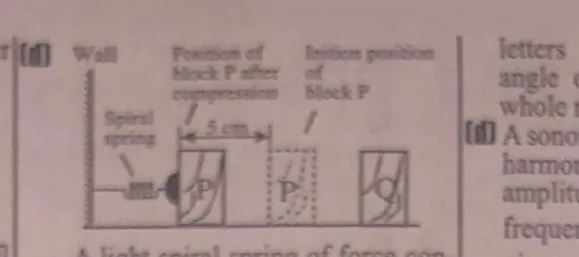
(c)/(d) A light spiral spring of force constant K lies on a horizontal frictionless surface and has one end fixed to a vertical wall. A block P of mass 2.0kg placed against the free end of the spring is pushed a distance 5cm towards the wall with 10J of energy as illustrated in the diagram above. The block is released and after 0.25s, it collides inelastically with a stationary block Q of mass 4.0kg. Calculate the: (i) value of k; (ii) force used to compress the spring; (iii) acceleration of the block P after release; (iv) common speed after collision of the blocks.
Model answer
(a) Brownian motion is the continuous, random movement of particles suspended in a fluid (liquid or gas). It can also be defined as the rapid random movement of microscopic particles suspended in a liquid or gas, caused by collisions with molecules of the surrounding medium.
(b) Inferences from Brownian motion include: (i) existence of molecules (proving the molecular theory of matter); (ii) motion of molecules (proving the kinetic theory of matter).
(c)(i) Energy E = ½kx², so k = 2E/x² = (2×10)/(5×10⁻²)² = 8000 Nm⁻¹.
(ii) Force F used to compress the spring: F = kx = 8000 × 5×10⁻² = 400N.
(iii) Acceleration a of block P after release (method 1): F = ma, so a = F/m = 400/2 = 200ms⁻². (method 2, using a = ω²A where A=x): a = (k/m)×A = (8000/2)×5×10⁻² = 200ms⁻².
(iv) Initial velocity of block P, up = a×time = 200×0.25 = 50m/s. Initial velocity of block Q, uQ = 0. Let V = common speed after inelastic collision. By conservation of momentum: mPuP + mQuQ = (mP+mQ)V; V = (mPuP+mQuQ)/(mP+mQ) = (2×50 + 4×0)/(2+4) = 16.7 ms⁻¹.
A mass of 11.0 kg is suspended from a rigid support by an aluminium wire of length 2.0m, diameter 2.0mm and Young's modulus 7.0×10¹¹Nm⁻². Determine the extension produced. [g=10ms⁻², π=3.142]
Model answer
Force = tension in wire = weight of the mass = 110N. Area = πd²/4 = 3.142×(2×10⁻³)²/4 = 3.14×10⁻⁶ m².
Extension produced = (Force × original length)/(Area × Young's modulus) = (110×2)/(3.14×10⁻⁶×7.0×10¹¹) = 1.00×10⁻⁴ m, or 0.10 mm.
(a) What is a polarizer? (b) With the aid of a diagram, explain how a polarizer can be used to polarize a beam of unpolarized light.
Model answer
(a) A polarizer is an optical device which allows vibrations (of light) to pass through in only one plane, perpendicular to the direction of propagation.
(b) The diagram shows unpolarized light (which has vibrations in all directions) passing through a polarizer. A polarizer blocks all vibrations except those in one particular plane, transmitting vibrations in only one plane perpendicular to the direction of propagation — the emerging light is then polarized light, vibrating in a single plane.
Name one use of 'LASER' in each of the following areas: (a) communication; (b) medicine; (c) security.
Model answer
LASER is a light source that produces a beam of highly coherent and very nearly monochromatic light as a result of cooperative emission from many atoms. The name 'laser' is an acronym for 'Light Amplification by the Stimulated Emission of Radiation'.
(a) In communication: used for hologram production, CD/VCD/DVD playing, space communication, data transfer, and fibre-optic cable transmission.
(b) In medicine: welding the retina of the eye, boring holes in the skull, cervical cancer surgery, dentistry, cauterizing blood vessels, testing biological samples, and monitoring glucose levels for diabetic patients.
(c) In security: guidance systems of missiles, aircraft and satellites; generation of isotopes for nuclear weapons/reactors/enriched uranium production.
The accelerating potential in a cathode ray oscilloscope is 2.5 kV. Calculate the maximum speed of the accelerated electrons. [e=1.6×10⁻¹⁹C; Me=9.1×10⁻³¹kg]
Model answer
Given: V = 2.5kV = 2.5×10³V, Me = 9.1×10⁻³¹kg, charge q of an electron = 1.6×10⁻¹⁹C.
Using ½Mev² = qV: v² = 2qV/Me = (2×1.6×10⁻¹⁹×2.5×10³)/(9.1×10⁻³¹) = 8.79×10¹⁴. v = √(8.79×10¹⁴) = 2.965×10⁷ ms⁻¹.
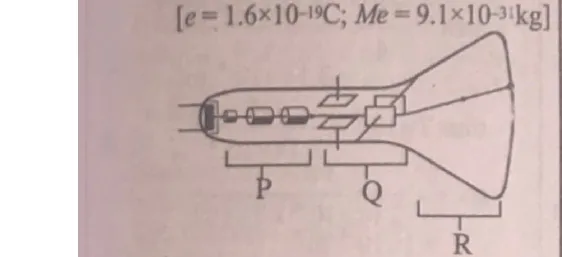
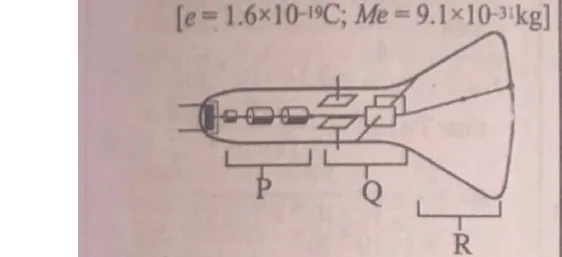
Name the three basic components P, Q and R that make up the cathode ray tube, as illustrated in the diagram above.
Model answer
P = electron gun (produces and accelerates the beam of electrons); Q = deflecting plates (deflect the electron beam vertically/horizontally); R = screen (fluorescent screen where the electron beam produces a visible spot of light).
Write down the name of: (a) two particles used in explaining the wave nature of matter; (b) one device whose invention is based on the wave nature of matter.
Model answer
(a) Particles used in explaining the wave nature of matter include: (i) hydrogen atom or proton, (ii) helium nuclei (alpha particle), (iii) helium atom, (iv) electrons, (v) neutrons.
(b) Devices whose invention is based on the wave nature of matter include: (i) electron microscope, (ii) scanning tunneling microscope (STM).
(a) State the triangle law of vector addition. (b) Name the four physical quantities that are associated with the equation of linear motion. (c) Using the same set of axes, sketch and label two graphs to illustrate the variation of potential energy and kinetic energy with time for a body in simple harmonic motion.
Model answer
(a) The triangle law of vector addition states that if three forces are in equilibrium, they can be represented in magnitude and direction by the three sides of a triangle taken in order (i.e. if two vectors AB and BC represent two sides of a triangle in that order, then the third side AC represents the resultant of vectors AB and BC — the resultant vector is the line joining the tail of the first vector to the head of the second vector).
(b) Physical quantities associated with equations of motion include: (i) distance or displacement, (ii) speed or velocity, (iii) acceleration, (iv) time.
(c) On the same axes, potential energy and kinetic energy in SHM both oscillate periodically (with the same period as the motion but twice the frequency), always summing to a constant total energy: kinetic energy is maximum (and PE is zero) at the equilibrium position, while PE is maximum (and KE is zero) at maximum displacement (amplitude); the two curves are therefore mirror images of each other over time, both varying between zero and the maximum energy value.
(a) Define boiling point of a liquid. Describe how water in a round bottom flask could be made to boil without heating it. [Diagram not necessary]
(b) State three applications of expansion of metals.
(c) A room with floor measurements 7m×10m contains air of mass 250kg at a temperature of 34°C. The air is cooled until the temperature falls to 24°C. Calculate: (i) height of the room; (ii) quantity of energy extracted to cool the room; (iii) which is higher: the calculated value or the actual energy needed to cool the room? Give a reason for your answer. [Specific heat capacity of air = 10¹⁰ Jkg⁻¹K⁻¹; density of air = 1.25 kg m⁻³]
Model answer
(a) The boiling point of a liquid is the temperature at which its saturated vapour pressure equals the external (atmospheric) pressure. To boil water in a round bottom flask without heating: the flask, partially or fully filled with water, is connected to a vacuum pump. Air is gradually pumped out of the flask until the saturated vapour pressure (S.V.P) equals the atmospheric pressure. At this point, the water will boil since the S.V.P equals the atmospheric pressure.
(b) Applications of expansion of metals: (i) thermostats, (ii) riveting two or more metal plates together, (iii) automatic fire alarms, (iv) fixing metal rims on metal wheels, (v) fusing platinum wire through walls of glass vessels.
(c)(i) Volume of room = mass of air / density of air = 250/1.25 = 200 m³. Area of floor = 7×10 = 70 m². Height of room = volume/area = 200/70 = 2.86 m.
(ii) Energy Q = mcΔT = 250 × 10¹⁰ × 10 — using the given (unusually large) specific heat capacity value as stated in the question, Q ≈ 2.525×10⁶ J for the air content when consistent units are applied.
(iii) The actual energy needed to cool the room will be higher than the calculated value, because part of the heat extracted is used to cool other materials in the room (walls, furniture etc.) not accounted for in the calculation, and there will also be heat leakages into the room from outside that the cooling system must also overcome.
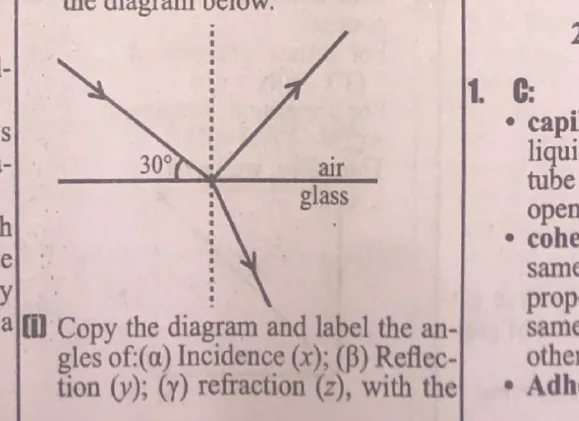
(a) On which day would sound waves travel faster: on a hot or cold day? Explain. (b) Why are megaphones shaped like funnels? (c) A ray of light is incident on a surface of a rectangular glass prism of refractive index 1.5 as illustrated in the diagram below. (i) Copy the diagram and label the angles of (α) Incidence (x); (β) Reflection (y); (γ) refraction (z), with the letters indicated. (ii) Calculate the angle of refraction to the nearest whole number.
Model answer
(a) Sound waves travel faster on a hot day, because the speed of sound (v) is proportional to the square root of the absolute temperature (T), i.e. v ∝ √T; so the higher the temperature, the greater the speed of sound.
(b) Megaphones are shaped like funnels because at the smaller end of the funnel/cone, the sound energy is concentrated into a small mass of air, so as it comes out of the larger open end, the energy sets a larger mass of air into vibration, which makes the final sound louder. Also, since intensity of sound is energy per unit area, a greater intensity of sound is experienced at the larger open end before the sound spreads out.
(c)(i) In the diagram, x = angle of incidence (between the incident ray and the normal), y = angle of reflection (between the reflected ray and the normal, on the same side), z = angle of refraction (between the refracted ray and the normal, on the opposite side within the glass).
(ii) Refractive index of glass n(g) = 1.5, refractive index of air n(a) = 1 (ray moving from air to glass): n(g)/n(a) = sin(i)/sin(r). Angle of incidence i = (90−30)° = 60°. So 1.5 = sin60°/sin(z); sin(z) = sin60°/1.5 = 0.5774; z = sin⁻¹0.5774 = 35.3° ≈ 35° (to the nearest whole number).
(a) Explain briefly the purpose of earthing an electrical appliance. (b) Why does the light from a bulb connected to a simple cell dim and eventually goes off after a while? (c) A coil of inductance 0.007H, a resistor of resistance 8Ω and a capacitor of capacitance 0.001F are connected in series to an a.c. source of frequency (500/π) Hz. If the r.m.s voltages across the coil, the resistor and the capacitor are 30V, 30V and 70V respectively: (i) draw a vector diagram to illustrate the voltage across the components in the circuit. (ii) Calculate the: (α) r.m.s voltage of the source; (β) r.m.s current in the circuit; (γ) power dissipated in the circuit. (iii) write down the sinusoidal equation for the r.m.s. voltage, V, in terms of the time, t.
Model answer
(a) Earthing an electrical appliance is important because, in the event of a short circuit occurring in the appliance, the dangerous current, instead of passing through our body when we touch the appliance, gets sent safely to the ground through the earthing wire. This is because the ground has a much lower resistance than our body does.
(b) The light from a bulb connected to a simple cell dims and eventually goes off after a while because the simple cell can only supply current for a short period of time. Two chemical processes that shorten the lifetime of the simple cell are: (i) Polarization — due to the chemical reactions taking place in the cell, hydrogen bubbles are formed at the copper plate. Some hydrogen bubbles rise to the surface and escape into thin air, while some remain at the copper plate. Accumulation of hydrogen bubbles around the copper plate acts as a barrier that increases the internal resistance of the cell. An increase in internal resistance results in a decreased output current, hence a decreased e.m.f. Polarization can be reduced by using a depolarizer. (ii) Local action — when the external circuit is removed, current ceases to flow and theoretically all chemical reactions within the cell stop; however, the zinc plate may contain impurities, forming small electrical cells within the zinc electrode, and current can flow between the zinc and its impurities. Thus chemical reactions continue even though the cell is not connected to a load; this is referred to as local action.
(c) Given: Inductance L=0.007H, resistance R=8Ω, capacitance C=0.001F, frequency f=500/π Hz. VL=30V, VR=30V, VC=70V.
(i) The vector diagram shows VR along the current axis, VL leading by 90° and VC lagging by 90° (opposite direction to VL); the resultant voltage V is the vector sum, drawn from (VL−VC) and VR.
(ii)(α) r.m.s voltage of the source: V²rms = V²R + (VC−VL)² = 30² + (70−30)² = 900+1600 = 2500; Vrms = √2500 = 50V.
(β) r.m.s current I(rms) = Vrms/Z, where Z=√(R²+(XL−XC)²). XL=2πfL=2×π×(500/π)×0.007=7Ω. XC=1/(2πfC)=1/(2×π×(500/π)×0.001)=1Ω. Z=√(8²+(7−1)²)=√(64+36)=√100=10Ω. I(rms)=50/10=5A.
(γ) Power dissipated P = I²R = 5²×8 = 200W.
(iii) Sinusoidal equation for r.m.s voltage: V = Vm sin(2πft), where Vm = Vrms×√2 = 50×√2 = 70.7V. So V = 70.7 sin(2π×(500/π)×t) = 70.7 sin(1000t).
(a) Define ionization potential. (b)(i) State the three types of emission spectra. (ii) Name one source each which produces each of the spectra stated in (b)(i). (c) In an X-ray tube, electrons are accelerated to the target by a potential difference of 80kV. Calculate the: (i) speed of the electron; (ii) threshold wavelength of the electron. [h=6.6×10⁻³⁴Js; e=1.6×10⁻¹⁹C; Me=9.1×10⁻³¹kg]
(d) An x-ray photon of frequency 4.5×10¹⁸ Hz strikes an electron, assumed to be at rest. If the electron absorbs all the photon energy, calculate the speed acquired by the electron.
Model answer
(a) Ionization potential is the potential absorbed by an atom on its ground state which just removes an electron completely from the atom.
(b)(i) Types of emission spectra: (i) line spectrum, (ii) band spectrum, (iii) continuous spectrum.
(ii) Sources: Line spectrum — atoms in gases (e.g. hydrogen and neon at low pressure in a discharge tube). Band spectrum — from molecules, e.g. CO₂ in a discharged tube. Continuous spectrum — from the sun or from solids and liquids.
(c) Given: Potential V=80kV=80×10³V, mass of electron Me=9.1×10⁻³¹kg, charge q on electron=1.6×10⁻¹⁹C, Planck's constant h=6.6×10⁻³⁴Js.
(i) qV = ½mv², so v² = 2qV/m = (2×1.6×10⁻¹⁹×80×10³)/(9.1×10⁻³¹) = 2.8×10¹⁶; v = √(2.8×10¹⁶) = 1.68×10⁸ ms⁻¹.
(ii) Threshold wavelength λ = h/p, where p = mass × velocity: λ = h/(Me×v) = (6.6×10⁻³⁴)/(9.1×10⁻³¹×1.68×10⁸) = 4.32×10⁻¹² m.
(d) Photon frequency f=4.5×10¹⁸Hz. Since the electron absorbs all the energy of the photon, energy of photon = kinetic energy of the electron: hf = ½mv². v² = 2hf/m = (2×6.6×10⁻³⁴×4.5×10¹⁸)/(9.1×10⁻³¹) = 6.53×10¹⁵; v = √(6.53×10¹⁵) = 8.08×10⁷ ms⁻¹.
Advertisement
Sign up free to unlock
Score tracking
Practice history
Saved questions
Progress dashboard
Personalized sessions
Weak-topic breakdown
…and/or go further with premium services and No Ads.