WAEC Physics 2013 Theory — Question 4
Question 4 of 15 from the West African Examinations Council (WAEC) Physics 2013 Theory paper, with the correct answer and a full explanation.
Advertisement
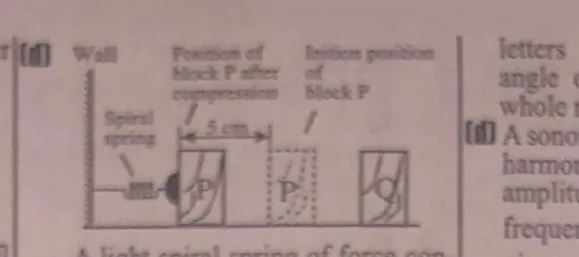
(a) What is Brownian motion? (b) State two inferences that can be drawn from the Brownian motion experiment. (c)/(d) A light spiral spring of force constant K lies on a horizontal frictionless surface and has one end fixed to a vertical wall. A block P of mass 2.0kg placed against the free end of the spring is pushed a distance 5cm towards the wall with 10J of energy as illustrated in the diagram above. The block is released and after 0.25s, it collides inelastically with a stationary block Q of mass 4.0kg. Calculate the: (i) value of k; (ii) force used to compress the spring; (iii) acceleration of the block P after release; (iv) common speed after collision of the blocks.
Model answer
(a) Brownian motion is the continuous, random movement of particles suspended in a fluid (liquid or gas). It can also be defined as the rapid random movement of microscopic particles suspended in a liquid or gas, caused by collisions with molecules of the surrounding medium. (b) Inferences from Brownian motion include: (i) existence of molecules (proving the molecular theory of matter); (ii) motion of molecules (proving the kinetic theory of matter). (c)(i) Energy E = ½kx², so k = 2E/x² = (2×10)/(5×10⁻²)² = 8000 Nm⁻¹. (ii) Force F used to compress the spring: F = kx = 8000 × 5×10⁻² = 400N. (iii) Acceleration a of block P after release (method 1): F = ma, so a = F/m = 400/2 = 200ms⁻². (method 2, using a = ω²A where A=x): a = (k/m)×A = (8000/2)×5×10⁻² = 200ms⁻². (iv) Initial velocity of block P, up = a×time = 200×0.25 = 50m/s. Initial velocity of block Q, uQ = 0. Let V = common speed after inelastic collision. By conservation of momentum: mPuP + mQuQ = (mP+mQ)V; V = (mPuP+mQuQ)/(mP+mQ) = (2×50 + 4×0)/(2+4) = 16.7 ms⁻¹.
Advertisement
Sign up free to unlock
- Score tracking
- Practice history
- Saved questions
- Progress dashboard
- Personalized sessions
- Weak-topic breakdown
…and/or go further with premium services and No Ads.