All 12 questions from the West African Examinations Council (WAEC) Physics 2016 Theory paper, with the correct answer and a full explanation for each. Free, no signup needed.
A projectile is fired with a velocity of 20ms⁻¹ at an angle of 40° to the horizontal. Determine the components of the velocity of the projectile at its maximum height.
Model answer
At maximum height, the vertical component of velocity, vy = 0.
The horizontal component remains unchanged: vx = u cos40° = 20 × cos40° = 20 × 0.766 = 15.32 ms⁻¹
So at maximum height: horizontal component = 15.32 ms⁻¹, vertical component = 0 ms⁻¹.
State three different materials that can be used to demonstrate Brownian motion.
Model answer
Materials that can be used to demonstrate Brownian motion include:
• Smoke particles (due to bombardment by air molecules)
• Pollen grains (due to their bombardment by water molecules)
• Dust particles
• Carbon particles
• Potassium permanganate crystals
(Any three of the above are acceptable.)
An electron enters perpendicularly into a uniform magnetic field which has a flux density of 0.12T. This results in a magnetic force of 9.6×10⁻¹²N on the electron. Calculate the speed of the electron as it enters the magnetic field. (e=1.6×10⁻¹⁹ C)
Model answer
F = evB sinθ, θ=90° (perpendicular entry)
F = evB
v = F/(eB)
v = 9.6×10⁻¹² / (1.6×10⁻¹⁹ × 0.12)
v = 9.6×10⁻¹² / (1.92×10⁻²⁰)
v = 5×10⁸ ms⁻¹
Rockets are used for:
(i) Fireworks
(ii) Weaponry (as missiles)
(iii) Ejection seats
(iv) Launch vehicles for artificial satellites
(v) Human spaceflight
(vi) Space exploration
(Any three of the above are acceptable.)
6(a) What is doping?
(b) Explain how doping improves the conductivity of a semiconductor.
Model answer
(a) Doping is the process of adding small amounts of suitable impurities to an intrinsic semiconductor. An intrinsic semiconductor is a pure semiconductor. Impurities can either be donors or acceptors and they increase the conductivity of a pure semiconductor.
(b) When a pure semiconductor is doped, the relative number of charge carriers (electrons or holes) within the semiconductor increases, and this affects and increases the conductivity of the semiconductor.
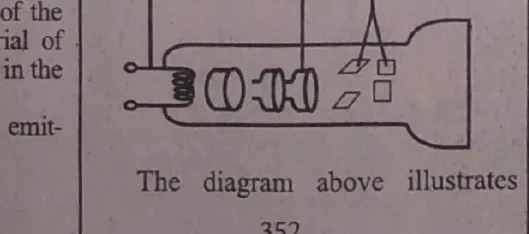
The diagram above illustrates a components X, Y and Z. Identify the components X, Y, and Z and state their function.
Model answer
From the diagram of the cathode ray tube:
X = Heat supply/filament — Heat supply to the cathode to release electrons (thermionic emission)
Y = Anode — Accelerates electrons to high velocity
Z = Deflecting plates — Y-plate deflects the electron beam vertically; X-plate deflects the electron beam horizontally
Other components and functions:
1. Heat supply (filament): Heat the cathode to release the electrons
2. Cathode: Produce electrons on heating
3. Grid: Control the amount of electrons reaching the screen
4. Anode: Accelerates electrons to high velocity
5. Y-plate: Deflect electron beam vertically
6. X-plate: Deflect electron beam horizontally
7. Fluorescent screen: Glows when struck by electrons to produce bright spot on screen
PART II (FOR ALL CANDIDATES)
8(a) Explain the term net force.
(b) Define the principle of conservation of linear momentum and state one example of it.
(c) A ball of mass 200 g released from a height of 2.0m hits a horizontal floor and rebounds to a height of 1.8m. Calculate the impulse received by the floor. (g=10 ms⁻²).
(d) A body of mass 20 g performs a simple harmonic motion at a frequency of 5 Hz. At a distance of 10 cm from the mean position, its velocity is 200 cms⁻¹. Calculate its: (i) maximum displacement from the mean position; (ii) maximum velocity; (iii) maximum potential energy. (g=10 ms⁻², π=3.14)
Model answer
(a) The net force is the sum of all forces acting on an object. It is the vector sum of all forces which are acting on any object. When two or more forces are acting on a particle, the net force comes into account. When the forces acting on an object are balanced, the net force is zero and the object will move with uniform velocity, i.e. zero acceleration.
(b) The principle of conservation of linear momentum states that in any system of colliding objects, the total momentum of the system before collision is equal to the total momentum of the system after collision, provided there is no net external force acting on the system.
Examples: (i) Collision of two bodies (ii) firing of a gun
(c) 200g=0.2kg
Velocity at which ball hits ground: v²=u²+2gs = 0+2×10×2 → v=√40=6.32 ms⁻¹ (downward)
Velocity of rebound: v²=u²-2gs (rising 1.8m) → v=√(2×10×1.8)=√36=6 ms⁻¹ (upward, opposite direction)
Impulse = m(vf-vi) = 0.2×(-6-6.32) = 0.2×(-12.32) = -2.464 kg m/s
The impulse received by the floor is 2.464 kg·m/s (the negative sign shows the change in momentum is directed upward, i.e. opposite to the initial motion).
(d)(i) v=ω√(A²-x²); v=200cm/s=2m/s, x=10cm=0.1m
ω=2×3.14×5=31.4 rad/s⁻¹
2=31.4√(A²-0.1²)
A²-0.1²=(2/31.4)²=0.00405≈0.0046
A²=0.01+0.0046=0.0146
A=√0.0146=0.121m
(ii) Maximum velocity, from V=ω√(A²-x²), Vmax occurs when x=0:
Vmax=ωA=31.4×0.121=3.8 m/s
(iii) Maximum potential energy = Total energy = ½kA² = ½ω²mA² (since w²=k/m, k=w²m)
= ½×(31.4)²×0.02×(0.121)²
= 0.142 J
9(a) Explain the terms: (i) thermal equilibrium; (ii) fundamental interval.
(b) List two uses of the hydraulic press.
(c) Name the material used to reset the steel index on the Six's maximum and minimum thermometer.
(d)(i) A nursing mother prepared her baby's milk mixture at 85°C, in a feeding bottle. In order to cool it to 40°C, she immersed the bottle in an aluminium bowl of heat capacity 90 JK⁻¹ containing 500g of water at 26°C. If the mass of the mixture is 300g, calculate the specific heat capacity of the mixture. [Neglect heat losses and heat capacity of the bottle; specific heat capacity of water 4200 Jkg⁻¹ K⁻¹]
(ii)(a) Name two ways through which the bottle loses heat.
(b) Name two industrial processes in which heat exchangers are used.
Model answer
(a)(i) Thermal Equilibrium: When two bodies of different temperature are in contact, a point is reached where the two bodies attain the same temperature due to equal heat exchange. At this point, we say the bodies have attained thermal equilibrium.
(ii) Fundamental interval: This is the distance between the upper fixed point and the lower fixed point. Each thermometer has 2 reference temperatures (fixed points) which are: (i) The upper fixed point which is the temperature of steam from pure water boiling at standard atmospheric pressure of 760mmHg. (ii) The lower fixed point which is the temperature of pure melting ice at the standard atmospheric pressure of 760mmHg. On a Celsius scale it is 100°F(C) and 180°F on a Fahrenheit scale.
(b) The hydraulic press is an application of the transmission of pressure in fluids. It consists of two interconnected cylinders of different cross-sectional areas. A small effort applied to the small piston results in a much greater force on the large piston, since pressure is transmitted equally throughout the liquid (Pascal's principle).
Uses: (i) Barbers' chairs (ii) Hydraulic brakes / vehicle lifts and jacks
(c) In the Six's thermometer, the indexes made of steel have light springs that hold them in position in the stem, and these can be reset with a magnet brought into contact with the mercury.
(d)(i) Heat gained by mixture, q = m꜀C꜀ΔT꜀, where m꜀=0.3kg (mass of mixture), C꜀=specific heat capacity of mixture(unknown), ΔT꜀=(85-40)=45°C
q = 0.3×C꜀×45 = 13.5C꜀
Heat gained by aluminium bowl = mᵦCᵦΔTᵦ; heat capacity of bowl = mᵦCᵦ = 90 JK⁻¹, ΔTᵦ=(40-26)=14°C
Heat gained by bowl = 90×14 = 1,260 J
Heat gained by water: mw=0.5kg, Cw=4200 Jkg⁻¹K⁻¹, ΔTw=(40-26)=14°C
Heat gained by water = 0.5×4200×14 = 29,400 J
Heat lost by mixture = heat gained by bowl + heat gained by water
13.5C꜀ = 1,260+29,400 = 30,660
C꜀ = 30,660/13.5 = 2,271.1 Jkg⁻¹K⁻¹
(ii)(a) Two ways the bottle loses heat: (i) Conduction (ii) Convection
(b) Two industrial processes where heat exchangers are used: (i) Air-conditioning/Refrigeration (ii) Space heating/Natural gas processing
10(a) Define critical angle.
(b) How are anti-nodes created in a stationary wave?
(c) The angle of minimum deviation of an equilateral triangular glass prism is 46.2°. Calculate the refractive index of the glass.
(d) An illuminated object is placed in front of a concave mirror and the position of a screen is adjusted in front of the mirror but no image is obtained on the screen. Give two possible reasons for this observation.
(e) An illuminated object is placed at a distance of 75 cm from a converging lens of focal length 30 cm. (i) Determine the image distance. (ii) Replacing the lens by another converging lens. Since the object moved 25 cm further away, it has its sharp image on the screen. Determine the focal length of the second lens.
Model answer
(a) The critical angle is defined as an angle of incidence where the angle of refraction is 90°. This usually happens when light travels from a denser medium to a less dense medium.
(b) Antinodes are created in a stationary wave as a result of the superposition of the reflected waves. It is a result of the interference between two waves traveling in the opposite direction.
(c) Given: Angle of minimum deviation Dm=46.2°, required refractive index n=?
n = sin((Dm+A)/2) / sin(A/2)
For an equilateral triangle, A=60°
n = sin((46.2+60)/2) / sin(60/2) = sin(53.1°)/sin(30°) = 0.7997/0.5 = 1.5993 ≈ 1.6
(d) Possible reasons:
(i) The concave mirror and the screen may not be coaxially placed.
(ii) The illuminated object might be placed at a distance less than the focal length of the mirror (making the image virtual, formed behind the mirror, so it cannot appear on the screen).
(e)(i) Given: f=30cm, u=75cm, find v.
1/f = 1/u + 1/v
1/30 = 1/75 + 1/v
1/v = 1/30 - 1/75 = (5-2)/150 = 3/150
v = 150/3 = 50 cm
(ii) The object moved 25cm further away, so new u = 75+25 = 100cm, while v remains 50cm.
1/f = 1/u + 1/v = 1/100 + 1/50 = 1/100 + 2/100 = 3/100
f = 100/3 = 33.33 cm
11(a) Define dielectric strength.
(b)(i) An electromagnetic wave has a wavelength shorter than those of radio wave and microwave but longer than that of visible light. Identify the wave. (ii) Name one suitable detector for the wave. (iii) Name one source of the wave.
(c) An oil drop carrying a charge of 1.0×10⁻¹⁹C is found to remain at rest in a uniform electric field of intensity 1,200 NC⁻¹. Calculate the weight of the oil drop.
(d) An RLC series circuit consists of a 100 Ω resistor, 0.05 H inductor and a 25 μF capacitor. A 220 V, 50 Hz mains voltage is applied across the circuit. Calculate the: (i) impedance; (ii) current. (Take π=3.14)
Model answer
(a) Dielectric strength is defined as the maximum voltage that can be applied to a given material without causing it to breakdown. It is the material property that determines the electrical insulation quality of a material. It is measured in volt per metre (Vm⁻¹).
(b)(i) The wave is Infrared wave (its wavelength is shorter than radio and microwaves but longer than visible light).
(ii) Detector: Thermopile / Bolometer / Pneumatic detector / Golay cell / pyroelectric detector
(iii) Source: Human body / Light bulb / Sun
(c) At equilibrium, the electric force balances the weight:
F = W (=mg)
E = F/q → F = E×q = 1200 × 1.0×10⁻¹⁹ = 1.2×10⁻¹⁶N
The weight of the oil drop = 1.2×10⁻¹⁶N
(d) Given R=100Ω, L=0.05H, C=25μF, V=220V, f=50Hz
Impedance Z=√(R²+(XL-XC)²)
XL=2πfL=2π×50×0.05=5π=15.7Ω
XC=1/(2πfC)=1/(2×3.14×50×25×10⁻⁶)=10⁶/7855=127.3Ω
Z=√(100²+(15.7-127.3)²)=√(100²+(-111.6)²)=√(10000+12454.56)=√22454.56=149.85Ω
(ii) Current I=V/Z=220/149.85=1.47A
12(a) Explain the following terms: (i) mass defect; (ii) binding energy of a nucleus; (iii) Assuming the wave nature of an electron, what is the effect of decreasing the speed of a photoelectron on its: (a) wavelength? (b) energy?
(b) A particle of mass 4.4×10⁻²³ kg moves with a velocity of 10⁵ ms⁻¹. Calculate its wavelength. (h=6.6×10⁻³⁴Js)
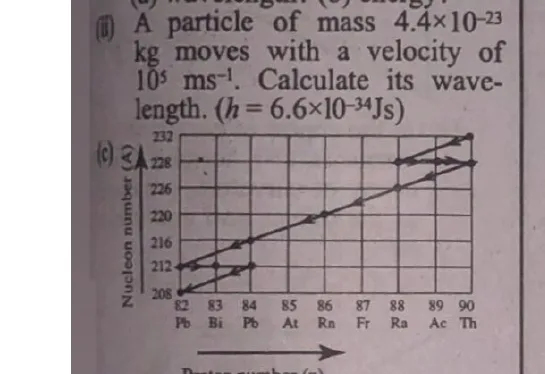
(c) The diagram above shows part of a radioactive series. Use it to answer the following questions. (i) Name a pair of isotopes. (ii) Name the isotopes with which the series starts. (iii) Write down a nuclear equation for two examples of each of: (a) alpha decay; (b) beta decay.
Model answer
(a)(i) Mass defect (Δm) of a nucleus is the difference between the mass of the atom and the sum of the masses of its constituent parts, i.e. the nucleons of which it is composed.
Δm = (Sum of mass of nucleons) - (Mass of nucleus)
(ii) Binding energy: Binding energy is applicable to subatomic particles in atomic nuclei. It is therefore the minimum energy required to separate the nucleus of an atom into its component parts (neutrons and protons).
(iii) Effect of decreasing speed of photoelectron on:
(a) wavelength ⇒ Wavelength increases, as can be seen from the relation λ=h/mv
(β) Energy ⇒ decreases
(b) Given m=4.4×10⁻²³kg, v=10⁵ms⁻¹, h=6.6×10⁻³⁴Js
λ = h/(mv) = 6.6×10⁻³⁴/(4.4×10⁻²³×10⁵) = 1.5×10⁻¹⁶ m
(c)(i) Pair of isotopes (same proton number, different nucleon number):
²³²₉₀Th and ²²⁸₉₀Th OR ²²⁴₈₈Ra and ²²⁸₈₈Ra OR ²¹²₈₄Po and ²¹⁶₈₄Po OR ²¹²₈₂Pb and ²⁰⁸₈₂Pb
(ii) Isotopes with which the series starts: ²³²₉₀Th and ²²⁸₉₀Th
(iii)(a) Alpha decay examples:
²³²₉₀Th → ²²⁸₈₈Ra + ⁴₂He + energy
²¹⁶₈₄Po → ²¹²₈₂Pb + ⁴₂He + energy
(b) Beta decay examples:
²²⁸₈₈Ra → ²²⁸₈₉Ac + ⁰₋₁e + energy
²¹²₈₂Pb → ²¹²₈₃Bi + ⁰₋₁e + energy
Advertisement
Sign up free to unlock
Score tracking
Practice history
Saved questions
Progress dashboard
Personalized sessions
Weak-topic breakdown
…and/or go further with premium services and No Ads.