All 33 questions from the West African Examinations Council (WAEC) Physics 2017 Theory paper, with the correct answer and a full explanation for each. Free, no signup needed.
A particle is dropped from a vertical height h and falls freely for a time t. With the aid of a sketch, explain how h varies with t².
Model answer
If a particle is dropped from a vertical height h and falls freely for a time t, the height h increases linearly with t² (since h=1/2 g t², a straight-line graph through the origin when h is plotted against t²).
A particle is projected horizontally at 15ms^-1 from a height of 20m. Calculate the horizontal distance covered by the particle just before hitting the ground. [g=10ms^-2]
Model answer
H=ut(vertical)+1/2gt²; since initial vertical velocity=0: H=1/2gt². 20=1/2x10xt² → t²=4 → t=2s. Horizontal distance R = u_x x t = 15x2 = 30m.
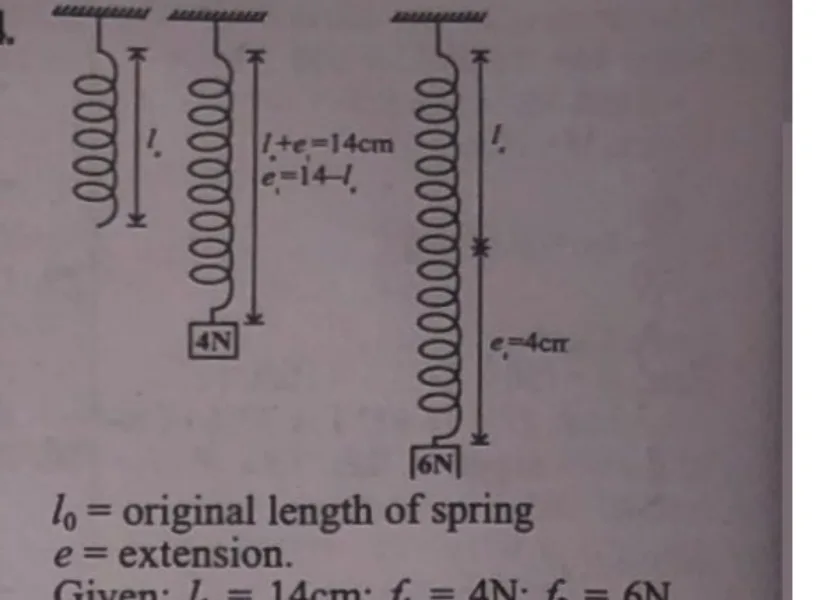
A spiral has a length of 14cm when a force of 4N is hung on it. A force of 6N extends the springs by 4cm. Calculate the unstretched length of the spring.
Model answer
l0 = original length of spring, e = extension. Given: l0+e1=14cm, e1=14-l0; and second case e2=4cm with f1=4N, f2=6N. Since f=ke, k=f/e = constant: f1/e1=f2/e2 → 4/(14-l0)=6/4. Solving: 4x4=6x(14-l0) → 16=84-6l0 → 6l0=84-16=68 → l0=68/6=11.33cm.
5(b) How can mosquito larvae be made to sink in stagnant water?
Model answer
A mosquito larva can be made to sink in stagnant water by reducing the surface tension of the stagnant water. This can be done by: (i) adding impurities e.g. soap, oil, alcohol, detergent, camphor etc. (ii) heating the liquid or increasing the temperature of the liquid.
6. List three advantages of fluorescent tubes over filament bulbs
Model answer
Advantages of fluorescent tubes over filament tubes include: (i) energy efficiency: they consume less electrical energy (ii) long life span of tubes (iii) less heat is produced or less heat emission (iv) better light diffusion and distribution.
7. List three advantages of p-n junction diode over diode valve
Model answer
Advantages of p-n junction diode over diode valve: (i) Smaller size (ii) Lower operating voltage (iii) Lighter weight (iv) Higher efficiency (v) Lower power dissipation (vi) Instant on (i.e. no heater warm-up time) (any three).
8(b) If the distance between two equal masses is doubled and their individual masses are also doubled, what would happen to the force between them? Support your answer quantitatively.
Model answer
From F=Gm1m2/r². At first instance: F1=Gm1m2/r1². At second instance, r2=2r1, m1'=2m1 and m2'=2m2: F2=G(2m1)(2m2)/(2r1)² = G x 4m1m2/4r1² = Gm1m2/r1². Therefore F2=F1: the force of attraction between them will still be the same.
8(c) State the factors that affect the maximum height, Hmax, reached by a projectile launched at an angle θ, without neglecting air resistance.
Model answer
Maximum height, Hmax = u²sin²θ/2g. Without neglecting air resistance, the factors that affect Hmax include: Initial velocity of projection, u; Angle of projection; Acceleration due to gravity; Air resistance.
8(d) State two practical examples of mechanical resonance
Model answer
(i) A pendulum forcing another pendulum to oscillate (ii) Glass cups getting broken due to high pitch sounds (iii) Bridges collapsing due to soldiers marching in step with the bridge's natural frequency (any two).
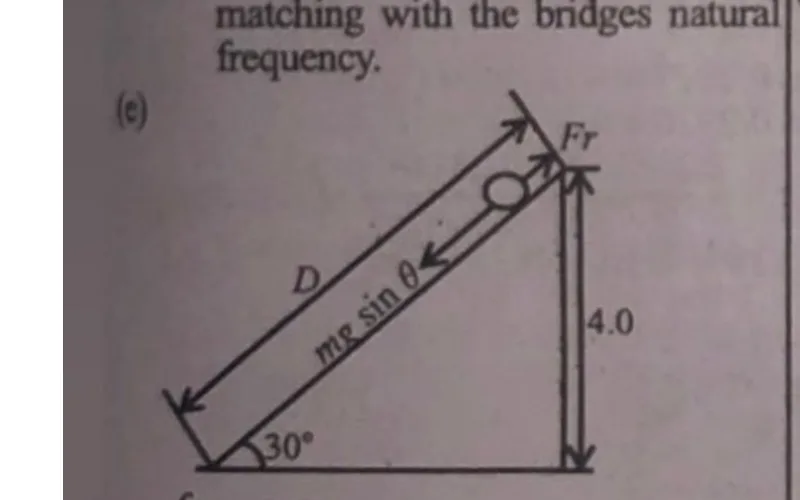
8(e) A body is released from rest at the top of a plane inclined at 30° to the horizontal and 4.0m high. If the coefficient of friction between the body and the plane is 0.3, calculate the time the body takes to reach the bottom of the plane
Model answer
F_net=ma. mg sinθ - Fr = ma. mg sinθ - μmg cosθ = ma. Dividing through by m: g sinθ - μg cosθ = a. a = 10xsin30 - 0.3x10xcos30 = 5-2.6 = 2.4ms^-2. Distance D covered by the body: sin30=4/D ∴ D=4/sin30=8m. From s=ut+1/2at²; s=D=8m, u=0 (at rest), a=2.4m/s: 8=1/2x2.4xt² → 16/2.4=t² → t²=6.67 ∴ t=√6.67=2.58s.
9(a) Define stable equilibrium as applied to a rigid body
Model answer
A body is said to be in a stable equilibrium if the body returns to its original position without toppling after being slightly displaced. E.g. a cone resting on its base, a heavy base lamp, a ball in the middle of a bowl.
9(c) At the beginning of a race, a tyre of volume 8.0x10^-4m3 at 20°C has a pressure of 4.5x10^5Pa. Calculate the temperature of the gas in the tyre at the end of the race if the pressure has risen to 4.6x10^5Pa.
9(d)(i) The table below gives readings of the resistance and pressure of a platinum resistance thermometer and a gas thermometer, respectively, when immersed in the same liquid bath (ice point: resistance 5.67Ω/pressure 7.13x10^4Pa; steam point: resistance 7.75Ω/pressure 9.74x10^4Pa). Use this data to determine the temperature of the bath on the: (a) Resistance thermometer; (b) gas thermometer
10(b)(i) State two practical uses of glass prisms.
Model answer
Uses of glass prisms: To split light into components with different polarization; To make instruments used to view far away objects e.g. telescopes, binoculars etc.
10(b)(ii) List two factors that determine the deviation of a ray of light travelling from air to a triangular glass prism.
Model answer
Factors that determine the deviation include: the angle of incidence of the incident ray; the refractive index of the glass prism; the refraction angle, A, of the prism (any two).
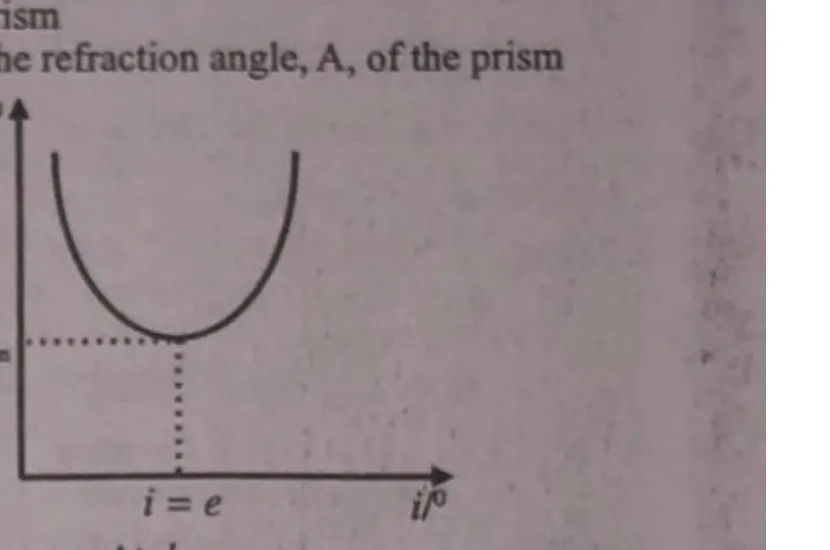
10(b)(iii) Sketch a graph to illustrate the variation of the angle of deviation, d, with that of incidence, i, for a ray of light travelling from air into a triangular glass prism. Indicate on the graph the point at which the angle of incidence i is equal to the angle of emergence e.
Model answer
The graph of deviation d against angle of incidence i is a curve which decreases to a minimum value (d_min) and then increases again. At d_min, the angle of incidence i equals the angle of emergence e (i=e), as marked on the graph.
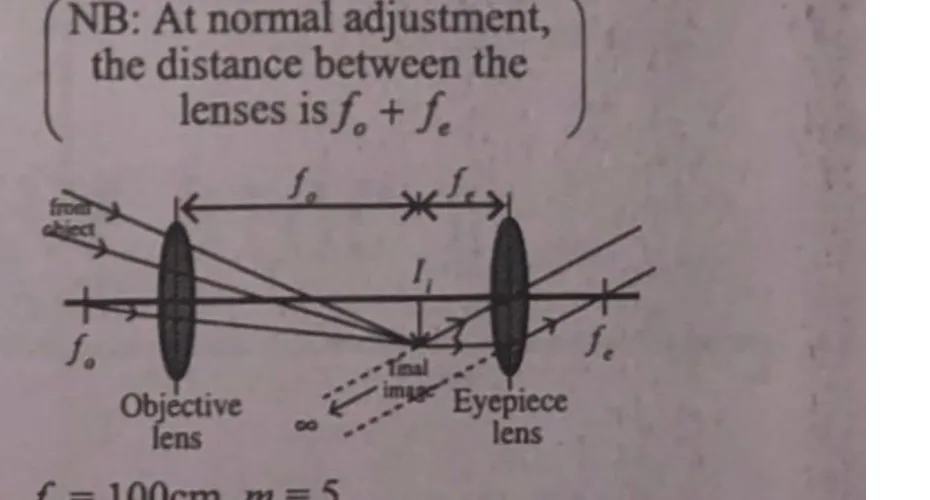
10(c)(i) Draw and label a diagram of an astronomical telescope in normal adjustment
Model answer
A labelled diagram of an astronomical telescope showing the objective lens and eyepiece lens, with the object at infinity, rays converging to form a final image, and (at normal adjustment) the distance between the lenses equal to fo+fe.
10(c)(ii) The angular magnification of an astronomical telescope in normal adjustment is 5, if the focal length of the objective is 100cm, calculate the: (I) focal length of the eyepiece; (II) length of the telescope
Model answer
fo=100cm, m=5. Since m=fo/fe: fe=fo/m=100/5=20cm. (II) Length of telescope = fe+fo = (100+20)cm = 120cm.
A dielectric is an insulating material that is used to separate the two plates of a capacitor. Examples of dielectric are: air, paper, polyester, ceramic, glass etc.
11(a)(ii) A parallel plate capacitor consists of two plates each of area 9.6x10^-3m², separated by a dielectric of thickness 2.25x10^-4m and dielectric constant 900. Calculate the capacitance of the capacitor. [εo=permittivity of free space=8.85x10^-12Fm^-1]
Model answer
A=9.6x10^-3m²; d=2.25x10^-4m; εr=900, εo=8.85x10^-12Fm^-1. Capacitance C = εrεoA/d = (8.85x10^-12 x 900 x 9.6x10^-3)/(2.25x10^-4) = (7.65x10^-11)/(2.25x10^-4) = 3.4x10^-7F.
11(b)(i) Which of the following devices has a higher resistance: an ammeter or a voltmeter? Give a reason for your answer
Model answer
A voltmeter has a higher resistance. A voltmeter is always placed in parallel with the resistance or components across which the p.d. is to be measured. A voltmeter ought therefore to have a high resistance compared with the resistance across which the voltage is to be measured, so that they take a comparatively negligible current, and so disturb the circuit as little as possible.
11(b)(ii) The resistance of the voltmeter in the circuit diagram illustrated above is 800Ω, calculate the voltmeter reading
Model answer
Resolving the two parallel branches (400Ω combined with the 800Ω voltmeter branch): Total resistance in the circuit where R1+R2=RT. 1/R1=1/400+1/400=2/400, so R1=200Ω. And 1/R2=1/800+1/800 [NB: the other is the resistance of the voltmeter], giving R2=400Ω (⇒Ω=400Ω). RT=(200+400)Ω=600Ω. From V=IR: VT=IT.RT. VT=6V; RT=600Ω ∴ IT=VT/RT=6/600=0.01A. V_voltmeter=I_voltmeter x R_voltmeter=IT x R2=0.01x400=4.0V.
11(c) The battery of negligible internal resistance is connected to a set of resistors as illustrated in the circuit diagram above. Determine the equivalent resistance of the circuit
Model answer
Resolving R2 & R3 (both 2Ω, in parallel) makes their corresponding equivalent resistance be in series with R1 and R4: 1/R23=1/2+1/2=1 ∴ R23=1Ω. RT=R1+R4+R23=2+2+1=5Ω.
Nuclear fission is defined as the disintegration of a massive nucleus into two fragments of roughly equal masses with release of a huge amount of energy and neutrons.
12(a)(ii) State the function of each of the following materials in a nuclear fission reactor: (a) graphite; (b) boron rods; (c) liquid sodium
Model answer
(a) Graphite: To slow down the neutrons so that not all of them would be absorbed by uranium. (b) Boron rods: To absorb some of the neutrons (that are excess) and this controls the rate of the nuclear reaction. (c) Liquid sodium: To extract excess heat from the reaction chamber.
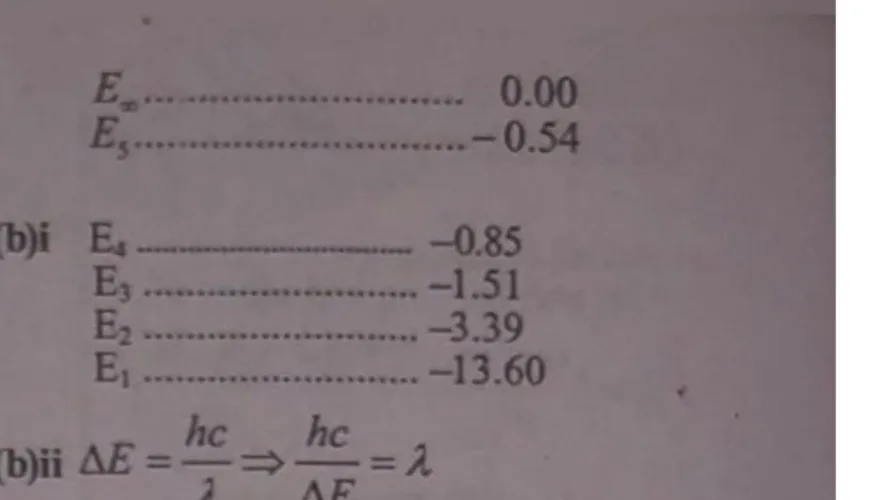
12(b) The table below gives some of the energy levels of a hydrogen atom (N=1,2,3,4,5,∞ with E in eV = -13.60,-3.39,-1.51,-0.85,-0.54,0.00). (i) Draw the energy level diagram for the atom; (ii) Determine the wavelength of the photon emitted when the atom goes from the energy state n=3 to the ground state. [h=6.6x10^-34Js, C=3.0x10^8ms^-1, e=1.6x10^-19C]
Model answer
(i) The energy level diagram is drawn with horizontal lines at the given eV values (E1=-13.60eV, E2=-3.39eV, E3=-1.51eV, E4=-0.85eV, E5=-0.54eV, E∞=0.00eV), with the ground state (n=1) at the bottom and n=∞ at the top.
(ii) ΔE=hc/λ ⇒ λ=hc/ΔE. Transition from n=3 to n=1: ΔE=E3-E1=-1.51-(-13.60)=12.09eV. Converting to Joules: ΔE=12.09x1.6x10^-19 = 1.9344x10^-18J. λ = (6.63x10^-34 x 3x10^8)/(1.9344x10^-18) = 1.03x10^-7m.
12(c) A piece of ancient bone from an excavation site showed 14C activity of 9.5 disintegrations per minute per 1.0x10^-3kg. If a bone specimen from a living creature shows 14C activity of 12.0 disintegrations per minute per 1.0x10^-3kg, determine the age of the ancient bone. [Half-life of 14C = 5572 years]
Model answer
T1/2=5572 years. Decay constant λ=0.693/T1/2=0.693/5572=1.244x10^-4 yr^-1. N0=12.0min^-1 per 1.0x10^-3kg (living); N=9.5min^-1 per 1.0x10^-3kg (ancient). N/N0=9.5/12.0=0.7917. Using N/N0=e^-λt: 0.7917=e^-λt. ln(0.7917)=-λt ⇒ -0.2336=-λt. t=0.2336/λ=0.2336/1.244x10^-4 = 1877.8 ≈ 1878 years.
Advertisement
Sign up free to unlock
Score tracking
Practice history
Saved questions
Progress dashboard
Personalized sessions
Weak-topic breakdown
…and/or go further with premium services and No Ads.