All 35 questions from the West African Examinations Council (WAEC) Physics 2021 Theory paper, with the correct answer and a full explanation for each. Free, no signup needed.
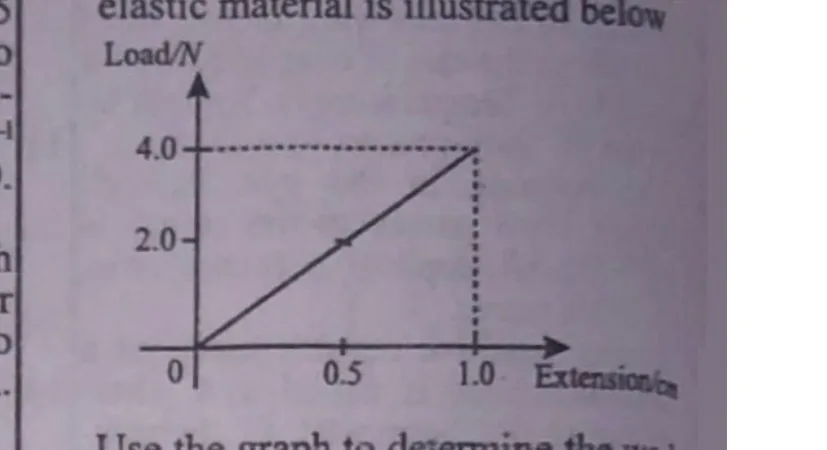
The load-extension graph of an elastic material is illustrated below (Load/N vs Extension/cm, a straight line through the origin to about (1.0, 4.0)). Use the graph to determine the work done in stretching the material.
Model answer
Work done = area under the load-extension graph (a triangle) = ½×base×height = ½×(1.0×10⁻²m)×4.0N = 2×10⁻² J.
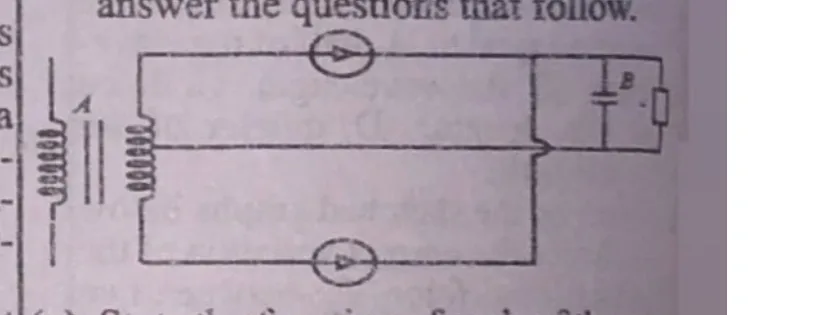
4. The circuit diagram below is a simple current rectifier circuit. Use it to answer the questions that follow: (a) State the function of each of the parts labelled A and B. (b) Sketch the output signal produced.
Model answer
(a) Part A (the a.c. source/diode arrangement) produces/rectifies the alternating current into a pulsating direct current. Part B (the capacitor) smooths the rectified current into a steadier direct current.
(b) The output signal starts as a series of positive humps (full-wave rectified a.c.) which, after smoothing by the capacitor, becomes a nearly steady line with small ripples (smoothed d.c.).
Wave-particle duality means light exhibits the behaviour of a wave (e.g. interference and diffraction) as well as that of a particle — travelling as photons/discrete packets of energy (e.g. in the photoelectric effect) — though not simultaneously in the same experiment.
7(b). Explain each of the following terms as used in fibre optics: (i) Core (ii) Cladding.
Model answer
(i) Core: the central part of the optical fibre through which light is transmitted/carried.
(ii) Cladding: the outer layer surrounding the core, made of material with a lower refractive index, which keeps light confined within the core by total internal reflection.
Hooke's law states that the extension produced in an elastic material is directly proportional to the applied force (load), provided the elastic limit is not exceeded.
8(a)(ii). A spring has a length of 0.20 m when a mass of 0.30 kg hangs on it, and a length of 0.75 m when a mass of 1.95 kg hangs on it. Calculate the: I. force constant of the spring; II. length of the spring when unloaded. [g=10 ms⁻²]
Model answer
Weights: F1=0.30×10=3N, F2=1.95×10=19.5N. Using F=k×extension: 3=k(0.20-l₀) and 19.5=k(0.75-l₀). Dividing and solving simultaneously gives k=30 Nm⁻¹ and unloaded length l₀=0.10 m.
8(b)(i)-(iii). (i) What is diffusion? (ii) State two factors that affect the rate of diffusion of a substance. (iii) State the exact relationship between the rate of diffusion of a gas and its density.
Model answer
(i) Diffusion is the movement of molecules of a substance from a region of higher concentration to a region of lower concentration until evenly distributed (equilibrium).
(ii) Any two of: temperature, surface area/concentration gradient, density of the substances, medium of diffusion.
(iii) Rate of diffusion is inversely proportional to the square root of the density of the gas (Graham's law): rate ∝ 1/√density.
9(a). A satellite of mass m orbits the earth of mass M with a velocity v at a distance R from the centre of the earth. Derive the relationship between the period, T, of the orbit and R.
Model answer
Gravitational force provides the centripetal force: GMm/R² = mv²/R, so v²=GM/R. Since v=2πR/T, (2πR/T)²=GM/R, giving T²=(4π²/GM)R³ — i.e. T² is proportional to R³ (Kepler's third law).
9(b). (i) What is Dew point? (ii) Explain why dew forms more quickly on metal parts than on rubber parts.
Model answer
(i) Dew point is the temperature at which the water vapour in a given volume of air is just sufficient to saturate it, so that it begins to condense into liquid water.
(ii) Metal is a much better conductor of heat than rubber, so at night metal loses heat (and cools below the dew point) faster than rubber, causing dew to form on it more quickly.
9(c). (i) Explain the statement: 'the specific heat capacity of copper is 400 J/kg K'. (ii) Two metals P and Q are supplied the same quantity of heat. If the ratio of the specific heat capacity of P to Q is 3:1 and their masses are in the ratio 1:2, calculate the ratio of the temperature rise of P to Q.
Model answer
(i) It means that 400 Joules of heat energy is required to raise the temperature of 1 kg of copper by 1 Kelvin (1°C).
(ii) H=mcΔθ is equal for both (same heat supplied). With Cp=3Cq and Mp=Mq/2: Mp·Cp·Δθp = Mq·Cq·Δθq ⟹ Δθp/Δθq = (Mq·Cq)/(Mp·Cp) = (2×1)/(1×3) = 2:3.
9(d). Define coefficient of thermal conductivity of a material.
Model answer
The coefficient of thermal conductivity is the rate of flow of heat per unit cross-sectional area per unit temperature gradient across the material. Its SI unit is J s⁻¹ m⁻¹ K⁻¹ (or W m⁻¹ K⁻¹).
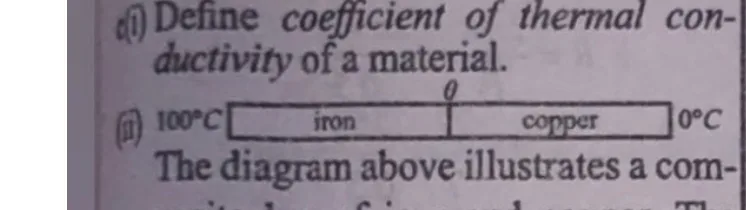
9(e). The diagram illustrates a composite bar of iron and copper, insulated along its sides, with a diameter of 10 mm. The length and thermal conductivity of the iron are 0.15 m and 40 Wm⁻¹K⁻¹ respectively, and those of the copper are 0.05 m and 360 Wm⁻¹K⁻¹ respectively. If the free ends of the iron and copper are kept at 100°C and 0°C respectively, calculate: I. the temperature θ at the interface between the bars; II. the rate of heat flow along the bar.
Model answer
At steady state, the rate of heat flow through both bars is equal: (KA×Δθ/l)iron = (KA×Δθ/l)copper. 40×(100-θ)/0.15 = 360×(θ-0)/0.05. Solving gives θ ≈ 3.6°C.
Rate of heat flow, Q/t = KA(θ_H-θ_C)/l, using the copper section: Q/t = 360×(π×0.01²/4)×(3.6-0)/0.05 ≈ 2.02 W.
10(a)(i). Define each of the following terms as it relates to converging lenses: I. focal length; II. optical centre.
Model answer
I. Focal length: the distance between the optical centre of the lens and its principal focus.
II. Optical centre: the point through the lens through which light rays pass undeviated (the geometric centre of the lens).
10(a)(ii). Draw a ray diagram to illustrate how a converging lens is used to produce a virtual image of an object.
Model answer
With the object placed between the optical centre and the principal focus of a converging lens, two rays (one through the optical centre undeviated, one parallel to the axis then refracted through the far focus) are drawn; on extending the emerging rays backward, they appear to meet on the same side as the object — forming a magnified, upright, virtual image.
10(c). A ray passes symmetrically through a glass prism of angle 60° and refractive index 1.5. Calculate the angle of: (i) incidence; (ii) minimum deviation.
Model answer
For symmetric passage, r=A/2=30°. Using n=sin i/sin r: sin i=1.5×sin30°=0.75, so i=sin⁻¹(0.75)≈48.6°.
For minimum deviation: n=sin((Dm+A)/2)/sin(A/2) → sin((Dm+60°)/2)=1.5×sin30°=0.75 → (Dm+60°)/2≈48.59° → Dm≈37.2°.
11(a). (i) What is meant by the root-mean-square value of an alternating current? (ii) Define impedance of an alternating current circuit.
Model answer
(i) The r.m.s. value of an alternating current is the value of a steady direct current that produces the same heating effect in a given resistor as the alternating current.
(ii) Impedance is the total opposition offered by a circuit to the flow of alternating current, combining both resistive and reactive components.
11(b). An electrical device rated 120 V, 60 W is operated on a 240 V, 50 Hz mains supply. The circuit has a capacitor connected in series with the electrical device and the supply. Calculate the capacitance of the capacitor. [π=3.142]
Model answer
Resistance of device R=V²/P=120²/60=240 Ω. Using V²=VR²+VC²: 240²=120²+VC² → VC=207.85 V. Current I=VR/R=120/240=0.5 A. Reactance Xc=VC/I=415.7 Ω. Since Xc=1/(2πfC): C=1/(2π×50×415.7) ≈ 7.66 µF.
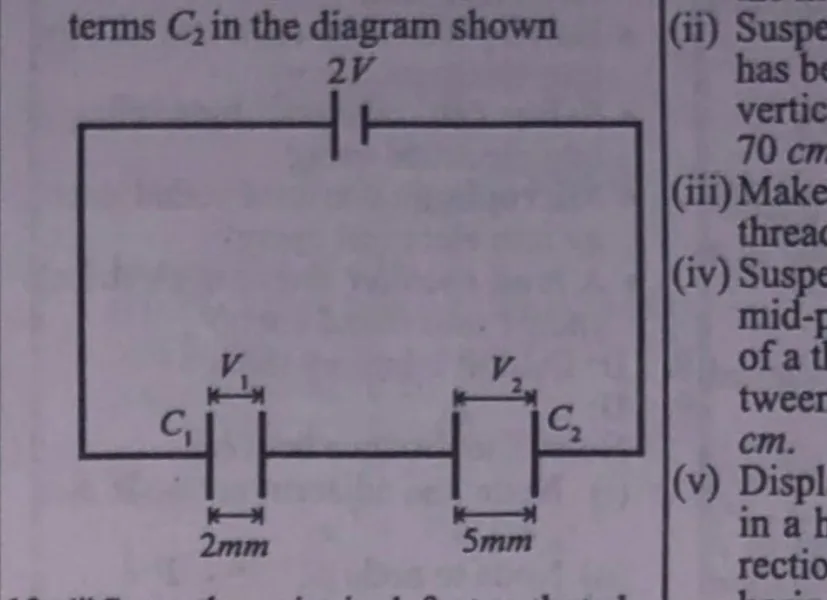
11(c)(ii). Obtain the equivalent capacitance, in terms of C₂, of the two capacitors (with plate separations 2 mm and 5 mm) shown connected in the diagram.
Model answer
Since capacitance C∝1/d (plate separation) for otherwise identical capacitors, C1/C2 = d2/d1 = 5/2, so C1=(5/2)C2. For capacitors in series: CT = C1C2/(C1+C2) = [(5/2)C2×C2] / [(5/2)C2+C2] = (5/2 C2²)/(7/2 C2) = (5/7)C2.
12(a). (i) State the principal factor that determines the relative stability of a radioactive nucleus. (ii) Arrange the radionuclides ⁴⁰₂₀X, ⁹²₃₆W and ⁹²₄₂Y in decreasing order of stability. Justify your answer.
Model answer
(i) The neutron-to-proton (n:p) ratio of the nucleus is the principal factor determining its relative stability.
(ii) n:p ratios: X = 20/20 = 1.0; Y = 53/42 ≈ 1.26; W = 56/36 ≈ 1.56. The ratio closest to 1 is most stable, so decreasing order of stability: X > Y > W.
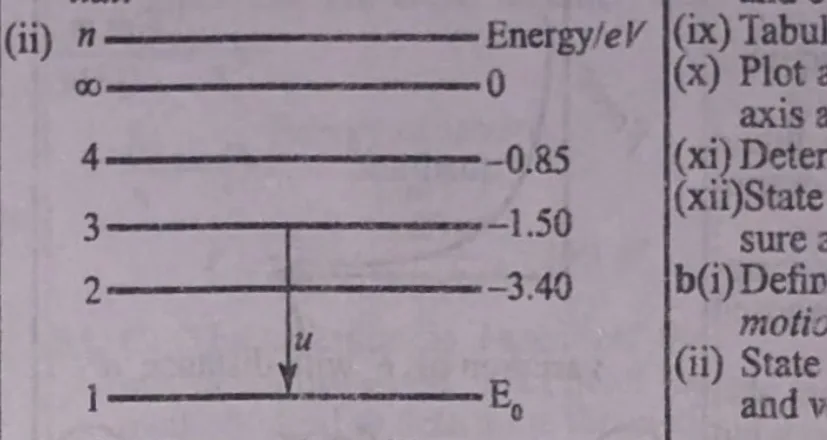
12(b). (i) Explain the term ionization potential. (ii) Using the energy level diagram shown (n=1 to n=∞, with given energies in eV), calculate the ionization potential of the hydrogen atom, given the transition from n=3 to n=1 emits a photon of wavelength 1.02×10⁻⁷ m.
Model answer
(i) Ionization potential is the minimum energy required to remove the most loosely bound electron from an atom in its gaseous (ground) state.
(ii) Energy of transition ΔE=hc/λ = (6.6×10⁻³⁴×3×10⁸)/(1.02×10⁻⁷) = 1.94×10⁻¹⁸ J = 12.13 eV. Since ΔE=E₃-E₀ and E₃=-1.5 eV (from the diagram), E₀ = E₃-ΔE = -1.5-12.13 = -13.63 eV. The ionization potential is therefore 13.63 eV (magnitude of E₀).
12(c)(ii). Light of wavelength 160 nm is shone on the surface of a sodium metal of work function 2.0 eV. Determine whether photoelectrons will be emitted. [h=6.6×10⁻³⁴ Js, c=3.0×10⁸ ms⁻¹, 1 eV=1.6×10⁻¹⁹ J]
Model answer
Photon energy E=hc/λ = (6.6×10⁻³⁴×3.0×10⁸)/(160×10⁻⁹) = 1.2375×10⁻¹⁸ J = 7.73 eV. Since E (7.73 eV) > work function (2.0 eV), photoelectrons WILL be emitted.
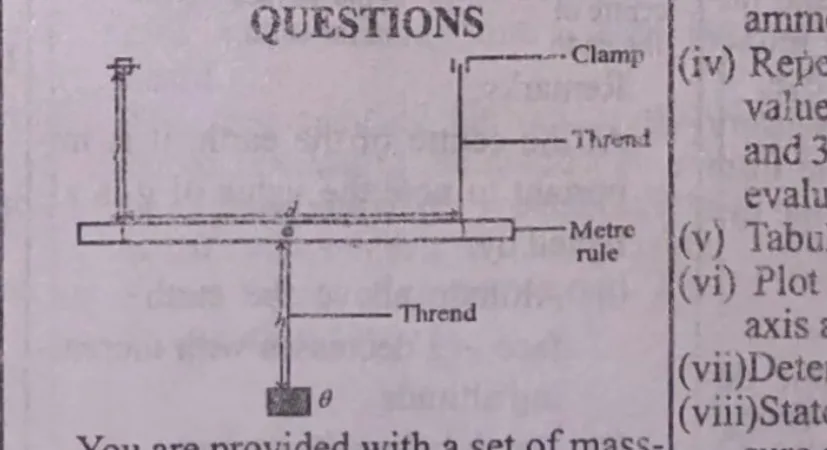
Practical 1(a). Using the apparatus shown (retort stands, clamps, split corks, a metre rule, thread and a weighing balance), perform an experiment to investigate horizontal oscillations of a loaded metre rule: measure the mass M of the rule; suspend it by two vertical strings of length l=70 cm with separation d=80 cm; suspend a mass m=20 g at the mid-point via a thread of length h=15 cm; displace and release to oscillate horizontally; time 20 oscillations; evaluate T, T² and T⁻¹ for m=20,30,50,70,100 g; tabulate; plot a graph of T² against m; determine the slope, s; state two precautions.
Model answer
This is a practical experiment: the student records the time for 20 oscillations at each mass, computes the period T (time/20), tabulates m, t, T, T² for all 5 masses, plots T² (y-axis) against m (x-axis) — expecting a straight line through the origin (since T²∝m) — and reads the slope s = Δ(T²)/Δm from the graph. Precautions include ensuring smooth, regular oscillations in the horizontal plane and avoiding parallax error when reading the metre rule.
Practical 1(b). (i) Define the period of an oscillatory motion. (ii) State two differences between mass and weight.
Model answer
(i) The period is the time taken for an oscillating body to complete one full cycle (oscillation).
(ii) Mass is a scalar quantity, measured in kilograms, and is constant everywhere; weight is a vector quantity, measured in Newtons, and varies from place to place depending on the gravitational field strength.
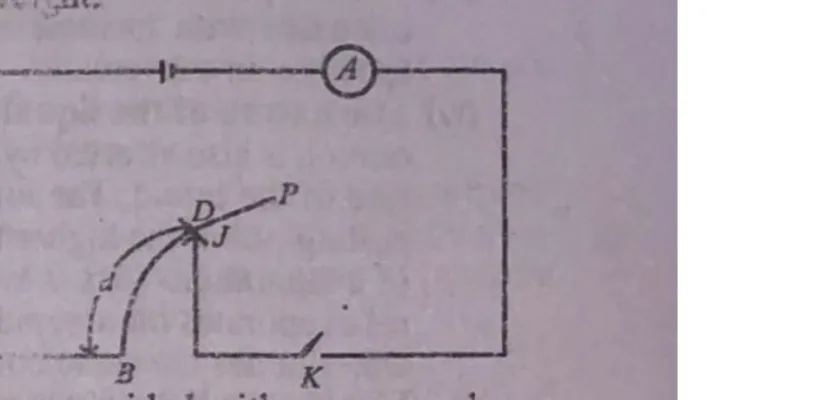
Practical 2(a). Using an accumulator, an ammeter, a 2 Ω resistor, a key K, a resistance wire BP, a crocodile clip J and other material: connect the circuit as shown; use the crocodile clip to hold the resistance wire at D such that BD=d=80 cm; close the key and record the ammeter reading I, then evaluate I⁻¹; repeat for d=70, 50, 40, 30 cm; tabulate the results; plot a graph of d (vertical axis) against I⁻¹ (horizontal axis); determine the slope, s, of the graph; state two precautions taken to ensure accurate results.
Model answer
This is a practical experiment: for each length d of resistance wire in the circuit, the ammeter reading I is recorded and I⁻¹ computed. A graph of d against I⁻¹ is plotted (expected to be a straight line, since resistance—and hence I⁻¹—is proportional to length d), and the slope s is read from the graph. Precautions include ensuring tight, clean circuit connections and avoiding parallax error when reading the ammeter.
Practical 2(b)(i). State two factors on which the sensitivity of a moving-coil galvanometer depends.
Model answer
The sensitivity of a moving-coil galvanometer depends on: (1) the strength of the magnetic field (B) of the permanent magnet, and (2) the number of turns of the coil.
Practical 2(b)(ii). A resistance wire of diameter 0.6 cm has a resistivity of 1.0×10⁻⁶ Ωm. What length of the wire would be needed to make a 4 Ω resistor?
Model answer
R=ρL/A, so L=RA/ρ = R×π d²/(4ρ) = (4×π×(6×10⁻³)²)/(4×1.0×10⁻⁶) ≈ 113.14 m.
Advertisement
Sign up free to unlock
Score tracking
Practice history
Saved questions
Progress dashboard
Personalized sessions
Weak-topic breakdown
…and/or go further with premium services and No Ads.