All 34 questions from the West African Examinations Council (WAEC) Physics 2025 Theory paper, with the correct answer and a full explanation for each. Free, no signup needed.
A missile is launched vertically upward with an initial velocity u at an angle θ to the horizontal. It travels a horizontal distance, R, often referred to as the range, which is represented by the expression R = u²sin2θ/g. Determine the dimension of R.
Model answer
R = u²sin2θ/g, where u = initial velocity (LT⁻¹) and g = acceleration due to gravity (LT⁻²). sin2θ is dimensionless. R = (LT⁻¹)² / (LT⁻²) = L²T⁻² / (LT⁻²) = L. Therefore the dimension of Range, R, is [L].
State one use each of: (i) gas laser; (ii) chemical laser; (iii) dye laser.
Model answer
(i) Gas laser: used for surgical procedures/skin treatment, missile guidance, reading barcodes, target designation, and making holograms.
(ii) Chemical laser: used for cutting metals, drilling materials, military weapon manufacturing, spectroscopy and military defence.
(iii) Dye laser: used for isotope separation, detecting pollutants, studying absorption/emission spectra, and atomic vapour laser isotope separation.
An object was projected in space with an initial velocity, u at an angle θ to the horizontal. It attained a maximum height, H before falling at a spot on the same plane as the point of projection. With the aid of a suitable diagram, draw a graph of the object's motion indicating the initial velocity, u, maximum height, H, angle, θ, and the range, R.
Model answer
The path of the object is a parabola (projectile motion). On a graph of vertical distance (y) against horizontal distance (x/m): the object leaves the origin with initial velocity u at angle θ to the horizontal, rises smoothly to a peak at maximum height H (at the midpoint of the horizontal range), then descends symmetrically, landing back on the horizontal (x) axis at a horizontal distance R (the range) from the point of projection. The curve is symmetric about the vertical line through the point of maximum height.
A satellite orbits the earth with a velocity of 5.8 km/s. The period of the satellite in the orbit is 20.2 hours. How high above the earth is the satellite? [Radius of the earth, R = 6400 km, Mass of the earth, M = 5.97×10²⁴ kg, π = 3.14, Universal Gravitational Constant, G = 6.67×10⁻¹¹ m³s⁻²kg⁻¹]
Model answer
For circular orbital motion, v = 2π(R+h)/T.
5.8 = [2×3.14×(6400+h)] / (20.2×3600)
421776 / (2×3.142) = 6400+h
67161.78 = 6400 + h
h = 67161.78 − 6400 ≈ 60,761.78 km ≈ 60,762 km above the earth's surface.
State three differences between Laser light and white light.
Model answer
Laser light: consists of a single wavelength/colour (monochromatic); the light waves are in phase with each other (coherent); it is directional, travelling in a narrow beam; it is very intense and has a high concentration of energy.
White light: consists of a broad spectrum of wavelengths (polychromatic); the waves are not in phase (incoherent); it is non-directional and scatters in various directions; it is less intense than laser light.
7(i) Define retentivity of a magnetic material. (ii) State one material with high susceptibility.
Model answer
(i) Retentivity is the ability of a magnetic material to retain its magnetism even after the external magnetic field that magnetized it has been removed.
(ii) Materials with high magnetic susceptibility include: Iron, Nickel, Cobalt, Magnetite and Alnico (any one).
8a(i) State the one condition under which a semiconductor is said to be doped. (ii) Define the terms: I. intrinsic semi-conductor II. extrinsic semi-conductor.
Model answer
(i) A semiconductor is said to be doped when impurities are deliberately added to it.
(ii) I. Intrinsic semi-conductor: a pure semiconductor material, i.e. a semiconductor with an equal number of holes and electrons.
II. Extrinsic semi-conductor: a semiconductor material that has been doped with impurities, so that the numbers of holes and electrons differ.
8(b) The current, I, through a P–N junction diode is plotted against the applied voltage, V, for both forward and reverse biases on a graph. With the aid of a suitable diagram, illustrate the current-voltage characteristics of the junction diode showing the current, I, voltage, V, forward bias and the reverse bias.
Model answer
In forward bias, current, I, rises slowly at first then increases sharply (almost exponentially) once the applied voltage, V, exceeds the diode's threshold/turn-on voltage. In reverse bias, only a very small (near-zero) leakage/reverse-saturation current flows as V is increased in the negative direction, until the breakdown voltage is reached, beyond which current increases sharply again.
8(c) An aluminium metal is illuminated with light of wavelength 3.0×10⁻⁷ m. If the kinetic energy of the emitted photoelectron is 1.5×10⁻¹⁹ J, calculate the: (i) maximum velocity of the photoelectron; (ii) work function of the metal. [c = 3.0×10⁸ ms⁻¹, me = 9.1×10⁻³¹ kg, h = 6.6×10⁻³⁴ Js]
Stopping potential is the negative potential of the anode in a photocell which is just sufficient to stop the most energetic photoelectron from reaching it; i.e. the negative voltage applied at the anode (with respect to the cathode) that just prevents the most energetic electron in a photocell from reaching the anode.
9(a) State one difference between deformation and elasticity.
Model answer
Deformation is the change in the dimensional shape and size of an object due to an applied external force. Elasticity is the property/ability of a material under an applied force to regain its original shape or size once the force is removed.
9(b) The following results were obtained from an experiment performed on a spiral spring (stretching force, F/N: 0.0, 1.0, 2.0, 3.0, 4.0, 5.0, 6.0; extension, cm: 0.0, 5.0, 10.0, 15.0, 20.0, 25.0, 30.0). (i) Plot a graph of stretching force on the vertical axis against extension on the horizontal axis. (ii) Determine the slope, s, of the graph. (iii) What does the slope represent?
Model answer
(i) The plot of F(N) against extension(cm) is a straight line passing through the origin, showing that extension is directly proportional to the applied force (Hooke's law).
(ii) Slope, s = ΔF/Δe = (5−1)/(25−5) = 4/20 = 0.2 N/cm.
(iii) The slope represents the force constant (spring constant) of the spiral spring.
9(c) A rubber gun is used to project a stone of mass 40g. If the rubber of the gun has an elastic constant of 350 Nm⁻¹ and was stretched 4 cm, calculate the stone's speed of projection.
Model answer
Elastic potential energy of the rubber = Kinetic energy of the stone: ½ke² = ½mv² → v = √(ke²/m) = √(350×(0.04)²/0.04) = √14 = 3.74 ms⁻¹.
9(d)(i) Define bulk modulus. (ii) A vertical wire is suspended from a support with a mass of 2.5g attached to the free end to stretch the wire. If the load on the wire extends it by 2 cm, determine the energy gained by the wire. [g = 10 ms⁻²]
Model answer
(i) Bulk modulus is the ratio of the very small increase in pressure applied to a material to the resulting relative decrease in its volume: k = −ΔP/(ΔV/V) (Pa), where ΔP is the change in pressure, ΔV is the change in volume, and V is the original volume. The negative sign shows that an increase in pressure leads to a decrease in volume.
(ii) F = mg = 2.5×10⁻³×10 = 0.025 N; e = 0.02 m. Energy gained, W = ½Fe = ½×0.025×0.02 = 2.5×10⁻⁴ J.
10a(i) Define the term first overtone. (ii) Define the term end correction.
Model answer
(i) First overtone is the next frequency of vibration immediately above the fundamental frequency in a system of a vibrating string or air column.
(ii) End correction is the difference between the effective length of a vibrating air column in a pipe and the actual physical length of the pipe.
10(b) A 40 cm tube closed at one end resonates at its fundamental frequency with a tuning fork of unknown frequency. If the end correction of the tube is 3.2 cm, determine the frequency of the fork. [Velocity of sound in air is 330 ms⁻¹]
Model answer
For a closed pipe at fundamental frequency: l + e = λ/4 → λ = 4(l+e) = 4(40+3.2) = 4×43.2 = 172.8 cm = 1.728 m.
f = v/λ = 330/1.728 ≈ 191 Hz.
10c(i) Two plane mirrors are inclined at an angle, β, to each other. An object placed between them formed 8 images. At what angle are the mirrors inclined?
Model answer
Number of images, N = 360/β − 1. 8 = 360/β − 1 → 9 = 360/β → β = 40°.
10c(ii) State two differences between mirage and total internal reflection of light.
Model answer
Mirage: involves gradual refraction at boundaries as light passes through air layers of varying density; occurs on hot road surfaces or in deserts due to a temperature difference in the air layers; often observed on a hot road or in a desert.
Total internal reflection: involves sudden reflection of light at a single boundary; occurs at an angle of incidence greater than the critical angle; observed in fibre optics and prisms.
10c(iii) A compound microscope consists of an objective lens of focal length 3.0 cm and eyepiece lens of focal length 6.0 cm placed 20.0 cm apart. The final image is formed at infinity. How far is the object from the objective lens?
Model answer
For the final image to form at infinity, the image formed by the objective lens must lie at the focal point of the eyepiece lens. This means the image distance for the objective lens, v₀ = 20 − 6 = 14 cm.
Using the lens formula, 1/f₀ = 1/u₀ + 1/v₀ → 1/3 = 1/u₀ + 1/14 → 1/u₀ = 1/3 − 1/14 = 11/42 → u₀ = 42/11 ≈ 3.82 cm.
11a(i) Give two similarities between photoelectric emission and evaporation.
Model answer
Both processes: are surface phenomena; involve the escape of particles (electrons or molecules) from a material; require energy input for the particles to escape.
11a(ii) Mention two differences between photon and photoelectron.
Model answer
Photon: an electromagnetic radiation (a quantum of light); carries no electric charge; has no rest mass; its energy depends on its frequency.
Photoelectron: a particle of matter (an electron); is negatively charged; has a rest mass (9.1×10⁻³¹ kg); its (kinetic) energy depends on the work function of the metal and the frequency/energy of the incident radiation.
11(b) A 4.0 μF capacitor is connected in series with a 400 Ω resistor. The connection is placed across a source of root-mean-square value of 60V and alternating frequency (1500/π) Hz. Calculate: (i) the impedance of the circuit; (ii) the potential difference across the capacitor. [π = 3.14]
Model answer
(i) Xc = 1/(2πfC) = 1/(2×(1500/π)×π×4×10⁻⁶) = 1/(2×1500×4×10⁻⁶) = 1/0.012 ≈ 83.3 Ω.
Impedance, Z = √(R²+Xc²) = √(400²+83.3²) = √166,938.9 ≈ 408.6 Ω.
(ii) Current, I = Vrms/Z = 60/408.6 ≈ 0.1469 A. Potential difference across capacitor, Vc = I×Xc = 0.1469×83.3 ≈ 12.24 V.
11c(i) State three characteristics of magnetic lines of force. (ii) What is a solenoid?
Model answer
(i) Magnetic lines of force point away from the North pole and towards the South pole outside the magnet; they are closer together where the field is stronger; they never intersect one another; they form closed loops.
(ii) A solenoid is a long wire wound in the shape of a helix (spiral), usually around a cylindrical core, used to produce a uniform magnetic field when current flows through it.
12a(i) State two similarities associated with alpha (α), beta (β) particles and gamma (γ) rays. (ii) Define natural radioactivity. (iii) Write a general equation for alpha decay, where X is the parent nucleus and Y represents the daughter nuclide. (iv) Mention one example of natural radioactivity.
Model answer
(i) Similarities: they can cause biological damage to body cells; they can penetrate materials (to varying extents); they are all emitted by radioactive materials.
(ii) Natural radioactivity is the spontaneous disintegration/decay of an unstable atomic nucleus, with the emission of alpha, beta and/or gamma radiation (singly or in combination), accompanied by a release of energy.
(iii) Alpha decay: ᴬₓX → ⁴₂He + ᴬ⁻⁴ₓ₋₂Y.
(iv) Example: Uranium–238 decaying into Thorium–234 (²³⁸₉₂U → ²³⁴₉₀Th + ⁴₂He); or Radium–226 decaying into Radon–222.
12(b)(i) A kinetic energy of 1.80×10⁻¹⁶ J is possessed by an electron ejected from the surface of a metal when the surface is illuminated by light. If the work function of the metal is 1.20×10⁻¹⁶ J, calculate the frequency of the incident photon. [c = 3.0×10⁸ ms⁻¹, h = 6.6×10⁻³⁴ Js] (ii) State two characteristics of a cathode ray tube.
Model answer
(i) From Einstein's photoelectric equation, hf = W₀ + K.E. → f = (W₀+K.E.)/h = (1.2×10⁻¹⁶+1.8×10⁻¹⁶)/6.6×10⁻³⁴ = 3.0×10⁻¹⁶/6.6×10⁻³⁴ ≈ 4.55×10¹⁷ Hz.
(ii) A cathode ray tube: operates in a high-vacuum environment to minimize electron scattering; uses magnetic/electrostatic fields to deflect the electron beam; is coated with phosphorus on the inside of the screen; uses the electron beam to create images on the screen.
12(c)(i) Given that ¹³₇G undergoes alpha decay: I. Write an equation representing the process. II. Identify the daughter nuclide. (ii) In the decay series ²³⁸U → ²⁰⁶Pb + n(⁴₂He), determine the number of alpha particles emitted.
Model answer
(i) I. ¹³₇G → ⁴₂He + ⁹₅Y.
II. Daughter nuclide has mass number 9 and atomic number 5 (as given in the WAEC marking scheme).
(ii) By conservation of mass number: 238 = 206 + 4n → 4n = 32 → n = 8. Therefore, eight (8) alpha particles are emitted in the decay series.
1(a) You are provided with a G-clamp, a metre rule, masses, sellotape and a stop watch. Clamp the metre rule firmly to the workbench such that 90 cm of its length is projected outward, with 10.0 cm clamped and 20.0 cm apart marked on the bench (100cm ... 90cm ... 0cm as shown). Use sellotape to attach a mass, M = 150g at the free end of the metre rule. Depress the loaded end of the metre rule slightly and determine the time, t, for 10 complete vertical oscillations. Determine the period, T, of one complete oscillation. Repeat the procedure for four other values of M = 200g, 250g, 300g and 350g. Tabulate the results, plot a graph of Log T on the vertical axis and Log M on the horizontal axis, determine the slope, s, of the graph, and use the graph to determine the time, t₀, for 10 complete vertical oscillations of the cantilever when a mass, M₀ = 280g is placed at the free end of the rule. State two precautions taken to ensure accurate results.
Model answer
Sample results (n = 10 oscillations): M(g): 150, 200, 250, 300, 350; t(s): 6.000, 6.500, 7.200, 7.800, 8.400; T = t/n (s): 0.600, 0.650, 0.720, 0.780, 0.840; log T: −0.222, −0.187, −0.143, −0.108, −0.076; log M: 2.176, 2.301, 2.398, 2.477, 2.544.
A graph of log T (y-axis) against log M (x-axis) gives a straight line. Slope, s = ΔlogT/ΔlogM = (0.08−(−0.19))/(2.54−2.30) ≈ 0.27/0.24 ≈ 0.458 ≈ 0.46 (taking the magnitude).
For M₀ = 280g, log M₀ = log280 ≈ 2.45. Reading off the graph, log T₀ ≈ −0.12, so T₀ ≈ 0.759 s, giving t₀ = 10×0.759 ≈ 7.59 s.
Precautions: avoided draughts throughout the experiment; avoided parallax error when taking readings on the stopwatch and metre rule scale; ensured smooth and regular oscillations of the rule in the vertical plane.
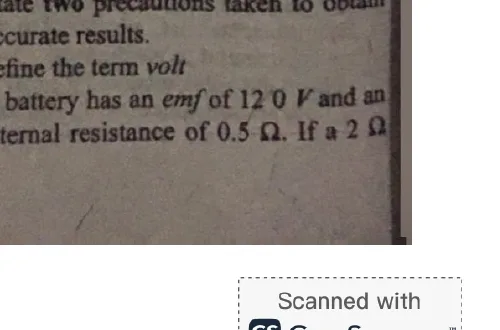
1(b)(i) Define the term volt. (ii) A battery has an e.m.f. of 12.0 V and an internal resistance of 0.5 Ω. If a 2 Ω resistor is connected across the battery terminals, calculate the terminal voltage.
Model answer
(i) The volt is the SI unit of electric potential difference; it is (one volt) defined as the potential difference between two points in an electric circuit when one Joule of work is done to move one coulomb of charge from one point to the other.
(ii) I = E/(R+r) = 12/(2+0.5) = 12/2.5 = 4.8 A. Terminal voltage, V = IR = 4.8×2 = 9.6 V.
2(a)(i) State three characteristics of magnetic lines of force. (ii) What is a solenoid?
Model answer
(i) Magnetic lines of force point away from a North pole and towards a South pole; they are closer together where the magnetic field is stronger; they do not intersect one another; they form closed loops.
(ii) A solenoid is a long wire wound in the shape of a helix (spiral), usually around a cylindrical core.
2(b)(i) A battery has an e.m.f. of 12.0 V and an internal resistance of 0.5 Ω. If a 2 Ω resistor is connected across the battery terminals, calculate the terminal voltage.
Model answer
log RT = 0.17 → RT = 10^0.17 ≈ 1.48 Ω.
(xi) Precautions taken: ensured tight connections of the wire, key and other component parts; avoided error due to parallax when taking readings on ammeter and voltmeter respectively.
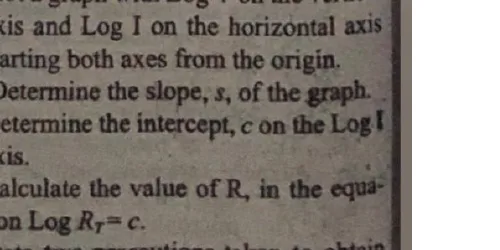
3. Connect the circuit as shown (battery, key, rheostat, ammeter and voltmeter with resistors R₁ and R₂) leaving the key open. Close the key and adjust the rheostat until the ammeter reads I = 0.20 A. Record the corresponding voltmeter reading, V. Repeat the experiment for I = 0.30 A, 0.40 A, 0.50 A and 0.60 A, recording V, Log V and Log I for each case. Tabulate the results, plot a graph of Log V on the vertical axis against Log I on the horizontal axis (starting both axes from the origin), determine the slope, s, of the graph and the intercept, c, on the Log V axis, and calculate the value of R in the equation Log RT = c. State two precautions taken to obtain accurate results.
Model answer
Sample results: I(A): 0.20, 0.30, 0.40, 0.50, 0.60; V(V): 0.13, 0.20, 0.27, 0.34, 0.40; log I: −0.70, −0.52, −0.40, −0.30, −0.22; log V: −0.90, −0.70, −0.60, −0.50, −0.40.
Slope, s = ΔlogV/ΔlogI = (−0.28−(−0.70))/(−0.1−(−0.5)) = 0.42/0.4 ≈ 1.04.
Intercept on the log I axis ≈ 0.17. Since log RT = c, RT = 10^0.17 ≈ 1.48 Ω.
Precautions: ensured tight connections of the wires, key and other component parts of the circuit; avoided errors due to parallax when taking readings on the ammeter and voltmeter.
Advertisement
Sign up free to unlock
Score tracking
Practice history
Saved questions
Progress dashboard
Personalized sessions
Weak-topic breakdown
…and/or go further with premium services and No Ads.