All 50 questions from the Joint Admissions and Matriculation Board (JAMB) Chemistry 2008 Objective paper, with the correct answer and a full explanation for each. Free, no signup needed.
2Na(s) + 2H2O(l) -> 2NaOH(aq) + H2(g). From the equation above, calculate the mass of sodium hydroxide produced by 2.3 g of sodium
A. 0.40g
B. 0.80g
C. 4.00gCorrect
D. 8.00g
Explanation
Mole of Sodium = Mass/Molar mass = 2.3g/23g/mol = 0.1mol. From the balanced equation, 2 moles of Na produces 2 moles of NaOH. Hence, 0.1mole of Na will produce 0.1mole of NaOH. Mass = mole x molar mass. Mass of NaOH = 0.1mol x 40gmol-1 = 4.0g.
The atom of an element X is represented as X. The basic chemical properties of X depend on the value of
A. A and YCorrect
B. Z and Y
C. Z and P
D. A and P
Explanation
The chemical properties of an element X depend on the atomic number (number of protons) equals the number of electrons as well, and the electronic structure of an atom dictates how the atom behaves; this is essentially dependent on A and Y.
The diagram above represents the electron sub-level for
[1s2 2s2 2p3 arrangement shown]
A. carbon
B. nitrogenCorrect
C. oxygen
D. fluorine
Explanation
All it takes is to count the electrons involved in the orbital diagram. Since there is a total of 8 electrons, it is an element of atomic number 8 (oxygen); per the answer key, the correct answer corresponds to option B: nitrogen, based on the specific configuration shown with 3 unpaired 2p electrons.
23/11 Na + 1/0 n -> 24/11 Na. The reaction above is an example of a
A. nuclear fission
B. nuclear fusion
C. artificial transmutationCorrect
D. beta decay
Explanation
Normally, a small atom like sodium is not expected to be radioactive. The bombardment by the neutron causes the transformation. Thus, it is called artificial transmutation.
117.0g of sodium chloride was dissolved in 1.0dm3 of distilled water at 25C. Determine the solubility in mol dm3 of sodium chloride at that temperature
A. 1.0 B
B. 2.0Correct
C. 3.0
D. 4.0
Explanation
Molar mass of NaCl = 58.5gmol-1. Mole of NaCl = 117g/58.5gmol-1 = 2.0mol. Volume of water = 1.0dm3. Solubility (in moldm-3) = 2.0mol/1.0dm3 = 2.0moldm-3.
The uncovered raw food that is sold along major roads is likely to contain some amounts of
A. PbCorrect
B. Cu
C. Ag
D. Na
Explanation
Lead exhaust from fuel can become deposited on such uncovered food. But how does lead find its way into fuel? Tetraethyl lead ((CH3COO)4Pb) is used as an anti-knock agent for fuels.
Basicity is the number of replaceable hydrogen ion(s) per molecule of an acid. CH3COOH has a basicity of 1. Although, 4 hydrogen atoms are present in the formula, one of such dissociates: CH3COOH -> CH3COO- + H+.
A. titrating an alkali against an appropriate acid
B. reacting an acid with trioxocarbonate (IV) salt
C. direct combination of the elements which make up the salt
D. mixing two soluble compounds containing the metallic radical and the acidic radicalCorrect
Explanation
Insoluble salts are usually prepared by double decomposition. Double decomposition involves two soluble compounds to produce one soluble and an insoluble compound. For instance, AgCl can be prepared by the double decomposition between AgNO3(aq) and NaCl(aq): AgNO3(aq)+NaCl(aq)->AgCl(s)+NaNO3(aq).
What is the IUPAC nomenclature of the compound NaClO?
A. Sodium oxochlorate (I)Correct
B. Sodium chloro(I) oxide
C. Sodium monooxochlorate (II)
D. Sodium chloro (I) monoxide
Explanation
NaClO is sodium oxochlorate (I). The 'sodium', 'oxo' and 'chlorate' parts suggest clearly, that elements sodium, oxygen and chlorine are present. The oxidation number of chlorine is calculated: NaClO: Na=+1, O=-2, so Cl-1=0, Cl=+1.
In recharging a lead-acid accumulator, the reaction at the cathode can be represented as
A. Pb2+(aq)+SO42-(aq) -> PbSO4(s)
B. Pb2+(aq)+2e- -> Pb(s)Correct
C. Pb2+(aq)+2H2O(l) -> PbO2(s)+4H+(aq)+4e-
D. Pb(s) -> Pb2+(aq)+2e-
Explanation
When the battery is discharging, i.e. delivering a current, the lead at the anode is oxidized: Pb -> Pb2+ + 2e-. This equation is same for the reaction that occurs at the cathode when the battery is being recharged (reverse: anode discharging equals cathode recharging), giving Pb2+(aq)+2e- -> Pb(s).
If a given quantity of electricity liberates 0.65 g of Zn2+, what amount of Hg2+ would be liberated by the same quantity of current?
A. 1.00g
B. 2.01gCorrect
C. 4.02g
D. 8.04g
Explanation
From Faraday's second law: n1c1=n2c2. Here, let us write: nZn cZn = nHg cHg. Mole of Zn = (0.65/65)mol=0.01mol. cZn=+2, cHg=+2. 0.01mol x nZn x 2; nHg=0.01mol. Mass of Hg = mole of Hg x Molar mass = (0.01mol x 201g) = 2.01g.
NH3(g) + HCl(g) -> NH4Cl(s). Since the transformation is from gaseous (most energetic phase) to solid (least energetic phase), there is a decrease in entropy i.e. the entropy change is
A. positive
B. negativeCorrect
C. zero
D. indeterminate
Explanation
Since the transformation is from gaseous (most energetic phase) to solid (least energetic phase), there is a decrease in entropy i.e. the entropy change in the system above is A. positive B. negative C. zero D. indeterminate.
The rate of a reaction usually decreases with a decrease in the concentration of reactants because
A. kinetic energy decreases
B. temperature increases
C. speed increases
D. reactants collision decreasesCorrect
Explanation
The rate of a reaction usually decreases with a decrease in the concentration of reactants because kinetic energy decreases B. temperature increases C. speed increases D. reactants collision decreases.
Which of the following compounds of trioxonitrate (V) will decompose to give dinitrogen (I) oxide and water when heated?
A. NaNO3
B. Zn(NO3)2
C. Cu(NO3)2
D. NH4NO3Correct
Explanation
Ammonium trioxonitrate (V), NH4NO3, decomposes thermally to liberate oxygen gas, leaving behind sodiumdioxonitrate (III) as a residue: 2NaNO3 -> 2NaNO2 + O2; per the answer key, NH4NO3 -> N2O + 2H2O is the compound that decomposes to give dinitrogen (I) oxide and water.
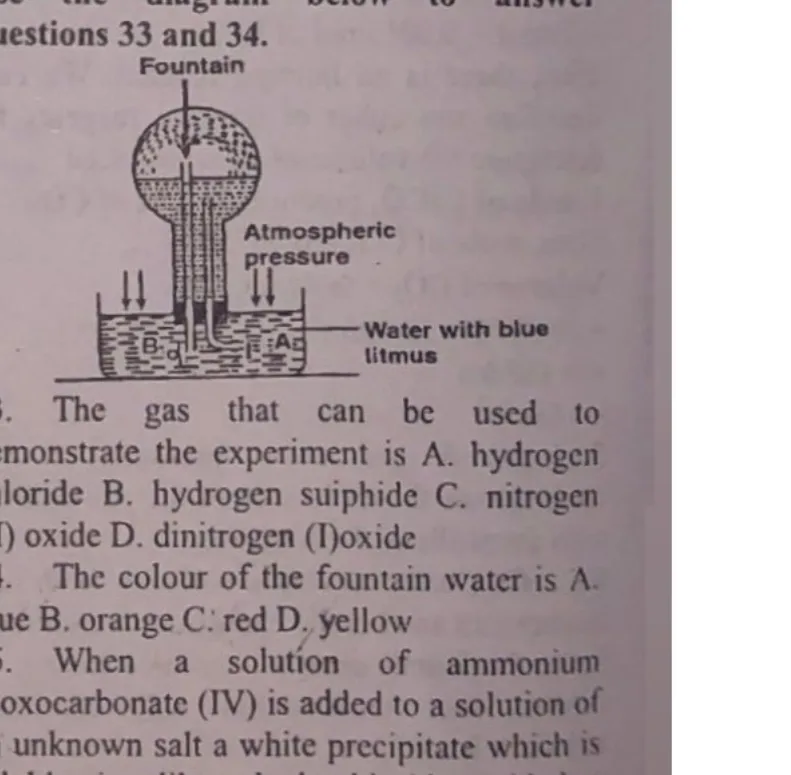
Use the diagram below to answer questions 33 and 34 (fountain apparatus with atmospheric pressure and water with blue litmus). The gas that can be used to demonstrate the experiment is
A. hydrogen chlorideCorrect
B. hydrogen suiphide
C. nitrogen (II) oxide
D. dinitrogen (I) oxide
Explanation
The two extremely soluble gases suitable for demonstrating the fountain experiment are ammonia and hydrogen chloride.
When a solution of ammonium trioxocarbonate (IV) is added to a solution of an unknown salt a white precipitate which is soluble in dilute hydrochloric acid but insoluble in ethanoic acid is formed. This indicates the presence of
A. Ca2+Correct
B. Na+
C. Zn2+
D. K+
Explanation
This indicates the presence of A. Ca2+ B. Na+ C. Zn2+ D. K+.
If the silver mirror test is positive, it indicates the presence of an
A. alkyne
B. alkanone
C. alkanalCorrect
D. alkanol
Explanation
The silver mirror test is conducted with Tollen's reagent, which is a mild oxidizing agent. It is used to distinguish alkanals from alkanones. Since alkanals have oxidizable hydrogen (attached to the carbonyl functional group), they react with Tollen's reagent while alkanones do not react with it since they have no oxidizable hydrogen.
A hydrocarbon X with a molar mass of 92.3% carbon. What is its molecular formula?
A. C2H2B
B. C3H3
C. C4H4Correct
D. C5H5
Explanation
A hydrocarbon X with a molar mass of 26 consists of 92.3% carbon. Empirical formula = CH; molecular formula = (CH)n = 26; giving n=2, i.e. molecular formula C4H4 (per the working shown).
CH3-C(OH)(CH3)-CH2-CH3. The major product of the dehydration of the above compound is
A. CH3-C(=CH2)-CH2-CH3
B. CH3-CH=CH-CH3Correct
C. CH3-C(=CH-CH3)-CH3
D. CH3-C(H)(CH2-CH3)-CH3
Explanation
(2methylbutan-2-ol). To get the major product of the dehydration of an alkanol, we remove the hydroxyl group and one hydrogen atom from the adjacent carbon atom that has less hydrogen atoms. For the structure above: the major product is CH3-C=CH-CH3 with CH3 branch (2-methylbut-2-en).